“Sir, I live here.” Fifteen-year-old Malik Carter tried to keep his voice steady even as Officer Raymond Keller tightened both fists around the front of his red T-shirt and pushed him harder against the brownstone railing. Malik’s black backpack was trapped painfully between his shoulders and the stone wall, and his short twisted dreadlocks shook as he struggled to keep his balance. “Shut up,” Keller snapped inches from his face. “You little punk kids always wreck neighborhoods like this, and I’m sick of your kind lying to my face.”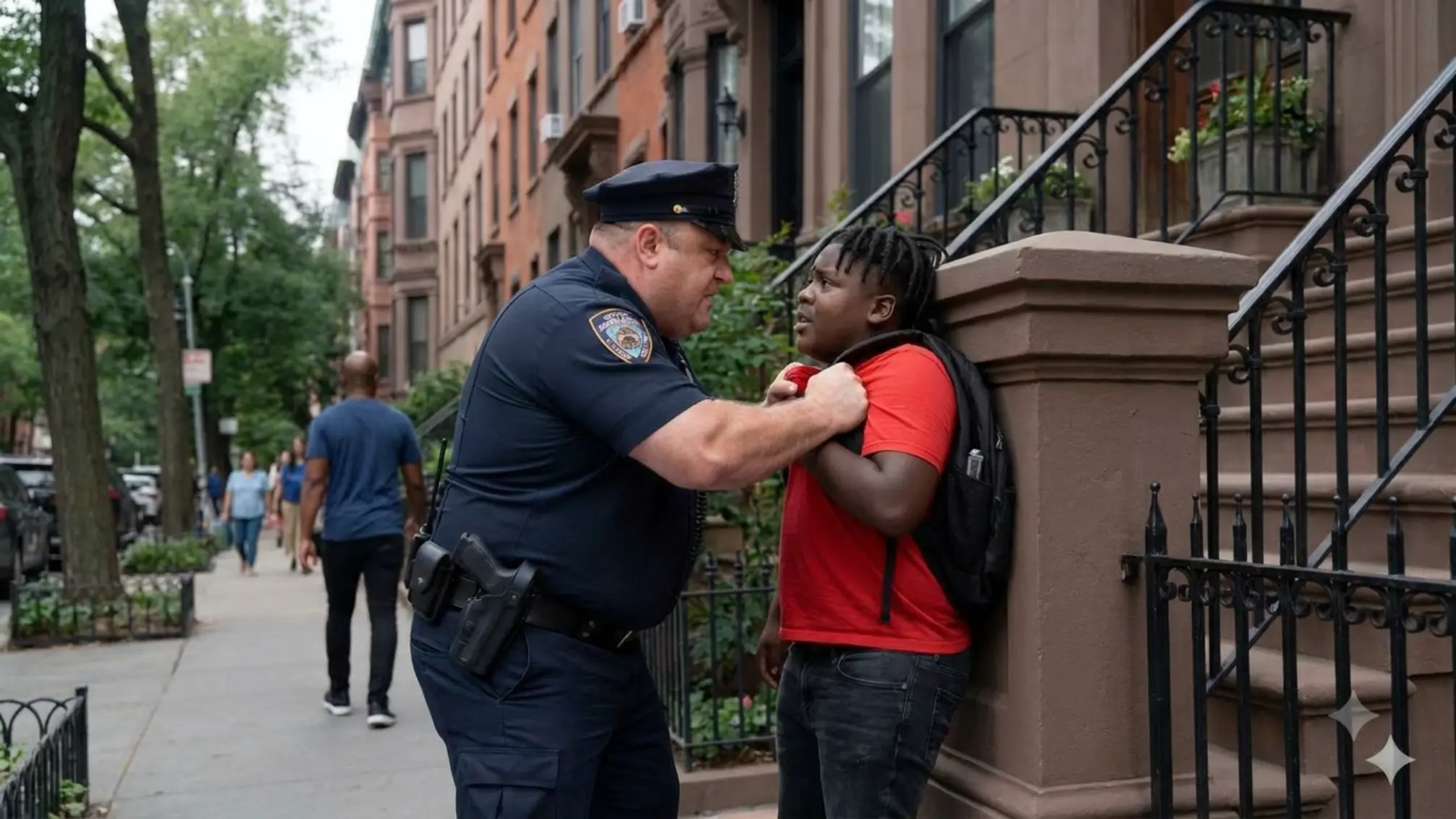
Malik swallowed hard and looked past the officer toward the front door of 418 Madison Row, the Brooklyn brownstone where he had lived since he was six years old. His mother’s flowerpot sat on the second-floor window ledge, his bicycle was chained beside the stoop, and the faded Knicks sticker he had put on the mailbox in middle school was still crooked beneath the number. None of that seemed to matter to Keller. “Take your hands off me,” Malik said. “I told you I live here, and my mom works at your precinct.”
Keller laughed. “Good. Then let’s call the station and see how fast your mother explains why I’ve got her son pinned to a wall.” Two pedestrians had stopped several yards away, and a delivery driver across the street had already lifted his phone to record. Malik could feel Keller’s knuckles digging into his chest through the cotton shirt. The boy was frightened, but the fear was beginning to harden into anger.
The afternoon had started with nothing more dangerous than a forgotten geometry notebook. Malik had gotten home from summer tutoring at 3:40, discovered the notebook was still in his locker at Roosevelt Prep, and walked four blocks back toward the school before remembering the building had already closed. He turned around, stopped at a corner store for a sports drink, and headed home with one earbud in and his backpack slung over one shoulder. He had no idea that someone three houses down had already called police.
The caller was Eleanor Price, a sixty-eight-year-old homeowner who had recently joined the neighborhood safety committee after several packages disappeared from porches. She reported “a teenage male looking into homes” and said he appeared to be “checking which houses were empty.” When dispatch asked whether she had seen him enter a yard, touch a door, take anything, or damage property, Eleanor admitted she had not. Her description was short: Black boy, red shirt, backpack.
Officer Keller was only six blocks away when the call came through. He had nineteen years on the job, a reputation for aggressive stops, and a personal habit of treating neighborhood complaints as more reliable than the people he stopped. His body camera would later show that he arrived less than two minutes after dispatch provided the description. He saw Malik walking toward 418 Madison Row and immediately accelerated to the curb.
“Hey! Stop right there.” Malik removed his earbud and turned. “Me?” Keller slammed his cruiser door. “Hands where I can see them.”
Malik raised both hands halfway, confused. “What did I do?” Keller approached quickly and looked at the backpack. “Where were you just coming from?” Malik answered, “The store.”
“What store?” Keller demanded. Malik pointed down the block. “Washington Market.”
Keller looked toward the brownstone. “And where are you going?” Malik pointed toward the front steps. “Home.” The officer’s eyes narrowed.
“That house?” Malik nodded. “Yes.”
“You live there?” Malik lowered one hand enough to point toward the second floor. “With my mom.”
Keller looked at the immaculate brownstone, then back at Malik. Something in his expression changed from investigation to disbelief. “Don’t lie to me.”
Malik frowned. “I’m not.” Keller stepped closer. “We got a burglary complaint.”
“I didn’t burglarize anything.” Malik pulled his phone halfway from his pocket. “I can call my mom.”
Keller’s hand shot forward and slapped the phone from Malik’s fingers. It bounced once on the sidewalk and landed face-down beside the stoop. “Did I tell you to reach?” Keller shouted.
Malik froze. “I said I was calling my mom.” Keller grabbed the front strap of his backpack. “Turn around.”
“Why?” Malik asked. “Because I told you to.”
That was when the situation changed from frightening to dangerous. Malik took one step backward toward his front door, not attempting to run, but Keller interpreted the movement as resistance and grabbed his shirt. Within seconds, Malik was pinned against the brownstone railing while Keller accused him of trying to flee.
The body camera captured Malik saying the same thing repeatedly. “I live here.” Then: “My keys are in my pocket.” Then: “Look at the mailbox.”
Keller did none of those things. Instead, he demanded identification. Malik explained that he was fifteen and did not carry a driver’s license.
“School ID?” Keller asked. “In my backpack.”
Keller ripped the backpack off Malik’s shoulders and dumped it on the sidewalk. Textbooks, pencils, a calculator, a half-eaten granola bar, and a Roosevelt Prep student card scattered across the pavement. The card contained Malik’s photograph and full name.
Keller looked at it. “Doesn’t prove you live here.”
Malik stared at him. “My house key does.”
“Anybody can steal a key.” Malik’s mouth opened in disbelief. “Then ring the doorbell.”
Keller refused. That refusal would matter later because the front door was equipped with a video doorbell connected directly to Malik’s mother’s phone. If Keller had simply pressed the button, he would have seen Lieutenant Renee Carter answer from inside the 81st Precinct less than three miles away.
Instead, Keller continued.
A second officer arrived, twenty-eight-year-old Noah Ramirez. He parked behind Keller’s cruiser and walked toward the sidewalk. Ramirez looked at the scattered school supplies first, then at Malik pinned against the building.
“What happened?” he asked. Keller answered, “Possible burglary suspect. Kid’s lying about living here.”
Malik immediately said, “I’m not lying.” Keller tightened his grip. “Be quiet.”
Ramirez looked at the house number. “Did we verify the address?” Keller shot him an irritated glance. “I’m handling it.”
Ramirez crouched and picked up Malik’s school identification. “Malik Carter?” Malik nodded.
The surname made Ramirez pause. “Carter?” Malik looked at him. “My mom is Lieutenant Renee Carter.”
Ramirez’s face changed. Keller noticed.
“What?” Keller asked. Ramirez stood slowly.
“You know Lieutenant Carter?” Malik said, “She works at the Eighty-First.”
Keller laughed again. “Everybody’s mother suddenly works for the police when cuffs come out.” Ramirez did not laugh.
Renee Carter was not a celebrity, but within Brooklyn patrol circles her name was well known. She had spent twenty-two years in the department and currently supervised professional standards and field training for the 81st Precinct. She was respected because she had worked patrol herself for more than a decade and had a reputation for defending officers when evidence supported them and disciplining them when it did not.
Ramirez looked at Keller. “Ray, we should verify this.” Keller’s face hardened.
“You afraid because the kid dropped a name?” Ramirez answered carefully, “No. I think we should verify an address before arresting someone for being outside it.”
Malik looked at Ramirez with sudden hope. Keller looked at him with anger.
“You want to supervise my stop now?” Keller asked. Ramirez shook his head. “I want to prevent a bad one.”
The sentence landed badly. Keller pulled Malik away from the wall, twisted one arm behind his back, and reached for his handcuffs. Malik panicked.
“Wait! What are you arresting me for?” Keller forced his wrist backward. “Obstruction.”
“I didn’t do anything!” Malik shouted. “Stop moving.”
“I’m not moving!” Keller snapped the first cuff shut.
Ramirez stepped closer. “Ray, stop.” Keller ignored him and secured the second cuff.
A woman across the street shouted, “He lives there!” Everyone turned.
Mrs. Naomi Thompson stood beside her small terrier, pointing toward Malik’s house. She had lived next door for eleven years and had watched Malik grow from a first-grader carrying a Spider-Man backpack into a teenager nearly as tall as she was. “That’s Renee’s boy,” she said. “I see him every day.”
Keller frowned. “Ma’am, stay out of this.” Naomi laughed in disbelief.
“You’re arresting a child outside his own front door.” Keller pointed toward her. “Back away.”
Naomi raised both hands but remained where she stood. “Press the doorbell.”
Keller did not.
The delivery driver continued recording. Another neighbor joined him. What had begun as one officer confronting one teenager had become a public scene with witnesses pointing toward the simplest possible answer.
Ramirez finally reached for his radio. “Dispatch, can you run the resident information for 418 Madison Row?” Keller glared at him.
The dispatcher responded after several seconds. “Property occupant records show Renee Carter and dependent Malik Carter.” Ramirez looked directly at Keller.
Malik closed his eyes.
“There,” Ramirez said quietly.
Keller still did not remove the handcuffs.
Instead, he shifted the justification. “Doesn’t mean he wasn’t casing other properties.”
Malik’s eyes opened. “You said I didn’t live here. Now you know I do.”
Keller looked at him sharply. “Watch your mouth.”
Malik laughed once, but there was no humor in it. “You just keep changing the reason.”
Several phones captured the sentence.
Ramirez stepped between Keller and Malik. “Take the cuffs off.” Keller stared at him.
“I have an active investigation.” Ramirez shook his head. “Of what?”
“Suspicious activity.” Ramirez gestured toward the street.
“What activity?” Keller did not answer.
Malik spoke again. “Walking home?”
Keller turned toward him. “One more word and I’ll—”
A voice exploded from Ramirez’s radio.
“Unit 431, precinct supervisor requesting your exact location immediately.” Ramirez pressed the button.
“Madison Row at Fourth.” The dispatcher responded, “Lieutenant Carter is en route.”
For the first time, Keller’s confidence faltered.
Malik saw it.
Five minutes earlier, the officer had laughed at the idea that Malik’s mother worked for the department. Now he looked toward the intersection every few seconds.
Renee Carter arrived in an unmarked department sedan three minutes later. She was forty-six, Black, with shoulder-length natural curls pulled neatly behind her head, and she wore a navy blouse, dark trousers, department credentials clipped to her belt, and the controlled expression of a supervisor arriving at a scene she did not yet fully understand.
Then she saw her son in handcuffs.
The control nearly disappeared.
“Malik.” He turned.
“Mom.”
Renee stopped several feet away because twenty-two years of police work told her not to run into an active scene, even when every maternal instinct demanded it. She looked at the cuffs, the scattered school books, Keller, Ramirez, and the recording neighbors.
“Who placed him in restraints?” she asked.
Keller stepped forward. “Lieutenant, I did. We received a burglary complaint and—”
“Was he identified?” Renee interrupted. Keller hesitated.
Ramirez answered. “Yes.”
“Address verified?” Ramirez nodded.
“Yes.”
“Witness confirmation?” Another nod.
“Yes.”
Renee looked at Keller. “Then why is he still cuffed?”
Keller’s mouth tightened. “He was verbally confrontational.”
Malik stared at his mother. “I kept telling him I live here.”
Renee looked toward her son. “Did you physically resist?” Malik shook his head.
“No.”
Keller immediately said, “He pulled away when I grabbed him.” Renee turned back.
“Before or after you established probable cause for an arrest?”
Keller said nothing.
She looked at Ramirez. “Body cameras active?”
“Yes, Lieutenant.” Renee nodded once.
“Good.”
Then she looked at Keller.
“Remove the cuffs.”
Keller did.
Malik immediately rubbed his wrists. Renee wanted to touch him, hug him, inspect every mark, but she forced herself to remain professional until the scene was secured.
“Malik, go stand beside Mrs. Thompson.” He hesitated.
“Mom—”
“Please.”
He obeyed.
Renee then turned toward Keller. “Do not explain this to me.”
He looked surprised.
“Lieutenant, I need you to understand—”
“No.” Her voice remained calm.
“I am his mother. That makes me the least appropriate person here to decide whether you violated policy.”
Keller seemed relieved for one second.
Then Renee continued. “So your body camera, Officer Ramirez’s camera, dispatch audio, neighbor footage, and an outside supervisor will decide.”
The relief vanished.
Renee called the duty inspector herself and requested immediate evidence preservation. She also requested that Keller be removed from patrol pending preliminary review because the allegation involved a juvenile, physical restraint, disputed justification, and possible biased policing.
Keller’s face reddened. “You’re suspending me because he’s your kid?”
Renee looked at him.
“No.”
She pointed toward Malik.
“You should be worried that you treated him differently before you knew whose kid he was.”
Nobody spoke.
Keller tried again. “We had a legitimate call.”
“Then answer it legitimately.”
“I did.”
Renee gestured toward the house.
“You were told he lived here.”
“Suspects lie.”
“A neighbor confirmed it.”
“People cover for each other.”
“Dispatch confirmed it.”
Keller’s jaw tightened.
Renee continued. “At what point does evidence become more important than your assumption?”
The question ended the argument.
The investigation lasted six weeks. Renee formally removed herself from the command chain immediately, and the case went to the department’s external professional standards unit. Investigators reviewed Keller’s body camera minute by minute.
The evidence was devastating.
Malik never threatened him. He never attempted to flee. He repeatedly offered ways to verify his residence.
Keller ignored all of them.
More importantly, investigators discovered that the original complaint had never accused Malik of touching a house, entering a yard, stealing property, or damaging anything. Eleanor Price had reported a teenager “looking around.”
When interviewed, Eleanor admitted something uncomfortable.
She had seen Malik several times before.
She simply had not realized he lived there.
“Why did you think he was suspicious?” the investigator asked.
Eleanor looked down.
“I don’t know.”
The investigator waited.
Eventually she said, “He just seemed out of place.”
That phrase appeared in the final report.
So did another finding.
Officer Keller had accumulated thirteen prior complaints over seven years involving stops of Black and Latino teenagers. Nine had been closed as unfounded.
Investigators reopened the body-camera footage.
A pattern emerged.
Teenagers were repeatedly described as “evasive” for asking why they were being stopped. Hands entering pockets became “furtive movements” even after officers instructed them to produce identification.
One Black seventeen-year-old had been detained outside his grandmother’s house because Keller wrote that he “did not appear associated with the residence.” The grandmother had been inside the entire time.
Another boy was stopped while carrying a bicycle through an affluent neighborhood. Keller suspected the bicycle was stolen because it was expensive.
It belonged to the boy.
Renee read the report alone in her office after investigators finished. She reached the final page, closed the folder, and sat silently for several minutes.
Her son’s case was no longer about Malik.
It had never really been only about Malik.
He had simply been the child whose mother knew exactly where to look once the system failed him.
Keller was terminated after the disciplinary process found improper detention, unjustified use of restraints, inaccurate reporting, and repeated failures to follow bias-free policing standards. A supervisor who had previously closed several complaints without adequately reviewing video was reassigned and later disciplined.
Ramirez received no medal.
He did not want one.
He met Renee privately after the investigation.
“I should’ve stopped him sooner,” he said.
Renee looked at him.
“You did eventually.”
“That’s not the same.”
“No.”
Ramirez lowered his eyes. “I knew he was wrong before dispatch confirmed the address.”
Renee nodded slowly.
“Remember that feeling.”
He looked up.
“The moment you know another officer is wrong but haven’t spoken yet,” she continued. “That’s where culture lives.”
Ramirez never forgot it.
Malik returned to school two weeks later. The video had spread widely around Brooklyn, and classmates initially treated him like a celebrity.
He hated it.
People asked whether his mother had destroyed Keller’s career.
Malik always corrected them.
“The camera did.”
Eventually the attention faded.
The emotional impact did not.
For months, Malik felt his body tense whenever a patrol car slowed nearby. He stopped wearing headphones while walking home because he wanted to hear every approaching vehicle.
Renee noticed.
One evening she found him sitting on the front steps.
“You okay?” she asked.
Malik shrugged.
“Yeah.”
She sat beside him.
After several minutes he said, “What if you didn’t work for them?”
Renee knew exactly what he meant.
“What if I told him my mom worked at a grocery store?” Malik asked. “Or a hospital? Or nowhere?”
Renee looked down the block.
“The cuffs still should’ve come off.”
“But would they?”
She did not lie to him.
“I don’t know.”
Malik nodded.
“That’s the part I keep thinking about.”
Renee placed one hand on his shoulder.
“It’s the part I keep thinking about too.”
Within the year, the precinct introduced mandatory supervisor review whenever juveniles were detained based solely on suspicious-person calls. Dispatchers were trained to require specific behaviors instead of accepting phrases such as “doesn’t belong here.”
Body-camera footage from juvenile stops received random auditing.
Repeat complaints against individual officers triggered automatic outside review.
Renee pushed hardest for one rule.
Whenever a young person said, I live here, officers had to make a reasonable verification attempt before treating the claim as deception unless immediate danger made verification impossible.
Some officers called the rule unnecessary.
Renee answered with one sentence.
“My son gave an officer five ways to verify him.”
Nobody argued after that.
Almost a year later, Malik walked home wearing another red shirt.
A patrol cruiser slowed beside him.
Malik’s shoulders tightened automatically.
Officer Ramirez lowered the window.
“Hey, Malik.”
Malik stopped.
“Hey.”
Ramirez pointed toward the basketball beneath Malik’s arm.
“Roosevelt win?”
“By eleven.”
“You score?”
“Eighteen.”
Ramirez smiled.
“Not bad.”
Malik raised an eyebrow.
“Not bad?”
“Fine. Very good.”
Malik laughed.
The cruiser drove away.
Nothing happened.
No hands against walls.
No backpack dumped onto pavement.
No need to say who his mother was.
Malik walked up the brownstone steps, unlocked his own front door, and disappeared inside.
Across the street, Renee had been sitting in her car and watching.
She smiled.
That ordinary moment meant more to her than Keller losing his badge.
Her son had walked home.
A police officer had seen him.
And nobody demanded that Malik prove he belonged before allowing him to continue.
For Renee Carter, that was the standard the department should have met from the beginning.
Not because Malik was a lieutenant’s son.
Not because cameras were recording.
Not because a senior officer might arrive.
Simply because a fifteen-year-old Black boy walking toward his own front door should never have needed a powerful mother to make the truth matter.