Officer Brett Harland had already decided what kind of woman Simone Avery was before he ever turned on his lights. She rode alone through late-evening traffic on the south side of Grey Haven, dressed in a fitted black motorcycle jacket, protective riding pants, and dark boots, her black sport bike polished enough to attract attention. To Harland, the expensive motorcycle looked like something worth seizing, and the solitary Black woman riding it looked like someone he believed would have trouble convincing strangers that a uniformed officer was lying. He followed her for six blocks before activating the patrol car’s lights.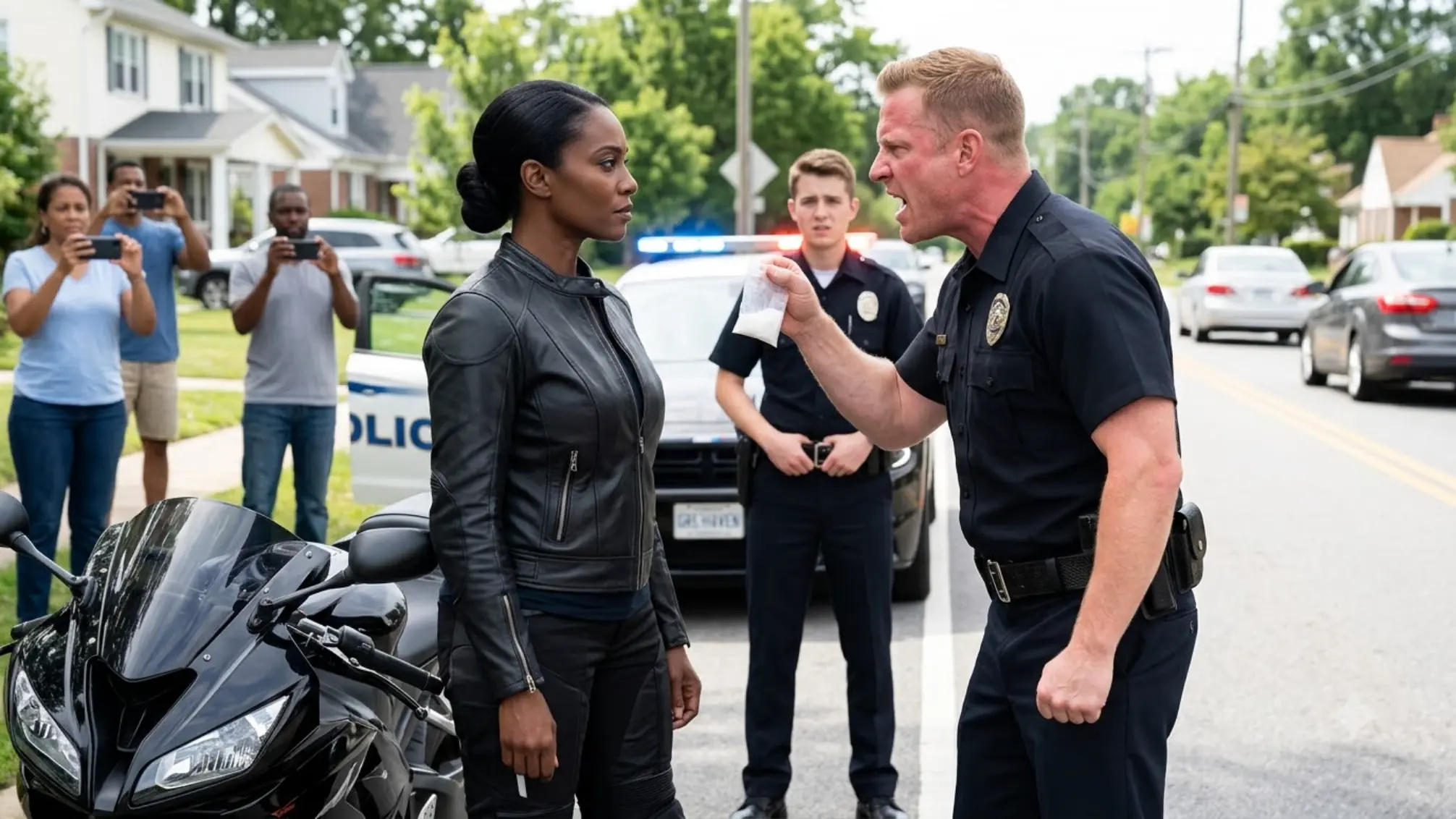
Simone immediately reduced her speed and pulled into a brightly illuminated gas station rather than stopping on a dark shoulder. She parked beside the air pump, removed her gloves, and kept both hands visible on the handlebars while waiting for the officer to approach. Earlier that day she had been reviewing sealed applications connected to a federal corruption investigation involving suspicious vehicle seizures, missing narcotics evidence, and several Grey Haven officers. One name had appeared repeatedly in those files: Brett Harland.
She had read his name, but she had never studied his face carefully enough to recognize him immediately. His voice changed that when he approached the motorcycle and demanded her license and registration without greeting her. Simone handed over both documents and calmly asked for the reason behind the stop. Harland claimed she had crossed the center line, and she answered simply, “I did not.”
Harland looked at her license without appearing to recognize the name. In riding gear, with her hair tucked beneath a helmet liner and no judicial robe surrounding her, Simone looked nothing like the official portrait displayed on federal court websites. “You calling me a liar?” he asked, leaning closer. Simone held his stare and replied, “I’m asking for the legal basis of the stop.”
His jaw tightened immediately. Harland ordered her off the motorcycle and directed her toward the front of his patrol car, speaking as though every reasonable question was an act of defiance. A younger officer named Caleb Dorsey arrived as backup less than two minutes later, stepped from his cruiser, and greeted Simone politely. Harland interrupted him before he could finish, barking, “Watch her hands.”
Caleb had been with the department for less than two years, and his discomfort showed immediately. Simone noticed the glowing body-camera indicator on his uniform and filed the detail away without comment. Harland began circling the motorcycle, examining it with far greater interest than anything connected to his supposed traffic violation. When he reached the rear storage compartment, Simone saw his right hand disappear briefly inside his own jacket.
The movement was small enough that most people would have missed it. Simone did not. In the motorcycle’s small mirror she saw him angle his body between Caleb and the bike, then lean over the compartment beneath the rear seat. “What are you doing?” she asked.
“Searching the bike.”
“You don’t have my consent.”
Harland smiled. “I smell marijuana.”
Simone almost laughed, but she stopped herself. She had never used marijuana, and nothing around the gas station suggested the odor he claimed to detect. More importantly, nearly identical language appeared in several complaints included in the corruption file she had reviewed that afternoon. Drivers had repeatedly reported officers claiming to smell narcotics immediately before discovering drugs and seizing expensive vehicles.
Simone turned slightly toward Caleb. “Officer Dorsey, is your body camera recording?” Caleb glanced toward the device on his chest and answered, “Yes, ma’am.” Harland spun toward him and snapped, “Don’t answer her questions.” Then he reached beneath the motorcycle seat and produced a small plastic bag containing white powder.
For several seconds, nobody spoke. Harland held the bag beneath the gas station lights like a hunter displaying a trophy, and a smug smile spread across his face. “Well,” he said loudly, making sure nearby customers could hear, “looks like tonight just got worse for you.” Simone felt her pulse accelerate, but her expression barely changed.
“Seal that bag before anyone else touches it,” she said. “Record the exact time, and note that Officer Harland handled the compartment without gloves.” Caleb looked immediately toward Harland, understanding the significance of the request. Harland’s smile vanished.
“Turn around.”
Simone did not move. “Officer Dorsey, did you see where that bag came from?” Caleb opened his mouth, but Harland stepped between them and shouted the command again. He grabbed Simone’s wrist, twisted her arm behind her back, and closed handcuffs around both wrists.
People near the gas pumps began recording. A man shouted, “What did she do?” and Harland raised the bag high enough for the phones to capture it. “Drug possession,” he announced, watching the crowd’s expressions change almost instantly.
Simone saw suspicion replace concern. A woman who had been filming lowered her phone slightly and whispered something to her husband, while another customer backed away from Simone as though the accusation itself proved guilt. That transformation hurt more than the handcuffs because Simone had seen it happen inside courtrooms for years. People often believed the first official story simply because changing their minds required more effort.
Harland confiscated Simone’s phone and placed it into an evidence bag. Then he called Lyle Recovery, a towing company whose name Simone recognized immediately from the sealed federal investigation. The company had received an extraordinary percentage of Grey Haven Police Department’s vehicle-seizure business during the previous four years. Simone said nothing as a tow truck arrived and lifted her motorcycle from the pavement.
The bike meant more to her than Harland could possibly understand. It had belonged to her father, Elias Avery, who had spent twenty-six years as a police officer before losing his badge after refusing to change a report involving another officer’s misconduct. Evidence later disappeared, blame shifted toward Elias, and his reputation collapsed before the truth could be established. After his death, Simone found the motorcycle beneath a tarp and restored it piece by piece.
Her father’s experience had helped shape the reason she entered law. Simone believed institutions could fail, but she also believed law properly applied could expose the people abusing those institutions. Now she sat handcuffed in a patrol car while an officer connected to the investigation she had been reviewing transported her toward a station potentially controlled by the same network. She knew immediately that revealing her identity too early might destroy evidence.
The booking desk changed everything. A night sergeant typed Simone’s information into the department computer, stared at the monitor, and then slowly looked at her. “Judge Avery?” he whispered.
Harland moved around the desk and looked at the screen himself. The color drained from his face when he read the line identifying her as United States District Judge Simone Avery. Caleb stepped backward as though suddenly realizing the scale of what had happened. Simone simply watched them.
Someone should have removed the handcuffs. Instead, Sergeant Wade Crowell emerged from a glass office at the end of the corridor. He was broad, silver-haired, and composed, and Simone recognized him immediately from surveillance photographs attached to the sealed corruption applications.
“So,” Crowell said slowly, “you’re Judge Avery.”
“Yes.”
His eyes moved toward the plastic bag sitting on the booking counter. “Where was it found?” Harland answered that it had been beneath the motorcycle seat. Crowell studied Simone with the expression of someone encountering an unexpected problem rather than learning that one of his officers might have made a catastrophic mistake.
“I want an attorney,” Simone said.
“You’ll get one.”
“I also want that bag sealed in my presence.”
Crowell smiled coldly. “You don’t run this station.”
Simone met his gaze. “No, but the Constitution still applies inside it.” The smile disappeared, and Crowell ordered another officer to take Simone into an interview room. Before she left, she heard him tell Harland to prepare an additional report claiming Simone had resisted arrest.
Caleb stared at Crowell. “She didn’t resist.” Crowell turned slowly toward the younger officer and asked him to repeat himself. Caleb lowered his eyes and whispered, “Nothing, Sergeant.”
Inside the interview room, Simone heard voices through the wall. Harland said she had reached toward his weapon, Caleb objected that nothing like that had happened, and Crowell responded, “Your report will say what happened.” Simone closed her eyes and remembered something her father once told her. Corruption rarely began with bags of money; sometimes it began with one changed sentence and everybody deciding silence was easier than confrontation.
Across Grey Haven, nineteen-year-old Mara Avery sat alone in an auditorium seat waiting for her aunt to arrive. Mara had just completed her first semester of college and was receiving a scholarship named for local public defenders, and Simone had promised she would attend. When the ceremony ended and the seat beside Mara remained empty, she checked her phone. A video from the gas station had already begun circulating online.
The caption read, FEDERAL JUDGE CAUGHT WITH COCAINE. Mara watched the clip twice before recognizing Simone beneath the motorcycle helmet. She called repeatedly, but every call went directly to voicemail. By the time she reached the police station, reporters had already surrounded the entrance.
“That’s my aunt,” Mara told the officer blocking the door. “She’s a federal judge.” The officer answered that being a judge did not prevent someone from being arrested. Mara knew that, because Simone had spent years teaching her that nobody was above the law.
But Mara also knew her aunt. Simone did not use drugs, and she would never deliberately miss Mara’s ceremony without explanation. Still, doubt slipped into Mara’s mind because Simone had been secretive for weeks, canceling dinners and refusing to explain where she was going. Mara hated herself for wondering whether there might be something she did not know.
Assistant U.S. Attorney Naomi Vance arrived before midnight accompanied by two federal agents and an attorney for Simone. Naomi had led the corruption investigation for eight months and immediately understood that Simone could no longer participate in the matter as a judge. She had become a potential victim and witness, which meant all investigative decisions now had to be handled by other prosecutors and judges. Simone could not use her office to retaliate against anyone, even if the arrest proved criminal.
“They’re adding assault on an officer,” Simone said when Naomi entered the interview room. Naomi asked whether she had touched Harland, and Simone answered no. Harland’s camera had been turned off during the search, but Caleb’s body camera had recorded part of the encounter. Unfortunately, Harland’s body had blocked the clearest view of the motorcycle compartment.
Naomi had another problem. Crowell had ordered the narcotics evidence transferred to the central property facility at six in the morning. Once the bag left the station, identifying marks linking it to an older evidence seizure could disappear. Naomi began seeking an emergency preservation order from another federal judge.
Outside, Caleb sat at a desk staring at the false report Crowell expected him to sign. The document stated that Simone had ignored repeated commands, moved aggressively toward Harland, and reached toward his duty belt. Caleb knew every sentence was false. He also knew exactly what happened to Grey Haven officers who challenged Crowell.
One detective who questioned evidence handling had been transferred to nights and later fired over paperwork violations. Another officer who refused to participate in an unlawful search was accused of drinking on duty. Caleb thought about his wife, their new baby, and the mortgage payment already stretching every paycheck. Then he looked through the station doors and saw Mara sitting outside holding Simone’s damaged helmet against her chest.
At two in the morning, Naomi received information from a federal laboratory technician who had reviewed photographs taken before the bag left the station. Beneath the temporary evidence label, a fragment of an older barcode remained visible. The number corresponded to narcotics seized eighteen months earlier in a case already closed. The cocaine Harland claimed to find on Simone’s motorcycle had originally belonged to the Grey Haven Police Department’s evidence room.
Naomi confronted Crowell. He dismissed the barcode as proof that somebody had reused old packaging. Naomi asked whether he genuinely expected anyone to believe a federal judge stored cocaine inside a police evidence bag. Crowell folded his arms and replied, “I expect you to prove otherwise.”
The preservation order was approved at 4:45 in the morning. The bag had already disappeared. Crowell claimed an early scheduling change had moved the evidence shipment ahead of schedule, and the courier van had departed thirty minutes before the order arrived.
Federal agents intercepted the vehicle before it reached central property. The original plastic bag was gone. In its place sat a new evidence pouch containing white powder but no barcode fragment. Harland’s confidence returned immediately.
Simone was released after sunrise pending further review, though the false assault allegation remained open. News helicopters followed her home while commentators debated her guilt before any laboratory analysis had been completed. Mara waited in the kitchen. Simone entered slowly, bruises darkening around her wrists.
“Why didn’t you call me?”
“They took my phone.”
“You were keeping secrets before that.”
“I was handling sealed matters.”
Mara’s voice broke. “You missed my ceremony.” Simone told her she knew and that she was sorry, but Mara demanded the complete truth. Simone explained she could not legally discuss the investigation, and Mara’s expression suggested that limitation sounded exactly like avoidance.
“I have never used cocaine,” Simone said. “The officer planted it.” Mara stared at her. “Then prove it.” She left the room before Simone could answer.
Later that morning, Harland met Crowell behind Lyle Recovery. Victor Lyle stood beside Simone’s motorcycle while holding a small recording unit that had been removed from the bike. Harland suggested destroying the motorcycle entirely, but Crowell warned that would attract unnecessary attention. What mattered was controlling Caleb and eliminating evidence.
Caleb had already decided differently. Through an attorney, he contacted Naomi and provided a private copy of electronic evidence-room access logs. Those records showed Harland entering narcotics storage less than three hours before stopping Simone. His stated purpose was laboratory transport, but no transport had been scheduled.
The logs contained something worse. Crowell had approved Harland’s access remotely. Naomi now had evidence showing preparation for the stop, though she still lacked a clear image of Harland physically placing the bag inside Simone’s motorcycle. Then Caleb remembered something about his body camera.
The camera maintained a thirty-second pre-record buffer. Caleb had never actually switched his device off when Harland ordered him to do so; he had merely looked downward and pretended to comply. Audio technicians enhanced the recording. Beneath traffic noise, Harland’s voice emerged clearly saying, “Kill your camera.”
Several seconds later came the scrape of plastic. Then Harland muttered, “This one’s worth twenty grand.” The number almost exactly matched the expected auction value of Simone’s motorcycle. Naomi immediately sought warrants for the Grey Haven evidence room, Lyle Recovery, and financial accounts tied to Crowell’s relatives.
Investigators uncovered records connected to forty-three vehicle seizures. Many involved drivers Harland claimed had been stopped after he smelled narcotics, and several cases were dismissed long after the vehicles had already accumulated storage charges or been auctioned. Money from Lyle Recovery flowed into a consulting company controlled by Crowell’s sister. The pattern transformed Simone’s arrest from an isolated accusation into part of a long-running operation.
Someone inside the department warned Harland about the warrants. That night he entered the evidence building using Crowell’s access card, carrying replacement seals, blank inventory documents, and cleaning solvent. He believed he could alter enough records to create confusion about the seized narcotics. He did not know federal agents had installed temporary surveillance equipment after the manipulated transfer of Simone’s evidence.
Caleb was inside with them. From a concealed position, he watched Harland enter the narcotics locker and remove archived bags. Harland then sat at a computer terminal and began altering records. Caleb whispered, “That’s him.”
Naomi gave the order. Federal agents entered through two doors simultaneously, and Harland immediately ran toward the rear corridor. He nearly reached the emergency exit before Caleb stepped into his path.
“You think they’ll protect you?” Harland snarled. “You’re finished in this department.” Caleb’s hands trembled, but he did not move. “Maybe,” he answered, “but I’m done lying for you.”
Harland lunged toward him. Federal agents intercepted him before he reached Caleb and drove him to the floor, securing his wrists behind his back. Naomi entered moments later.
Harland looked up at her. “This is because of that judge.” Naomi shook her head. “No. This is because of what you did before you knew who she was.”
The public hearing three weeks later filled a federal courtroom. Simone sat at the witness table wearing a simple navy suit rather than judicial robes. She did not sit on the bench because this was not her courtroom and she refused to allow anyone to argue that her title had placed her above the process.
Harland’s attorney claimed the entire investigation was retaliation. He argued Simone recognized Harland from sealed corruption files and manipulated federal resources after becoming angry about an ordinary arrest. Naomi answered with evidence rather than argument. She presented the property-room access logs, body-camera audio, barcode photographs, altered evidence records, seizure patterns, financial transfers, and surveillance footage showing Harland attempting to destroy records.
Caleb testified last. He admitted that he had not stopped Harland from handcuffing Simone and that he had seriously considered signing Crowell’s false report. Harland’s attorney asked whether Caleb expected the court to treat him as courageous after remaining silent when it mattered most. Caleb answered, “No.”
“I want the court to understand how men like him survive,” Caleb continued. “They survive because people like me stay quiet.” The courtroom became completely silent. Simone watched him without smiling because she understood that telling the truth late did not erase the moment he had failed to act.
When Simone took the stand, Harland refused to look at her. She described the traffic stop, the unsupported search, the bag appearing, the pressure placed on Caleb, and the decision to add false assault allegations after her identity became known. Naomi then asked why Simone had not immediately announced that she was a federal judge. Simone paused before answering.
“Because my title should not determine whether my rights are respected,” she said. “If that stop was unlawful before they knew my name, it remained unlawful afterward.” Several people in the gallery nodded. The case was never supposed to be about whether a powerful woman deserved better treatment; it was about whether every person Harland targeted should have received lawful treatment from the beginning.
Crowell and Victor Lyle were taken into custody as the larger investigation expanded. Harland faced federal charges involving civil-rights violations, obstruction, evidence theft, conspiracy, and falsifying records. Over the following months, forty-three cases connected to the seizure operation were reopened. Several convictions were vacated, and families received compensation for vehicles illegally taken and sold.
Officers personally involved in the scheme faced individual investigations and charges. Those who had not participated remained at work under independent oversight and new evidence-handling procedures. Caleb was suspended for failing to intervene during Simone’s arrest and underwent disciplinary review. He kept his job only after accepting responsibility and cooperating fully.
Simone supported that outcome. She believed truth told late was still better than truth never told, but she refused to pretend that late honesty erased earlier silence. The department adopted stricter rules governing body cameras, narcotics evidence access, vehicle seizures, and third-party towing contracts. Lyle Recovery lost its city contracts and became the subject of separate financial proceedings.
When Simone’s motorcycle was finally returned, it barely resembled the machine Harland had taken. The engine had been damaged, its camera had disappeared, and one of the original metal panels restored by Simone’s father was bent beyond repair. She stood alone in the garage running her fingers across the dented fuel tank. For the first time since the arrest, she allowed herself to look exhausted.
Mara appeared behind her carrying a toolbox. “I’m sorry,” she said. Simone turned and asked why. Mara swallowed before answering, “For doubting you.”
“You were scared.”
“I should have known.”
Simone shook her head. “No. You should have been able to trust the evidence.” Mara looked toward the motorcycle, and Simone added, “That’s what the system is supposed to give people.”
Mara set the toolbox on the floor. “Can we fix it?” Simone ran her hand across the damaged panel. “Not exactly the way it was.”
“Then we make it something new.”
They worked together for several weekends. Simone taught Mara how to clean the engine, replace damaged wiring, repair the fairing, and inspect fuel lines. She repeated instructions Elias Avery had once given her in an empty church parking lot when she was seventeen.
Months later, the motorcycle started again. The engine filled the garage with a deep, steady sound that brought tears to Simone’s eyes. Mara climbed onto the seat behind her.
At a community meeting held after the federal investigation concluded, Simone sat among families whose cars had been seized and whose reputations had been damaged by false arrests. Organizers had prepared a raised platform for her, but she declined it and took a folding chair in the front row. When invited to speak, she did not talk about revenge. She talked about systems.
She spoke about her father losing his badge after refusing to change a report. She spoke about Caleb remaining quiet because fear made silence easier. Most of all, she spoke about people whose complaints had been ignored because they lacked money, status, lawyers, or influence.
“A badge deserves respect,” Simone said, “only when the person wearing it respects the law.” She paused and looked across the room. “A robe deserves respect only when the person wearing it remembers that the law belongs to everyone.”
Afterward, Mara waited outside beside the restored motorcycle. Simone put on her helmet and looked once toward the courthouse lights. Harland had chosen her because he believed she looked powerless.
He had been wrong about her identity.
But Simone knew that was never his greatest mistake. His greatest mistake was believing innocence mattered only when the innocent person had enough power to fight back.
She started the motorcycle.
Mara climbed onto the seat behind her.
Together they rode home.