The fastest way to reveal someone’s character is to give them power and an audience.
The July sun hung high above Jefferson County, turning the downtown square into a shimmering patchwork of heat and light. The temperature had already climbed past ninety-three degrees, and the air felt thick enough to hold every sound in place.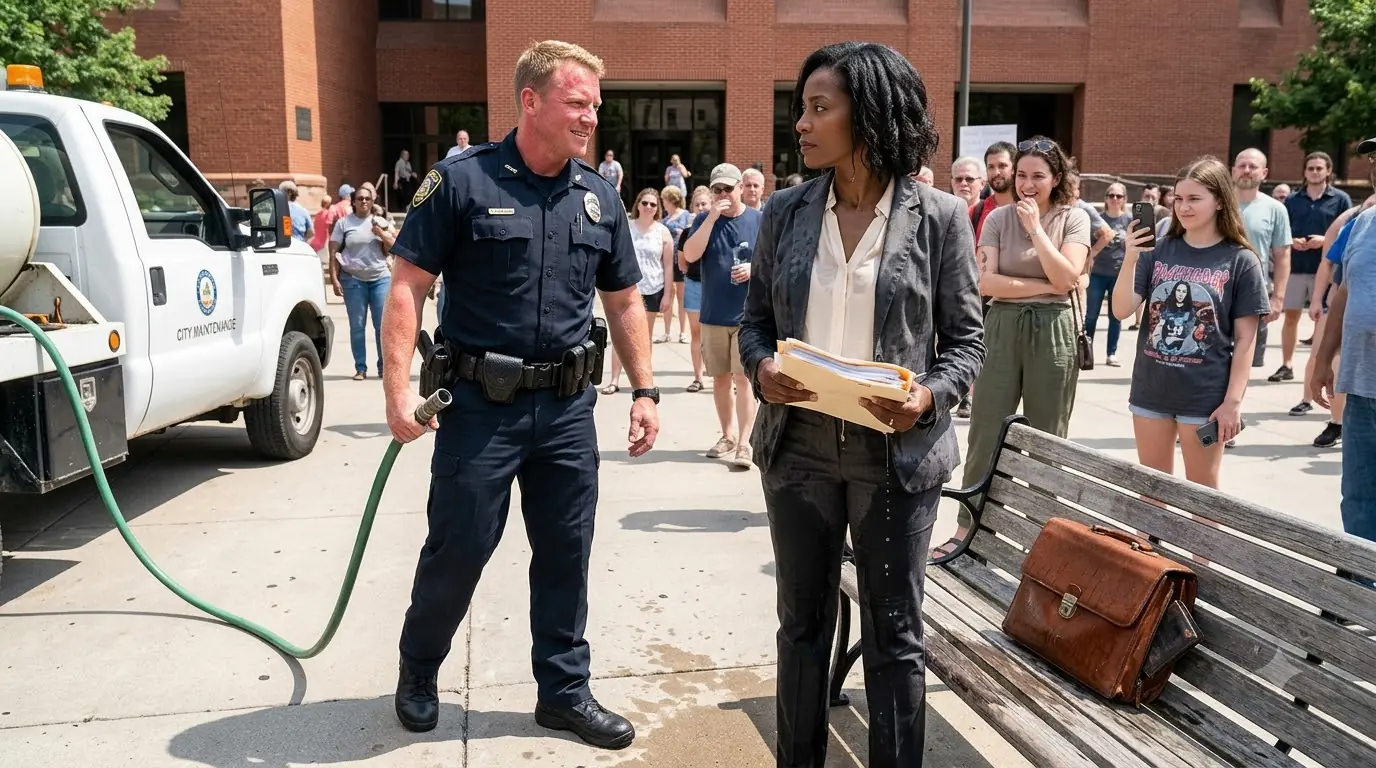
Children darted through the public fountain at the center of the plaza. Office workers hurried between buildings with iced drinks in hand. Tourists lingered beneath colorful umbrellas. It looked like the kind of summer afternoon that belonged on a postcard.
Then Officer Kyle Brennan decided to make everyone laugh.
Standing near a city maintenance truck parked beside the fountain, Brennan rested one hand on a large water hose connected to the vehicle. He was well known around town. People recognized him from community events, local news segments, and the short videos that often circulated online.
Some admired his confidence. Others simply tolerated it. Brennan enjoyed attention, and attention usually followed him wherever he went.
A small crowd had gathered nearby as city workers prepared to clean part of the plaza. Brennan noticed a woman sitting alone on a bench beneath a tree at the edge of the square.
She wore a faded dark jacket despite the heat. Beside her sat an old leather briefcase that looked as though it had traveled thousands of miles. Nothing about her appearance attracted attention.
In fact, most people walking through the plaza barely noticed she was there.
The woman sat quietly reading from a folder resting on her lap. Her expression was calm, focused, detached from the noise around her.
Brennan glanced toward several bystanders watching him.
A grin spread across his face.
Then, without warning, he lifted the hose and directed a burst of water toward the bench.
The stream crossed the open space in seconds. A spray of cold water splashed across the woman, soaking her jacket, her papers, and the side of the weathered briefcase.
Gasps erupted from nearby pedestrians.
Then came nervous laughter.
Brennan lowered the hose slightly and chuckled.
“Looks like somebody needed to cool off.”
More laughter followed.
Not everyone joined in, but enough did.
The woman slowly lowered the folder from her hands. Water dripped from the edges of the papers onto the pavement below.
For several seconds, she did not move. She simply stared at the wet pages resting in her lap.
The plaza seemed to pause around her. Even the children near the fountain appeared quieter.
Brennan expected anger. Most people would have shouted. Some would have stormed over demanding an apology. Others might have caused a scene.
Instead, the woman calmly closed the folder and placed it inside the briefcase.
Then she rose from the bench.
Water streamed from the sleeves of her jacket. Her face revealed nothing. No outrage, no embarrassment, no fear.
Just composure.
Brennan’s smile faded slightly.
The reaction was not what he expected.
As the woman lifted the briefcase, something slipped from beneath the loose flap and fell onto the concrete walkway. It landed face down near her feet.
A small leather item.
Old.
Worn.
Important enough that she immediately bent to retrieve it.
Brennan barely noticed. Most people in the crowd did not either. They were too busy reacting to what had just happened.
But one person did notice.
She had been recording from the moment the hose moved. Her camera captured everything, the water, the laughter, the silence afterward.
The woman picked up the object and carefully returned it to the briefcase before securing the clasp. Then she looked directly at Brennan.
The crowd waited for an explosion that never came.
Her voice, when it finally arrived, was calm enough to cut through the heat.
“I hope that was worth it, Officer.”
Brennan laughed again, though this time it sounded less certain.
“Just having a little fun, ma’am.”
The woman studied him for another second. Then she nodded once, turned away, and began walking across the plaza.
Water dripped from her clothing with every step.
The teenage girl lowered her phone, but did not stop recording.
Around them, the sounds of the city gradually returned. Cars moved through nearby intersections. The fountain continued splashing beneath the summer sun. People resumed their conversations.
Yet something invisible had shifted.
Brennan did not know it yet.
Neither did anyone else standing in that square.
But before the day was over, the entire city would be talking about the woman who walked away without a single word of anger, carrying a soaked briefcase and a secret nobody in Jefferson County was prepared to discover.
Water continued dripping from the sleeves of her jacket, leaving a faint trail across the sunlit concrete. Around her, life resumed as if nothing important had happened.
The fountain splashed rhythmically in the center of the square. A delivery truck rolled past the courthouse. The smell of hot pavement drifted through the humid afternoon air.
Yet several people continued watching her leave.
Among them was the teenage girl with the phone.
Her name was Mia Johnson, and unlike most people in the plaza, she could not stop thinking about what she had just witnessed.
Something about the woman’s reaction felt unusual. Most people would have demanded an apology. Some would have shouted. Others might have turned the entire encounter into a public argument.
But this woman had done none of those things.
She simply walked away.
Mia glanced down at the video she had recorded. The screen showed every second, the water, the laughter, the silence, the calm response.
Without really thinking about it, she uploaded the clip to her social media account before slipping her phone back into her pocket.
Meanwhile, several blocks away, the woman entered a small brick building tucked between a bookstore and a coffee shop. A brass plaque near the entrance displayed the name of a local legal consulting office.
Inside, cool air replaced the summer heat. The receptionist immediately stood when she saw her.
“Good afternoon,” the woman offered with a polite smile.
“Afternoon. Would you like me to bring towels?” the receptionist asked, noticing the soaked jacket.
The woman glanced down at the water stains and laughed softly for the first time all day.
“That might help.”
A few minutes later, she sat alone inside a private office. Sunlight filtered through wooden blinds, casting narrow bands of gold across the room. Law books lined one wall. Framed photographs occupied another.
The woman carefully opened the old leather briefcase resting on her desk. The interior smelled faintly of paper and age.
Despite the water, most of the contents remained protected.
She removed several folders, dried them with a towel, and placed them neatly across the desk.
Finally, she reached for the small leather item that had fallen onto the plaza earlier.
She turned it over in her hands. The edges were worn smooth from years of use.
For a moment, she simply stared at it.
The object carried memories, responsibility, history, things that could not be replaced.
Her expression softened.
Then she returned it to the briefcase and secured the latch.
Across town, Officer Kyle Brennan was still enjoying the attention.
Several bystanders had approached him after the incident. Some laughed about it. Others congratulated him on what they called a harmless joke.
Brennan accepted the praise easily.
He had always enjoyed being the center of a story.
What he did not know was that the story was already moving beyond his control.
By four o’clock that afternoon, Mia’s video had accumulated thousands of views. By five o’clock, local residents were debating the incident online. Some defended Brennan. Others criticized him.
The comments multiplied faster than anyone expected.
Yet one detail continued appearing in the discussions.
Nobody knew the identity of the woman.
Who was she?
Why had she remained so calm?
What was inside the briefcase?
Why had she seemed completely unfazed by public embarrassment?
The mystery only fueled interest.
Back inside the legal office, the woman finally changed into a dry blazer provided by a colleague. Through the window, she could see the courthouse dome rising above the city skyline in the distance.
Jefferson County looked peaceful beneath the afternoon sun. Cars moved steadily through the streets. People hurried home from work.
Her phone vibrated on the desk, then vibrated again.
She glanced at the screen.
Several missed calls.
Multiple messages.
One email marked urgent.
The woman read the first message carefully. Then another.
A faint smile appeared at the corner of her mouth. Not because she found the situation amusing, but because she realized something important.
The city had finally started paying attention.
Outside, the summer sunlight slowly began fading toward evening.
Inside the office, she closed the final folder and looked toward the courthouse once more.
The same courthouse where a special meeting had just been scheduled for the following morning.
A meeting involving city officials, department leaders, and several people who believed they understood exactly what was happening.
The woman knew otherwise.
Because unlike everyone arguing online, she already understood the truth.
And by this time tomorrow, so would the rest of Jefferson County.
By sunset, Jefferson County was divided.
The video continued spreading across phones, televisions, and computer screens faster than anyone expected. Coffee shops buzzed with debate. Restaurant televisions replayed the footage. Local radio hosts discussed it between traffic reports and weather updates.
Everywhere people gathered, the conversation seemed to return to the same question.
Who was the woman with the old briefcase?
Yet inside the police department, Officer Kyle Brennan viewed the entire situation very differently.
He sat comfortably in the break room with several fellow officers while a local news segment played on a mounted television. The reporter described the growing controversy surrounding the video.
Brennan shook his head and laughed.
“People will complain about anything these days.”
One officer shrugged.
Another avoided responding entirely.
Not everyone found the situation amusing anymore.
The footage looked different each time it aired. What seemed harmless in the moment appeared less harmless when viewed repeatedly from multiple angles, especially because of the woman’s reaction.
Her silence made the incident harder to dismiss.
Brennan noticed the hesitation around him and leaned back in his chair.
“Come on. Nobody got hurt. It was water.”
Nobody argued.
Yet nobody laughed either.
The room felt strangely quiet.
Later that evening, Brennan drove home through the warm glow of streetlights reflecting off storefront windows.
His neighborhood sat on the western edge of the city, where older homes lined tree-covered streets. It was peaceful, familiar, predictable, the kind of place where people believed they knew everyone around them.
As he pulled into his driveway, his phone vibrated again.
Another notification.
Another message about the video.
He ignored it and headed inside.
Across town, the woman remained at her office long after most businesses had closed.
The courthouse dome glowed softly against the darkening sky. Several folders remained spread across her desk, maps, reports, correspondence, documents carrying years of work.
She moved carefully through each page, making notes with quiet concentration. Every so often, her eyes drifted toward the old leather briefcase resting beside the desk.
The worn object seemed almost ordinary under the office lamp.
Yet appearances had always been deceptive.
Her phone rang.
She answered immediately.
“Good evening.”
A woman’s voice responded from the other end, calm and professional.
“The meeting is confirmed for nine o’clock tomorrow morning.”
The woman nodded even though the caller could not see her.
“Will everyone be there?”
“Everyone who matters.”
The answer carried more meaning than the words themselves.
The woman thanked the caller and ended the conversation.
For several moments, she remained seated in silence. The city beyond the window seemed unusually still.
Then she opened the briefcase once more.
Inside were several protected compartments. Most contained documents. One held the small leather item that had fallen onto the plaza.
She removed it carefully and placed it on the desk.
The object reflected a faint glow beneath the lamp.
Her expression grew thoughtful.
Memories surfaced.
Long nights.
Difficult decisions.
Promises made years ago.
She closed her eyes briefly before returning it to its compartment.
Meanwhile, less than two miles away, city hall remained brightly lit despite the late hour.
Mayor Helen Porter stood inside a conference room overlooking downtown. Several department leaders sat around a polished table reviewing reports.
Copies of the video were displayed on multiple screens.
The atmosphere felt tense.
Not because of public criticism alone.
Something else had captured their attention.
A name, one that appeared repeatedly in recent communications. One connected to tomorrow’s emergency meeting.
The mayor folded her hands.
“Has anyone spoken to Officer Brennan?”
A city administrator nodded.
“Not yet.”
“Then someone should.”
Another official shifted uneasily in his chair.
“Do we tell him?”
The mayor looked toward the window. The courthouse lights shimmered in the distance.
“No,” she said.
Her voice remained calm.
“Not tonight.”
The room fell silent.
Nobody questioned the decision because everyone present understood something Brennan did not.
The woman from the plaza was never simply a woman sitting alone on a bench.
The briefcase was never ordinary.
The meeting scheduled for tomorrow was never routine.
And by the time the morning sun rose over Jefferson County, one careless moment in a public square would become connected to a story far larger than anyone could imagine.
The next morning arrived beneath a pale blue sky streaked with thin clouds drifting above Jefferson County.
Downtown streets filled early. News vans occupied nearly every available parking space around city hall. Reporters gathered near the entrance, speaking quietly into cameras while city employees hurried through security checkpoints carrying folders and coffee cups.
Something important was about to happen.
Nobody outside seemed entirely sure what.
They only knew that a special emergency meeting had been called with less than twenty-four hours’ notice.
Inside police headquarters, Officer Kyle Brennan adjusted his uniform and glanced at the message he had received before sunrise.
Mandatory attendance. City Hall. 9:00 sharp.
No additional explanation.
He found it mildly annoying more than concerning.
In his mind, the entire situation remained exaggerated. The video had generated attention, but attention always faded eventually. That was how these things worked.
At least that was what he believed.
Traffic moved steadily. People crossed intersections carrying briefcases and breakfast sandwiches. Everything appeared normal.
Yet the closer he came to city hall, the more unusual the atmosphere felt.
Several department vehicles were already parked outside. Senior officials stood near the entrance, speaking in low voices. Nobody seemed relaxed.
Brennan entered the building and followed signs directing attendees toward the council chamber.
The room was larger than he expected. Long polished tables occupied the center. Rows of seats lined the walls. Television cameras had been positioned near the rear of the chamber, though they were not yet recording.
The room carried the quiet tension of a place where important decisions were made.
Brennan took a seat near several other officers.
Around him sat department leaders, city attorneys, council members, and administrative staff. More people than seemed necessary for a meeting about an online video.
He checked his watch.
8:58.
Conversations continued in hushed tones.
Then, precisely at nine o’clock, the side doors opened.
The room immediately grew silent.
Several people stood. Others straightened in their seats.
Brennan frowned slightly. He followed their gaze toward the entrance.
A woman stepped inside carrying a familiar leather briefcase.
For a moment, his mind refused to connect what his eyes were seeing.
The same woman from yesterday.
The faded jacket was gone now, replaced by a clean blazer, but the briefcase was unmistakable.
Inside rested folders, reports, and official documents protected within neatly organized compartments.
Then she removed the small leather item that had fallen onto the plaza the previous day.
For the first time, Brennan saw it clearly.
It was not a wallet.
Not a notebook.
It was an official federal credential case.
The mayor’s voice remained steady.
“Please welcome Dr. Simone Reed, lead federal civil rights attorney assigned to the Jefferson County Review Initiative.”
Silence.
Complete silence.
Brennan felt every conversation from the previous day replaying inside his head.
The water.
The laughter.
The crowd.
The confidence with which he had dismissed everything afterward.
Dr. Reed opened the credential case and placed it on the table.
Federal identification rested inside beneath the chamber lights.
Around the room, officials sat perfectly still.
Nobody seemed surprised.
Nobody except him.
Then Dr. Reed looked up.
Her eyes moved calmly across the chamber before settling briefly on Brennan.
Not with anger.
Not with satisfaction.
Simply recognition.
The kind that comes when a truth can no longer remain hidden.
In that moment, Officer Kyle Brennan finally understood that the woman he had mocked in front of an entire city had never been an ordinary bystander at all.
She had been the person leading the most important investigation Jefferson County had faced in decades.
The silence inside the council chamber lingered for several long seconds after Dr. Simone Reed placed her federal credentials on the table.
Outside the tall windows, the city continued moving as though nothing extraordinary had happened. Cars rolled through intersections. Pedestrians crossed busy sidewalks. The morning sun reflected from glass buildings across downtown Jefferson County.
Yet inside the chamber, everything had changed.
Officer Kyle Brennan sat motionless in his chair.
The confidence that had followed him into the room seemed to evaporate with every passing second.
Around him, city officials shifted uneasily. Department leaders exchanged brief glances. Several reporters standing near the back of the chamber quietly adjusted their cameras.
Nobody wanted to miss what came next.
Dr. Reed remained standing.
Her expression revealed neither anger nor satisfaction. She looked exactly the same as she had the day before while sitting on the park bench, calm, focused, entirely in control of herself.
The mayor stepped aside, allowing her to address the room.
Simone opened one of the folders from the briefcase and placed several documents on the table.
The pages appeared ordinary.
Yet the reaction they produced was immediate.
Multiple city administrators leaned forward. Attorneys began reviewing copies distributed along the front row.
“For the past fourteen months,” Simone began, her voice steady and clear, “my team has been conducting an independent federal review concerning public accountability, community trust, and administrative oversight within Jefferson County.”
The room remained silent.
Every word seemed to land with weight.
“This review was requested through lawful channels and supported by documented concerns raised by residents over several years.”
Several council members lowered their eyes toward the reports in front of them. Others listened carefully without moving.
Simone continued.
“The purpose of this review is not punishment. It is understanding. The goal is not embarrassment. The goal is improvement.”
Brennan found himself staring at the same woman he had publicly humiliated less than twenty-four hours earlier.
The contrast felt impossible to ignore.
Yesterday, she had stood alone while strangers laughed.
Today, an entire chamber listened to every word she spoke.
Yet what unsettled him most was not her position.
It was her composure.
She carried no visible resentment. No desire to retaliate. No effort to single him out.
That somehow made the situation more difficult.
Across the room, Mayor Helen Porter folded her hands and listened closely. She had worked with federal investigators for months preparing for this moment. Even so, hearing the findings presented publicly felt different, more real, more urgent.
Simone turned another page.
“Trust between institutions and communities cannot survive assumptions.”
The statement hung quietly in the air.
Brennan felt his stomach tighten.
“Every individual deserves dignity before judgment, respect before conclusions, fair treatment before labels.”
Several people shifted in their seats.
Nobody needed the message explained.
The previous day’s video had already become impossible to ignore. Millions of views now stretched far beyond Jefferson County.
What happened in the plaza was no longer a local story.
It had become a symbol.
Simone paused briefly.
Then she continued.
“Yesterday’s incident has received significant public attention. However, I want to make one fact absolutely clear.”
The chamber grew even quieter.
“Our investigation began long before yesterday. It is larger than any single person.”
Brennan slowly lifted his eyes toward her.
For the first time since entering the room, he felt a small measure of relief.
She was not there to destroy him.
She was there to reveal something larger, something systemic, something deeper.
Yet relief quickly gave way to a different feeling.
Regret.
Because he understood that he had become part of the story she was describing.
A story about assumptions, about perception, about people being judged before being understood.
Simone closed the folder and looked around the chamber.
“The choices we make when nobody important is watching reveal who we truly are.”
Her gaze briefly settled on Brennan, only for a moment, then it moved on.
No accusation.
No humiliation.
Just truth.
Somewhere outside, a church bell rang through the city. The sound drifted faintly through the glass.
Brennan lowered his eyes again.
For the first time in years, he was not thinking about policy, procedure, or public image.
He was thinking about a woman sitting quietly on a bench in the summer heat.
And the split-second decision that had revealed far more about him than it ever did about her.
As the meeting continued, one uncomfortable realization settled deeper into his mind.
The federal investigation might examine institutions, but the lesson he needed to learn had already begun.
That evening, Jefferson County felt quieter than usual.
The excitement surrounding the emergency meeting had begun settling into something deeper.
Reflection.
Across downtown, television stations replayed clips from the council chamber. Commentators discussed accountability, leadership, and public trust.
Social media remained active, but the tone had changed. The laughter that filled the comments the day before had largely disappeared.
In its place came questions.
Honest questions.
Difficult questions.
The kind that linger long after headlines fade.
Dr. Simone Reed stood alone in her office as twilight settled across the city. Below, a train horn echoed faintly through the evening air.
Meanwhile, several miles away, Officer Kyle Brennan sat alone at his kitchen table.
The television remained off. His phone rested face down beside a cold cup of coffee.
For nearly an hour, he had done nothing except stare through the window above the sink.
The neighborhood outside looked unchanged. Porch lights glowed warmly. Neighbors walked dogs along quiet sidewalks. Everything appeared normal.
Yet nothing felt normal.
The meeting replayed repeatedly inside his mind.
Not the federal reports.
Not the cameras.
Not the officials.
Simone herself.
Her calm voice.
Her restraint.
Her refusal to humiliate him despite every opportunity.
Brennan leaned back in his chair and rubbed his eyes.
Throughout his career, he had always believed character revealed itself under pressure.
What unsettled him now was the realization that pressure had revealed far more about his own character than he wanted to admit.
He remembered the laughter in the plaza, the crowd, the attention, the ease with which he had dismissed someone he knew nothing about.
The memory felt heavier now, not because he feared consequences, but because he finally understood the lesson.
Back in her office, Simone folded a letter and returned it to the envelope.
Then she placed it carefully inside the briefcase and secured the clasp.
Her father had once written a single sentence she never forgot.
True strength is measured by how you treat people when you have no reason to impress them.
She walked back to the window.
The city stretched endlessly beneath the stars. Somewhere out there, thousands of lives moved through their ordinary routines. People carried invisible burdens, invisible hopes, invisible stories, the same stories her work existed to protect.
A soft breeze brushed against the glass outside.
Simone closed her eyes briefly and listened to the quiet.
Tomorrow would bring more meetings, more reports, more difficult conversations. But for now, there was only stillness.
A city settling into night.
A woman holding tightly to her principles.
And a man miles away beginning to understand that real change often starts in the silence after the lesson has already been learned.
The following morning dawned cooler than the days before.
A thin layer of clouds softened the sunlight above Jefferson County, casting the city in pale gold rather than harsh summer brightness.
Downtown streets were busy again, but the mood felt different.
The conversation had shifted from controversy to curiosity.
People wanted answers. They wanted to know what the federal review would uncover. They wanted to understand how a single moment in a public square had become connected to something much larger.
Inside the Federal Review office, Dr. Simone Reed arrived before seven.
She carried the familiar leather briefcase through quiet hallways lined with framed photographs and legal certifications. The building had not changed, yet the attention surrounding her work had.
Several staff members greeted her as she entered. One handed her a fresh report. Another updated her on overnight developments.
Simone listened carefully, thanked them, and continued toward the conference room at the end of the corridor.
Waiting inside were several members of her investigative team. Large screens displayed maps, timelines, and administrative records gathered over more than a year.
Coffee cups sat beside stacks of documents. The atmosphere was focused, professional, purposeful.
Simone took her seat and opened the meeting.
For nearly an hour, they reviewed findings, discussed recommendations, and prepared the next phase of the review.
Then one of the investigators projected a document onto the screen.
The room became noticeably quieter.
Simone leaned forward.
The file contained correspondence from years earlier. Old records, archived commendations, community outreach reports.
She studied the information carefully.
Then she saw a name she recognized.
Kyle Brennan.
The room remained silent as the investigator continued.
“This file was uncovered during a secondary review of historical community relations initiatives.”
Simone kept reading.
The details surprised her.
More than a decade earlier, Brennan had participated in several volunteer programs serving disadvantaged neighborhoods throughout the county.
He had organized youth mentorship events. He had helped establish after-school activities. Multiple letters praised his dedication to community engagement.
One letter in particular caught her attention.
Written by a local principal many years ago, it described Brennan as a young officer who treated every student with dignity regardless of background or circumstance.
Simone sat back slowly.
The information did not erase what happened in the plaza.
It did not excuse poor judgment.
But it complicated the story.
Human beings rarely fit neatly into simple categories.
That truth had guided her work for years.
Meanwhile, across town, Brennan reported to police headquarters for an administrative review meeting.
The building felt unfamiliar despite the years he had spent there. Conversations quieted when he entered hallways. Colleagues nodded politely, but seemed unsure what to say.
Brennan understood.
He probably would have reacted the same way.
He entered a conference room where Chief Robert Hayes waited with several department supervisors.
The meeting began professionally. They discussed public trust, department standards, and ongoing evaluations.
Then Chief Hayes placed a folder in front of him.
Brennan expected disciplinary documents.
Instead, he found copies of his own commendations stretching back nearly fifteen years.
Community service awards.
Letters of appreciation.
Volunteer recognition.
He looked up, confused.
Hayes folded his hands.
“Do you recognize these?”
Brennan nodded.
“Of course.”
The chief remained silent for a moment.
“Then tell me something.”
Brennan waited.
“What happened to that officer?”
The question landed harder than any accusation.
Brennan stared at the pages.
He remembered every event, every program, every student, every neighborhood gathering.
Somewhere along the way, confidence had become certainty.
Certainty had become assumption.
And assumption had become a blind spot he never noticed growing.
Back at the review office, Simone closed the file and looked out the conference room window.
Beyond the glass, the city stretched beneath the morning sky.
The discovery had revealed something important.
The story was not about a villain and a victim.
It was about people.
About choices.
About how easily good intentions could drift away when humility disappeared.
She returned her attention to the team.
“Include the full context in the report,” she said.
One investigator looked surprised.
“Everything?”
Simone nodded.
“Everything.”
Because the truth mattered most when it was complete.
As another chapter of the review began, both Simone Reed and Kyle Brennan were moving toward the same realization from opposite directions.
Real justice was not built on humiliation.
It was built on honesty.
The storm was gentle, more like a reminder than a disruption.
Inside the Federal Review office, Dr. Simone Reed finished reading the final draft of a report summary while rain tapped softly against the windows.
The investigation was far from complete, but important milestones had been reached. Facts had been gathered. Context had been preserved. Most importantly, the conversation had begun moving beyond blame and toward understanding.
Simone closed the report and leaned back in her chair.
Her eyes drifted toward the leather briefcase resting beside the desk.
It had become an unexpected symbol throughout the county. Reporters wrote about it. Commentators mentioned it. Yet none of them understood what mattered most.
The briefcase itself was never important.
What mattered was the lesson attached to it.
A knock sounded at the door.
Simone looked up.
“Come in.”
The receptionist stepped inside.
“There is someone here asking to see you.”
Simone immediately understood who it was.
The receptionist did not need to say the name.
“Send him in.”
A minute later, Kyle Brennan entered the office.
The confident officer from the plaza seemed very far away now. He still wore his uniform, but his posture carried a different weight.
Not defeat.
Humility.
The rain continued falling beyond the windows as the door quietly closed behind him.
For several moments, neither spoke.
Brennan glanced toward the city skyline outside before returning his attention to Simone.
“Thank you for seeing me.”
Simone gestured toward a chair.
“Please sit.”
He did.
The silence that followed felt uncomfortable at first, but not hostile.
More like two people standing at the edge of an honest conversation.
Brennan folded his hands together.
“I spent the last two days thinking.”
Simone listened.
“Probably not enough,” he added with a faint, self-critical smile.
Simone said nothing.
She simply allowed him the space to continue.
Brennan took a slow breath.
“For years, I convinced myself that experience made me accurate.”
He looked down briefly.
“Somewhere along the way, I stopped questioning my assumptions.”
The rain traced thin lines across the glass behind him. The office remained quiet, except for the distant sounds of the city.
“I watched the video again,” his voice softened. “Then I watched it again.”
Simone understood.
Some lessons became clearer each time they were revisited.
Brennan shook his head slightly.
“What bothers me most is not what people think about me.”
He paused.
“It is realizing how easily I forgot the person standing in front of me was a human being first.”
The words hung in the air between them.
Honest.
Uncomfortable.
Necessary.
Simone folded her hands on the desk.
“That realization matters.”
Brennan nodded.
“I know.”
Another silence followed. This one felt calmer, less burdened.
Brennan finally looked directly at her.
“I am sorry.”
The apology arrived without excuses attached to it. No justification. No attempt to soften responsibility.
Just sincerity.
Simone studied him for several seconds.
Then she nodded.
“I believe you are.”
Relief briefly crossed his face.
Not because he expected forgiveness.
Because he had finally said what needed to be said.
Brennan glanced toward the report on her desk.
“What happens now?”
Simone followed his gaze.
“The same thing that should happen in every community.”
He waited.
“People learn.”
The answer surprised him.
She continued.
“Not just you. Not just departments. Everyone.”
Outside, the rain gradually began slowing. Sunlight pushed through a break in the clouds, casting warm reflections across nearby buildings.
Brennan looked out the window.
“I thought you were going to destroy my career.”
Simone almost smiled.
“If destroying people fixed problems, our work would be much easier.”
Brennan laughed quietly for the first time since entering the office. The sound carried equal parts relief and regret.
Simone stood and walked toward the window overlooking downtown Jefferson County.
After a moment, Brennan joined her.
Together, they looked out across the city.
Cars moved through rain-darkened streets. Pedestrians hurried beneath umbrellas.
Life continued.
Ordinary and complicated.
Simone spoke without turning around.
“Mercy is not avoiding consequences.”
Brennan listened carefully.
“Mercy is giving people a chance to become better than their worst moment.”
The rain finally stopped.