“Take that uniform off. You think wearing it makes you a hero?”
Sergeant Daniel Hargrove’s hand shot out and slapped the military ID from Commander Isaiah Rollins’s fingers, sending it skidding across the airport tile. His polished boot came down on it, grinding the edge into the floor.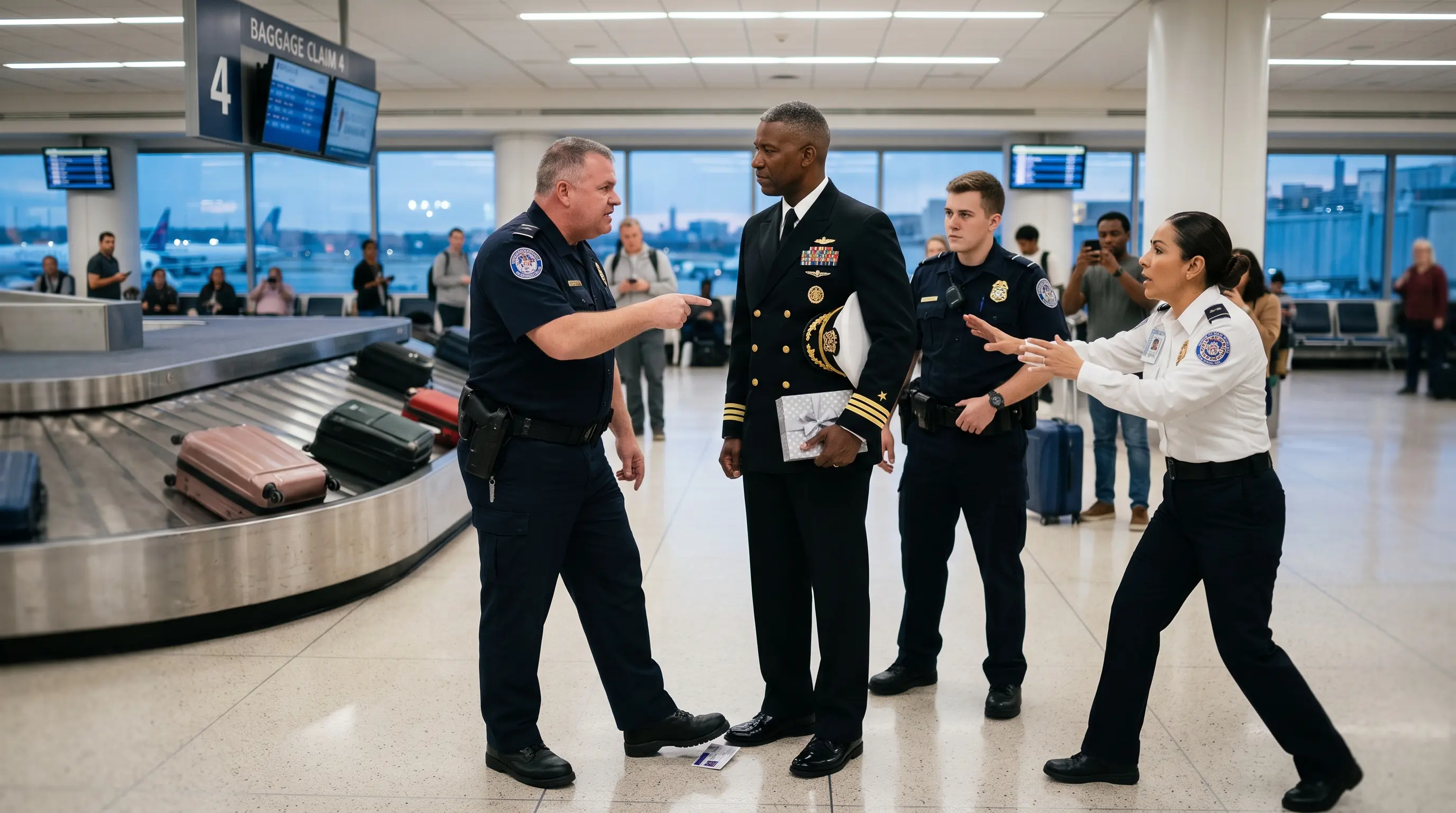
“Fake medals. Fake rank,” Hargrove said. “People like you will try anything to feel important.”
Isaiah did not flinch.
His dress blues were razor sharp. His ribbons were perfectly aligned. The gold trident gleamed under the fluorescent glare. Around him, phones lifted and whispers spread through the terminal.
“On your knees!” Hargrove barked, shoving him forward.
He had no idea the man he was humiliating answered to forces far beyond this terminal.
The fluorescent lights of Reagan National Airport cast harsh reflections across the polished floor of baggage claim. Commander Isaiah Rollins stood tall in his perfectly pressed dress blues, a small gift box tucked under his arm. The elderly woman he had just helped beamed at him as she gripped the handle of her retrieved suitcase.
“Such a gentleman,” she said. “They don’t make many like you anymore.”
Isaiah nodded politely, his mind already on his mother’s face when he surprised her for her seventieth birthday. The small box contained a vintage brooch he had found in an antique shop in Dubai, exactly like the one his father had given her decades ago before he passed.
A shrill voice cut through the ambient noise of rolling luggage and murmuring travelers.
“That’s him. He was hovering around my bag.”
Isaiah turned to see a well-dressed woman in her fifties pointing at him, her face flushed with anger. Linda Carver clutched her designer purse to her chest as if protecting it from theft.
“Ma’am,” Isaiah said, keeping his voice steady and professional. Twenty years of military service had taught him how to handle hostile situations with calm authority. “There seems to be a misunderstanding.”
“I saw you,” Linda snapped, drawing more stares. “You were watching my bag, waiting for a chance to grab it.”
Two airport police officers approached rapidly. The older one, Sergeant Hargrove, immediately positioned himself between Isaiah and Linda. Officer Mercer, younger and visibly tense, flanked Isaiah’s other side.
“What seems to be the problem here?” Hargrove asked, one hand resting casually near his holster, his eyes already narrowed with suspicion.
“This man was trying to steal my purse,” Linda declared. “I saw him watching it at the carousel.”
Isaiah slowly reached for his military ID.
“There’s been a misunderstanding. I’m Commander Isaiah Rollins, United States Navy.”
“Hands where I can see them,” Hargrove barked, taking an aggressive step forward.
Isaiah froze, acutely aware of the growing crowd. Phones emerged from pockets and purses, their camera lenses gleaming like eager eyes.
“I was helping that elderly woman with her luggage,” Isaiah explained calmly, nodding toward where she had stood. But she had already disappeared into the crowd, perhaps frightened by the confrontation.
“Let’s see this ID you’re talking about,” Hargrove demanded, his tone dripping with skepticism.
With deliberate slowness, Isaiah retrieved his military identification and offered it. Hargrove snatched it, studying it with exaggerated scrutiny.
“You expect me to believe you’re a Navy commander?” Hargrove’s lip curled. “These costume shops are getting better with fake IDs.”
A TSA supervisor pushed through the growing crowd. Angela Ruiz’s eyes widened with recognition.
“Sergeant, that is Commander Rollins. I attended his commendation ceremony last year at the Pentagon. He’s—”
“Ma’am, please step back,” Hargrove cut her off without even looking at her. “This is a police matter now.”
The small gift box shifted under Isaiah’s arm as he maintained his composure.
“Sergeant, you can verify my identity with one phone call.”
“You’re going to put that box down nice and slow,” Hargrove interrupted, his voice hardening. “Then we’re going to discuss impersonating military personnel.”
Isaiah felt his jaw tighten, but his voice remained measured.
“Sergeant, you’re making a serious mistake.”
“The only mistake,” Hargrove said, stepping closer, “is thinking that fancy uniform gives you special treatment.”
Phones continued recording as the confrontation escalated. Linda Carver had backed away, her initial certainty wavering as she watched the scene unfold.
“On your knees,” Mercer suddenly shouted, feeding off Hargrove’s energy.
“I will not kneel,” Isaiah stated firmly. “I’ve done nothing wrong, and you have no cause to—”
The impact came without warning.
Hargrove moved with practiced efficiency, sweeping Isaiah’s legs while driving him forward. The polished airport tile rushed up to meet him. The crack of Isaiah’s face hitting the floor echoed through baggage claim.
His medals, earned through years of service and sacrifice, scattered across the tile like dropped coins. The gift box skittered away, its wrapping paper tearing.
Gasps rippled through the crowd. Angela Ruiz shouted something in protest, but her voice was lost in the chaos.
Officer Mercer drove his knee into Isaiah’s back, wrenching his arms behind him. The handcuffs bit into his wrists with unnecessary force.
Through the haze of pain and humiliation, Isaiah tasted blood from his split lip. He could see his reflection in the polished floor. His crisp uniform was now crumpled, a small smear of red marking his chin.
Around him, his medals lay scattered like broken promises.
“Not so commanding now, are you?” Hargrove said from above, his voice thick with satisfaction.
Isaiah remained silent, his mother’s words echoing in his memory.
Sometimes dignity means bearing the weight of other people’s shame.
Travelers continued filming as Mercer roughly pulled Isaiah to his feet. A child began crying somewhere in the crowd. The vintage brooch lay exposed in its cracked box nearby.
Through it all, Isaiah kept his eyes forward and his back straight, despite the hands gripping his arms. His medals gleamed on the floor, each one a testament to service that these men had just ground beneath their boots.
The crowd parted as they began to lead him away, phones tracking his every step. Linda Carver stood frozen, her designer bag clutched forgotten at her side as the full weight of what she had initiated settled over her face.
Officer Mercer’s knee had dug deep into Isaiah’s back when he was pinned, and now he yanked the handcuffs tighter, making the metal bite into Isaiah’s wrists.
“Sir, please,” Angela Ruiz said, pushing forward through the murmurs. The TSA supervisor held her phone out like a shield. “This is Commander Rollins. I can prove it.”
Her fingers moved rapidly across the screen before she thrust it toward Sergeant Hargrove. The video showed Isaiah receiving a commendation at the Pentagon, his bearing just as dignified then as it had been moments before being forced to the floor.
“That is him,” Angela insisted, her voice trembling with barely contained anger. “I was there. He received the Navy Cross for actions that saved American lives.”
Hargrove barely glanced at the footage.
“Could be anyone,” he said. “Could be where he got the idea for this little costume party.”
He turned to address the growing crowd of onlookers, their phones recording every second.
“Folks, please stay back. We’re dealing with a case of stolen valor here.”
Isaiah felt the cold seep through his uniform as Mercer shifted his grip, still holding him with unnecessary force despite his complete lack of resistance. The young officer’s breathing was rapid, betraying his nervousness despite his aggressive posture.
“The Pentagon can confirm my identity with one phone call,” Isaiah said quietly. His words were measured and clear despite his awkward position. Blood from his split lip left a small red circle on the white tile.
“Oh, now he’s claiming Pentagon connections,” Hargrove sneered. He nodded to Mercer. “Get him up. We’ll add disorderly conduct to the charges.”
Mercer roughly pulled Isaiah to his feet, the handcuffs ensuring his arms remained painfully wrenched behind his back. A teenage girl in the crowd gasped as she got a clear view of his bloodied face.
“You need to stop this now,” Angela pleaded, looking around desperately for support. “He’s a decorated commander. This is completely wrong.”
From the edge of the scene, airport security director Pamela Vance watched with calculated detachment. Her perfectly manicured fingers tapped against her crossed arms, but she made no move to intervene.
Her eyes met Isaiah’s for a brief moment before sliding away, already composing the press release in her head.
“Ma’am, return to your post or face disciplinary action,” Hargrove warned Angela. “This man was causing a disturbance, harassing passengers, and is now resisting arrest while impersonating military personnel.”
Isaiah stood straight despite the restraints, his voice carrying clearly across the terminal.
“Sergeant Hargrove, Officer Mercer, you are making a decision that will permanently impact your careers. This isn’t a threat. It’s a fact.”
Hargrove’s face darkened.
“Are you threatening law enforcement officers? Add that to the list.”
He grabbed Isaiah’s arm roughly.
“Let’s go, Commander. We’ve got a nice cell where you can explain all about your made-up military career.”
“I want to file a complaint,” Angela announced, pulling out her own phone. “I’m recording this abuse of power.”
“Ma’am, interfering with police business is grounds for arrest,” Mercer called out, his voice cracking slightly.
Dozens of phones tracked their movement as Hargrove and Mercer began marching Isaiah through the terminal. His polished shoes, now scuffed from the takedown, clicked against the floor in a steady rhythm.
Despite the handcuffs and the blood on his chin, he walked with military precision, head high.
Travelers pressed against the walls, creating a corridor of shocked faces and recording devices. A mother pulled her young son close, covering his eyes. An elderly veteran in a Korean War cap stood and saluted, his weathered face twisted with outrage.
“This isn’t right,” someone in the crowd called out. “He’s military.”
“Stay back,” Hargrove barked, tightening his grip on Isaiah’s arm.
They passed the security checkpoint where Isaiah had walked through just thirty minutes earlier, back when his uniform was pristine and his mother’s gift was safely tucked under his arm.
TSA agents watched with uncertain expressions. Some averted their eyes. Others shot concerned glances at Angela, who followed several paces behind, still recording.
Isaiah’s voice remained calm, though it carried an edge of steel.
“Officer Mercer, you still have time to think about what you’re participating in. Your sergeant may be comfortable destroying his career, but you don’t have to go down with him.”
Mercer’s step faltered slightly.
Hargrove quickly snapped, “Keep moving. Don’t let him play mind games.”
The automatic doors at the terminal exit loomed ahead. Through the glass, Isaiah could see a police vehicle waiting, its lights already flashing.
Behind him, he heard Pamela Vance’s heels clicking on the tile as she finally moved forward, probably to begin damage control.
The doors slid open with a soft whoosh, letting in a blast of humid Virginia air. As they crossed the threshold, Isaiah counted silently in his head, measuring time with the precision that had kept him alive through countless missions.
The doors whispered shut behind them just as the first alarm siren split the air.
Red emergency lights began pulsing throughout the terminal. Through the glass, Isaiah saw confusion spread across the faces of the crowd inside.
Hargrove’s grip tightened painfully.
“What did you do?”
Isaiah kept his eyes forward and said nothing.
The sirens continued their urgent wail as they approached the waiting police car, its lights painting the gathering dusk in alternating red and blue.
The fluorescent lights hummed overhead in the stark airport holding facility as Isaiah sat at a cold metal table, his bruised face a sharp contrast to his now disheveled dress blues.
Officer Mercer stood beside him, hands trembling slightly as he removed each medal with exaggerated care, dropping them one by one into a clear evidence bag.
Clink.
The Navy Cross.
Clink.
The Silver Star.
Clink.
The Bronze Star with Valor.
Each medal told a story of service and sacrifice, now being cataloged like common contraband.
Isaiah watched silently, his bearing still military straight despite the handcuffs securing him to the table ring.
Sergeant Hargrove leaned against the wall, arms crossed, a smirk playing at the corners of his mouth.
“Quite a collection you’ve got there,” he said. “Must have taken some time to put it all together. Party supply store, maybe?”
Isaiah did not respond. His eyes tracked each medal as it disappeared into the bag. The cut on his lip had stopped bleeding, leaving a dark crust that pulled when he moved his mouth.
“Still playing the silent, dignified routine?”
Hargrove pushed off from the wall and approached the table.
“Let’s see what the charges are looking like. Impersonating military personnel. Resisting arrest. Disorderly conduct. Threatening law enforcement officers.”
He made a show of writing each one down.
“That designer bag you were eyeing? We’ll add attempted theft, too.”
Mercer paused in his task, glancing uncertainly at his supervisor.
“Sir, the woman didn’t actually see him—”
“Write it up, officer,” Hargrove cut him off sharply. “Our job is to protect the public. If he was making passengers uncomfortable, that’s probable cause.”
Outside the holding room, phones buzzed with breaking news alerts. The first shaky videos were already trending.
Black man in military uniform arrested at Reagan National.
Comment sections filled with heated debate. Some demanded answers. Others assumed guilt.
Three floors up, Angela Ruiz stood her ground in front of Pamela Vance’s desk, holding out a manila folder.
“This is my formal statement confirming Commander Rollins’s identity, along with documentation from the ceremony where I saw him receive commendation.”
Vance barely looked up from her computer screen, where news alerts continued to populate.
“Thank you, Ms. Ruiz. We’ll need to review this through proper channels before—”
“Proper channels?” Angela’s voice rose slightly. “He’s a decorated Navy officer being held on false charges. I’m an eyewitness to his legitimate military status.”
“Which we appreciate,” Vance replied smoothly, finally meeting Angela’s eyes. “But we have procedures to follow. Officer safety is our primary concern, and the suspect demonstrated aggressive—”
“Aggressive?” Angela interrupted. “He didn’t resist at all. I have it on video.”
Vance’s perfectly lined lips tightened.
“Ms. Ruiz, perhaps you should take the rest of your shift off. You seem emotionally invested in this situation.”
Back in the holding room, Isaiah finally spoke, his voice level.
“I’d like to make my phone call now.”
Hargrove laughed.
“Your phone call? What is this, TV? You think one call is going to fix this?”
He leaned over the table, placing both palms flat on the metal surface.
“You’re not going anywhere until we verify every piece of ID you claimed was real. Could take days. Weeks, even.”
“It’s my right,” Isaiah stated simply. “One phone call.”
Mercer shifted uncomfortably, the evidence bag crinkling in his hands.
“Sarge, he’s technically correct. Policy says—”
“Fine.”
Hargrove straightened up with an exaggerated sigh.
“Give the man his phone call. Let him waste it on whatever fake commanding officer he’s cooked up.”
Mercer produced a landline phone from the wall, placing it on the table within Isaiah’s reach. The handcuffs allowed just enough movement to dial.
Isaiah’s fingers moved with practiced precision, entering a number from memory. Each digit was deliberate.
“Office of Naval Operations,” a crisp voice answered.
“This is Commander Isaiah Rollins. Authorization code Sierra 749 Echo,” Isaiah said, his voice carrying the weight of absolute authority despite his circumstances. “I need to speak with Admiral Morrison’s office immediately.”
There was a pause on the line.
Hargrove rolled his eyes, but something in the quality of the silence made Mercer take a small step back from the table.
“Authorization code confirmed,” the voice returned, all traces of routine professionalism replaced with sharp attention. “One moment, Commander.”
Another voice came on the line, deeper and bearing the unmistakable tone of command.
“Commander Rollins, this is Captain Phillips. Report your situation.”
“I’ve been detained at Reagan National Airport under false charges. My current location is airport holding. Time in custody approximately ninety minutes.”
Isaiah’s report was precise and clinical.
“Sir, I was en route under classified directive.”
The silence that followed seemed to suck all the air from the room. Even Hargrove’s smirk faltered slightly.
Captain Phillips’s voice returned, measured but carrying an undercurrent of controlled fury.
“Were you on schedule for the designated transfer?”
“Yes, sir, until my arrest.”
“Were you in possession of the package at the time of detainment?”
Isaiah’s eyes flicked briefly to the evidence bag containing his medals.
“Negative, sir. Status of the package is currently unknown.”
The line went dead without another word.
The dial tone hummed in the sudden stillness.
Mercer’s face had gone pale, his fingers clutching the evidence bag too tightly. Even Hargrove’s customary arrogance showed hairline cracks around the edges.
Isaiah sat back in his chair as much as the handcuffs would allow. His expression remained unchanged, but something in his posture suggested a man who knew exactly what came next.
The security radio on Hargrove’s belt crackled to life, breaking the tense silence that had followed Isaiah’s phone call. Urgent voices overlapped each other in a cascade of confusion.
“Multiple federal vehicles approaching Gate C. Requesting clearance.”
“Security checkpoint three, stand down. Priority access granted.”
“All units, maintain positions. Repeat, maintain positions.”
Hargrove grabbed his radio, knuckles white against the black plastic.
“This is Sergeant Hargrove. What federal vehicles? Who authorized—”
“Direct order from airport command,” the radio cut him off. “All security personnel clear access routes immediately.”
Through the holding room’s small window, red and blue lights began strobing across the walls. Mercer stood frozen, still clutching the evidence bag containing Isaiah’s medals, his young face drained of color.
Up in her office, Pamela Vance’s phone rang.
Her perfectly manicured nail hovered over the answer button for a fraction of a second before pressing down.
“This is Director Vance.”
“This is Colonel James Mitchell, Pentagon Office of Special Operations,” a clipped voice responded. “We need immediate clarification regarding the detention of Commander Isaiah Rollins.”
Vance’s professional smile remained fixed, though no one was there to see it.
“Of course, Colonel. We’re following standard procedure for—”
“Director Vance,” the voice hardened, “are you aware you’re currently interfering with a classified military operation?”
The smile slipped.
“I… our officers responded to a public complaint. The suspect was—”
“Commander Rollins is a decorated Navy officer conducting official business. We require his immediate release and full access to all evidence collected during his wrongful detention.”
In the holding area, Hargrove paced like a caged animal, barking into his phone.
“Listen, I don’t care what department they’re from. We followed procedure. The suspect was combative, refusing to—”
“Sergeant,” a new voice interrupted, deep and carrying the weight of decades of command. “This is Admiral Thomas Caldwell. I’m going to speak very slowly and clearly. You have exactly five minutes to release Commander Rollins before I personally ensure your career ends today.”
Hargrove’s face flushed red.
“Now wait just a minute. You can’t just—”
“Four minutes and fifty seconds,” Caldwell said. “Commander Rollins was transporting encrypted defense materials vital to ongoing operations. Your actions have compromised national security protocols. Four minutes and thirty seconds.”
Down the hall, Isaiah sat alone in his cell, back straight despite his fatigue. The cut on his lip had stopped bleeding, but his dress blues, pristine just hours ago, were wrinkled and stained from the floor.
His mother’s birthday gift, the small box wrapped in silver paper, sat on the processing desk outside next to his confiscated belongings.
The sound of rapid footsteps echoed through the corridor. Multiple sets moving with purpose.
“This way,” Mercer said, his voice higher than usual with stress. “He’s in holding cell three.”
Heavy boots stopped outside the cell.
Keys rattled in the lock.
The door swung open to reveal a stern-faced woman in a dark suit flanked by two military police officers.
“Commander Rollins.”
Her credentials flashed.
“Department of Defense. I’m Agent Sarah Marshall. You’re being released immediately.”
Isaiah stood smoothly, his bearing military precise despite the handcuffs.
“The encrypted package?”
“Already located and secured,” Marshall replied, gesturing for one of the MPs to remove the cuffs. “Admiral Caldwell is handling the situation personally.”
In the processing area, Hargrove watched the scene unfold, his usual swagger deflated. The evidence bag containing Isaiah’s medals sat on the desk between them next to forms half-filled with false charges that would never be filed.
Agent Marshall’s voice cut through the tension.
“Sergeant Hargrove, we’ll need all documentation related to this incident. Every form, every note, every video recording.”
Her tone left no room for argument.
“The Department of Defense is now handling this matter directly.”
The metal cuffs fell away from Isaiah’s wrists, leaving angry red marks on his skin. He rubbed them absently, his eyes meeting Hargrove’s across the room.
He did not speak.
He did not need to.
Mercer hovered uncertainly by the desk, looking between his sergeant and the federal agents.
“Sir, should I… what about the evidence log?”
“Everything,” Marshall emphasized. “And sergeant, the Pentagon will be conducting a full review of your department’s detention procedures.”
She turned to Isaiah.
“Commander, if you’ll come with me, Admiral Caldwell would like to speak with you directly.”
Isaiah nodded once, then reached for his mother’s gift, still sitting on the processing desk. The silver paper was slightly crumpled now, one corner torn.
He straightened it carefully before picking it up.
Through the window, more emergency lights painted the walls in alternating patterns. Radio chatter continued to fill the air with urgent voices and rapid-fire instructions.
The airport’s carefully maintained order had been shattered by a single phone call.
Hargrove stood rigid, watching as Isaiah was escorted out by the federal team. His carefully constructed narrative was crumbling around him, and for the first time since the incident began, real fear showed in his eyes.
Just before they reached the door, Isaiah paused. He turned back, not to Hargrove, but to Officer Mercer.
His voice was quiet, but it carried clearly in the tense silence.
“Remember what I said earlier,” Isaiah stated simply. “About decisions that follow you.”
The young officer swallowed hard and nodded, unable to meet Isaiah’s gaze.
Agent Marshall guided Isaiah through the door, the MPs falling into step behind them. Their footsteps echoed down the corridor, growing fainter until only the persistent radio chatter remained.
Hargrove slumped against the desk, his face ashen. The evidence bag crinkled under his hand. Medals that had been earned in service now gathered as proof of a crime that never existed.
Through the window, he could see more federal vehicles arriving, their lights casting long shadows across the airport’s facade.
The fluorescent lights in the airport’s administrative office buzzed overhead, casting harsh shadows across the mahogany conference table. Isaiah sat straight-backed in his chair, his bruised face reflected in the polished wood surface.
Across from him, Pamela Vance adjusted her designer blazer, flanked by two grim-faced men in expensive suits from city legal counsel.
“Commander Rollins,” Vance began, her voice professionally sympathetic, “first, let me express our deepest regrets for today’s unfortunate incident.”
She slid a thick document folder across the table.
“We want to make this right.”
Isaiah did not touch the folder. His pressed uniform, though wrinkled from the arrest, still commanded respect. The cut on his lip had stopped bleeding, but the injury stood out starkly against his dark skin under the harsh lighting.
“Make it right,” he repeated quietly, letting the words hang in the air.
One of the lawyers cleared his throat.
“We’re prepared to offer immediate compensation along with a formal apology from the department.” He tapped the folder. “The terms are quite generous.”
Colonel Phillips, the Pentagon representative who had been standing silently by the window, stepped forward.
“Commander, given the classified nature of your mission, discretion would be advantageous for all parties.”
Vance nodded eagerly.
“Exactly. We need to consider airport stability. The impact on public trust. Our federal partnerships.”
She leaned forward, lowering her voice.
“This doesn’t have to become a larger incident.”
Isaiah’s phone buzzed on the table. Another news alert.
He turned it over, but not before catching the headline.
Black Navy officer arrested in uniform. Profiling alleged at Reagan National.
“The video is already viral,” Isaiah stated matter-of-factly. “People are asking questions.”
“Questions we can manage,” Vance assured him. “With your cooperation, we can frame this as a simple misunderstanding. No lasting damage done.”
Isaiah’s expression did not change, but something hardened in his eyes.
“No lasting damage,” he repeated. “Like these bruises will fade. Like my mother watching her son in handcuffs on the evening news.”
“Commander,” Colonel Phillips interjected, “the Pentagon’s primary concern is protecting operational security. A public spectacle could compromise—”
“With respect, Colonel,” Isaiah cut in, his voice steady but firm, “operational security was compromised the moment Sergeant Hargrove decided to abuse his authority.”
He gestured to his face.
“This isn’t about classified missions anymore. This is about accountability.”
Down in the airport police office, Sergeant Hargrove sat at his desk, staring at his computer screen. Social media had exploded with video clips of the arrest. His jaw clenched as he read comment after comment condemning the department’s actions.
“They don’t understand,” he muttered, closing the browser. “We followed procedure. He was resistant.”
Even to his own ears, the words sounded hollow.
Officer Mercer knocked tentatively on his door.
“Sergeant, Internal Affairs is requesting the body cam footage.”
“It malfunctioned,” Hargrove snapped. “Technical error. Make sure that’s in the report.”
Back in the administrative office, Vance was growing visibly frustrated behind her professional veneer.
“Commander Rollins, surely we can find a reasonable solution here. The airport is willing to—”
“Ms. Vance,” Isaiah interrupted softly. “Do you know what Navy SEALs are trained to do when interrogated?”
He did not wait for her response.
“We’re trained to remain silent, to give nothing away, to resist pressure.” His eyes met hers directly. “But we’re also trained to recognize when silence protects the wrong people.”
The lawyers exchanged glances. Colonel Phillips shifted uncomfortably.
“Your officer profiled me, assaulted me, and accused me of stolen valor while I was wearing the uniform I’ve served in for twenty years,” Isaiah said. His voice remained calm, but carried an edge of steel. “And now you want me to help you bury it.”
“We’re trying to protect—” Vance began.
“The airport’s reputation? Federal funding? Or Sergeant Hargrove’s badge?”
Isaiah stood slowly.
“I won’t be silent. Not this time. Not for any amount of money.”
Outside the administrative offices, reporters had begun gathering. News vans lined the terminal drop-off zone, their satellite dishes raised against the night sky. The story was spreading faster than the airport’s PR team could contain it.
Vance made one final attempt.
“Commander, please consider the broader implications. The damage to department morale. To public trust.”
“Public trust was damaged the moment your officer slammed a uniformed serviceman to the ground,” Isaiah replied. “I’m not here to help you hide that.”
He gathered his cover from the table, straightening it carefully. His mother’s gift, the silver paper now creased and torn, sat beside it. Twenty-four hours ago, he had planned to surprise her. Now she had seen him arrested on national television.
“The Pentagon strongly advises discretion,” Colonel Phillips reminded him stiffly.
Isaiah nodded respectfully to the colonel.
“Note my discretion regarding classified materials, sir. The rest…”
He shook his head.
“That’s not classified. That’s just wrong.”
Camera flashes began strobing through the office windows as Isaiah moved toward the door. Reporters had spotted movement inside. Their shouts carried faintly through the glass.
“Commander! Commander Rollins, can you comment on the arrest?”
“Was this profiling?”
Vance stood quickly.
“We can arrange a private exit.”
“No,” Isaiah said firmly. “No more hiding.”
He opened the door and stepped into the hallway, his bearing military straight despite the exhaustion weighing on him. The bruises on his face stood out under the harsh airport lighting. His uniform, though wrinkled, still commanded attention.
The reporters surged forward as he emerged. Microphones thrust toward him like weapons. Camera flashes exploded in his face, turning night into stuttering day.
Questions overlapped into a wall of sound.
But Isaiah did not break stride.
He had faced worse than cameras. He had faced worse than Hargrove. He had faced worse than Vance’s attempts to buy his silence.
The sea of microphones pressed closer as Isaiah stepped into the glare of camera lights outside Reagan National. Reporters jostled each other, their questions overlapping in an urgent chorus. The night air was thick with humidity, making his bruised face throb beneath the relentless camera flashes.
“Commander Rollins, can you describe what happened?”
“Was this racially motivated?”
“Did you resist arrest?”
Isaiah raised his hand slightly, and the crowd quieted.
His voice, when it came, was measured and clear.
“Today, while traveling to visit my mother, I was falsely accused, physically assaulted, and arrested while in full military dress. The conduct of certain officers was not just unprofessional. It was discriminatory and dangerous.”
More cameras clicked.
A reporter thrust her microphone forward.
“The airport police claim you were combative.”
“I presented valid military identification,” Isaiah continued calmly. “I maintained my composure even as I was forced to the floor. My service medals were scattered across the terminal tile. This isn’t about one incident. This is about accountability and abuse of power.”
The questions erupted again, but Isaiah moved steadily through the crowd toward his rental car. Behind him, the airport’s glass doors reflected the chaos of flashing lights like silent lightning.
Hours later, in a carefully staged press conference, Pamela Vance stood at a podium in the airport’s media room. Her pearl necklace gleamed under the professional lighting as she gripped the edges of the lectern.
“While we regret any misunderstanding,” she said, her voice crisp and corporate, “our officers followed standard protocol when confronted with an aggressive individual who refused to comply with reasonable requests.”
The word scrolled across news tickers nationwide.
Airport claims Navy officer was aggressive. Officer safety cited.
On CNN’s split-screen panel, commentators argued over grainy cell phone footage of the arrest.
“If you look closely,” a former police chief insisted, “you can see resistance.”
“Resistance?” interrupted a civil rights attorney. “He’s literally standing still with his hands visible in full military dress.”
Across town, Sergeant Hargrove sat for a local news interview, his uniform pressed and his stance rigid.
“Our officers are trained to make split-second decisions,” he declared. “When someone claims military status, we have to verify in this day and age.”
“But the TSA supervisor confirmed his identity,” the reporter pressed.
Hargrove’s jaw tightened.
“Ma’am, you weren’t there. You didn’t see his attitude. His demeanor.”
The interview cut to more viral footage. Isaiah on the ground, medals scattered, Hargrove’s knee in his back.
In Norfolk, Virginia, Lillian Rollins’s hands shook as she collected her mail. Mixed among the bills and catalogs was an envelope with no return address. Inside, a crude message had been typed.
Tell your son to keep his mouth shut if he knows what’s good for him.
She placed it carefully in a plastic bag, her movements deliberate despite her anger. Years of raising a Black son in America had taught her to document everything. The previous letter, You people don’t belong in uniform, was already sealed away as evidence.
Her phone rang.
Isaiah’s name lit up the screen.
“Baby, I saw the news,” she said before he could speak. “You did right. Your daddy would have been proud.”
“They’re trying to spin it, Mama,” Isaiah said. His voice was tired but determined. “Making me out to be the threat.”
“Let them try,” Lillian said, her voice hardening. “Truth shows itself in time.”
She paused, debating whether to mention the threats.
Not yet.
He had enough to handle.
Outside her window, a car drove past slowly, its occupants staring at her house. She drew the curtains with practiced casualness.
In the parking lot of his hotel, Isaiah sat in his rental car, scrolling through endless social media posts about the incident. New angles of footage appeared hourly: his medals skittering across the floor, Hargrove’s sneer, the crowd’s shocked faces.
A notification popped up. Hargrove’s interview was trending.
Isaiah watched his attacker defend the assault with rehearsed phrases about officer safety and proper procedure.
His phone buzzed with a text from Angela Ruiz, the TSA supervisor.
They’re trying to bury my incident report. Document everything.
Isaiah opened his evidence log, cataloging the items returned after his release.
Wallet.
Keys.
Phone.
Mother’s gift.
Damaged uniform items.
He frowned, scrolling back through the list.
Something nagged at his training-sharpened mind.
The encrypted device.
Small, flat, designed to look like a common power bank, standard issue for sensitive transport missions. He had carried it in his inner uniform pocket when Hargrove took him down.
It was not listed in the returned items.
He checked the evidence forms again methodically.
Nothing.
The device containing sensitive defense data was missing.
Isaiah’s pulse quickened, but his face remained composed. Years of training had taught him to process threats without revealing awareness. He reviewed the viral footage again, focusing now on Mercer’s hands as they searched him.
The young officer had definitely removed something from his uniform pocket.
But where was it now?
More cars pulled into the hotel parking lot. News vans, their satellite dishes raised like periscopes. They had found his hotel. The media frenzy was about to begin another cycle.
In the rearview mirror, Isaiah studied his reflection. The bruises were darkening, telling their own story. But now there was something bigger at play.
The missing device was not just evidence of police misconduct anymore.
It was a national security breach.
Isaiah’s fingers hovered over his phone’s keypad in the darkened rental car. The weight of what he was about to report settled heavily in his chest.
He dialed Admiral Caldwell’s direct line, a number few had access to.
“Caldwell,” came the crisp answer on the first ring.
“Admiral, Commander Rollins. We have a situation.”
Isaiah kept his voice low, scanning the parking lot where news vans continued to gather.
“The encrypted transport device wasn’t returned with my personal effects.”
A long pause followed. When Caldwell spoke again, his tone had shifted from administrative to tactical.
“Say again, Commander.”
“The device is missing, sir. Not listed in any of the return documentation.”
A sharp breath came through the line.
“That device contains operational data for…”
Caldwell caught himself.
“Hold for verification.”
Isaiah waited, watching a reporter set up a camera tripod near his car. He slouched lower in his seat, though the tinted windows provided some cover. His mind raced through the arrest sequence. Hargrove’s takedown. Mercer’s search. The evidence processing.
Caldwell’s voice returned, tight with controlled urgency.
“Device was logged into airport police evidence at 1847 hours. Signing officer: K. Mercer.”
“Mercer,” Isaiah repeated, remembering the young officer’s nervous energy during the search. “He conducted the initial pat-down.”
“I’m activating federal retrieval protocols now. This elevates everything.”
More typing sounded through the phone.
“Our cyber team confirms no unauthorized access attempts on the encrypted channels. But that doesn’t mean—”
“Permission to investigate locally, sir,” Isaiah interrupted, his training already mapping out a careful approach. “I can be back at the station in fifteen minutes.”
“Negative, Commander. Pentagon oversight is en route. Stand down and maintain—”
“Sir,” Isaiah said, still respectful but firm. “By the time oversight arrives, that device could be anywhere. You know my capabilities. Let me do what I’m trained for.”
Another pause. Isaiah could almost hear the admiral weighing operational security against time sensitivity.
“You have one hour,” Caldwell finally said. “Reconnaissance only. Do not engage. The moment our team arrives, you step back. Clear?”
“Crystal, sir.”
Isaiah ended the call and started the car. As he pulled out of the parking lot, two news vans attempted to follow. He used careful route changes and traffic timing to lose them before heading back toward the airport police station.
The station sat in a separate building from the main terminal, a squat concrete structure with high security fencing. Isaiah parked in the public lot, noting camera positions and guard rotations, automatic threat assessment ingrained from years of missions.
Inside, fluorescent lights hummed overhead as he approached the front desk. The night shift clerk looked up, recognition flickering across her face.
“I need to review the evidence inventory from my arrest,” Isaiah said, placing his military ID on the counter. “Specifically items logged at 1847 hours by Officer Mercer.”
“Sir, evidence requests require federal authorization.”
Isaiah slid a document across the counter, emergency access credentials Caldwell had just texted him.
“This should cover it.”
The clerk examined the paperwork, made a call, then buzzed him through to the evidence processing area.
The room smelled of dust and old paper. Metal shelving units stretched into the shadows.
“Records terminal is here,” she said, gesturing to an old computer. “I’ll need to supervise your search.”
Isaiah nodded, fingers moving efficiently across the keyboard. He pulled up the day’s logs, scanning for Mercer’s badge number.
The timeline emerged in green text.
1835: initial evidence intake.
1847: device logged into storage.
2012: device signed out by Mercer.
Isaiah checked his watch.
The device had been out of secure storage for more than two hours.
“I need to know where Officer Mercer took this item,” he said, pointing to the entry.
The clerk peered at the screen.
“Says here it was transferred to external technical analysis.”
“At this hour? What facility?”
She shrugged.
“Above my clearance. You’d have to ask Officer Mercer directly.”
Isaiah stood, jaw tight.
“Thank you for your assistance.”
Outside, he updated Caldwell while walking to his car.
“Device was removed from evidence two hours ago. Mercer logged it for external analysis, but no destination facility is listed.”
“That’s not protocol,” Caldwell growled. “No authorized analysis would happen off-site, especially not at night. Our team is twenty minutes out. Hold position.”
A police cruiser pulled into the lot, lights off. Through the windshield, Isaiah recognized Officer Mercer’s profile. The young officer parked and hurried inside, carrying what looked like a laptop bag.
“Sir,” Isaiah said, “Mercer just returned to the station. Request permission to maintain surveillance.”
“Granted, but do not engage. I repeat, do not—”
Isaiah ended the call, sliding deeper into the shadows near the building’s side entrance. His trained eyes tracked Mercer through the windows as the officer moved through the station.
Something about his body language set off warning bells.
The furtive glances.
The too-casual pace.
Through the evidence room window, Isaiah watched Mercer approach the clerk’s desk. Their conversation was brief. The clerk checked something on her computer, then shook her head.
Mercer’s shoulders tensed. He turned quickly and left through a different door, still carrying the laptop bag.
Isaiah’s phone vibrated.
A message from Caldwell.
Federal team five minutes out. Hold position.
But Isaiah’s instinct screamed that in five minutes, whatever was happening would be too late to stop.
He watched Mercer’s retreating figure, remembering the young officer’s face during the arrest, the flicker of doubt before following Hargrove’s orders.
The evidence clerk’s voice drifted through the window as she made a call.
“Yeah, Officer Mercer just tried to backdate a transfer log. Said he needed to add a destination facility.”
She paused, listening.
“No, I told him the system doesn’t work that way. He left kind of weird.”
Isaiah’s muscles coiled with practiced readiness.
The missing device was vital to active military operations. If it had been compromised, the consequences could reach far beyond one airport police station.
He touched his phone, considering one last check with Caldwell.
But sometimes in the field, hesitation meant mission failure.
He moved silently through the shadows, following Mercer’s path while maintaining his distance.
The fluorescent lights buzzed overhead in the empty hallway as Officer Mercer emerged from the office. His head was down, focused on the laptop bag clutched against his chest.
When he looked up and saw Isaiah standing there, he stumbled backward, face draining of color.
“Commander,” Mercer whispered, eyes darting to the nearest exit.
Isaiah remained motionless, his presence filling the narrow corridor. He did not speak, letting the silence build pressure.
It was an interrogation technique he had learned years ago. Sometimes the best way to get someone talking was to say nothing at all.
Mercer’s hand trembled as he adjusted his grip on the bag.
“I… I was just…”
“The encrypted device,” Isaiah said quietly, his voice carrying the weight of authority without raising its volume. “Where is it?”
Sweat beaded on Mercer’s forehead. He glanced over his shoulder, then back at Isaiah. The young officer’s chest rose and fell rapidly with shallow breaths.
“I can’t,” Mercer said, swallowing hard. “Sergeant Hargrove said…”
“Hargrove isn’t here,” Isaiah interrupted. “It’s just you and me. And right now, you’re holding classified military hardware that was removed from evidence without authorization.”
He took one step forward.
“That’s a federal offense.”
Mercer’s shoulders slumped.
“He told me to take it,” he said, voice barely above a whisper. “Said we needed insurance. Leverage. In case you tried to make trouble about the arrest.”
Isaiah studied the younger man’s face, reading the conflict there.
“Walk with me,” he said, gesturing toward an empty breakroom nearby.
Mercer hesitated, then followed.
Inside, Isaiah closed the door and pulled out a chair.
“Sit.”
The officer sank into the seat, placing the laptop bag on the table between them. His hand shook as he unzipped it, revealing the encrypted device nestled among papers.
“He said you were dangerous,” Mercer continued, words spilling out now. “That you’d try to destroy our careers over a simple misunderstanding. He ordered me to log it out for technical analysis. Said we needed to prove you were carrying suspicious equipment.”
“And you followed those orders without question.”
Mercer’s face flushed.
“I didn’t know what else to do. Hargrove’s been my supervisor for three years. He has connections all through the department. His father was a captain.”
“Show me proof,” Isaiah said. “If what you’re saying is true, there must be evidence of Hargrove’s involvement.”
Mercer pulled out his phone with trembling fingers.
“I kept screenshots of the keycard logs.”
He pulled up several images, sliding the phone across the table.
“See? Hargrove accessed the restricted storage area twice after hours. Once right before he told me to remove the device, and again an hour later.”
Isaiah examined the logs carefully. The timestamps aligned with the evidence records he had seen earlier.
“Why are you showing me this now?”
“Because…”
Mercer’s voice cracked. He cleared his throat and tried again.
“Because I saw the news reports. The videos. What really happened out there.”
He met Isaiah’s eyes for the first time.
“And because Hargrove’s been acting strange since the Pentagon got involved. Making threats. Telling me to stay quiet, or else.”
“Or else what?”
“He didn’t say exactly. But the way he said it…”
Mercer shuddered.
“I’ve got a family. A baby daughter. I can’t… I can’t risk—”
“Federal witness protection exists for exactly this reason,” Isaiah said. “But you have to be willing to come forward officially. To tell Internal Affairs everything you just told me.”
Mercer’s leg bounced nervously under the table.
“What about Hargrove? He’ll know I talked.”
“He’s already under investigation,” Isaiah explained. “The Pentagon doesn’t take kindly to interference with classified operations. Your testimony could help ensure he faces consequences rather than finding another department to continue this behavior.”
The young officer stared at his hands for a long moment. The breakroom’s ancient coffee maker gurgled in the corner, marking the silence.
Finally, he looked up.
“What do I need to do?”
“First, we secure the device.”
Isaiah carefully placed it in his pocket.
“Then we walk to Internal Affairs together. You make a formal statement about everything. The orders, the evidence tampering, the threats. I’ll ensure federal authorities are notified to provide protection.”
“Just like that?”
“Just like that.”
Isaiah stood.
“Sometimes doing the right thing is simple. Not easy, but simple.”
Mercer rose slowly, squaring his shoulders as if physically taking on his decision.
“Hargrove always said we had to stick together. That the badge meant protecting our own.”
“The badge means protecting everyone,” Isaiah corrected. “Including from those who abuse their authority.”
They moved toward the door. Mercer paused with his hand on the handle.
“Commander, I’m sorry about the arrest. I should have—”
“You can make it right now,” Isaiah said. “That’s what matters.”
The hallway was still empty as they emerged. Their footsteps echoed on the linoleum as they walked side by side toward the Internal Affairs office. With each step, Mercer’s posture straightened slightly, as if shedding a weight.
“They’ll want to know everything,” Isaiah warned. “Every detail. Every conversation.”
Mercer nodded.
“I remember it all. Been replaying it in my head since it happened.”
They reached the frosted glass door marked Internal Affairs Division. Through the glass, shadows moved inside. Despite the late hour, Isaiah knew federal agents would already be waiting, alerted by his earlier calls.
Mercer took a deep breath, hand reaching for the door handle. The young officer’s face showed fear, but also something else.
Relief, perhaps.
Or determination.
The Internal Affairs office hummed with activity despite the late hour. Under harsh fluorescent lights, Officer Mercer hunched over a metal desk, his pen scratching against official statement forms. Two federal agents in dark suits stood near the window, speaking in low tones while reviewing the keycard logs on a laptop.
Isaiah sat quietly in a corner chair, watching Mercer’s hand tremble slightly as he detailed Hargrove’s instructions. The young officer paused occasionally, closing his eyes to recall specific conversations, then continued writing with renewed purpose.
“Take your time,” said Agent Morrison, the lead investigator. She placed a fresh bottle of water near Mercer’s elbow. “We need everything documented exactly as you remember it.”
Mercer nodded, flipping to another page.
“He was specific about the timing,” he said. “Told me to wait until shift change, when fewer people would be around. Said it had to look routine.”
Isaiah noticed Mercer’s uniform collar was dark with sweat despite the room’s chill. The officer had been writing for nearly an hour, filling page after page with detailed accounts of Hargrove’s actions over the past twenty-four hours.
Agent Morrison’s phone buzzed. She stepped into the hallway to answer it, returning moments later with a slight smile.
“Pentagon officials have authorized a formal reopening of the investigation,” she announced. “Based on Officer Mercer’s testimony and the keycard evidence, we have enough to proceed with full federal involvement.”
The second agent, Thompson, looked up from his laptop.
“News outlets are already picking up chatter about a potential whistleblower. Social media is lighting up again.”
Isaiah’s own phone vibrated. Admiral Caldwell had texted.
Temporary reinstatement approved pending investigation outcome. Well done, Commander.
Mercer finished another page, flexing his cramped fingers.
“There’s something else,” he said quietly. “About Director Vance’s involvement.”
Agent Morrison pulled up a chair.
“Go on.”
“She knew about the profiling. Had meetings with Hargrove about targeting certain types of passengers.”
Mercer could not meet Isaiah’s eyes.
“There were weekly briefings. She called them enhanced screening guidelines, but everyone knew what she meant.”
Morrison’s pen moved rapidly across her notepad.
“Can you provide specific dates and times?”
“They’re in my calendar app. I was required to attend as shift supervisor.”
Mercer pulled out his phone, scrolling through entries.
“Here. Every Tuesday at 0900 hours. Special security protocol review, they called it.”
The federal agents exchanged looks. Thompson began typing furiously on his laptop.
A knock at the door made everyone turn. A tech specialist entered, carrying several hard drives.
“We’ve started recovering deleted security footage from the evidence room servers,” she reported. “Multiple cameras, multiple angles. We should have preliminary results within the hour.”
Isaiah watched Mercer’s shoulders relax slightly at the news. The evidence would support his testimony and provide proof of the misconduct.
Agent Morrison’s phone buzzed again. She stepped out once more, this time returning with a grim expression.
“Commander,” she said to Isaiah. “You’ll want to see this.”
She held out her phone, displaying a breaking news alert.
Airport police officer breaks silence. Profiling and evidence tampering alleged in Navy officer arrest.
Below the headline was a photo of Isaiah in his dress blues, taken moments before the arrest. The article already had thousands of shares.
“Public support is surging,” Thompson noted, scanning social media reactions. “Local civil rights groups are organizing protests. Police accountability organizations are demanding immediate action.”
Mercer signed the final page of his statement with a shaky hand.
“What happens now?”
“Protective custody,” Morrison replied. “We’ll move you and your family to a secure location tonight. Federal marshals are already en route to your home.”
Isaiah stood, stretching his stiff muscles.
“The encrypted device needs to be logged into evidence properly,” he said. “Under federal supervision.”
Morrison nodded to Thompson, who produced an evidence bag and documentation forms. They carefully sealed and labeled the device, recording every detail of its recovery.
The tech specialist returned, her expression troubled.
“We have a problem,” she announced. “The evidence room footage. Something’s wrong with it.”
Everyone turned to look at her as she connected her laptop to a large monitor on the wall. The screen showed security camera footage from earlier that day, but instead of clear images, there was only digital static and corrupted frames.
“What happened?” Morrison demanded.
“The files appear to have been corrupted by some kind of targeted deletion program,” the tech explained. “It’s sophisticated. Not your typical evidence tampering. Someone knew exactly what they were doing.”
Mercer’s face went pale.
“Hargrove has a friend in IT. Marcus. They go way back. He’s helped cover things up before.”
Morrison was already on her phone, barking orders.
“I want that IT employee detained for questioning immediately. Get cyber forensics down here now. And somebody find me Sergeant Hargrove.”
The tech continued working, but her frown deepened.
“It’s not just one camera. All evidence room footage from the past twenty-four hours is corrupted. Even the backup servers are affected.”
Isaiah watched the static dance across the screen, remembering similar tactics he had encountered during counterintelligence operations. This was not amateur work. This was professional-grade obstruction.
“How long until you can recover it?” Thompson asked.
The tech shook her head slowly.
“That’s just it. This level of corruption… I’m not sure we can. The data appears to be completely destroyed.”
Morrison slammed her hand on the desk, making Mercer jump.
“Get every available resource on this. I want that footage recovered.”
But Isaiah could see from the tech’s expression that the damage was done. Hours of crucial video evidence showing exactly who accessed the evidence room and when had been systematically erased.
The clock on the wall ticked past midnight as they stared at the screen full of static, the weight of the setback settling over the room like a heavy blanket.
The Internal Affairs office door burst open as two uniformed officers escorted Mercer back inside. His face was ashen, eyes darting nervously between Isaiah and the federal agents.
Something had changed in the twenty minutes since he had left for a brief break.
Agent Morrison straightened in her chair.
“Officer Mercer, is everything all right?”
Mercer’s hands trembled as he clutched a new document.
“I need to amend my statement.”
Thompson frowned.
“What do you mean, amend? We just spent three hours taking your detailed testimony.”
“That testimony was given under duress,” Mercer said, his voice quavering. “Commander Rollins threatened me. Said he’d make sure I never worked in law enforcement again if I didn’t help him frame Sergeant Hargrove.”
Isaiah remained perfectly still in his chair, only his jaw tightening slightly.
The room temperature seemed to drop several degrees.
“That’s a serious accusation,” Morrison said carefully. “You understand making false statements to federal agents is a felony offense?”
“I’m not lying now,” Mercer insisted, though his eyes could not meet anyone’s gaze. “Commander Rollins cornered me in the hallway. Said he had Pentagon connections that could destroy my career. He forced me to make up those stories about Sergeant Hargrove.”
One of the escorting officers stepped forward, producing an official complaint form.
“Sergeant Hargrove has filed formal charges of witness intimidation and evidence tampering against Commander Rollins.”
Isaiah finally spoke, his voice low and controlled.
“Officer Mercer, look at me.”
Mercer flinched but raised his eyes.
“You know exactly what happened,” Isaiah continued. “You know who’s really threatening who here.”
“Don’t address the witness directly,” snapped one of the officers. “Sergeant Hargrove has provided security footage showing you following Officer Mercer into an isolated corridor before he made his original statement.”
Morrison held up her hand.
“We’ll need to see this footage immediately.”
“It’s been submitted to Internal Affairs,” the officer replied, “along with sworn statements from three other officers corroborating Sergeant Hargrove’s account of Commander Rollins’s aggressive behavior during the arrest.”
Thompson’s phone buzzed. He checked it and grimaced.
“The Pentagon’s issuing a statement. They’re distancing themselves from the situation pending full investigation of all parties.”
“The classified operation can’t be compromised,” Morrison muttered. “They’re cutting him loose to protect it.”
The tech specialist, who had been working on the corrupted evidence room footage, looked up from her computer.
“Agent Morrison, the deletion program that wiped our cameras… preliminary analysis shows it was activated using Commander Rollins’s confiscated phone.”
Isaiah did not move.
He did not protest.
He had seen this playbook before. The systematic dismantling of credibility. The coordinated testimonies. The manufactured evidence.
But knowing the tactics did not make them less effective.
“I’m sorry,” Mercer whispered almost too quietly to hear. “I have a family.”
More people entered the office. Senior police officials, department lawyers, uniformed brass. The small room quickly became crowded with bodies and voices and rustling papers.
A stern-faced woman in a navy suit approached Isaiah.
“Commander Rollins, I’m Karen Mitchell from the Judge Advocate General’s office. In light of these allegations, your service record is being placed under immediate review. Your security clearance and command authority are temporarily suspended pending full investigation.”
She handed him an official notice on Department of Defense letterhead. The words blurred slightly as Isaiah scanned them.
Conduct unbecoming.
Interference with civilian law enforcement.
Breach of classified protocols.
Outside in the hallway, phones were already buzzing with news alerts. Someone had leaked Mercer’s retraction. Social media that had been championing Isaiah hours ago was now flooding with questions and accusations.
“Commander,” Morrison said quietly. “Given the seriousness of these charges, we’ll need you to surrender your military ID and any remaining classified materials.”
Isaiah reached slowly into his pocket and withdrew his ID card, the same one Hargrove had questioned at the airport, setting the whole chain of events in motion.
He placed it carefully on the desk.
“Agent Morrison,” he said calmly, “I trust you’ll ensure proper chain of custody for all evidence in this case, including the timestamps on when that deletion program was actually installed on my phone.”
Morrison met his gaze and nodded slightly.
She understood what he was really saying.
Follow the evidence.
Not the narrative.
The department lawyers huddled with the police brass, speaking in hushed tones about damage control and public statements. Through the office windows, Isaiah could see news vans arriving in the parking lot, their satellite dishes extending skyward like metal trees.
Mitchell gestured toward the door.
“Commander, there’s a press gathering outside. We can arrange for you to exit through—”
“No,” Isaiah interrupted. “I’ll use the front door.”
He stood, straightening his wrinkled dress blues. His medals were still in evidence storage, but he carried himself as if wearing every commendation he had earned over twenty years of service.
The crowd parted as he walked to the door. Mercer would not look at him. The federal agents watched silently.
Only Morrison spoke.
“This isn’t over, Commander.”
Isaiah paused in the doorway.
“No,” he agreed quietly. “It isn’t.”
The hallway beyond was packed with reporters and cameras. As Isaiah stepped out, flashbulbs exploded like artillery fire. Microphones thrust toward his face. Questions overlapped into white noise.
He held up the suspension notice so the cameras could capture it clearly.
Let them see exactly what speaking truth to power had cost him.
Let them document every detail of how the system protected its own.
The notice trembled slightly in his hand, not from fear or anger, but from the sheer force of camera flashes turning night into day.
Isaiah sat in his parked rental car, the engine off, listening to the soft patter of rain against the windshield. The parking lot lights cast orange halos through the water droplets, creating distorted patterns across his dashboard.
His reflection in the rearview mirror showed exhaustion etched into his features, but his eyes remained sharp and focused.
He pulled out his phone and scrolled through the viral videos of his arrest again. Each angle told the same story. His takedown. The scattered medals. The cuffs.
But something nagged at his tactical mind, a detail he had overlooked in the chaos.
The clock on his dashboard read 11:47 p.m.
The station’s lights behind him had dimmed as the night shift settled in.
He closed his eyes, using mental reconstruction techniques drilled into him through years of training. Frame by frame, he rebuilt the sequence.
Walking through baggage claim.
The elderly woman with her suitcase.
Linda Carver’s accusation.
Hargrove’s arrival.
The confrontation.
The takedown.
Isaiah’s eyes snapped open.
The takedown.
That sudden surge of adrenaline when Hargrove slammed him to the floor. His heart rate had spiked, and when a Navy SEAL’s vitals spiked during a classified assignment, certain protective systems activated automatically.
He reached up to touch the spot where his dress uniform’s collar met his neck. The microscopic bump was still there, invisible unless you knew exactly where to feel for it.
The mission-issued recording device.
It was smaller than a shirt button, developed for covert documentation during sensitive operations. It did not store footage locally. Instead, it transmitted encrypted data directly to secure naval servers.
Isaiah pulled out his phone again, this time dialing a different number from memory.
It rang three times before connecting.
“Do you know what time it is, Commander?” Admiral Caldwell’s voice was gruff but alert.
“Yes, sir. I apologize for the late hour, but this is time-sensitive.”
Isaiah kept his voice steady and professional.
“Sir, during the airport incident, I was wearing the modified field camera from Operation Starlight.”
A long pause followed. Isaiah could almost hear the admiral’s mind working through the implications.
“You’re certain it was active?” Caldwell finally asked.
“The takedown would have triggered the biometric sensors, sir. Heart rate spike, sudden movement, physical stress. All activation parameters.”
Isaiah glanced at his reflection again.
“And it would have kept recording through the entire detention process.”
Papers rustled on Caldwell’s end.
“That footage would be classified under the original operation parameters. Getting it cleared for non-military use won’t be simple.”
“Understood, sir. But that footage wouldn’t just show my arrest. It would have captured everything. Conversations, commands, the evidence handling, including what happened to the encrypted device.”
More silence as Caldwell absorbed this.
Isaiah waited patiently, watching raindrops race down his windshield. A police cruiser rolled past his car, the officer inside giving him a long look before continuing on patrol.
“Give me the timestamp parameters,” Caldwell said finally. “When did the incident begin?”
Isaiah provided the exact times, his training allowing him to recall precise details despite the stress of the day.
“Initial contact at approximately 1642 hours. Detention processing concluded at 2015 hours.”
The sound of typing came through the phone.
“Accessing the secure server now. This will take a moment.”
Isaiah drummed his fingers lightly on the steering wheel, the only outward sign of tension.
If the footage had not uploaded properly, if the camera had malfunctioned, if the server had failed to archive—
“Found it,” Caldwell said. “Multiple data packets uploaded during that time frame, all properly encrypted. Video and audio feeds intact.”
Isaiah released a breath he had not realized he was holding.
“Can you confirm the content, sir?”
More typing.
“I’m looking at the first segment now. Airport terminal. Clear view from chest level. I can see Sergeant Hargrove approaching. Quality is excellent.”
“The full detention period should be documented,” Isaiah said, “including any conversations in holding and evidence processing.”
“Commander,” Caldwell said, his voice taking on a cautionary tone, “using classified surveillance equipment in a civilian law enforcement encounter raises serious jurisdictional questions. The Pentagon’s legal team will need to review before—”
“With respect, sir,” Isaiah interrupted carefully, “we both know this isn’t just about a law enforcement encounter anymore. The encrypted device went missing. Evidence room footage was corrupted. Officer Mercer was pressured into retracting his statement. This goes beyond jurisdictional concerns.”
Rain drummed harder on the roof as Isaiah waited for the admiral’s response. A flash of lightning briefly illuminated the parking lot.
“You’re right,” Caldwell said finally. “I’ll start the clearance process immediately. We’ll need to redact any mission-sensitive content, but the relevant portions can be prepared.”
He paused.
“How soon do you need this?”
“Internal Affairs is building their case on manufactured evidence, sir. The sooner we can provide an unaltered record of events, the better.”
“Understood. I’ll have my team work through the night. We should have preliminary clearance by morning.”
Caldwell paused again.
“Commander, this footage… how bad is it?”
Isaiah thought about Hargrove’s smug certainty. Mercer’s fear. Vance’s calculated indifference. All of it captured in high definition with clear audio.
“Bad enough to end careers, sir.”
“I was afraid you’d say that,” Caldwell sighed. “I’ll call you as soon as we have authorization. And Commander, watch your back. If they’re willing to go this far to cover their tracks…”
The Pentagon’s secure conference room hummed with the soft sound of air conditioning as morning light filtered through reinforced windows. Isaiah sat at the polished oak table, his posture perfect despite his exhaustion.
Admiral Caldwell stood behind him while two federal attorneys and a DOJ prosecutor arranged documents and laptops.
“The footage has been cleared for evidentiary use,” Caldwell announced, nodding to the technical officer manning the display system. “All classified elements have been redacted, but the relevant content remains intact.”
The room darkened as the projection screen illuminated.
Isaiah watched his own perspective materialize. The airport terminal seen from chest height. The initial confrontation playing out in stark clarity.
“Audio is synchronized,” the tech officer reported, adjusting levels.
The footage showed Hargrove’s initial approach, his body language aggressive even before he spoke. The camera’s microphone picked up everything with surgical precision.
“Here,” the senior attorney, Martinez, said, pausing the playback. “Sergeant Hargrove’s first response when shown military ID. Can we enhance the audio?”
The sound crystallized.
Hargrove’s voice emerged clearly.
“Like people like him can’t buy fake IDs. Probably stolen uniform, too.”
Isaiah’s face remained impassive, but his jaw tightened slightly.
Caldwell placed a steadying hand on his shoulder.
“Continue playback,” Martinez instructed.
The footage rolled forward. They watched the escalation unfold. Hargrove dismissing the TSA supervisor’s confirmation. The rising tension.
The camera caught a quiet exchange between Hargrove and Mercer that had not been audible to bystanders.
“Show him what happens when they don’t know their place,” Hargrove muttered.
The takedown followed.
The camera’s stabilization software kept the image remarkably clear despite the violent motion. Isaiah’s medals scattered across the floor in perfect focus.
“Stop here,” DOJ prosecutor Watson ordered. “Timestamp this sequence. Clear excessive force. Clear bias in the initial approach.”
But the most damaging evidence came from the holding facility footage. The camera captured Hargrove entering the detention area, speaking to other officers.
“These people think that uniform means something. Think it makes them special.”
A harsh laugh.
“Nobody’s going to take his word over ours. We write the reports. We control the narrative.”
Martinez made careful notes.
“Premeditation in tampering with evidence. Consciousness of guilt.”
The footage continued.
Mercer appeared visibly uncertain about handling Isaiah’s belongings.
“Sir, his credentials seem legitimate,” Mercer began.
“You going soft?” Hargrove snapped. “Get that encrypted whatever it is into evidence. We’ll deal with it later.”
Watson leaned forward.
“Officer Mercer’s hesitation demonstrates he knew the arrest was improper. This confirms his original statement before the retraction.”
But the most explosive segment came from three days before the incident. The camera had activated during Isaiah’s first pass through the airport, catching an exchange between Hargrove and Pamela Vance in a side corridor.
“I want increased scrutiny on certain profiles,” Vance said, her corporate polish unable to disguise her meaning. “Especially in restricted areas. Some people don’t belong in uniform, if you understand me.”
“Oh, I understand completely,” Hargrove replied. “We’ll make examples when necessary.”
The room filled with tension as the implications sank in.
“This wasn’t just one incident. It was a systematic pattern and practice,” Watson stated grimly. “Director Vance establishing discriminatory policy, Sergeant Hargrove implementing it. This goes beyond individual misconduct.”
The footage continued through Isaiah’s detention, capturing every biased comment, every procedural violation, every moment of calculated intimidation.
When Mercer returned to process Isaiah’s belongings, the camera recorded Hargrove’s explicit instructions.
“Log everything except the encrypted device. That’s our insurance policy.”
A pause.
“And if anyone asks, you never saw it.”
Isaiah finally spoke, his voice controlled.
“The device contained tactical data related to ongoing operations. Withholding it wasn’t just tampering. It was a potential national security breach.”
“Agreed,” Caldwell said. “This elevates the charges significantly.”
Martinez reviewed his notes.
“We have clear evidence of civil rights violations, profiling as policy, evidence tampering, conspiracy to obstruct justice, false imprisonment, excessive force, filing false reports, and interference with a federal operation.”
Watson nodded, already drafting on her laptop.
“I’m preparing warrant applications now. We’ll need simultaneous execution to prevent evidence destruction.”
The technical officer forwarded through the remaining footage. Hours of Isaiah’s detention, each moment reinforcing the pattern of misconduct. Every frame strengthened the case.
“Sound quality is exceptional,” Martinez noted. “Every conversation is admissible. No room for misinterpretation.”
“The camera’s encryption is secure,” Caldwell explained. “They can’t claim tampering. This is exactly what happened. Exactly as it happened.”
Watson looked up from her laptop.
“Warrants will be ready within the hour. I’m requesting a federal task force for execution. Given the scope of corruption indicated, we can’t risk using local law enforcement.”
Isaiah watched the final moments of footage. His release. The smug certainty on Hargrove’s face. Vance’s carefully constructed press statement.
Every frame was another nail in their professional coffins.
“One more thing,” Martinez said, rewinding to an earlier segment. “Notice Director Vance’s phone call after the arrest. She mentions ‘maintaining narrative control like we discussed last month.’ This suggests a broader conspiracy.”
“Expand the warrant scope,” Watson agreed. “We’ll need communication records, meeting minutes, policy documents, everything.”
The lights came up gradually. Morning sun now streamed fully through the windows, reflecting off the polished table.
Isaiah straightened his uniform jacket, every medal now properly restored to its place.
“How long until execution?” Caldwell asked.
“Once the judge signs off, we move immediately,” Watson replied, still typing. “No warnings. No courtesy calls to the department. Clean sweep.”
The National Press Club’s main ballroom buzzed with anticipation. Camera crews jostled for position while journalists packed every available seat. The air felt electric, charged with the knowledge that something momentous was about to unfold.
Admiral Caldwell stood at the podium, flanked by federal prosecutors Watson and Martinez. Behind them, a massive screen dominated the wall.
Isaiah sat in the front row, dress blues immaculate, his bearing steady and professional despite the circus around him.
“Good afternoon,” Caldwell began, his voice cutting through the chatter. “What you are about to see has been cleared for public release by the Department of Defense. Some portions have been redacted for national security, but the essential content remains unaltered.”
Pamela Vance sat three rows back, her corporate polish showing its first cracks, her perfectly manicured nails drumming silently against her leather portfolio. Sergeant Hargrove had chosen a seat near the exit, his usual swagger replaced by barely concealed tension.
The lights dimmed.
The footage began to play.
The first gasp rippled through the room at Hargrove’s initial approach to Isaiah. His unfiltered comments, caught clearly on the body camera’s audio, caused several reporters to physically recoil. One veteran journalist from The Washington Post dropped his pen.
“Like people like him can’t buy fake IDs.”
The line echoed through the sound system.
Smartphones rose in unison to capture reactions. A photographer’s flash caught Hargrove’s face turning pale.
The footage continued. When it reached the violent takedown showing Isaiah’s medals scattering across the airport floor, an angry murmur swept the room.
But it was the holding facility footage that truly ignited the crowd.
“Nobody’s going to take his word over ours. We write the reports. We control the narrative.”
A reporter from CNN stood up abruptly, unable to contain herself.
“Director Vance, did you authorize this behavior?”
The footage answered for her.
The scene from three days prior played out in pristine clarity.
“I want increased scrutiny on certain profiles,” Vance’s carefully worded instructions filled the room.
Her current expression crumbled as her own voice convicted her. Several journalists turned to stare at her directly, their faces hard with accusation.
Officer Mercer, seated in the middle of the room, began visibly trembling as the footage showed his interactions with Hargrove. The young officer’s hands shook as he watched himself following illegal orders. His earlier hesitation was now painfully obvious.
“Get that encrypted whatever it is into evidence. We’ll deal with it later.”
Watson paused the playback.
“This references a classified device containing sensitive military data. By illegally withholding it, these officers not only violated civil rights but potentially compromised national security.”
The room erupted.
Journalists shouted questions while photographers’ flashes strobed continuously. Hargrove stood, edging toward the exit, but federal agents who had been quietly positioning themselves throughout the presentation stepped forward to block his path.
“Sergeant Hargrove,” Martinez announced into the microphone, “remain where you are.”
More footage played. Every discriminatory comment, every procedural violation, every abuse of power laid bare. The camera’s unblinking eye revealed the systematic nature of the misconduct, the casual cruelty of power abused.
Mercer suddenly shot to his feet, his voice cracking.
“I can’t… I can’t do this anymore.”
All cameras swung to capture him.
“Everything in my retraction was a lie. Sergeant Hargrove ordered me to change my statement. He said he’d destroy my career if I didn’t.”
The young officer’s confession, breaking down in real time, created instant chaos. Reporters scrambled to capture every word while federal agents moved with practiced efficiency through the crowd.
“Pamela Vance,” Watson stated clearly into the microphone, “you are under arrest for civil rights violations, conspiracy to obstruct justice, and interfering with a federal investigation.”
Two agents reached Vance, who had finally lost all composure. Her portfolio slipped from trembling fingers, scattering papers across the floor.
But the room’s focus shifted as Hargrove made a desperate push toward the side door. He barely made it two steps before agents converged. The former sergeant fought briefly, his face contorted with rage and fear.
“Get your hands off me!” he snarled.
Then he froze as handcuffs clicked into place.
Cameras crowded close, capturing every second. The man who had so confidently abused his authority now stood restrained, his badge and gun already removed by efficient federal hands.
Isaiah remained seated, watching silently as justice unfolded. He made no move to gloat or celebrate.
His vindication came not from their humiliation, but from the truth finally emerging into the light.
More footage played behind the unfolding arrests. Every damning moment served as backdrop to Hargrove being led toward the exit in handcuffs. His face, once set in smug authority, now showed the dawning realization that his career was not just over.
He was facing serious federal charges.
“Daniel Hargrove,” Watson continued, her voice carrying clearly over the chaos, “you are under arrest for civil rights violations, evidence tampering, false imprisonment, excessive force, filing false reports, and interfering with a classified federal operation.”
A reporter thrust a microphone toward Hargrove.
“Sergeant, do you have any response to the footage?”
Hargrove’s face twisted. He tried to lunge at the reporter, but the agents held him firmly. The cameras caught every second of his loss of control, his mask of authority finally crumbling completely.
“Get these cameras out of my face,” he shouted, struggling against the handcuffs.
“Please continue recording,” Martinez instructed the press. “The public has a right to see this.”
The agents began moving Hargrove toward the exit. Each step was captured by dozens of cameras, his resistance only making the footage more damning. His shouts echoed off the ballroom walls, his authority evaporating with each failed attempt to maintain control.
The handcuffs gleamed under the camera lights as Hargrove was led past the podium. He locked eyes briefly with Isaiah, and for the first time, true fear showed on the former sergeant’s face.
Camera crews swarmed the courthouse steps as federal prosecutors emerged into the bright afternoon sunlight. The air hummed with anticipation as reporters jostled for position. Microphones extended like reaching hands.
Behind them, a wall of photographers captured every moment, their rapid-fire clicks creating a constant undertone.
U.S. Attorney Sharon Martinez approached the hastily assembled podium, her expression grave but satisfied. Beside her, FBI Special Agent Thompson stood ramrod straight, his badge catching the sun.
The crowd fell silent as Martinez adjusted the microphone.
“Today, we are announcing multiple federal indictments following a comprehensive investigation into civil rights violations at Reagan National Airport,” Martinez began, her voice clear and unwavering. “Former Sergeant Daniel Hargrove faces charges of civil rights violations under color of law, evidence tampering, filing false reports, and interfering with a classified federal operation.”
Cameras flashed as she held up the official indictment papers.
“Additionally, former airport security director Pamela Vance has been indicted on charges of conspiracy, obstruction of justice, and implementing discriminatory security protocols.”
From his position at the edge of the crowd, Isaiah watched the proceedings with quiet intensity. Admiral Caldwell stood beside him, both men in full dress uniform. The medals on Isaiah’s chest had been meticulously restored to their proper positions, each one representing years of dedicated service.
“The Department of Justice takes these violations extremely seriously,” Martinez continued. “When law enforcement officers abuse their authority and violate the civil rights of those they’re sworn to protect, they undermine the very foundation of public trust.”
A reporter from The Washington Post raised her hand.
“What about Officer Mercer?”
“Officer Mercer has agreed to cooperate fully with prosecutors,” Martinez replied. “His testimony will be crucial in establishing the pattern of misconduct within the department.”
The questions came rapid-fire after that.
“Will the Airport Police Department face additional oversight?”
Martinez nodded to Agent Thompson, who stepped forward.
“Effective immediately, the airport police department will operate under direct federal supervision. We’re implementing mandatory bias training, reviewing all use-of-force incidents from the past five years, and installing new leadership vetted by the Justice Department.”
“What about the classified material that was tampered with?”
Admiral Caldwell moved to the podium, his presence commanding immediate attention.
“The Pentagon has conducted a thorough security review. Thanks to Commander Rollins’s quick thinking and professional conduct under duress, no classified information was compromised.”
Isaiah remained stoic as cameras swung toward him. He had maintained his composure throughout the entire ordeal, and he was not about to break it now.
“Commander Rollins has been fully reinstated,” Caldwell continued, his voice carrying authority earned through decades of service. “The Pentagon commends his exceptional judgment and restraint during an unlawful detention that could have severely compromised national security.”
More questions flew.
“Commander Rollins, how do you feel about the indictments?”
“Will you be filing a civil suit?”
“What message do you have for other officers who might abuse their power?”
Isaiah stepped forward, his movements measured and deliberate. The crowd hushed as he approached the microphone, reporters leaning forward eagerly.
“I wear this uniform with pride,” he began, his voice steady and controlled. “It represents not just military service, but a commitment to protecting the rights and dignity of all Americans. What happened at that airport wasn’t just an attack on me. It was an assault on everything this uniform stands for.”
A murmur of appreciation rippled through the crowd. Several veteran reporters nodded in agreement.
“The system worked this time,” Isaiah continued. “Not because it was designed to, but because people of integrity chose to do what was right. Officer Mercer found his conscience. Admiral Caldwell stood for truth over expediency. Federal prosecutors chose justice over convenience.”
He paused, letting his words sink in.
“But we shouldn’t need extraordinary circumstances or high-level connections to ensure basic rights are protected. Every citizen deserves equal treatment under the law, regardless of rank, appearance, or position.”
Martinez stepped back to the microphone to address additional questions about the prosecution timeline. She detailed how Hargrove faced up to twenty years if convicted on all charges, while Vance could face up to fifteen.
“The airport board has terminated Ms. Vance’s employment effective immediately,” Martinez added. “Her implementation of discriminatory security protocols affected countless travelers. We are currently reviewing cases from her entire tenure.”
As the press conference continued, Admiral Caldwell quietly led Isaiah away from the crowd toward a more private area of the courthouse steps. He removed an envelope from his briefcase, the Department of the Navy seal prominent on its surface.
“This isn’t just a reinstatement, Commander,” Caldwell said, his voice low but warm. “The Secretary of the Navy has authorized a formal commendation for your conduct during this incident. You maintained operational security while facing direct civil rights violations. That’s not just professional. It’s exceptional.”
Isaiah accepted the envelope with appropriate military precision, though his eyes betrayed a hint of emotion. The certificate inside represented more than recognition. It was vindication of his unwavering belief that the system could correct itself when good people refused to stay silent.
Behind them, Martinez was still addressing the press.
“Let this serve as a warning to any official who would abuse their authority. The Justice Department will investigate. We will prosecute. And we will hold you accountable.”
The late afternoon sun cast long shadows across the courthouse steps as photographers captured one final image: Isaiah and Admiral Caldwell reviewing the commendation certificate, both men standing tall in their dress blues, while in the background federal agents escorted a handcuffed Hargrove away.
The evening air in Norfolk carried the sweet scent of magnolia blossoms as a convoy of military vehicles pulled up to Lillian Rollins’s modest two-story home. Warm light spilled from the windows, and the sounds of gathered family filtered through the screened porch.
Birthday decorations fluttered in the gentle breeze, creating a stark contrast to the news vans parked discreetly down the street.
Isaiah stepped out of the lead vehicle, his dress blues immaculate once again. Behind him, six fellow Navy SEALs emerged in their formal uniforms, forming an informal honor guard. They had insisted on accompanying him, a silent statement of solidarity that spoke volumes about the brotherhood they shared.
The front door burst open before Isaiah reached the steps.
His mother, Lillian, stood in the doorway, her usual dignity momentarily forgotten as she rushed to meet him. She was elegant in a deep purple dress, a birthday corsage pinned to her shoulder, but her eyes were fixed on the bruises still visible on her son’s face.
“Isaiah,” she breathed, reaching up to touch his cheek with trembling fingers.
Despite her seventy years, her grip was strong as she pulled him into an embrace.
“My boy.”
The gathered family members crowded the doorway, their faces a mix of concern and pride. Cousins, aunts, uncles, three generations of Rollins strength watching this reunion. Someone had set up a television in the living room where a news channel silently played footage of the day’s events at the courthouse.
“Mama,” Isaiah said softly, holding her close. “I’m sorry I’m late for your birthday.”
Lillian pulled back, her eyes fierce despite their moisture.
“Don’t you dare apologize. Not for standing tall. Not for doing what’s right.”
She straightened his already perfect collar with practiced hands.
“Your father would have told them they picked the wrong fight.”
A small smile touched Isaiah’s lips.
“That’s exactly what he would have said.”
The SEALs remained at parade rest at the bottom of the porch steps, a protective presence that did not intrude on the family moment. Down the street, camera crews maintained their respectful distance, though their lenses caught the touching scene.
Inside, the house was warm with the smell of birthday cake and family cooking. Isaiah’s aunt Marie had outdone herself with the spread, and someone had arranged Isaiah’s childhood photos alongside recent military ceremony pictures on a special table.
The television played quietly in the background as family members gathered around.
“Look at that,” Uncle James said, nodding toward the screen.
The footage showed Sergeant Hargrove being processed into federal custody, his face a mask of barely contained rage as officers removed his personal effects.
The caption read:
Former airport police sergeant faces 20 years on civil rights charges.
Lillian watched the screen for a moment, then turned to her son.
“You didn’t break, did you? Even when they had you down on that floor?”
“No, Mama.”
“Never broke.”
“That’s my boy.”
She patted his chest where his medals caught the light.
“Your father wore his uniform with the same pride. He taught you well.”
Isaiah’s cousin Marcus, a local pastor, spoke up from near the kitchen.
“The whole congregation’s been praying. When we saw that first video…”
He shook his head.
“But you showed them what dignity looks like.”
Through the window, camera flashes occasionally lit up the evening as photographers captured the family gathering. The story was still hot. America loved seeing justice served, especially when it involved a decorated serviceman triumphing over corrupt officials.
On the television, the news shifted to footage of airport security director Vance being led away by federal agents, her corporate poise finally cracking as reporters shouted questions.
The anchor’s voice provided context.
“Sources say the investigation has expanded to examine years of discriminatory practices at Reagan National.”
“They thought the uniform was a costume,” Isaiah’s young nephew said, looking up at him with wide eyes. “But it was real.”
“Everything about your uncle is real,” Lillian told the boy. “The medals, the courage, the principle. All of it.”
She turned to the assembled family.
“Now, enough about all that. We’re here to celebrate, and I want to cut my cake before those news people figure out a way to interview it.”
The family laughed, and the tension eased. Aunt Marie disappeared into the kitchen to retrieve the elaborate cake she had made, decorated with delicate purple flowers that matched Lillian’s dress.
The SEALs were invited inside, making the house even more crowded but adding to the feeling of security and celebration.
As everyone gathered around the dining room table, Isaiah caught glimpses of more news footage. Officer Mercer giving his formal statement to prosecutors. Federal agents carrying boxes of evidence from the airport police station. Airport board members announcing sweeping reforms.
But here in his mother’s home, surrounded by family and brothers in arms, those images seemed distant.
The victory was complete, yes, but it was not about destroyed careers or public humiliation. It was about standing firm. About maintaining dignity in the face of injustice. About proving that the truth could still prevail.
Lillian insisted on getting a photo of Isaiah with his fellow SEALs on the front porch. As they assembled, the porch light caught his restored medals, making them gleam. Down the street, cameras captured the moment.
Not just of a vindicated commander, but of a family celebrating one of their own who had refused to bend.
“Perfect timing,” Lillian said, looking at the photo on someone’s phone. “The light caught your medals just right.”
She squeezed Isaiah’s arm.
“Now let’s get inside before these news people decide they need another statement. It’s my birthday, and I want to hear you try to explain why you’re still not married.”
For the first time in a long, brutal day, Isaiah laughed.
Not because everything had been erased.
Not because the humiliation had never happened.
But because he was home. Because the people who loved him had never doubted him. Because the truth had survived every attempt to bury it.
And because the uniform Hargrove had tried to turn into a costume now shone again exactly as it was meant to.
Not as decoration.
Not as privilege.
But as proof of service, discipline, sacrifice, and dignity that no corrupt officer could grind into the floor.