Break up this welfare birthday party. These people don't belong in our park.
Lieutenant Sarah Mitchell storms toward the celebration and flips the entire birthday table. Eight-year-old Marcus' Spider-Man cake explodes across the concrete along with plates of food and wrapped presents.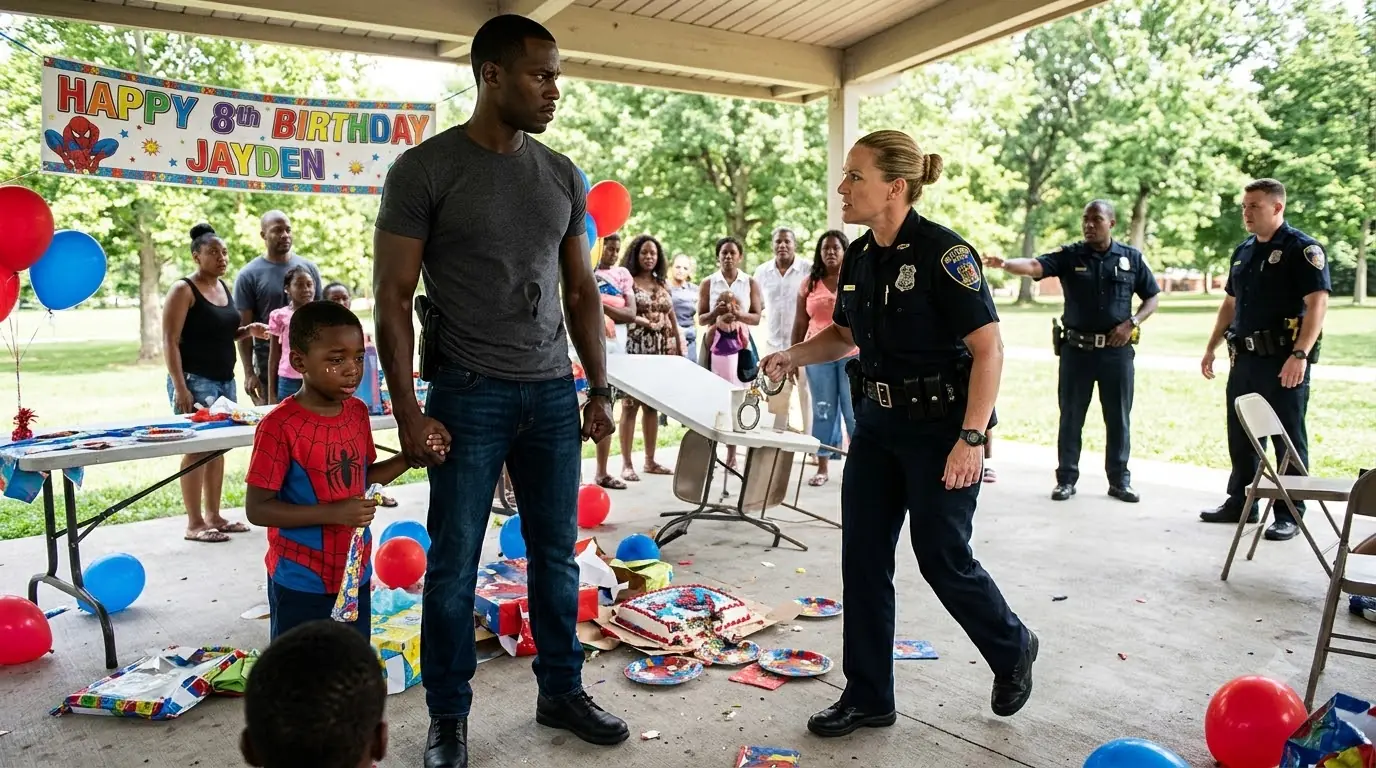
She stomps on gift boxes, crushing toys inside. Look at all this food bought with taxpayer money while hardworking Americans struggle.
Parents scramble to shield their children as Mitchell kicks over chairs and tears down decorations. The beautiful birthday setup becomes a wasteland of destruction in seconds.
She zeros in on a tall black man who was hanging streamers near the pavilion. He turns slowly, his face a mask of controlled fury as he watches his son's special day being destroyed.
You the one responsible for this ghetto circus boy? Time to shut it down and learn your place.
The father stands motionless, his hands trembling as he stares at the ruined party. One phone call will change everything these officers think they know about power.
2 hours earlier, James Thompson had been the picture of a devoted father preparing the perfect birthday celebration. He moved methodically around Druid Hill Park, checking every detail with the precision of someone who understood that memories mattered.
The red and blue streamers hung at exactly the right height. The picnic tables formed a perfect rectangle.
Even the placement of each folding chair seemed calculated for maximum joy.
"Baby, you're being obsessive again,"Maya called from across the pavilion, her voice carrying the gentle teasing of 8 years of marriage. She was arranging gift bags with their son's name written in careful cursive, but her eyes kept drifting to her husband's constant surveillance of their surroundings.
James paused in hanging the happy 8th birthday Marcus banner, his gaze automatically scanning the park's entrance, the treeline, the parking lot. Old habits died hard, especially when those habits had kept him alive for fifteen years in federal law enforcement.
But today wasn't about Agent Thompson. Today was about Dad.
"I just want everything perfect for Marcus,"he replied, adjusting the banner one final time. "He's been talking about this party for weeks."
The community had started arriving an hour ago and James knew each family by name. Eight months of carefully constructed normalcy had built these relationships.
Mrs. Washington from two blocks over whose arthritis flared up in the humidity but who still brought her famous potato salad to every gathering. The Johnson twins whose father worked double shifts at the shipyard just to afford their school supplies.
Young Kesha's grandmother, who made the best cornbread in East Baltimore and never missed a community event despite her failing eyesight.
James had memorized their stories, their struggles, their hopes. It wasn't just good cover for his undercover assignment, tracking Lieutenant Mitchell's corruption network.
These people had become his people. He'd attended their church services, helped fix broken porch steps, and driven elderly neighbors to medical appointments.
Every genuine moment of connection made the deception weigh heavier on his conscience.
Marcus burst from behind a tree where he'd been playing hide-and-seek with his cousins. His Spider-Man shirt already grass-stained from an afternoon of pure eight-year-old joy.
He crashed into his father's legs with the enthusiasm only children possessed, nearly knocking over the cooler full of juice boxes.
"Dad, this is the best birthday ever!"Marcus looked up with eyes that held complete trust in his father's ability to make everything right.
"All my friends are here, and Mom made my favorite cake with the web design, and you even got the Spider-Man decorations I wanted, and Mrs. Johnson brought those cookies that taste like heaven."
James knelt down to his son's eye level, fighting the familiar tightness in his chest that came with leading a double life. Every innocent question Marcus asked about his construction job felt like a small betrayal.
Every time his son introduced him proudly to friends as "my dad who builds important buildings,"James felt the weight of lies he'd have to explain someday.
"You deserve the best birthday, champ. You only turn eight once,"James said, ruffling his son's hair.
"Did you thank Mrs. Johnson for those cookies?"
"Already did, and I helped Grandma Washington set up her folding chair because her hands were hurting today."Marcus beamed with the pride of a child who'd been raised to care about his community.
But even as he spoke, James's trained eye caught movement at the park entrance. His hand instinctively moved to check his concealed badge, a habit so ingrained he barely noticed doing it anymore.
The FBI credentials were tucked safely in his jacket pocket along with a concealed service sidearm and an emergency alert device.
Eight months of surveillance had documented Mitchell's drug conspiracy, her systematic targeting of Black communities, her network of corrupt officers who treated their badges like licenses to terrorize.
"James."Maya's voice carried a warning note.
She'd learned to read his micro-expressions after years of watching him come home from cases that left invisible scars. The subtle shifts in his jaw that meant his agent instincts were kicking in.
The way his shoulders tensed when danger signals fired in his brain.
"Not today. Whatever you're thinking."
"Not today. This is Marcus's day."
He forced himself to relax, to be present in this moment with his family. The surveillance photos on his phone could wait.
Images of Mitchell taking envelopes full of drug money from known dealers. The recorded conversations documenting her racist rants could wait.
Audio of her calling community gatherings breeding grounds for criminals. The federal investigation that had consumed eight months of his life, eight months of pretending to be someone else, could wait.
"You're right,"he said, pulling his wife close and kissing her forehead. Maya smelled like the vanilla perfume she'd worn since their college days, back when life was simpler, and James's biggest worry was passing his criminology finals.
"Today, I'm just Dad."
But even as the words left his mouth, James couldn't shake the feeling that something was wrong. In eight months of living in this community, building relationships, and gathering evidence against Baltimore's most corrupt police unit, he'd developed an almost supernatural sense for danger.
The hair on the back of his neck stood up for no reason he could identify.
Marcus tugged on his father's hand, pulling him toward the group of children who were begging to start the treasure hunt James had planned. He'd hidden Spider-Man stickers and small toys around the pavilion, creating a map that would keep the kids entertained for at least an hour while the adults relaxed and enjoyed each other's company.
As they walked across the grass, James's phone buzzed with a text message. Without thinking, he glanced at the screen and his blood turned to ice.
It was from his FBI handler: Mitchell's unit had just received a dispatch to his location. An anonymous noise complaint had been filed 20 minutes earlier.
This wasn't random. His cover might be blown.
James's training kicked in immediately. He looked around the peaceful birthday celebration.
Children laughing as they searched for hidden treasures. Parents chatting about school events and neighborhood concerns.
His wife lighting candles on their son's chocolate cake decorated with Spider-Man's web pattern.
He realized with crystalline clarity that they'd been set up. Someone in the Baltimore Police Department knew exactly who he was and where to find him.
The question was whether it was Mitchell herself or someone higher up the corruption chain.
His cover might be blown, but his family was here, surrounded by innocent people who trusted him to keep them safe. People who had no idea that the man they'd welcomed into their community was a federal agent whose investigation could send dozens of cops to prison.
The sound of police sirens in the distance made his decision for him. James slipped the phone back into his pocket and walked calmly toward his son, his face betraying nothing of the federal storm about to descend on their perfect afternoon.
"Marcus,"he called, his voice steady despite the chaos building in his chest. "Come here, buddy."
But before he could reach his son, three police cars rounded the corner and entered the park with unmistakable aggressive intent. Lieutenant Sarah Mitchell had arrived to destroy everything they'd built.
Lieutenant Sarah Mitchell stepped out of her patrol car like a predator who'd cornered her prey. Her boots hit the asphalt with deliberate force, each step calculated to announce her authority.
Officers Barnes and Cruz flanked her, their hands resting near their duty belts despite facing a children's birthday party. The three moved across the park with the swagger of people who'd rarely faced consequences for their actions.
"Well, well, well. Look what we have here,"Mitchell announced, her voice carrying across the suddenly quiet pavilion.
Parents instinctively pulled their children closer as the officers approached. "Anonymous complaint about noise violations and illegal gathering."
"Funny how you people always seem to think the rules don't apply."
She surveyed the birthday celebration with theatrical disgust, her lip curling as she took in the decorations, the food, the families who'd been laughing moments before. "This whole setup reeks of welfare fraud."
"Who's paying for all this food? Hardworking taxpayers, I bet."
Mrs. Washington, 73 years old and a retired school teacher who devoted 40 years to educating Baltimore's children, stood up slowly from her folding chair. "Officer, this is just a child's birthday party."
"We have every right to be here."
Mitchell's eyes locked onto the elderly woman with predatory satisfaction. She dismissed her with a degrading remark and ordered her to sit down.
The casual cruelty in her voice made several parents gasp audibly.
James felt his jaw clench involuntarily, but he forced himself to remain motionless near the gift table. Eight months of surveillance had prepared him for Mitchell's racism, but hearing it directed at people he'd grown to care about felt like physical blows.
Officer Barnes moved toward the food tables with obvious intent. "Looks like a health code violation to me, Lieutenant."
"All this uncovered food sitting out in the heat could be dangerous."
"You're absolutely right, Barnes. Public safety hazard."
Mitchell nodded toward the carefully arranged buffet that Maya and the other mothers had spent hours preparing. "Better dispose of it properly."
Barnes swept his arm across the main table, sending potato salad, fried chicken, and homemade sides crashing to the ground in a disgusting mess. Children started crying as their birthday feast became garbage scattered across the concrete.
Maya's beautiful Spider-Man cake, decorated with loving detail the night before, hit the pavement with a wet splat.
"Oops,"Barnes said with a cruel grin. "Accidents happen when you don't follow proper food safety protocols."
Cruz joined in the destruction, flipping over the gift table. Wrapped presents tumbled across the grass, their colorful paper tearing as toys spilled out.
Marcus's new soccer ball rolled toward the parking lot, followed by art supplies and books that had been chosen with careful thought by relatives who could barely afford them.
Mitchell made another contemptuous remark about Section 8 families and their place in society. James stood frozen, watching his son's special day being systematically destroyed.
Every instinct screamed at him to reveal his badge and end the humiliation with federal authority, but his training held him back.
Blowing his cover now could compromise eight months of investigation and potentially let the wider corruption network escape accountability.
Maya appeared at his side, her hand finding his arm. She could feel the tension radiating from his body, the barely controlled rage that came from watching innocent people suffer.
"James,"she whispered urgently. "Don't."
"Think about Marcus."
But Mitchell had noticed James's stillness, his refusal to scatter like the other adults. She approached him with the focused attention of someone looking for resistance.
"You got something to say?"she demanded, stopping inches from his face.
"I noticed you standing there real quiet while everyone else is appropriately concerned about our presence. That makes me suspicious."
James met her eyes without flinching, his voice carefully neutral. "Just trying to give my son a birthday party, officer."
"No trouble intended."
"Your son?"Mitchell's smile turned vicious.
"So, you're the one responsible for this illegal gathering? The one teaching these children that they can ignore authority and do whatever they want?"
She gestured broadly at the destroyed party, the crying children, the adults who were now filming with their phones despite knowing it might make things worse for them later. "Look at this mess."
"Look at what you've caused by thinking you could just take over public property without proper permits."
Cruz had moved behind James, a tactical positioning that wasn't lost on someone with federal training. They were trying to intimidate him and provoke a reaction that would justify escalation.
"We have every right to use this public park,"James replied evenly. "The pavilion was properly reserved through the city."
Mitchell laughed harshly and accused the family of another welfare scam. She pulled out her citation book with theatrical slowness.
"Unlawful assembly. Disturbing the peace."
"Failure to maintain proper food safety standards. Should I keep going, or are you ready to admit this whole thing was a mistake?"
Barnes had found the small cooler where parents kept personal items. He dumped it out roughly, sending purses, car keys, and cell phones spilling across the ground.
"Searching for contraband,"he announced. "These gatherings are always cover for drug activity."
"That's an illegal search without probable cause,"called out Mr. Johnson, a man whose two jobs barely kept his family housed but who'd never missed a community meeting.
Cruz stepped toward Johnson aggressively and threatened to put him in handcuffs in front of his children. The systematic humiliation continued for another ten minutes.
Mitchell's unit moved through the gathered families like an occupying force, demanding identification, questioning legal status, treating American citizens like suspects in their own neighborhood. They made elderly women empty their purses.
They questioned teenage boys about gang affiliations. They implied that Black men present were probably violating parole.
James watched it all with growing fury, his hands clenched at his sides as Mitchell's unit practiced the exact kind of systematic racism he'd been documenting for eight months. But this wasn't surveillance footage or recorded conversations.
This was his community, his family, his son's birthday being destroyed by the very people he was supposed to bring to justice.
The breaking point came when Mitchell turned her attention back to James with renewed interest. "You know what bothers me about you?"
she said, circling him slowly. "You're too calm, too controlled."
"Most people get nervous around real authority, but you're just standing there like you think you're equal to me."
She stopped directly in front of him. "Time to teach you some respect."
Mitchell's predatory smile widened as she studied James's controlled composure. In eight months of terrorizing this community, she'd learned to read fear in people's faces, to spot the exact moment when resistance crumbled into submission.
But this man was different. His stillness felt dangerous rather than defeated, and that infuriated her.
"What's wrong with you?"she demanded, stepping even closer.
"Cat got your tongue? I'm talking to you."
James's training warred with his paternal instincts as he watched Mitchell's cruelty unfold. Every fiber of his being wanted to reveal his federal badge, but the investigation still hung in the balance.
"I'm listening, officer,"he replied carefully, his voice betraying nothing of the storm building inside him.
Mitchell taunted him, calling him a coward in front of his son and gesturing toward the destroyed birthday party. Marcus stood frozen near the ruined cake, chocolate frosting splattered across his Spider-Man shirt, his eight-year-old mind struggling to process why these adults were being so cruel.
Officer Barnes positioned himself behind James while Cruz moved to flank him from the left. The formation was designed to make him feel surrounded and powerless.
"Officer, I'm just trying to give my son a birthday party,"James said, his jaw clenched. "We're not causing any trouble."
Mitchell listed fabricated violations and pulled out her handcuffs, dangling them mockingly in front of James's face. She threatened to teach him respect in lockup.
Maya stepped forward instinctively, her protective instincts overriding her fear. "Please, officers, there's no need for this."
"We'll clean up and leave quietly."
Mitchell turned toward Maya and ordered her to stay out of it, making another degrading remark about the family. "Leave my wife alone,"James said quietly, and something in his tone made Barnes's posture change.
Mitchell stepped back toward James, trying to provoke him. She looked around the pavilion at the gathered families, ensuring she had the maximum audience for what came next.
"Everyone, watch this. This is what happens when people forget their place in society."
Mitchell grabbed James by the shoulder and forced him downward. James calculated the situation, but the father in him felt the eyes of his eight-year-old son watching this humiliation unfold.
He knelt slowly, his hands trembling with rage rather than fear.
"That's better,"Mitchell announced triumphantly. "This is the natural order."
"Authority on top, criminals on their knees."
She began a rough pat-down. When she reached his jacket pocket, her fingers found the leather case containing his FBI badge and credentials.
"Well, well, what do we have here?"She pulled out the badge case with exaggerated curiosity.
James's heart stopped. Eight months of carefully maintained cover was about to evaporate.
Mitchell opened the case, glanced at the gold FBI shield, and laughed dismissively. She announced to her officers that it was fake and tossed the badge case into the dirt next to the destroyed birthday cake.
The genuine federal credentials landed in chocolate frosting and grass stains.
Barnes and Cruz joined in her laughter. Cruz suggested mockingly that they should call the real FBI to report someone impersonating a federal agent.
Mitchell ground her heel into the badge case, pressing James's authentic federal credentials deeper into the dirt, and continued insulting him in front of his family.
Marcus had been watching this entire exchange with growing distress. His father, the strongest man in his world, was being forced to kneel in the dirt while strangers mocked and humiliated him.
The eight-year-old couldn't understand the complexities of undercover work or federal investigations. He only knew that bad people were hurting his daddy.
"Leave my daddy alone!"Marcus suddenly shouted, running toward the group of officers.
Maya caught him before he could reach them, wrapping her arms around her son as he struggled to break free. "Marcus, no!"
"Stay with Mommy!"
Mitchell threatened the child with foster care and claimed he needed to learn respect for authority.
"Don't you dare threaten my child,"James said from his kneeling position, and this time there was no hiding the steel in his voice.
Mitchell pulled out her radio and requested child services for a supposed welfare check, falsely describing the parents as neglectful and unsafe. The lie was so casual and practiced that James realized this was routine for her.
Maya protested that they hadn't done anything wrong. Mitchell replied with absolute confidence that she could do whatever she wanted and requested backup for multiple arrests on fabricated charges.
James remained on his knees in the dirt, his genuine FBI badge ground into the earth beside him, his son crying in his wife's arms, his community watching in horrified silence. The corrupt lieutenant who'd spent eight months destroying innocent lives had no idea she was about to face the full weight of federal justice.
But not yet. Not until his family was safe and these good people were protected from retaliation.
For now, James Thompson knelt in the dirt and let Sarah Mitchell believe she held all the power.
The sound of additional sirens filled the air as Mitchell's backup arrived. Two more patrol cars pulled into the park, and officers approached the pavilion with the casual confidence of people who had never faced real accountability.
"Shut this whole thing down,"Mitchell commanded. "Illegal assembly, health violations, disturbing the peace."
"I want every adult identified and processed."
The officers tore down more decorations and kicked over chairs. Mrs. Washington continued to object with dignity, insisting they had a legal right to gather in a public space.
Mitchell ordered the elderly woman to stand despite her arthritis. Maya pleaded with her to stop, explaining that Mrs. Washington could barely stand without help.
Mitchell shouted the order again.
Mrs. Washington struggled to her feet, refusing to be broken despite obvious pain. She stood straight-backed and proud, meeting Mitchell's glare without flinching.
One officer found Marcus's new bicycle, a surprise gift that James and Maya had saved for months to afford, and kicked it hard enough to bend the front wheel.
James watched from his kneeling position as his son's birthday dreams were systematically destroyed. The surveillance evidence on his phone documented Mitchell taking drug money, racist conduct, and a wider corruption network.
But none of that mattered while she terrorized his family and community.
Mitchell returned to James, accusing him of failing to show proper remorse. Barnes and Cruz continued threatening the family, suggesting prison time and removal of Marcus from his parents.
Maya begged them to let everyone clean up and go home. Mitchell refused, saying the whole community needed to see what happened to people who challenged her authority.
She grabbed James roughly by the arm, hauled him to his feet, and shoved him down again. His knees hit the concrete hard enough to tear his jeans, but his face remained impassive.
Maya recognized the dangerous stillness in her husband. "James,"she said urgently.
"Don't. Think about Marcus."
"Think about the consequences."
But Mitchell escalated beyond humiliation. She grabbed Marcus roughly by the arm, pulling the eight-year-old away from his mother despite his frightened crying.
She announced that child services would teach him respect.
Marcus struggled against her grip, tears streaming down his face as he looked desperately toward his father. "Daddy, help me."
"Make her let go."
The sound of his son's terrified voice shattered the last of James's restraint. Federal protocols, undercover operational security, eight months of careful investigation, all of it became secondary to protecting his child.
James rose from his kneeling position with controlled precision. The mild-mannered community member disappeared, replaced by someone whose presence radiated authority.
"Take your hands off my son,"he said quietly, his voice carrying the tone of someone accustomed to being obeyed.
Mitchell's cruel smile faltered slightly, but her grip on Marcus tightened. "What did you just say to me?"
"I said take your hands off my son. Right now."
Mitchell tried to provoke him into an assault. James reached into his jacket pocket with deliberate calm.
Instead of drawing a weapon, he withdrew his cell phone.
"No,"he said, maintaining eye contact with Mitchell while placing a call. "I'm going to make a phone call."
Mitchell mocked him, asking whether he was calling a lawyer or a civil-rights organization.
The phone connected after one ring. "This is Special Agent James Thompson,"he said clearly, his voice carrying across the suddenly silent pavilion.
"My cover has been compromised at Druid Hill Park, Baltimore. My family is under threat from officers involved in the corruption investigation."
"I need immediate federal response."
The effect was instantaneous. Mitchell's grip on Marcus loosened as confusion and disbelief moved across her face.
Barnes and Cruz exchanged uncertain glances, their predatory confidence evaporating.
James continued into the phone, explaining that the federal investigation into Lieutenant Sarah Mitchell's narcotics and civil-rights conspiracy had been ongoing for eight months and that he had documented evidence of corruption.
Mitchell's face cycled through disbelief, rage, and the first flicker of genuine fear. "You're lying,"she said, but her voice lacked conviction.
James pocketed his phone and bent down to retrieve his FBI credentials from the dirt. He wiped chocolate frosting from the gold shield and held it up for everyone to see.
"Eight months,"he said. "Eight months of watching you terrorize innocent families."
"Eight months of documenting your crimes. Eight months of waiting for enough evidence to dismantle this unit."
The sound of approaching federal aircraft and vehicles made Mitchell's face go pale. James told her to release his son and step away from his family.
But Mitchell, desperate and cornered, made one final catastrophic mistake. Instead of releasing Marcus, she pulled the terrified child closer and moved her hand toward her duty weapon.
"Nobody's going anywhere until I figure out what's really happening here,"she snarled.
James's voice turned absolute. "Lieutenant Sarah Mitchell, you are under arrest."
The federal response arrived moments later. Mitchell's face drained of color as she looked around at the agents entering the park and realized James had been telling the truth.
Gone was the submissive community member who'd knelt in the dirt. In his place stood a federal agent with fifteen years of experience bringing down corrupt officials.
James identified Mitchell and referenced the investigation's evidence: recorded conversations, financial records, and documented relationships with drug dealers. He deliberately avoided discussing operational specifics in front of the crowd.
Barnes and Cruz went silent. Their earlier bravado was replaced by the dawning realization that they'd just destroyed a federal agent's son's birthday party while dozens of witnesses recorded everything.
"Sir,"Barnes said tentatively, his voice small and uncertain. "We didn't know."
"We were just following orders."
James replied that the same excuse had been used for months of systematic abuse against people who couldn't fight back.
Agent Sarah Carter, James's handler, approached with a federal team and formally identified him as Special Agent Thompson. She requested a status report.
"Lieutenant Mitchell and her unit just committed multiple federal crimes in front of approximately thirty witnesses,"James replied, his voice carrying the calm professionalism of someone delivering a case summary. "Civil-rights violations, intimidation, destruction of property, and threats against a minor."
"Multiple witnesses recorded the incident."
Mitchell finally released Marcus completely. The terrified child ran to his mother's arms as federal agents surrounded the corrupt officers.
"This is impossible,"Mitchell whispered. "You can't be FBI."
"You live here. You work construction."
"I've seen you at community meetings."
James held up his credentials. "Special Agent James Thompson, Federal Bureau of Investigation, public-corruption unit."
"I was assigned to investigate systematic civil-rights violations and corruption within the Baltimore Police Department."
Agent Carter informed Mitchell that she was under arrest for federal civil-rights violations, corruption-related conspiracy, extortion, and intimidation connected to an ongoing federal investigation.
Mitchell claimed entrapment. James explained that undercover operations are lawful when investigating ongoing criminal conspiracies and that the case rested on a wide body of independently gathered evidence.
Barnes tried to step back and immediately offered to cooperate. Agent Carter informed him that he was also under arrest and would have the opportunity to cooperate through counsel.
Cruz stared at James's badge, finally understanding that the credentials they had mocked and thrown into the dirt were genuine.
The arrest process was swift. Federal agents read Miranda rights while community members continued recording.
The officers who had spent years intimidating families were now facing public accountability themselves.
Mitchell's last act of defiance was to spit on the ground near James's feet and insist that one arrest wouldn't change anything because the whole system protected officers like her.
James looked down at her and said this wasn't one arrest. The investigation had documented a much larger network, and coordinated arrests were already underway across the city.
As federal agents led Mitchell and members of her unit away in handcuffs, the destroyed birthday party fell into absolute silence. Community members who'd been terrorized by these officers for years watched their tormentors face justice at last.
Marcus tugged on his father's hand, looking up with eight-year-old confusion. "Daddy, are you really a policeman?"
James knelt down to his son's level, finally able to be completely honest. "I'm an FBI agent, buddy."
"And my job is to catch bad officers who hurt good people."
Within fifteen minutes of Mitchell's arrest, the first video appeared on social media. Mrs. Washington's granddaughter had been live-streaming the birthday party when the police arrived, and her phone had captured the escalating abuse followed by the federal intervention.
The video spread rapidly. Clips of Mitchell destroying the cake, forcing James to his knees, threatening Marcus, and then realizing James was federal law enforcement circulated across platforms.
Maya sat in the back of an FBI vehicle with Marcus, watching her phone screen as notification numbers climbed. The story was going viral.
The edited videos were brutal in their efficiency. The internet seized on the reversal, but James watched the explosion with mixed feelings.
His family's trauma was becoming content, their pain transformed into political ammunition for people who had never met them.
Opposing narratives appeared within hours. Some users celebrated accountability.
Others accused the FBI of entrapment and federal overreach. Carefully edited clips removed the earlier harassment and showed only the arrests.
More footage emerged from nearby security cameras, including a local barbershop system that had captured the incident from start to finish. The owner released it with a simple caption: "This is what we deal with every day."
Community members who'd suffered under Mitchell's unit for years began sharing their own stories with documents, photographs, old complaints, and video evidence. The birthday party incident opened a floodgate.
Anonymous leaks from inside the Baltimore Police Department revealed Mitchell's personnel file, previous complaints involving excessive force and racial profiling, and financial records showing luxury purchases far beyond her official salary.
The Baltimore Police Union held an emergency press conference and initially defended the officers as having responded to a legitimate noise complaint. When reporters played the footage showing the destroyed party and discriminatory remarks, the union president was forced to retreat from that position.
The FBI released a measured statement saying Agent Thompson's eight-month investigation had resulted in charges against dozens of Baltimore officers for civil-rights violations, corruption, and drug-trafficking conspiracy. The birthday party incident was only one piece of a much larger case.
International and national media picked up the story. The image of a federal agent kneeling in dirt while corrupt officers mocked his credentials became a symbol of institutional failure, but James remained focused on the human center of the case: an eight-year-old boy whose birthday had been destroyed and a community that had lived under fear for years.
Maya watched the digital storm from an FBI safe location where the family had been moved temporarily. "People are calling you the birthday party FBI agent,"she said, showing James her phone.
"Someone made a meme out of your arrest speech."
"I never wanted to be famous,"James said quietly, watching Marcus play nearby. "I just wanted to catch the bad guys and go home to my family."
"Looks like you did more than that,"Maya replied, scrolling through messages from community members expressing support and gratitude. "You gave people hope."
Three days after the viral arrest, FBI Special Agent Sarah Carter stood before the largest evidence board she'd ever assembled. The conference room at the Baltimore FBI field office was covered with photographs, financial documents, audio transcripts, and surveillance material from eight months of James Thompson's undercover work.
"Thirty-four officers,"Carter announced to the assembled federal prosecutors, civil-rights attorneys, and Justice Department officials. "Thirty-four sworn law-enforcement officers participating in what can only be described as an organized criminal enterprise operating under color of law."
She displayed Lieutenant Sarah Mitchell's financial analysis. Mitchell alone had received more than $200,000 in illicit proceeds over three years, but she wasn't at the top of the pyramid.
She was middle management in a corruption network that reached into senior leadership.
James's technical-support team summarized recorded conversations from community meetings, barbecues, church services, and informal gatherings. The recordings captured officers speaking freely about their contempt for the communities they were sworn to protect and their strategy of disrupting positive gatherings.
One recording from a community cookout captured Mitchell discussing the need to shut down gatherings before residents could organize politically. Carter explained that Agent Thompson had attended the event as a supportive neighbor while documenting the systematic planning behind the harassment.
US Attorney Patricia Williams leaned forward. "What's the scope of community targeting?"
"How many events were disrupted?"
The team had documented forty-seven incidents in eight months: birthday parties, graduation celebrations, church fundraisers, youth-sports events, and other gatherings. The pattern showed deliberate targeting of events that built social cohesion.
Another recording revealed Deputy Chief Robert Morrison discussing how to make incidents look justified on paper and how to use legal costs and court processing to punish residents who resisted.
The room went quiet. This was not rogue policing by a few individuals.
It was an organized system of intimidation.
Financial analysts showed that corrupt proceeds had been routed through union-linked accounts, political committees, and businesses connected to officers. Campaign contributions tied to illicit money had reached local judges and prosecutors.
Justice Department attorney Michael Chang asked whether the network was effectively buying favorable treatment throughout the justice system. The answer was yes: the evidence suggested that people who complained about police misconduct were often met with hostile prosecutors, skeptical judges, and financial pressure.
Surveillance photographs showed Mitchell and other officers meeting with known drug dealers, exchanging envelopes, and coordinating protection arrangements. The officers were not merely taking bribes.
They were active partners who used police authority to protect preferred dealers and target competitors.
Internal police communications showed another disturbing practice: officers maintained informal lists of community organizers, church leaders, parent activists, and others considered likely to mobilize resistance. Those people were subjected to increased stops, false arrests, and intimidation.
James Thompson's name appeared on one of those lists. The notation was dated six months before the birthday party incident, proving that people inside the department had suspected he might be federal law enforcement long before his cover was formally blown.
Carter explained that the birthday party had not been random. Mitchell's unit had escalated harassment to force James either to expose himself or to submit like other residents they had targeted.
US Attorney Williams recognized the pattern immediately. "This is racketeering territory."
"We're looking at an ongoing criminal enterprise using police powers to facilitate corruption while terrorizing communities that might resist."
The investigation also found connections to similar operations in three surrounding Maryland jurisdictions. The model of corruption was spreading through informal training and shared tactics.
James entered the conference room after days of debriefings. His eight-month performance had been so convincing that some community members initially refused to believe he was a federal agent, insisting that he was simply the construction worker they knew from church and neighborhood events.
"The personal cost has been significant,"he told the assembled officials. "My son asks why I lied to him about my job."
"My neighbors feel betrayed that I was secretly gathering evidence. People who trusted me with their deepest fears now wonder whether every conversation was part of the case."
Carter added that many community leaders had also called to thank him. James played a voicemail from Mrs. Washington.
"James, every Sunday you sat in our church, every time you fixed my porch steps, every conversation we had about keeping our children safe, all of that was real. The job was undercover, but the man was real, and that man is a hero to this community."
The message left the room silent for a moment. The human cost of undercover work was no longer abstract.
The evidence package contained thousands of hours of recordings, thousands of photographs, financial records for dozens of officers, and testimony from community members who had agreed to speak. Most importantly, the evidence showed pattern and practice rather than isolated misconduct.
One recording captured Mitchell saying that positive community gatherings should be disrupted before residents became politically organized. Justice Department attorneys recognized it as direct evidence of a civil-rights conspiracy.
Financial evidence showed millions of dollars in illicit proceeds over five years, distributed through a money-laundering structure involving union accounts, political action committees, and businesses connected to officers' families.
The scope of community damage was equally staggering: dozens of disrupted events, false arrests of community leaders, and hundreds of thousands of dollars in legal costs imposed on families fighting wrongful arrests.
James spoke quietly near the evidence boards. "Every conversation I recorded, every photograph I took, every financial transaction I documented, it all happened because these officers believed they were untouchable."
"They thought their badges made them immune to consequences."
Carter noted that internal affairs had dismissed most complaints against the officers and that institutional protection had allowed the corruption to continue for years.
US Attorney Williams stood and addressed the room. "This investigation is exactly why federal civil-rights enforcement exists."
"When local systems are too compromised to police themselves, federal intervention becomes necessary to protect constitutional rights."
As the briefing concluded, agents prepared warrants and coordinated arrests of additional suspects. The birthday party incident had exposed the public face of the investigation, but the prosecution would now depend on the months of evidence James had gathered before that day.
"Agent Thompson,"Williams called as he prepared to leave. "Your sacrifice, and your family's sacrifice, is going to save lives and restore rights for thousands of people."
James looked back at the evidence boards. "That birthday party was supposed to be the end of my investigation."
"Turns out it was just the beginning of justice."
Six weeks after the birthday party arrest, federal prosecutors had assembled a sweeping corruption case. The grand jury room at the Baltimore federal courthouse filled with witnesses prepared to testify against officers who had terrorized their communities for years.
One of the most important witnesses was Officer Luis Rodriguez, a fifteen-year Baltimore police veteran who had finally decided to break his silence. Rodriguez sat across from US Attorney Patricia Williams in a secure interview room, his hands shaking as he opened a folder containing evidence he had collected secretly for two years.
His police career was over. His family had received threats from other officers.
But his conscience could no longer bear the weight of complicity.
"I couldn't watch what happened to that family,"Rodriguez began. "That little boy was crying over his birthday cake while Mitchell laughed about it."
"That federal agent was forced to kneel in the dirt while she degraded him. I've got kids the same age."
Rodriguez explained that he had begun recording internal conversations after members of Mitchell's unit assaulted his nephew during a traffic stop. His nephew worked as a respiratory therapist and had simply been driving home from the hospital.
The first audio file captured Mitchell and Deputy Chief Morrison discussing community-policing strategies in openly coercive terms. They spoke about breaking residents' confidence, disrupting gatherings, and using fear to keep neighborhoods from organizing.
Williams asked how long the tactics had been used. Rodriguez said he could document at least eight years and had heard veteran officers say the pattern went back even further.
The recordings showed that Mitchell's unit had developed a playbook for disrupting community events while maintaining plausible legal cover. They monitored public posts for upcoming gatherings, used anonymous complaints to create a reason for police presence, and coordinated responses through sympathetic dispatch staff.
"They called it community management,"Rodriguez explained. "Birthday parties, block parties, church fundraisers, anything that brought people together in a positive way became a target."
One recording captured Mitchell training newer officers. She explained that the goal was often not arrest but humiliation: make parents feel powerless in front of their children, make families fear gatherings, and weaken social structures that might challenge police authority.
Williams leaned forward. "They were systematically destroying community cohesion as unofficial policy."
"Unofficial, but systematic,"Rodriguez confirmed. "Nothing went in writing, but every officer in the unit knew the real mission."
"We weren't protecting and serving. We were controlling."
Rodriguez had also photographed financial records and meetings between officers and drug dealers. His evidence showed that corruption proceeds were distributed in a way that encouraged loyalty while protecting supervisors from obvious paper trails.
He said Mitchell reported to Deputy Chief Morrison, and that Morrison appeared to have support from people above him. Rodriguez had heard references to political protection but had not personally recorded every level of the chain.
He also kept a list of more than two hundred community events disrupted by Mitchell's unit over five years. Birthday parties, graduation celebrations, church fundraisers, youth sports leagues, and other positive gatherings had all been systematically targeted.
Mitchell even kept informal performance notes on how many events her unit disrupted. Rodriguez described her as proud of the numbers.
The most damaging evidence involved targeting specific community leaders. Recordings showed officers discussing ministers, school-board members, and activists who might organize resistance, then planning harassment designed to destroy their credibility or exhaust them financially.
James Thompson had been identified as a potential threat six months before his cover was blown. Rodriguez said his community involvement, intelligence, and refusal to be intimidated had made senior officers suspicious.
They suspected he might be federal law enforcement, but they were not certain which agency or what he was investigating. The birthday party became a deliberate test.
Rodriguez explained that the plan was to humiliate James in front of his family, then use fabricated charges as leverage. The scheme failed because James had already built a federal case far stronger than they imagined.
Williams reviewed Rodriguez's evidence with growing appreciation. Audio recordings, financial documents, internal communications, witness statements, and photographs created a prosecutor's dream case.
"Officer Rodriguez, why are you coming forward now? Why risk everything?"
Rodriguez's eyes filled with tears. "Because I watched Agent Thompson take all that abuse to protect his investigation."
"If he could sacrifice eight months of his life for justice, I could sacrifice my career."
Community reaction to Rodriguez's cooperation was mixed. Some residents viewed him as complicit in years of abuse and believed he had waited too long.
Others understood that his testimony could be essential to securing convictions and exposing higher-ranking participants.
"Healing requires truth,"Rodriguez said. "Complete truth about how systematic this was, how high it reached, and how long it lasted."
"People need to understand this wasn't just bad cops. It was an institution that tolerated them."
Williams presented Rodriguez's evidence to the federal grand jury the following week. Twenty-three citizens listened to hours of recorded conversations, reviewed thousands of documents, and heard testimony from dozens of community members.
The grand jury returned a sweeping set of indictments against officers, judges, prosecutors, and civilians tied to the corruption and money-laundering network. The charges included civil-rights violations, racketeering, drug trafficking, and obstruction of justice.
The evidence also provided a roadmap for reform. It documented the institutional protection that enabled abuse, the political connections that sustained it, and the methods used to suppress complaints.
Marcus Thompson, now nine years old by the time of later proceedings, asked to testify. Prosecutors were cautious about involving a child, but his parents supported his desire to describe what he had seen.
"The bad officer made my daddy kneel in the dirt on my birthday,"Marcus told the grand jurors. "But my daddy was really a good agent all along, and he was protecting everyone."
His simple testimony reminded the grand jury why the case mattered. The issue was not abstract policy.
It was what happened when government power entered a child's birthday party and was used as a weapon.
Community leaders organized vigils outside the courthouse during the proceedings. Mrs. Washington, recovering from surgery, attended in a wheelchair holding a sign that read, "Justice for all God's children."
"Agent Thompson lived in our community for eight months,"she told reporters. "He ate at our tables, played with our children, and listened to our fears."
"He stayed long enough to build a case strong enough to change everything."
The evidence package eventually filled dozens of file boxes. Audio recordings, surveillance photographs, financial records, internal communications, and witness statements combined into an overwhelming portrait of systematic corruption.
Deputy Chief Morrison resigned the day before his scheduled grand-jury appearance, citing health concerns. He made no mention of the federal charges he faced or the communities he had helped terrorize.
Mitchell remained defiant even as evidence mounted. Her attorney argued selective prosecution and federal overreach, but the motions were rejected because the civil-rights and corruption evidence was extensive.
Rodriguez's cooperation encouraged more officers and civilians to come forward. People who had once been too frightened to speak began providing documents and testimony.
What began with a destroyed birthday party had revealed institutional corruption that had poisoned law enforcement relationships in Baltimore for years. Justice was no longer only a hope.
It had become a formal process backed by evidence.
Three months after the viral birthday party arrest, US Attorney Patricia Williams stood before a packed federal courtroom and announced the results of the sweeping prosecution. Outside, community members filled the plaza holding signs demanding accountability for years of abuse.
"Today marks a reckoning,"Williams began. "Dozens of defendants, including police officers and other public officials, have pleaded guilty or been convicted of crimes ranging from civil-rights violations to racketeering conspiracy."
Lieutenant Sarah Mitchell sat at the defendant's table in jail clothing, her arrogant swagger gone. The woman who had spent years terrorizing families now faced a lengthy federal sentence.
Judge Katherine Martinez reviewed the sentencing documents carefully. At sixty-two, she had seen many misconduct cases, but the systematic nature of this conspiracy disturbed even her.
"Sarah Mitchell,"Judge Martinez began, "you have been convicted of conspiracy to violate civil rights, racketeering, drug-trafficking conspiracy, and obstruction of justice. Before I pronounce sentence, you need to understand exactly what you did to this community."
The judge gestured toward the gallery where victims sat with their families. Marcus Thompson sat between his parents in the front row, wearing his best suit and holding a drawing of FBI helicopters and birthday cake.
"You terrorized a federal agent and traumatized his eight-year-old son on what should have been one of the happiest days of his young life,"the judge continued. "But that was only one day in a campaign that lasted years."
James Thompson stood when invited to give his victim-impact statement. Months of undercover work, debriefings, testimony, and depositions had taken their toll, but his voice was strong.
"Lieutenant Mitchell, you called my son's birthday party a degrading name. You forced me to my knees in front of my child."
"You threw my federal credentials into the dirt and laughed about it."
He paused, looking directly at Mitchell, who refused to meet his eyes. "But the worst part wasn't what you did to my family."
"The worst part was realizing you'd been doing versions of this to innocent families for years, families who had no federal badge to protect them."
James continued. "You asked me what kind of man I was."
"I'm the kind of man who spent eight months living in a community, building genuine relationships, and protecting people I'd grown to love while documenting your crimes."
He turned toward the judge. "She used her badge as a weapon against people she was sworn to protect and turned public service into personal profit."
Mrs. Washington, now using a walker but determined to be present, struggled to her feet when called. She described how Mitchell's unit had destroyed another family celebration and humiliated her grandson after his acceptance to medical school.
"You tried to break our spirits,"she said, pointing toward Mitchell. "You tried to make us afraid to celebrate our children's achievements."
"But we're still here, our children are still succeeding, and your reign is over."
Victim-impact statements continued for hours: parents whose children's birthday parties had been destroyed, church leaders whose fundraisers had been disrupted, teenagers falsely arrested, and small-business owners pressured by corrupt officers.
Maya Thompson spoke about the personal cost of her husband's undercover work. She described watching him carry the weight of a double life and watching their son process the trauma of seeing his father humiliated by people who were supposed to protect them.
Marcus also insisted on speaking. "The bad policewoman ruined my birthday party,"he said simply.
"She made my daddy kneel down and scared my friends. But my daddy was really protecting everybody."
"I'm proud of him for being brave."
Mitchell's attorney argued for leniency, claiming department culture and orders from superiors had shaped her conduct. Judge Martinez rejected the argument.
"These crimes were not momentary lapses in judgment,"the judge said. "They were systematic violations of constitutional rights, planned and repeated over years."
The judge cited audio recordings, financial records, and witness testimony showing that Mitchell had taken personal satisfaction in humiliating families while profiting from corruption.
Sarah Mitchell received a lengthy federal prison sentence, a permanent ban from law enforcement, and substantial restitution obligations. Barnes, Cruz, Morrison, and other participants received significant prison terms as well, depending on their conduct and level of cooperation.
The institutional reckoning extended beyond individual prosecutions. Federal oversight was imposed on the Baltimore Police Department, including civilian review, independent monitoring, and reforms to complaint investigation and officer accountability.
Outside the courthouse, community leaders organized a celebration. Mrs. Washington called it Marcus's real birthday party, the celebration that should have happened months earlier before corrupt officers destroyed it.
The menu deliberately echoed the original party: potato salad, fried chicken, and a Spider-Man cake like the one Mitchell had knocked to the ground. This time, families celebrated without fear.
James Thompson accepted a new federal role focused on community relations and rebuilding trust. His remarks centered on prevention rather than revenge.
"Mitchell and her conspirators believed their badges made them untouchable,"he told the crowd. "Today proves that no one is above the law and that constitutional rights must be protected when local systems fail."
Maya announced the creation of the Marcus Thompson Community Justice Foundation, funded in part through restitution and donations. The foundation would provide legal assistance to families facing police misconduct and support community organizing in neighborhoods that had been targeted.
"My family paid a price for justice,"Maya said. "But we paid that price so other families wouldn't have to suffer what we suffered."
Marcus spoke with remarkable composure for a nine-year-old. "The bad police thought they could scare us."
"But good can win when people are brave enough to do what's right."
Media coverage of the sentencing was extensive. Commentators debated federal oversight, police accountability, and the consequences of allowing local systems to ignore patterns of abuse.
A year later, Druid Hill Park hosted the first annual Justice Day celebration, centered on the positive community gathering Mitchell's unit had once tried to destroy.
Mitchell began serving her sentence in federal prison. The corruption network that had poisoned policing relationships for years was finally dismantled, though rebuilding trust would take much longer.
Two years after Mitchell was led away in handcuffs, Druid Hill Park buzzed with the same joyful energy that had filled it on Marcus Thompson's eighth birthday. But everything had changed.
The pavilion now bore a bronze plaque reading Thompson Community Justice Park, and police officers present wore genuine smiles as they helped children with face painting and balloon animals.
Marcus, now ten years old, stood at a podium addressing a crowd of families gathered for the second annual Justice Day celebration. His voice carried the confidence of a child who understood that what happened to him had helped change an entire city's conversation about policing.
"Two years ago, bad police came to my birthday party and tried to scare my family,"he began. "They didn't know my daddy was really an FBI agent working to protect everyone."
"They thought they could be mean to people and never get in trouble."
He looked out at former victims, community leaders, federal officials, and police officers who had embraced reform. "But good people fought back, and now kids can have birthday parties without being afraid."
"Now police officers help with celebrations instead of ruining them. My daddy says that's what justice looks like when everyone works together."
The crowd applauded as Marcus cut the ribbon on a new community center bearing his name. The Marcus Thompson Community Justice Center would provide legal assistance, police-accountability education, and conflict-resolution services across Baltimore.
James, now serving in a federal community-relations leadership role, watched his son with pride. Marcus had chosen to speak about what happened despite his youth and had endured media attention with remarkable grace.
"Every day I'm reminded why this work matters,"James told the crowd. "Two years ago, my family experienced the worst of what policing can become when officers forget they serve the community."
"Today we're celebrating the best of what law enforcement can be when accountability and partnership guide our actions."
The Baltimore Police Department had changed substantially under federal oversight. Body-camera rules were tightened, civilian oversight gained real authority, complaint processes became more transparent, and community-policing programs required officers to build relationships rather than simply respond during conflict.
Officer Jennifer Martinez, a rookie who had graduated from the reformed academy, worked the celebration with obvious comfort among residents. She had grown up in East Baltimore and chosen law enforcement specifically to help repair the damage caused by years of abusive policing.
"The old department saw community gatherings as threats to be controlled,"she explained to teenagers considering law-enforcement careers. "The new department sees them as opportunities to build relationships and earn trust."
"We're part of these neighborhoods, not above them."
Maya had turned her experience into a full-time career advocating for systemic change. The Marcus Thompson Community Justice Foundation had helped hundreds of families navigate complaints, find legal resources, and understand their rights.
"Healing doesn't happen automatically after bad people are arrested,"Maya told supporters at a fundraising table surrounded by children's artwork. "Communities need resources and ongoing advocacy to make sure reform changes daily life."
One of the foundation's programs paired families who had experienced police harassment with officers committed to rebuilding trust through regular community engagement.
Rodriguez, whose testimony had been crucial to the prosecution, spent much of his free time coaching youth basketball and attending community meetings. "I spent fifteen years being part of the problem,"he told parents.
"Now I'm spending whatever time I have left trying to be part of the solution."
Mrs. Washington, now seventy-six but still sharp and determined, became an unofficial grandmother to children whose families had been affected by police misconduct. She spent afternoons at the community center helping with homework and teaching civil-rights history.
"This celebration reminds me of the freedom schools we ran in Mississippi during the 1960s,"she told visitors. "Back then, we were fighting for the right to vote and attend integrated schools."
"Today, we're fighting for children to live and celebrate without harassment from people who are supposed to protect them."
The community-center display included photographs from Marcus's original birthday party, documentation from the federal investigation, and children's artwork imagining positive relationships between police and families.
Justice Department officials brought delegations from other cities to observe the reforms. They stressed that sustainable change required community engagement, independent accountability, and ongoing enforcement of constitutional standards.
Complaints against officers dropped sharply after the reforms, community trust increased, and documented positive interactions between officers and residents rose significantly.
Marcus became something of a celebrity among classmates, but his parents worked hard to protect his normal childhood. He still played soccer, struggled with math homework, and complained about cleaning his room.
"Sometimes kids at school call me the FBI boy,"he told his father during a quiet moment at the celebration. "They think it's cool that you caught bad guys, but I just want them to know I'm regular, too."
James knelt down to his son's level. "Being regular and being special aren't opposites, buddy."
"You helped make things better for lots of families. That's special."
"But you're also just Marcus, who likes Spider-Man and hates Brussels sprouts. That's regular."
As Justice Day wound down, families cleaned up together. This time, police officers helped load tables and sweep trash, working beside residents they knew by name rather than treating them as potential threats.
The bronze plaque commemorating the park included a line from Marcus's grand-jury testimony: "Good always wins when people are brave enough to do what's right."
Below it, someone had placed fresh flowers and a child's drawing of a birthday cake shared between police officers and families.
Mitchell remained in federal prison, still serving the sentence imposed for her role in the corruption conspiracy. Her absence had created space for healing, accountability, and genuine public service.
As the Thompson family drove home from the celebration, Marcus fell asleep in the back seat wearing his Justice Day T-shirt and clutching a balloon shaped like an FBI shield.
Through the car window, James could see community members and police officers working together to secure the park for another night. Justice wasn't an abstract concept anymore.
It was children playing safely while officers who had earned trust helped protect the community.
The birthday party had been restored, multiplied, and transformed into something larger than any one family's celebration. Hope lived there now, growing stronger every day.