“Where’d you steal that uniform, boy?”
Sergeant Garrett Caldwell’s voice echoed through Riverside Police Station, California, in May 2025 at 8:50 in the morning.
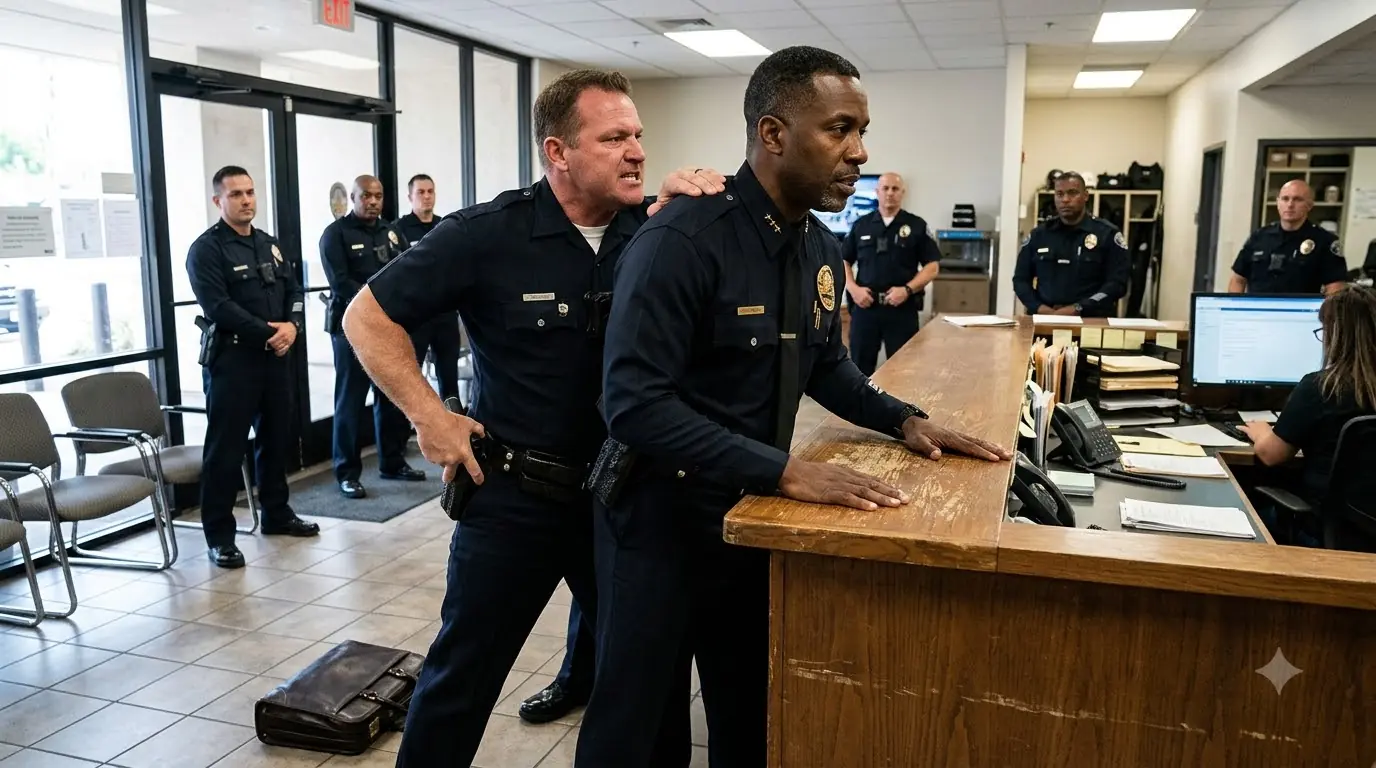
A man in full police blues stood at the front desk, badge clipped to his chest, uniform pressed, posture confident, everything official.
Too official.
“You think putting on our clothes makes you a cop?” Caldwell walked closer. “You think you can just walk in here wearing our uniform?”
The man turned. “I need to…”
“Get on the ground!”
Caldwell charged, grabbed his collar, yanked him backward, and forced him chest-first against the reception desk. “Stolen valor. Impersonating an officer. You’re going to jail.”
Steel handcuffs snapped around the man’s wrists. His face was pressed against the wood, his uniform crumpled, while thirteen officers watched from across the lobby.
Nobody intervened.
Eight minutes.
That was how long Isaac Norton stayed against that desk, face down, hands cuffed behind his back, his badge pressed painfully against his ribs. Caldwell stood over him.
“Don’t move. Backup’s coming.”
Isaac didn’t move or speak. His breathing stayed controlled even as his wrists began to go numb.
Twenty years as a cop had taught him that compliance bought time. Resistance could make a dangerous situation far worse.
Around him, the station continued as if nothing unusual had happened. Phones rang, keyboards clicked, and someone laughed at a joke in the break room.
An officer walked past carrying coffee, glanced down at Isaac, and kept walking. Not one person asked Caldwell what was happening.
Not one person checked Isaac’s badge. Not one person looked at a man in uniform and thought that perhaps they should ask questions first.
Eight minutes felt like eighty.
Six hours earlier, Isaac Norton had stood in his bathroom straightening his tie. He was forty-three years old, with twenty years in law enforcement, and that day was supposed to be different.
Today, he wasn’t just a cop.
He was the boss.
His son Jordan appeared in the doorway. Sixteen, tall, wearing a basketball jersey.
“You nervous?”
“Should I be?”
“New job, new city, new people who don’t know you yet.” Jordan leaned against the doorframe. “Yeah, Dad. You should be nervous.”
Isaac smiled and pinned his badge to his uniform. The gold shield caught the light.
Chief of Police, Riverside.
It had taken fifteen interviews, eight background checks, and three months of waiting, but he had gotten the position.
“You’ll be home for dinner, right?” Jordan asked.
“Promise.”
“You always say that.”
“I always mean it.”
Isaac grabbed his briefcase. Inside were personnel files, budget reports, reform proposals, and everything he believed he needed to begin fixing a troubled department.
“This is important, Jordan. This city needs change.”
“Just don’t let them eat you alive.”
Isaac paused and looked at his son.
“They won’t.”
But standing in the station now, pinned against a desk with handcuffs cutting into his wrists, Isaac wondered whether Jordan had been right.
Riverside had problems, and everyone knew it. Fifty-two complaints had been filed against police officers in three years, yet only two had resulted in meaningful discipline.
The rest had been buried, dismissed, or lost in bureaucratic limbo. residents were stopped roughly four times more often than white residents for comparable infractions, while use-of-force incidents were significantly higher in minority neighborhoods.
Every time someone complained, the system seemed to protect itself.
The previous chief had retired quietly. No scandal, no investigation, just a gold watch and a pension.
But people knew the complaints were not accidents. They formed patterns, and patterns could become policy even when nobody wrote that policy down.
The city council wanted an outsider, someone who owed no favors, someone the union could not easily control, and someone willing to hold officers accountable.
They chose Isaac.
“Outside perspective,” Mayor Rebecca Townsend had told him during his final interview. “You’re not part of the old boys’ club. That’s exactly what we need.”
Isaac had asked the difficult question.
“What if the department pushes back?”
“Then you push harder.”
Now, against the reception desk, Isaac understood what pushback could actually mean. It wasn’t necessarily arguments in meetings or bureaucratic delays.
It could mean humiliation.
It could mean dehumanization.
It could mean sending a message before he even reached his office.
You don’t belong here.
Caldwell’s radio crackled.
“Sarge, we got his information. You need to see this.”
There was a long pause.
Then Caldwell answered, quieter now.
“What?”
“His badge number checks out. It’s legit. And his ID says…”
The transmission stopped.
Silence stretched across the lobby like a held breath.
Caldwell grabbed Isaac’s shoulder, pulled him upright, and finally looked closely at the badge on his chest.
Chief Isaac Norton.
Riverside Police Department.
Caldwell’s face went pale.
The handcuffs were still on, but everything had changed.
Caldwell stared at the badge, then Isaac’s face, then the badge again.
Chief Isaac Norton.
The words seemed impossible to him. Caldwell had been there fifteen years and knew every supervisor and administrator.
Yet this man was standing in front of him wearing the chief’s badge.
“Get these cuffs off me.”
Isaac’s voice was flat, not angry.
Colder than angry.
Caldwell fumbled for his keys. His hands shook enough that he missed the lock twice before the cuffs finally clicked open.
Isaac stood slowly and rubbed his wrists. Red marks circled both arms where the steel had pressed against them.
He straightened his uniform and picked up his briefcase without looking at Caldwell.
The lobby was silent.
Every officer had stopped working.
They were watching.
Caldwell cleared his throat.
“Chief, I… We didn’t know…”
“You didn’t ask,” Isaac cut him off.
“You saw a man in uniform and assumed criminal. You didn’t check credentials. You didn’t ask questions. You just acted.”
“It was a misunderstanding.”
“It was exactly what it looked like.”
Isaac adjusted his badge. The metal had bent slightly from being pressed against the desk.
“Eight minutes on that desk. Eight minutes while you decided what I was worth.”
Caldwell’s jaw tightened.
“We have security protocols.”
“I was wearing a badge.”
“We thought it was stolen.”
“Why?”
The question hung between them.
Caldwell didn’t answer.
He couldn’t.
Because the truth wasn’t really about protocols. It was about assumptions, about who was believed and who was restrained before anyone bothered to ask.
Isaac picked up his briefcase.
“What’s your name?”
“Sergeant Garrett Caldwell.”
“How long with Riverside PD?”
“Fifteen years.”
“Complaints against you?”
Caldwell hesitated.
“Nothing sustained.”
“Nothing sustained,” Isaac repeated slowly. “Interesting.”
He walked toward the elevator.
Officers stepped back as he passed.
“Chief.”
Caldwell’s voice stopped him.
“We take care of our own here. This department is a family. We protect each other.”
Some of Caldwell’s confidence was returning.
“You’re new. You don’t know how things work. But you’ll learn.”
Isaac nodded.
“I’ll remember that.”
The elevator doors closed.
Alone now, Isaac exhaled.
Long.
Controlled.
It was the breath he had been holding since Caldwell grabbed him. His wrists throbbed, his chest hurt, and his shoulder ached.
None of that mattered as much as what had just happened.
Eight minutes had shown him almost everything.
This wasn’t merely a collection of isolated incidents. It was a culture, a system designed to protect itself.
The elevator opened on the second floor.
Isaac walked to his office.
The door already had his nameplate.
Inside was a small office with a desk, chair, window overlooking the parking lot, stacks of files, welcome materials, and policy manuals.
On top sat a handwritten note.
Welcome to Riverside. Looking forward to working with you.
Detective Lydia Mercer, Internal Affairs.
Isaac sat, opened his briefcase, and removed a worn leather notebook his father had given him.
Inside was an inscription.
Do right even when it costs.
It was costing already.
His phone buzzed.
Jordan.
How’s the first day?
Isaac stared at the screen. He could lie and say everything was fine.
Instead, he typed:
Complicated. Tell you tonight.
He looked out the window.
In the parking lot below, Caldwell was speaking with three other officers. They were looking toward the building, toward Isaac’s window.
Isaac recognized that look.
People who had just realized the rules might change and didn’t like it.
The office door opened.
A woman in her mid-thirties entered, wearing a detective badge and carrying the exhausted expression of someone who had spent years fighting battles nobody else wanted.
“Chief Norton. Lydia Mercer.”
Isaac stood and shook her hand.
“You left the note.”
“I did.”
She closed the door.
“I heard what happened. I’m sorry.”
“Don’t be. Just tell me, is Caldwell always like that?”
Mercer’s face remained neutral.
“You should see his file.”
She slid a folder across the desk.
Isaac opened it.
Inside were twelve formal complaints involving excessive force, racial profiling, intimidation, and falsified reports. The dates stretched across eight years.
Every complaint carried some variation of the same ending.
Not sustained.
Insufficient evidence.
Complainant declined to cooperate.
Twelve complaints.
Zero meaningful consequences.
Isaac looked up.
“How is this possible?”
“The union.”
Mercer sat.
“The POA protects everyone. It doesn’t matter what happened, they know how to bury it. I’ve been trying to investigate this for two years and got nowhere.”
“Why?”
“Because the previous chief was part of the problem. He and the union president were close. Every complaint I flagged got closed, witnesses stopped cooperating, and files somehow disappeared.”
She leaned forward.
“You want to know why Caldwell felt comfortable doing what he did? Because he’s faced accusations before and nothing ever happened.”
Isaac closed the folder and really looked at Mercer.
She was tired, battle-worn, the kind of tired that came from fighting alone.
“Not anymore,” he said.
Mercer’s expression barely changed, but something shifted in her eyes.
Hope.
Small and fragile, but there.
“What do you need from me?” she asked.
“Everything. Every complaint, every file, every name.”
“That’s going to make you very unpopular.”
“I didn’t come here to be popular.”
Outside, Caldwell was still watching.
Isaac wasn’t backing down.
At 11:30 that morning, a video went online.
Paulo Reyes, a city maintenance worker, had been in the lobby. He had seen Caldwell force Isaac against the desk and had watched the handcuffs go on.
He recorded the final three minutes with his phone.
His caption read:
They just handcuffed someone at the police station. Update: they handcuffed the new chief.
By noon, the video had 120,000 views.
By 1:00, every local news station had it.
By 2:00, it was trending nationally.
Isaac sat in his office while his phone exploded with text messages, emails, and voicemails. Everyone wanted a statement.
He ignored them.
Instead, he read files.
Mercer brought six more.
Officer Brian Voss had eight complaints involving illegal searches. One came from Natalie Hendricks, who said she had been subjected to a humiliating roadside search while traffic passed nearby.
The finding had been sustained with counseling.
In practice, that meant a verbal reprimand and a return to duty.
Officer Raymond Pierce had six complaints, all from and Latino residents.
Every one had been dismissed as unfounded.
Officer Dexter Callahan had multiple complaints, with the most recent involving Elliot Vaughn, a teenager injured during a traffic stop and later treated at an emergency room.
Callahan’s report said Vaughn had been combative.
The medical records raised serious questions about that account.
The finding was not sustained.
Isaac closed the file.
“How many total?”
“Fifty-two complaints in three years. Eighteen different officers. Two received real discipline.”
Mercer leaned against the desk.
“The pattern is always similar. Someone files paperwork, IA conducts a limited investigation, the union claims due-process violations, the investigation stalls, witnesses stop cooperating, and the case closes.”
“And you fought this?”
“For two years. I got isolated. My car was vandalized. My daughter was harassed at school.”
Her voice dropped.
“The message was clear.”
Isaac’s jaw tightened.
“That ends today.”
There was a knock.
An officer stuck his head through the door.
“Mayor’s on line one. Urgent.”
Isaac picked up.
“Mayor Townsend.”
“Chief.”
Her voice was tight.
“The video is everywhere. Press conference in thirty minutes. What’s your plan?”
“Do my job.”
“That’s not a plan.”
She paused.
“The union is calling this a misunderstanding. They’re saying Caldwell followed protocol. They’re controlling the narrative. What are you doing about it?”
Isaac looked at the files.
Fifty-two complaints.
Fifty-two people who had received almost nothing.
“Full Internal Affairs investigation. Starting with Caldwell. Then we review every complaint from the past three years.”
Silence.
Then Townsend spoke.
“You understand what you’re starting?”
“Yes.”