“Open this door. Police.”
“It’s two in the morning. Show me a warrant.”
“Your filthy dump of a house is a useless waste of resources.”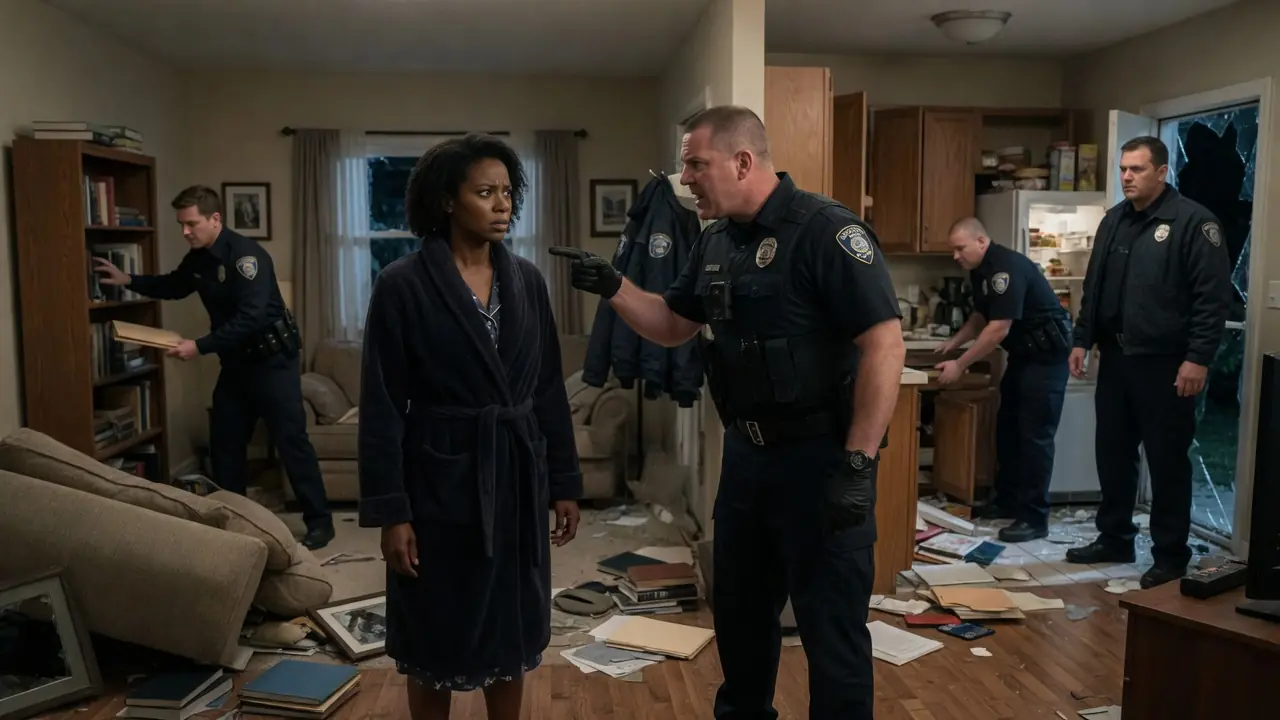
“I said, show me a warrant.”
Sergeant Garrett Cole laughed.
Then came the sound of footsteps and a hard strike against the door.
The door exploded inward.
Four officers rushed inside, screaming, flashlights stabbing the dark.
“On the ground!”
She did not move.
She stood in her robe, chin raised, eyes on the sergeant.
“This is my home. You have no—”
He grabbed her hard at the throat and slammed her into the wall.
Then he threw her down.
Handcuffs snapped tight before her next breath.
He leaned close, grinning.
“Your home? Not anymore.”
Her eyes slid to the jacket on the wall.
Three gold letters glowed under the flashlight.
None of them had seen it yet.
They had no idea they had just messed with the wrong person.
Three weeks earlier, a moving truck pulled up to 14 Maplewood Terrace just after dawn.
The street was quiet. Trimmed hedges lined every yard. American flags hung from porches. Sprinklers ticked across perfect lawns.
It was the kind of neighborhood where people waved from driveways and kept their doors unlocked.
Whitney Adams stepped out of a silver sedan behind the truck.
She wore jeans, a gray T-shirt, and white sneakers.
No jewelry.
No makeup.
She pulled a cardboard box from the back seat, balanced it on her hip, and walked toward the front door of the corner house, the one that had been vacant for six months.
She was thirty-four, lean, calm in the way people are when they have trained themselves to stay calm.
She moved with purpose, but never hurry.
Every motion was deliberate.
Every glance measured.
She had spent the last nine years at the Federal Bureau of Investigation.
Her specialty was public corruption, specifically law enforcement misconduct.
She had built cases against dirty cops in three states. She had testified before a congressional committee. She had put a police chief behind bars in Georgia.
And now she had transferred to this district.
New office.
New assignment.
New home.
She carried boxes in by herself.
Books.
Case files.
A framed photo of her mother.
A coffee maker.
And one item she hung on the wall beside the front door before anything else.
Her FBI field jacket.
Dark navy, three gold letters across the back.
Her name stitched below the badge patch.
She smoothed the fabric, stepped back, and nodded once.
It was not decoration.
It was identity.
By mid-morning, the truck was gone.
Whitney stood on her porch drinking coffee, looking out at the street.
A man across the road raised his hand.
She waved back.
A jogger passed and smiled.
She smiled in return.
Then she noticed the woman in the window.
Two houses down, behind a lace curtain, Brenda Hayes stood watching.
Arms crossed.
Jaw tight.
She had not moved from that window since the truck arrived.
Brenda was fifty-eight. She had lived on Maplewood Terrace for twenty-two years. She knew every family, organized the block party, and ran the homeowners association.
And in all those years, not a single family had moved onto her street.
She intended to keep it that way.
By noon, Brenda was on her phone.
She called her neighbor Dorothy.
“Have you seen her? Moving in like she owns the place. No husband, no family, just boxes and boxes of God knows what.”
Dorothy asked if she had spoken to the new woman.
“I don’t need to speak to her,” Brenda said. “I know exactly what kind of person she is.”
That evening, Whitney cooked dinner alone.
Rice and grilled chicken.
She ate standing at the kitchen counter, reading a case brief on her laptop.
The house was bare but clean, quiet.
A single lamp threw warm light across the living room.
The FBI jacket hung in shadow by the door.
Outside, Brenda Hayes sat in her living room composing a different kind of document.
She opened her phone and dialed the non-emergency police line.
“I’d like to report suspicious activity at 14 Maplewood Terrace,” she said.
Her voice was steady and rehearsed.
“A woman just moved in. . Lives alone. There’s been heavy foot traffic all day, people coming and going. I smelled something chemical. Could be drugs. I think she might have weapons in the house.”
Every word was a lie.
The dispatcher took the report.
A case number was assigned and forwarded to the local precinct.
It landed on the desk of Sergeant Garrett Cole.
Cole was forty-one, fourteen years on the force, built like a refrigerator.
He had a reputation, the kind that made rookies nervous and Internal Affairs look the other way.
Three formal complaints of excessive force.
Two accusations of racial profiling.
His union representative called him effective.
His captain called him reliable.
The people he arrested called him something else entirely.
Cole read Brenda’s report at 11:45 p.m.
He did not verify the caller’s identity.
He did not cross-reference the address.
He did not check whether the new resident had a record.
Because she did not.
He picked up his radio and assembled a four-man team.
“We’re hitting 14 Maplewood,” he said. “Possible narcotics and weapons. No-knock entry authorized.”
Deputy Wells, the youngest on the team, raised his hand.
“Shouldn’t we confirm the tip first, Sarge?”
Cole did not look at him.
“The tip is confirmed. I just confirmed it. Gear up.”
By 1:45 a.m., four officers sat in a ed-out cruiser two blocks from Whitney Adams’s front door.
Engines off.
Radios low.
Waiting for Cole’s signal.
Inside the house, Whitney slept.
The laptop was closed. The kitchen was dark. The only light came from a street lamp outside, casting a faint glow across the hallway wall, and across the three gold letters on the jacket no one had bothered to notice.
At 2:03 a.m., the cruiser crept forward with its headlights off.
Cole sat in the passenger seat.
He pulled on tactical gloves, one finger at a time.
Slow.
Deliberate.
Like a man preparing for something he had done many times before.
His jaw was set.
His eyes were flat.
Beside him, Officer Trent Nash checked his sidearm and holstered it with a click.
In the back seat, Officers Briggs and Dunlap adjusted their body armor straps and pulled balaclavas over their faces.
Nobody spoke.
The only sound was leather stretching and Velcro tearing.
Deputy Wells sat in the second vehicle, a patrol car parked thirty yards behind.
He left his engine running.
His notebook sat open on the passenger seat.
He had written one line.
No verification of tip. No confirmation of suspect identity. No criminal history check.
He stared at the words.
Then he closed the notebook and rubbed his eyes.
Cole keyed his radio.
“On my count, stack formation. I take point.”
“Copy,” Nash said.
Wells pressed his radio button.
“Sergeant, do we have confirmation the resident has a criminal history? I couldn’t find anything in the system.”
Silence.
Then Cole’s voice came back, cold as iron.
“Did I stutter, Deputy? Stack up or stay in the car.”
Wells stayed in the car.
The four officers moved across the front lawn in single file.
Wet grass soaked their boots.
A dog barked two streets over.
The porch light at number 14 was off.
Every window was dark.
The street was dead silent.
Cole reached the front door.
He pressed his ear against it for two seconds.
Nothing.
No sound.
No movement.
No voices.
Just a woman sleeping alone in her own home.
He did not knock.
He did not announce a warrant.
He did not call out through the door.
He raised his right boot and drove it into the wood just below the lock.
The frame shattered.
The deadbolt ripped through the jamb like a tooth yanked from bone.
The door swung inward and cracked against the hallway wall.
“Police! Get in here! Go, go, go!”
They poured through the doorway.
Flashlights mounted on weapons slashed the darkness.
Beams crossed the hallway, the living room, the kitchen doorway.
Boots pounded the hardwood like hammers.
Commands overlapped, crashing into each other.
“Clear left!”
“Movement!”
“Bedroom!”
“Get her! Get her now!”
Whitney had been asleep for three hours.
The first sound she registered was the door.
A crack so loud it sounded like a car accident inside her own house.
Then the shouting.
Then the blinding white light.
She sat up in bed.
Training kicked in before thought did.
Hands up.
Palms open.
Visible.
Feet flat on the mattress.
Center of gravity low.
“I’m unarmed,” she said.
Her voice was steady.
Not a tremor.
“I’m alone in the house. I’m cooperating.”
Cole was through the bedroom door before she finished the sentence.
His flashlight hit her face like a searchlight.
She squinted, but held her gaze on him.
“On the floor, face down, now.”
“I’m cooperating, officer. I need to see your warrant first.”
“You don’t need anything. Get on the ground.”
She swung her legs off the bed and lowered herself to one knee, hands still raised above her shoulders.
“I have a constitutional right to see the warrant. What am I being charged with?”
Cole crossed the room in two strides.
He grabbed her left arm, twisted it behind her back until pain flashed through her shoulder, and forced her chest-first onto the floor.
Her chin struck the hardwood.
She tasted blood.
His knee landed on her lower spine, not only to restrain, but to hurt.
“Shut your mouth,” he hissed. “You talk when I tell you to talk, understand?”
She understood more than he could possibly imagine.
Nash entered behind him and swept the bedroom closet.
He yanked clothes off hangers.
Blouses.
Blazers.
A dry-cleaned charcoal suit still in plastic.
He tossed them on the floor in a pile.
He pulled open every dresser drawer and dumped them.
Underwear, socks, neatly folded T-shirts, scattered across the carpet like garbage.
“Nothing here,” Nash said, kicking through the pile.
“Keep looking,” Cole said.
He had not moved his knee from her back.
Whitney lay still.
Her cheek was flat against the cold floor.
She could feel every grain of the wood pressed into her skin.
She could hear her own heartbeat.
Steady.
Controlled.
Sixty beats per minute.
She could smell boot polish, gun oil, and the faint sour trace of chewing tobacco on Cole’s breath above her.
She knew this script.
She had read dozens of case files exactly like this moment.
Forced entry on fabricated probable cause.
Escalation without evidence.
Intimidation designed to provoke a reaction that could be written up as resistance.
She had built her entire career prosecuting officers who did precisely what was happening to her right now.
But knowing the script did not make the knee any lighter.
“What exactly are you looking for?” she asked.
Calm.
Measured.
The tone of someone conducting an interview, not lying on a floor.
Cole leaned down.
His face was inches from hers.
“Drugs. Weapons. Whatever you’re hiding in this house.”
“There are no drugs. There are no weapons. You’re making a serious mistake, Sergeant.”
He smiled.
Not warmth.
Pure contempt.
The kind of smile that said he owned this moment and there was nothing she could do about it.
“A serious mistake,” he repeated, mocking her tone. “That’s adorable. You know what I think? I think you moved into this nice, quiet neighborhood to set up a pipeline. I think you’ve got product hidden behind these pretty walls, and I think by sunrise we’re going to find it.”
He paused.
“Or we’re going to find something.”
“You won’t find anything because there is nothing here.”
“We’ll see.”
He stood, finally lifting his knee.
A red mark bloomed on her lower back where the bone had pressed.
“Nash. Briggs. Dunlap. Take this place apart. Every room, every drawer, every crack.”
They obeyed.
The kitchen came first.
Cabinet doors flung open so hard one hinge snapped.
Plates pulled out and stacked on the counter.
The refrigerator emptied.
Containers of leftover rice, a carton of milk, a bag of grapes, a bottle of hot sauce, all placed on the floor in a row like tagged evidence.
Nash opened the oven and shone his light inside.
Briggs pulled the washing machine away from the wall and checked the space behind it.
Nothing.
The bathroom came next.
The medicine cabinet was swept clean in one motion.
A bottle of ibuprofen.
A tube of toothpaste.
A box of Band-Aids.
A jar of coconut oil.
All lined up along the sink edge like seized contraband.
Dunlap pulled the toilet tank lid off and aimed his flashlight into the water.
He reached in with his gloved hand, felt around, and pulled it out dripping.
Nothing.
Then the living room.
Couch cushions yanked off and thrown across the room.
A bookshelf searched.
Every book opened, shaken by the spine, and dropped to the floor.
A cardboard box of case files Whitney had not finished unpacking was torn open.
Manila folders spilled across the hardwood, papers fanning out like scattered playing cards.
Someone stepped on a framed photo of her mother.
The glass cracked under his boot.
Nobody stopped.
And still, nothing.
Cole stood in the center of the destroyed living room, hands on his hips, jaw clenched, breathing hard through his nose.
The house was wrecked around him.
Every room turned inside out.
Every surface touched.
Every belonging handled by strangers in gloves.
Not a single grain of evidence.
His face darkened.
He looked toward the bedroom doorway where Whitney still lay face down, hands cuffed behind her back.
She had not moved once.
Had not raised her voice.
Had not given him a single word or gesture he could twist into resisting arrest.
That silence enraged him more than any fight would have.
He walked back to the bedroom and stood over her.
“You think you’re clever?”
She did not answer.
“I asked you a question.”
“I’ve answered every question calmly and clearly, Sergeant. And you found nothing because there is nothing to find.”
He crouched beside her.
His voice dropped to a whisper.
The most dangerous volume a man like Garrett Cole could use.
“Let me explain how this works. I write the report. I decide what we found. I decide what happened here tonight. And right now, I’m deciding that you resisted arrest, that you made threatening movements, and that we discovered drug paraphernalia in your kitchen cabinet.”
He paused, letting each word land.
“Who do you think the judge will believe? A decorated sergeant or you?”
The question hung in the dark room like smoke.
Whitney said nothing.
She held his gaze from the floor, cheek pressed against cold wood, wrists locked in steel behind her back.
Her expression did not change.
Not fear.
Not anger.
Something else.
Something Cole was too arrogant to recognize.
Patience.
Outside, lights began turning on.
One porch lamp across the street.
Then a bedroom window next door.
Neighbors were waking.
Someone parted their blinds and pressed a phone against the glass.
The red recording dot blinked in the dark.
Brenda Hayes stood at her own window two houses down, arms folded tight across her chest.
A thin, satisfied smile pulled at her lips.
Everything was going exactly as she had planned.
And in the patrol car parked at the curb, Deputy Wells sat alone.
He had not gone inside.
His notebook was open on his knee, pen moving in the dome light.
He was writing every detail, every timestamp, every order he had heard through the radio.
He did not know yet how much those pages would matter.
Cole pulled Whitney up from the bedroom floor by her cuffed wrists.
The metal dug deep into her skin.
She winced, but said nothing.
He shoved her down the hallway into the living room and pushed her onto the couch, or what was left of it.
Cushions were scattered.
Books lay in piles on the floor.
Her case files were spread across every surface like confetti after a parade nobody wanted.
She sat straight.
Shoulders back.
Chin level.
Even in handcuffs, even in a bathrobe at two in the morning, she carried herself like a woman who knew exactly who she was.
Cole hated that.
He paced the wrecked living room, boots crunching over broken glass from her mother’s photo frame.
He did not notice.
Or he did not care.
His hands kept opening and closing into fists.
Nash stood by the kitchen doorway, arms crossed, watching Cole the way a dog watches thunder.
Alert.
Uncertain.
Briggs leaned against the hallway wall, flashlight off, staring at the floor.
Dunlap had gone outside to check the backyard.
The house had been searched top to bottom.
Every room emptied.
Every drawer dumped.
Every closet gutted.
They had found absolutely nothing.
And Cole was unraveling.
“Where is it?” he said, stopping in front of Whitney.
“Where is what?”
“Don’t play games with me. The drugs. The stash. Where did you hide it?”
“There is no stash, Sergeant. I told you that twenty minutes ago. I told you that when your knee was on my back. I’m telling you now. There is nothing illegal in this house.”
He leaned forward, knuckles on his thighs, face shoved toward hers.
“Every house I hit has something. Every single one. You’re no different.”
“Maybe your information is wrong.”
“My information is never wrong.”
“Then show me the warrant. Show me the name. Show me the probable cause affidavit.”
Cole’s eye twitched.
He straightened up and turned to Nash.
“You hearing this? She wants to see the warrant.”
He let out a short, ugly laugh.
“Like she’s a lawyer.”
Nash did not laugh.
He shifted his weight and looked away.
Whitney pressed on.
“I’m asking because I know my rights, Sergeant, and I know yours. You entered this home without proper identification. You used force before establishing a threat. You haven’t read me Miranda. You haven’t told me a charge. And you’ve searched every inch of this house without finding a single piece of evidence.”
Each sentence landed like a stone dropped into still water.
Cole’s jaw muscles flexed.
His nostrils flared.
He stepped closer until his shadow fell across her face.
“You want to talk about rights? Here’s one you should know. I have the right to write whatever I want in my report. I can say you lunged at me. I can say I found a bag of powder under your sink. And I can put you in a cell tonight where you’ll spend six months proving your innocence while your name sits in the system forever.”
He waited for her to break.
She did not.
“Are you threatening to fabricate evidence, Sergeant?”
The question was quiet, clinical.
The voice of someone who had asked that exact question under oath in courtrooms, in front of federal judges.
Cole did not know that.
All he saw was a woman who would not lower her eyes.
“I’m not threatening anything,” he said, his voice tight as a piano wire. “I’m explaining how the world works.”
He turned and grabbed her laptop from the kitchen counter.
He flipped it open.
“That’s personal property,” Whitney said.
“Nothing in this house is personal tonight.”
He tried the desktop.
A federal login screen appeared.
The Department of Justice seal.
Biometric authentication required.
Cole stared at it.
His brow creased.
“What the hell is this?”
“I told you not to touch that.”
“Nash, get over here.”
“What’s this screen?”
Nash walked over and looked.
His face went blank.
“That looks like a federal system, Sarge.”
“DOJ seal, federal?” Cole snorted. “Sure. And I’m the attorney general.”
He slammed the laptop shut and shoved it across the counter.
It slid hard and stopped against the toaster with a crack.
Whitney watched.
She cataloged.
Evidence tampering.
Possible destruction of federal property.
Another line on a list that was growing longer by the minute.
Cole radioed dispatch.
“This is Unit Seven at 14 Maplewood. Requesting additional backup. Suspect is uncooperative. May need transport.”
The radio crackled.
“Copy, Unit Seven. ETA fifteen minutes.”
He wanted an audience.
He wanted more uniforms.
He wanted the scene to look as big and as serious as the lie he had built around it.
Outside, the neighborhood was fully awake now.
Five porch lights burned along the street.
A man in a bathrobe stood barefoot on his lawn, arms crossed, staring at the cruisers.
An elderly couple watched from their doorway, whispering to each other.
A teenage girl across the street sat on her front steps, phone held steady, recording everything.
The red dot of her camera blinked without pause.
Brenda Hayes still stood at her window, but her smile had faded slightly.
She had not expected this many witnesses.
Dunlap came back through the rear door, shaking his head.
“Backyard’s clean. Shed’s empty. Nothing buried. Nothing in the trash cans. It’s clean, Sarge.”
Cole did not acknowledge him.
He stood in the middle of the ruined living room, grinding his teeth, staring at Whitney with the look of a man who had cornered what he thought was prey and found the cage empty.
He needed something.
Anything.
One shred of justification for the broken door, the wrecked house, the woman in handcuffs.
He snatched her phone from the side table.
“Unlock this.”
“No.”
“That wasn’t a request.”
“And that’s not going to happen. You have no legal authority to search my phone without a warrant specifically authorizing a digital search. Even a first-year law student knows that. Riley v. California, 2014, unanimous decision.”
Nash closed his eyes for a second.
“She’s right, Sarge. We can’t—”
“I know the law, Nash.”
Cole hurled the phone.
It hit the couch frame and clattered to the floor.
The screen cracked in one corner.
Briggs spoke from the hallway, his voice careful.
“Sarge, maybe we should call the lieutenant, get him down here before this gets—”
“Nobody is calling anyone. I run this scene. I say when it’s done.”
But it was not his scene anymore.
It had not been since the moment his boot hit that door.
He turned to Whitney one final time.
His face was crimson.
A vein throbbed at his temple.
Sweat beaded along his forehead despite the cold night air seeping through the broken doorway.
“Last chance,” he said. “Tell me what you’re hiding, or I guarantee you will not like how tonight ends.”
Whitney looked up at him.
And for the first time, something shifted in her face.
Not fear.
Not defeat.
Not anger.
Pity.
“Sergeant Cole,” she said, every word placed with the precision of a scalpel. “You’ve broken into a private residence on a fabricated anonymous tip. You’ve assaulted an unarmed civilian. You’ve threatened to manufacture evidence on a recorded line. You’ve attempted unauthorized access to a federal device, and you’ve damaged personal property belonging to a citizen who has committed no crime.”
She paused.
Let the silence build.
“And every single second of it has been captured by your own body cameras.”
The room went quiet.
Not silent.
Quiet.
The kind of quiet that falls when someone realizes the ground beneath them has been hollow all along.
Cole’s hand drifted to the body camera clipped to his vest.
The small red light blinked.
Steady.
Unwavering.
It had been recording since he stepped out of the cruiser.
Nash looked at his own camera.
Same red light.
Same blink.
Briggs took a half step backward toward the hallway.
Cole’s mouth opened.
Closed.
Opened again.
Nothing came out.
Whitney sat on the bare couch frame, hands cuffed behind her, bathrobe pulled across her shoulders.
She had not raised her voice.
She had not made a single aggressive movement.
She had not given them one frame of footage they could use.
But they had given her everything.
And she was not finished.
“There’s one more thing,” she said. “Something you would have known if you’d done even the most basic check before you kicked down my door.”
Cole swallowed.
The sound was audible in the stillness.
“What?”
She did not answer with words.
Her eyes moved slowly, deliberately, from his face to the wall beside the front door.
The wall that had been in shadow since they entered.
The wall not one of them had bothered to look at because they were too busy destroying everything else.
Nash followed her gaze.
He turned.
His flashlight beam swung across the hallway and landed on the wall.
And everything stopped.
The flashlight beam held steady on the wall.
A jacket.
Dark navy.
Hanging from a single hook beside the front door.
It had been there the whole time.
Through the shouting, through the search, through every threat and every insult.
Waiting.
Three letters across the back, pressed in gold fabric, each one four inches tall.
FBI.
Below them, stitched in white thread on a patch:
Special Agent Whitney Adams, Public Corruption Unit.
Nash’s flashlight did not move.
His arm locked in place like the muscle had forgotten how to work.
His lips parted, but no sound came out.
He read the patch once.
Then again.
Then a third time, as if repetition might change what it said.
“Sarge,” he whispered.
Cole was still facing Whitney.
He saw Nash’s expression first, the color draining from his face like water from a cracked glass.
Then he turned.
The flashlight beam was a spotlight now.
Every letter sharp.
Every stitch visible.
The gold caught the light and threw it back across the hallway, painting the walls with a faint amber glow.
Cole stared at the jacket for six full seconds.
Nobody counted, but everyone felt each one.
His hands dropped to his sides.
His shoulders, which had been squared and aggressive for the past forty minutes, sagged like someone had cut the strings holding them up.
The vein at his temple still pulsed, but the blood had left his face.
He was the color of old paper.
“That’s…”
He started, but did not finish.
Whitney stood up from the couch slowly, deliberately.
The handcuffs were still locked behind her back.
She did not ask permission.
She did not wait for it.
“My name is Special Agent Whitney Adams,” she said.
Her voice had not changed.
Same tone she had used from the floor.
Same tone she had used when his knee was on her spine.
Calm.
Level.
Absolute.
“I am assigned to the Federal Bureau of Investigation’s Public Corruption Unit. My badge number is 7719. My supervising officer is Special Agent in Charge Daniel Crawford, Eastern District Field Office.”
Each word fell into the silence like a hammer on an anvil.
Cole took a step backward.
His boot heel caught on a book he had thrown to the floor earlier.
He stumbled, but caught himself against the wall.
“I… we received a tip,” he said.
His voice had changed.
The authority was gone.
The edge was gone.
What remained was something smaller.
“We were acting on a credible report. Narcotics and weapons. We followed—”
“You followed nothing,” Whitney said.
She stepped toward him.
One step.
That was all it took.
He flinched.
A sergeant with fourteen years on the force, three commendations, and a reputation for making grown men confess, and he flinched from a woman in a bathrobe.
“You didn’t verify the tip. You didn’t check my name against any database. You didn’t confirm residency. You didn’t contact a supervisor. You obtained a no-knock entry based on an anonymous call and executed it with maximum force against a single unarmed woman in her own home at two in the morning.”
She stopped three feet from him.
Close enough that he could see the red mark on her chin where it had struck the floor.
Close enough that he could see the bruising forming on her left wrist where the cuffs had bitten deep.
“Take these off,” she said.
Quiet.
Not a request.
An instruction.
Cole’s hands were shaking.
He fumbled for his handcuff key.
It took him three tries to get it into the lock.
The cuffs clicked open and fell to the floor with a metallic clatter that sounded louder than any gunshot fired that night.
Whitney brought her hands forward.
She rubbed her wrists slowly, one at a time.
Red welts circled both like bracelets made of pain.
She did not look at them.
She looked at Cole.
“Now,” she said, “I’m going to make one phone call. Then you’re going to stand in this room, my room, in my home, and you’re going to wait.”
She walked to the kitchen counter.
She picked up her cracked phone from the floor, examined it, and dialed a number she knew by heart.
It rang twice.
“Crawford,” said the voice on the other end.
Groggy, but alert within one syllable.
“Sir, this is Adams. I need a team at my residence, 14 Maplewood Terrace. Local PD executed a no-knock raid on my home approximately forty minutes ago. Four officers on scene. Forced entry, unlawful search, assault, threats to fabricate evidence. Body camera footage is active. I need an evidence preservation team and an OPR investigator.”
A pause.
Then Crawford’s voice, no longer groggy.
“Are you injured?”
“Minor. I’ll need photos for documentation.”
“Teams en route. Twenty minutes. Don’t let anyone leave.”
“They’re not going anywhere, sir.”
She hung up and set the phone on the counter.
Cole stood exactly where she had left him.
He had not moved.
Nash was beside him, arms hanging limp, staring at the floor.
Briggs had backed all the way into the hallway and was leaning against the wall with his eyes closed.
Dunlap stood near the back door, one hand on the frame, looking like a man searching for an exit that did not exist.
Nobody spoke.
The red lights on their body cameras blinked on and on and on.
Outside, Deputy Wells sat in his patrol car.
Through the windshield, he could see the broken front door, the spill of light from inside, and the silhouettes of officers standing motionless.
He looked down at his notebook.
Twelve pages filled.
Every timestamp.
Every order.
Every word he had heard over the radio.
He picked up his personal phone and dialed the FBI tip line.
He had made his choice.
Nineteen minutes later, two SUVs turned onto Maplewood Terrace without sirens.
Headlights cut through the dark.
Tires rolled to a stop in front of number 14.
Special Agent in Charge Daniel Crawford stepped out of the second vehicle.
Silver-haired.
Square-jawed.
Built like a man who never stopped training.
He walked through the broken doorway and took in the scene with one slow sweep.
The destroyed living room.
Overturned furniture.
Books and papers everywhere.
A shattered photo frame on the floor.
And four local officers standing in a loose cluster, silent, their badges carrying none of the authority those badges were supposed to represent.
Crawford looked at Whitney first.
The bruise on her chin.
The red welts on her wrists.
He noted everything.
Then he turned to Cole.
“Sergeant Garrett Cole?”
Cole nodded.
“Sir, we received a credible tip. Narcotics and possible weapons. We followed standard—”
“Standard procedure,” Crawford repeated.
He said the words like he was reading them off a headstone.
“Standard procedure does not include kicking down the door of a federal agent. It does not include assaulting an unarmed woman. And it does not include threatening to plant evidence while your own body camera records every syllable.”
Cole opened his mouth.
Crawford raised one finger.
Cole shut it.
“Badge. Weapon. Now.”
Cole reached for his belt slowly, like a man touching something he knew he would never hold again.
He unclipped his badge and held it out.
Then his service weapon.
Magazine ejected.
Slide locked.
Crawford took both without looking down.
“Nash, same.”
Nash complied without a word.
Badge and weapon on the table.
He stepped back, face gray.
“Briggs. Dunlap.”
They followed.
Four badges and four weapons lay in a row on a scratched wooden surface under the light of a single lamp that somehow had not been knocked over.
“You are suspended effective immediately,” Crawford said. “Surrender your department phones and vehicle keys. Do not leave the county. Do not contact each other. Do not contact the complainant. Do not speak to media.”
Four nods.
No voices.
Chief Harold Morrison arrived at 3:22 a.m. in a wrinkled uniform, hair uncombed, face the color of ash.
He stood in the destroyed hallway and looked around like a man surveying the ruins of his own career.
“Agent Adams, on behalf of this department, I want to express—”
“Your officer threatened to fabricate evidence against me,” Whitney said. “Your department authorized a no-knock raid on a federal agent’s home based on an anonymous tip no one verified. This isn’t a mistake, Chief. This is a pattern.”
Morrison had no response.
Because she was right.
And she had the evidence to prove it.
Crawford’s team worked the scene for two hours.
They photographed every room.
They bagged Whitney’s handcuffs, her skin cells embedded in the metal.
They collected the cracked phone, the shoved laptop, and the broken photo frame.
They downloaded body camera footage from all four officers.
Then they found Brenda Hayes.
The dispatch call log traced the tip to 18 Maplewood Terrace, two houses down.
Crawford sent two agents at 4:15 a.m.
Brenda answered in a quilted housecoat, reading glasses on her nose, as if she had not been watching from her window all night.
“Mrs. Hayes, did you call the police non-emergency line at approximately 11:30 p.m. regarding your neighbor at number 14?”
She hesitated one second too long.
“Yes. I was concerned. I saw a suspicious—”
“What specifically did you observe? Heavy foot traffic? People coming and going? A chemical smell? Mrs. Hayes, street camera footage shows exactly one person entering that residence yesterday. The homeowner, carrying boxes. Alone.”
The agent paused.
“Would you like to revise your statement?”
Brenda’s fingers tightened on the doorframe.
Her face went rigid.
“I’d like to speak with my lawyer.”
“That would be wise.”
Back at number 14, Deputy Wells sat at Whitney’s kitchen table.
The one surface that had not been overturned.
His notebook lay open beside an FBI recording device.
He spoke clearly and without hesitation.
Times.
Orders.
Radio transmissions.
Cole’s exact words.
His own objections that were ignored.
Everything documented.
When he finished, Crawford shook his hand.
“You did the right thing, Deputy.”
Wells looked across the room at the broken front door hanging from one hinge.
Morning light was beginning to creep through the gap.
“I should have done it sooner,” he said.
The body camera footage leaked on a Tuesday.
No one knew who released it.
Internal Affairs pointed at the FBI.
The FBI pointed at the local precinct.
The precinct pointed at a civilian records request that had been filed three days after the raid.
It did not matter.
By Wednesday morning, thirty-eight seconds of Sergeant Garrett Cole threatening to plant evidence on a handcuffed woman in her own living room was playing on every screen in America.
The clip started mid-sentence.
Cole’s face lit by his own flashlight, leaning over Whitney.
His voice low and deliberate.
“I write the report. I decide what we found. I decide what happened here tonight.”
Then the pause.
Then the line that would end his career.
“Who do you think the judge will believe? A decorated sergeant or you?”
Thirty-eight seconds.
That was all it took.
The video hit fourteen million views in forty-eight hours.
News anchors played it on loop.
Legal analysts dissected every word.
Civil rights organizations issued statements before lunch.
By Thursday, Justice for Whitney was the number one trending topic in the country.
And then the other victims came forward.
The first was a man named Jerome Patterson, thirty-one, a truck driver.
He had been pulled over by Cole’s unit two years earlier on a routine traffic stop that turned into a ninety-minute roadside interrogation.
His car was searched without consent.
His phone was confiscated.
He was held in the back of a cruiser while Cole told him, almost word for word, the same threat he had made to Whitney.
Who do you think they’ll believe?
Jerome had filed a complaint.
It was dismissed in eleven days.
The second was a woman named Clara Voss, twenty-six, a nursing student.
Cole’s team had raided her apartment based on a tip from a neighbor dispute.
They found nothing.
But Cole’s report stated she had been verbally combative and physically resistant.
She was charged with obstruction.
She spent four months fighting the charge before it was dropped.
By then, she had lost her apartment and her enrollment.
Clara had filed a complaint.
It went nowhere.
Then came Raymond Hill, forty-four, small business owner.
Darnell Brooks, twenty-nine, college graduate visiting his mother.
Sophia Reyes, thirty-three, social worker.
Tamika Wells, no relation to the deputy, fifty-one, retired teacher.
Six people.
Six complaints.
Six files buried in the same cabinet in the same Internal Affairs office that answered to the same chief who had just stood in Whitney’s hallway and tried to apologize.
The pattern was undeniable.
And the FBI had the paper trail to prove it.
The federal grand jury convened five weeks after the raid.
The courtroom was standing room only.
Local media filled the first three rows.
National outlets set up cameras outside.
Protesters gathered on the courthouse steps holding signs with Whitney’s name and the names of the six who came before her.
Cole was indicted on four federal counts.
Deprivation of civil rights under color of law.
Unlawful entry.
Assault.
Witness intimidation.
The assault charge carried a sentencing enhancement because Whitney had identified herself as cooperating and he had used force anyway.
His attorney, a private defense lawyer named Philip Sawyer, argued that Cole had acted in good faith on a credible tip.
That the situation was dynamic.
That officers make split-second decisions under pressure and should not be judged by hindsight.
The prosecution played the body camera footage.
All of it.
Not thirty-eight seconds.
The full forty-seven minutes.
From the moment Cole stepped out of the cruiser to the moment Crawford took his badge.
Every command.
Every insult.
Every threat.
Every lie.
The jury watched in silence.
They heard Cole say, “You people always think you have rights.”
They heard him threaten to fabricate evidence.
They heard Whitney ask for a warrant seven times.
They heard her cite case law from the floor of her own bedroom with a knee on her spine.
They saw Nash look away.
They saw Briggs try to intervene and get shut down.
They saw Dunlap find nothing in every room and report it.
And they saw Cole ignore him every time.
They heard, in the final minutes, the moment Whitney said his body cameras were recording.
They watched Cole’s hand drift to his vest.
They watched his face collapse.
The jury deliberated for six hours.
Guilty on all four counts.
Cole stood motionless as the verdict was read.
His jaw was locked.
His eyes were dry.
He did not look at his attorney.
He did not look at the gallery.
He stared straight ahead at the bench like a man watching a wall close in.
The judge, the Honorable Patricia Sinclair, sentenced him to eight years in federal prison.
No parole eligibility for five.
“Sergeant Cole,” she said, her voice filling the silent courtroom, “you swore an oath to protect the citizens of this community. Instead, you terrorized them. You weaponized your badge. You used your authority not to serve justice, but to deny it. This court will not treat that lightly.”
Nash pleaded guilty before trial.
Cooperation agreement.
He testified against Cole in exchange for a reduced charge.
He received three years.
Briggs and Dunlap, who had participated in the search but not in the threats or the assault, received eighteen months each and permanent termination from law enforcement.
Brenda Hayes was charged separately in state court.
Filing a false police report.
Making a fraudulent emergency call.
Her defense was simple.
She believed what she reported.
The prosecution presented street camera footage, cell phone records, and testimony from three neighbors who confirmed that Whitney had moved in alone, quietly, with no visitors.
Brenda was convicted.
Twelve months in county jail.
Three years of probation.
A permanent restraining order keeping her five hundred feet from Whitney Adams and the property at 14 Maplewood Terrace.
Chief Morrison resigned the day after Cole’s sentencing.
He released a written statement calling the incident an isolated failure of judgment.
No one believed him.
The Department of Justice announced a consent decree, a federal oversight agreement requiring the entire department to undergo restructuring.
New use-of-force policies.
Mandatory de-escalation training.
An independent civilian review board with subpoena power.
Body camera footage to be reviewed weekly by an outside auditor.
The department that had operated without accountability for decades was now operating under a federal microscope.
Deputy Wells was offered a position with the FBI’s community liaison program.
He accepted.
On his last day at the precinct, he cleaned out his locker, turned in his badge, and walked out without looking back.
His notebook, twelve handwritten pages, was entered into the federal court record as Exhibit 14.
The judge called it one of the most detailed and courageous acts of internal accountability the court had seen.
Wells never spoke to Cole again.
One year later, Whitney Adams pulled into the driveway at 14 Maplewood Terrace.
The sun was going down.
The sky faded from peach into violet at the edges.
Sprinklers ticked across lawns.
A kid rode a bicycle in slow circles at the end of the street.
Everything about the evening was ordinary.
The kind of quiet that makes you forget anything bad ever happened here.
But the front door told a different story.
It was new.
Solid oak.
Heavier than the original.
Whitney had picked it herself, not for protection, but because she wanted to choose what stood at the entrance to her own home.
New frame.
New hinges.
New deadbolt.
No scars from a boot.
No memory of splintered wood and screaming voices.
She stepped out carrying groceries and a leather briefcase.
Navy blazer over a white shirt.
FBI credentials on a lanyard around her neck.
She had been promoted six months ago.
Senior Supervisory Special Agent, leading the regional public corruption task force.
Her unit now oversaw eleven police departments across three counties.
The irony was not lost on her.
Inside, the hallway was repainted.
The living room was furnished again.
New couch.
New bookshelf.
Books arranged by subject.
A silver-framed photo of her mother sat on the shelf.
The old one, cracked glass and all, was locked in an FBI evidence vault somewhere.
She did not need it back.
She remembered her mother’s face just fine.
The jacket still hung on the wall beside the front door.
Same hook.
Same spot.
She had never moved it.
She set the groceries down and opened the kitchen window.
Evening air drifted in.
Cut grass.
Someone’s barbecue.
The faint sound of a radio playing two houses down.
The house at number 18 had new occupants now, a young couple with a toddler.
They had waved at Whitney the day they moved in.
She brought them banana bread the following Saturday.
Brenda Hayes’s name was never spoken on Maplewood Terrace anymore.
Not from forgiveness.
From shame.
The neighbors who had watched that night, who saw the cruisers, the flashlights, the broken door, carried their own silence.
Some had done nothing.
Some had recorded.
The teenage girl across the street had uploaded her footage the next morning.
That video, paired with body camera clips, made the story impossible to bury.
Her name was Ellie Whitman, seventeen years old.
Whitney wrote her a college recommendation letter.
The street was different now.
Not in ways a stranger would notice, but the people who lived there understood.
Two new families had moved in over the year, one , one Hispanic.
The homeowners association, once controlled by Brenda with an iron grip and an unspoken racial filter, had been dissolved and rebuilt with an elected board.
Block parties happened again, but they looked different.
More faces.
More languages.
More chairs pulled into the circle.
It was not perfect.
No street is.
But it was honest.
And that was more than it had been before.
Whitney stood at her kitchen window, coffee in hand, watching the last light drain from the sky.
She thought about Cole sometimes.
Not with anger.
Not with satisfaction.
She remembered the moment in the living room when she looked at his face and felt pity instead of rage.
Men like him confused authority with power.
Power with righteousness.
Righteousness with immunity.
They always looked the same when the badge came off.
Smaller.
Older.
Lost.
She did not build her career on revenge.
She built it on records.
On evidence.
On the quiet, patient belief that truth, documented thoroughly enough, will eventually speak louder than any lie.
She rinsed her mug and sat down at the kitchen table with her briefcase.
New case files.
New complaints.
New names she had not learned yet.
Somewhere in another town, in another precinct, another officer was making the same choice Cole had made.
And somewhere, another person was lying on a floor, wrists in metal, wondering if anyone would ever believe them.
Whitney opened the first file and began to read.
The work did not end with one verdict.
It did not end with one door replaced or one sergeant in a cell.
The work continued because the problem continued.
And as long as it did, people like Whitney Adams would keep showing up with their credentials, their patience, and their unshakable refusal to look away.