The crowded county courthouse in Atlanta, Georgia, fell unusually quiet when Captain Ronald Mercer stopped beside the polished brass railing. He was fifty-two, broad-shouldered, silver-haired, and accustomed to seeing uniforms move out of his way before he spoke. Across the barrier sat a composed Black woman in a charcoal blazer, her sealed folder resting across her lap while several officers whispered and laughed behind him. Mercer looked down at her with a mocking grin, unaware that the disciplinary hearing had already begun in the only way that mattered.
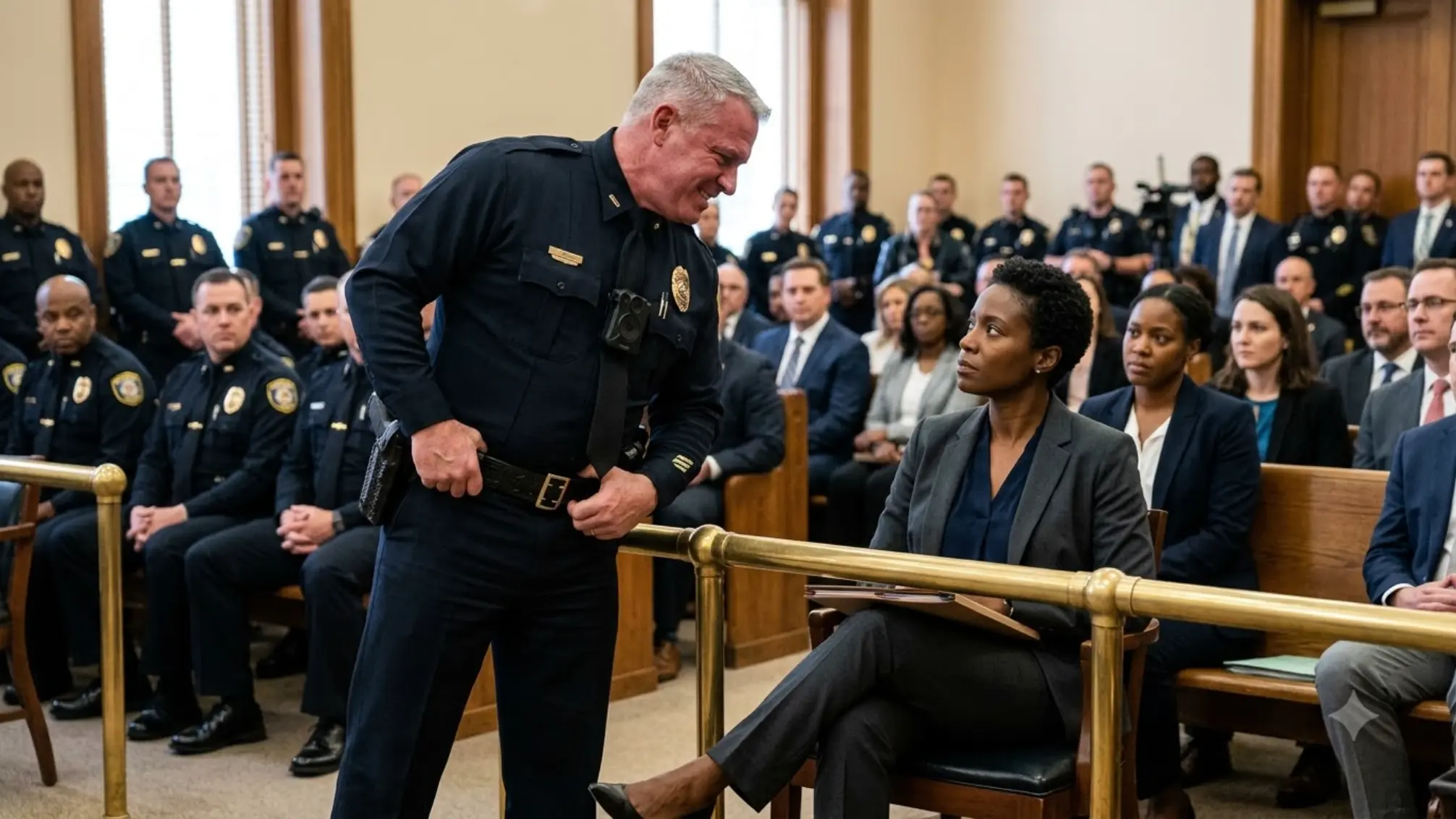
“I know who belong here and who doesn’t,” the police captain said, leaning over the railing.
The Black woman met his glare without blinking. “Then you should recognize authority when it sits before you.”
“Stand up now, or I’ll drag you out myself.”
She opened the sealed folder. “Touch me, Captain—I’m the police chief deciding whether you keep that badge.”
Mercer’s hand stopped against his duty belt. The laughter behind him vanished so abruptly that the scrape of a chair echoed through the courtroom. Several senior officers lowered their eyes, while a young patrolman near the aisle stared at the floor as though he could disappear into it. The woman rose slowly and placed a gold chief’s identification card beside the folder.
“My name is Dr. Evelyn Brooks,” she said. “As of six o’clock this morning, I am the chief of the Atlanta Metropolitan Police Department.”
Mercer’s face drained of color. News of the appointment had been expected later that afternoon, but city officials had deliberately withheld Evelyn’s photograph and arrival time. The mayor wanted her first hours inside the department to reveal how officers behaved when they believed no senior authority was watching. Evelyn had agreed because polished speeches and prepared handshakes rarely exposed the culture hidden beneath a uniform.
She had entered the courthouse alone, without an escort, visible badge, or ceremonial introduction. Her first official responsibility was to observe the disciplinary hearing concerning Lieutenant Marcus Reed, a Black officer accused of insubordination after reporting evidence that Mercer’s unit falsified arrest records. Evelyn had expected tension, defensiveness, and perhaps hostility. She had not expected the captain himself to threaten her before learning her name.
Judge Rebecca Holloway looked over the bench. “Captain Mercer, return to your assigned seat.”
Mercer straightened quickly. “Your Honor, I was not informed that—”
“You were informed that this courtroom requires professional conduct.”
“I believed she was sitting in a restricted section.”
Evelyn glanced at the empty public benches surrounding her. “You believed I did not belong because I was alone and unfamiliar.”
“That is not what I said.”
“It is what you demonstrated.”
Mercer returned to the defense table beside his attorney. His confidence had not disappeared completely, but it had changed into calculation. He began whispering urgently while Evelyn took the chair reserved for departmental leadership. The officers who had laughed now sat rigidly behind their captain, each silently reviewing what he or she had said before the reveal.
The hearing concerned an arrest made nine months earlier near a downtown apartment complex. Mercer’s tactical team had detained twenty-two-year-old college student Daniel Price after claiming he matched the description of an armed robbery suspect. Daniel was unarmed, wore different clothing from the suspect, and repeatedly stated that his identification was inside his backpack. Body-camera footage showed Mercer ordering officers to force Daniel onto the pavement after the young man hesitated to place his hands behind his back.
Daniel suffered a fractured wrist, a concussion, and injuries across his face. The department’s official report claimed he had attacked an officer and attempted to reach for a weapon. Four members of Mercer’s unit signed nearly identical statements supporting that version. Prosecutors initially charged Daniel with resisting arrest and assaulting law enforcement.
Lieutenant Marcus Reed reviewed the footage two weeks later while conducting an ordinary equipment audit. He discovered that several minutes were missing from the body-camera archive and that timestamps in the official evidence log did not match the original uploads. More troubling, the surviving footage showed Daniel’s hands clearly visible when Mercer gave the takedown command. No weapon appeared anywhere near him.
Marcus reported the discrepancy to Internal Affairs. Within forty-eight hours, Mercer accused him of mishandling evidence, removed him from active duty, and initiated disciplinary proceedings for insubordination. The department’s previous chief accepted Mercer’s version without ordering an independent review. Daniel’s charges remained active until a civilian attorney obtained security footage from the apartment building.
That video showed the entire encounter from above. Daniel had never attacked anyone. Mercer had approached aggressively, ignored the identification offered by the student, and ordered force after Daniel asked why he was being detained. One officer later placed a closed pocketknife near Daniel’s backpack before the scene photographs were taken.
The discovery triggered public outrage. The previous chief resigned, the mayor requested federal oversight, and the city council searched nationwide for a replacement capable of restoring trust. Evelyn Brooks became the unanimous choice after twenty-five years in policing, a doctorate in public administration, and a record of rebuilding departments damaged by corruption.
She had led homicide investigations, trained recruits, and served as deputy chief in Baltimore before accepting the Atlanta appointment. Yet none of those credentials mattered to Mercer when he saw a Black woman sitting alone beside a courtroom railing. He had assessed her value before hearing her name. That instinct now became evidence of the culture Evelyn had been hired to confront.
Judge Holloway called the first witness. An Internal Affairs investigator described how Marcus’s complaint had initially been classified as a personnel dispute rather than a possible criminal referral. The investigator admitted that Mercer personally contacted him twice before the review began. Both conversations were absent from the official case file.
“Why were they omitted?” the judge asked.
“I considered them informal.”
“What did Captain Mercer discuss?”
The investigator hesitated. “He said Lieutenant Reed had become unstable and was attempting to damage the unit.”
“Did he provide evidence of instability?”
“No, Your Honor.”
“Did you request any?”
“No.”
Evelyn wrote silently inside the folder. Mercer watched every movement of her pen. The same man who had threatened to drag her from the courtroom now appeared afraid of a handwritten note.
The next witness was the department’s digital evidence supervisor. She explained that body-camera files entered a secure server automatically and could not normally be deleted by field officers. However, command-level users could flag footage for technical review, temporarily removing it from the standard archive. Mercer had command-level access.
Records showed that his credentials were used three hours after Daniel’s arrest. Seven files were flagged, copied to an external review folder, and returned two days later. Three files came back shortened.
Mercer’s attorney objected, arguing that anyone with access to the captain’s computer could have used his credentials. The supervisor acknowledged that possibility but added that the system required Mercer’s physical security token. The token was issued to him personally and had never been reported lost.
Evelyn saw one officer in the gallery wipe sweat from his forehead. Officer Kyle Benton had been present during the arrest and had signed one of the identical reports. He kept glancing toward the exit whenever the altered footage was discussed.
During a short recess, Evelyn remained seated while attorneys left the room. Mercer approached again, this time stopping several feet away. His mocking grin had been replaced by a strained attempt at respect.
“Chief Brooks, I owe you an apology for the misunderstanding.”
“You threatened me.”
“I was maintaining courtroom security.”
“You are not assigned to courtroom security.”
“I believed there was a risk.”
“From a seated woman holding a folder?”
Mercer lowered his voice. “This department has been under tremendous pressure. Officers are exhausted, the media assumes the worst, and people who have never worn a badge are making judgments about split-second decisions.”
Evelyn closed her notebook. “The legitimacy of a badge depends on accepting judgment when that badge is misused.”
“You have not heard our side.”
“I am listening now.”
“Lieutenant Reed has been targeting me for years.”
“Then reliable evidence should protect you.”
Mercer’s jaw tightened. “You arrived today. You do not know these people.”
“I know what you did when you believed I had no power.”
For the first time, he had no response.
The hearing resumed with Marcus Reed taking the witness stand. He was forty-one, calm, and visibly exhausted after nine months of suspension. His wife sat behind him holding both hands together. Marcus described reviewing the body-camera files, noticing the timeline gaps, and requesting original server logs.
He had served under Mercer for six years. Early in their relationship, Mercer praised his work and recommended him for promotion. The relationship deteriorated when Marcus challenged arrest quotas that disproportionately targeted Black neighborhoods. Mercer called him disloyal and warned that command staff remembered officers who embarrassed the unit.
“Why did you continue investigating Daniel Price’s arrest?” the city attorney asked.
“Because the report did not match the video.”
“Were you attempting to damage Captain Mercer?”
“No.”
“Did you alter any evidence?”
“No.”
“Then why do you believe you were suspended?”
Marcus looked directly toward Mercer. “Because I refused to sign a lie.”
The courtroom remained silent.
Mercer’s attorney attempted to portray Marcus as resentful. He introduced emails in which Marcus questioned tactical decisions and criticized training standards. Marcus acknowledged writing every message. He explained that disagreement was not sabotage and that a lieutenant’s responsibility included correcting dangerous conduct before it became institutional practice.
“You believed you understood policing better than your captain?” the attorney asked.
“I believed an unarmed student should not be charged for an assault that never happened.”
“That was not my question.”
“It is my answer.”
Evelyn watched Mercer’s officers carefully. Some appeared angry, but others looked ashamed. The department was not divided simply between good officers and bad officers. It was divided between those who benefited from silence, those frightened into silence, and those who had finally decided silence cost too much.
Officer Kyle Benton asked to speak with the city attorney during the next recess. His lawyer objected, but Kyle insisted. Within minutes, Judge Holloway reconvened the hearing and allowed him to testify under limited immunity concerning administrative violations, though not potential criminal conduct.
Kyle entered the witness box trembling. He admitted that Mercer ordered every team member to use identical language in the arrest reports. The captain said consistency would prevent lawyers from exploiting minor differences. Officers were instructed to describe Daniel as aggressive, combative, and reaching toward his waistband.
“Did you see Daniel reach toward his waistband?” the city attorney asked.
“No.”
“Did he strike an officer?”
“No.”
“Why did you sign the report?”
Kyle looked toward the gallery. “Captain Mercer told us anyone who broke from the unit would lose assignments, overtime, and promotion recommendations.”
“Did he mention Lieutenant Reed?”
“Yes.”
“What did he say?”
Kyle swallowed. “He said Reed would become the example.”
A murmur spread across the courtroom. Mercer leaned toward his attorney, demanding an immediate objection, but the judge allowed the testimony to continue. Kyle revealed that the pocketknife photographed near Daniel’s backpack had come from an equipment pouch inside the tactical vehicle.
The officer who placed it there was Sergeant Paul Gaines, Mercer’s longtime friend. Gaines had believed the knife would justify the fear described in their reports. Mercer did not place it himself, but he saw Gaines carry it toward the scene and later approved the final evidence inventory.
Evelyn stopped writing. The case was no longer limited to misconduct or poor supervision. It involved evidence tampering, falsified reports, retaliation, and a conspiracy that could send officers to prison.
Mercer stood abruptly. “This hearing is becoming a public execution.”
Judge Holloway struck the gavel. “Sit down.”
“These accusations are coming from a frightened junior officer trying to save himself.”
“Sit down, Captain.”
Mercer looked toward Evelyn. “You understand what happens if officers believe command will abandon them every time someone complains?”
Evelyn rose. “They are not being abandoned for receiving a complaint. They are being investigated for manufacturing evidence against an innocent man.”
“You have already decided.”
“No. You decided when you ordered identical reports.”
Mercer’s face reddened. “You think that chair makes you untouchable?”
Several court deputies moved closer, but Evelyn raised one hand, signaling them to remain where they were. She stepped toward the railing until only a few feet separated her from Mercer.
“No one wearing a badge should be untouchable,” she said. “That includes me.”
Mercer’s fists tightened. “You walked in here looking for a reason to destroy us.”
“I walked in without announcing my rank. You provided the reason yourself.”
The judge ordered Mercer removed from the active proceedings after his outburst. Court deputies approached, but he stepped back before they touched him. His attorney followed him into the corridor while the officers in the gallery watched the man who had controlled their careers leave without anyone rising to defend him.
By late afternoon, Judge Holloway dismissed every administrative charge against Marcus Reed. She ruled that his suspension resulted from retaliation and ordered the city to restore his status pending a separate review of departmental leadership. Daniel Price’s remaining criminal charges had already been withdrawn, but the judge formally referred the evidence-tampering allegations to the district attorney.
Evelyn requested permission to address the officers before court adjourned. Judge Holloway granted it.
The new chief stood beside the witness box, still wearing the charcoal blazer in which Mercer had mistaken her for someone powerless. She did not shout or threaten mass punishment. She looked at every officer individually before speaking.
“This morning, some of you laughed when Captain Mercer told me I did not belong here,” she said. “You did not know my title, so you believed disrespect carried no consequence.”
Several officers lowered their eyes.
“The problem is not that you accidentally mocked your chief. The problem is that you were comfortable mocking any Black woman sitting alone in a courthouse. My rank revealed your conduct; it did not create its wrongness.”
She explained that every officer connected to Daniel Price’s arrest would be removed from field duty while an independent investigation proceeded. Mercer and Sergeant Gaines would be suspended without pay, their access to departmental systems revoked immediately. No witness would be punished for truthful cooperation.
“Loyalty does not mean protecting an officer from accountability,” Evelyn continued. “Loyalty means protecting the public, the law, and the integrity of every honest person wearing this uniform.”
Marcus watched from the front bench with tears in his eyes. He had spent nine months being treated as a traitor because he refused to participate in a lie. Evelyn turned toward him.
“Lieutenant Reed, your willingness to report misconduct did not dishonor this department. The department dishonored itself when it punished you for doing your duty.”
Six weeks later, the independent investigation confirmed nearly every allegation presented in court. Digital specialists recovered the missing body-camera segments from a backup server. The footage showed Mercer instructing officers to “clean up” their language before reports were filed. Another recording captured Gaines asking whether the knife would be sufficient to support the arrest.
Mercer was terminated after a formal disciplinary hearing. The district attorney charged him with conspiracy, official misconduct, evidence tampering, obstruction, and filing false reports. Gaines faced additional charges for planting evidence. Two other officers accepted plea agreements and agreed to testify.
Kyle Benton received a lengthy suspension and lost his position on the tactical team. Evelyn refused calls to fire him immediately because his case required the same due process she demanded for everyone else. His cooperation did not erase his signature on a false report, but it helped expose the truth before more people were harmed.
Daniel Price received a public apology and a civil settlement. More importantly, the department corrected his arrest record and issued written confirmation that he had committed no crime. Evelyn met him privately with his mother, not for a photograph, but to listen.
Daniel told her the physical injuries had healed faster than the fear. He still panicked when police vehicles slowed near him and avoided the apartment complex where the arrest occurred. Evelyn did not promise that one conviction or policy could restore trust. She promised the department would stop asking harmed citizens to repair relationships officers had broken.
Marcus Reed returned to duty and was later appointed commander of the new Office of Professional Integrity. He accepted only after Evelyn assured him the office would operate independently from patrol leadership and publish quarterly findings. Every body-camera deletion or alteration would require dual authorization and generate an automatic external log.
Evelyn also changed promotion standards. Command candidates would be evaluated not only by arrest numbers and tactical experience, but by complaint history, report accuracy, community trust, and treatment of subordinates. Officers who reported misconduct received legal protection from retaliation.
Some members of the department resisted. Anonymous messages accused Evelyn of weakening police authority and humiliating experienced officers. Union representatives warned that aggressive oversight would harm morale.
Evelyn answered that morale built on silence was not morale. It was fear wearing a uniform.
Three months after the courthouse hearing, she returned to the same courtroom for Mercer’s arraignment. This time she wore her full dress uniform, four gold stars on each collar and the chief’s badge visible over her heart. Reporters filled the benches, yet Evelyn avoided the cameras and sat quietly near Daniel’s family.
Mercer entered without his uniform. He looked smaller in an ordinary suit, no duty belt beneath his hands and no subordinates waiting for his approval. Their eyes met briefly across the railing where he had threatened to drag her from the room.
He looked away first.
Evelyn did not smile. His fall was not a personal victory, and the courtroom was not a stage for revenge. A damaged department would not heal simply because one captain faced consequences.
But the meaning of the moment remained impossible to ignore.
Mercer had once claimed he knew who belonged inside that courthouse. He believed belonging came from a uniform, a familiar face, and the power to make others move. Evelyn Brooks proved that real authority came from something harder to wear and easier to lose.
Integrity.
The morning he confronted her, Mercer saw only a Black woman he believed could be humiliated safely. By sunset, he understood she was the police chief evaluating his badge. In the months that followed, the entire department learned the deeper lesson he had missed.
A person’s dignity does not begin when powerful people discover who they are.