The garden hose was still running when Officer Grant Mercer forced Naomi Brooks onto her knees. Water curled across the immaculate lawn of her suburban Virginia home, soaking the hem of her pale green dress while two officers pulled her arms behind her back. Naomi’s wide sun hat had shifted sideways, but she kept her chin lifted and her voice controlled. “Take your hands off me now, or explain this arrest to whoever steps out of those black SUVs.”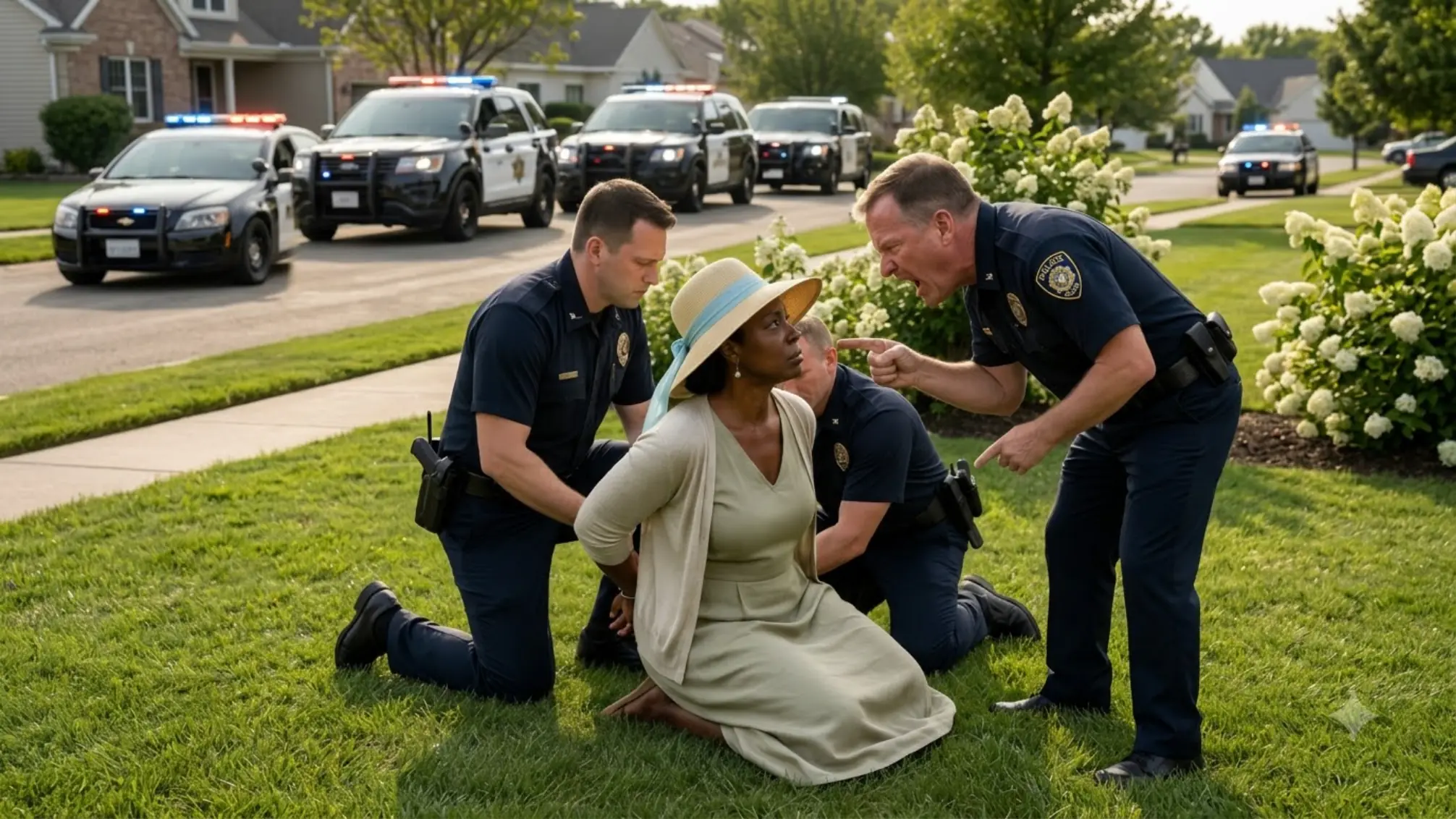
Mercer leaned so close that Naomi could smell coffee on his breath. “You’re in no position to threaten anybody while you’re on your knees.” He pointed toward the street as if the neighborhood itself belonged to him. Naomi looked past his shoulder and answered, “Then keep talking—because in thirty seconds, you’ll wish you hadn’t touched me at all.”
The confrontation had begun less than ten minutes earlier. Naomi had spent the morning working from home before changing into a light beige-green summer dress, a cream cardigan, and the pale-blue sun hat her daughter had given her for Mother’s Day. Gardening was one of the few things that emptied her mind completely. She had been watering white hydrangeas along the front walk when the first patrol car stopped at the curb.
Officer Mercer stepped out with Officer Daniel Reese. A third patrol unit pulled up seconds later, and Mercer crossed the lawn without greeting her. “Put the hose down.” Naomi looked toward the uniform, then toward the water running harmlessly over the flowers. “Why?”
“We received a report of a suspicious person around this property.” Naomi stared at him. “This property is mine.” Mercer’s eyes moved from her gardening hat to her dress, then toward the large brick house behind her. “We’ll determine that.”
Naomi turned off the nozzle and set it beside the flower bed. “My identification is inside.” Mercer immediately stepped in front of her. “You’re not going anywhere.” Naomi’s expression sharpened. “Then how exactly would you like me to prove I live here?”
Reese glanced toward the mailbox. The name BROOKS was clearly engraved on a brass plate beside the driveway. He started to speak, but Mercer raised one hand. “We have procedures.”
Naomi almost smiled. “Good. Follow them.” Mercer disliked the answer instantly. “First, tell me what you’re doing here.”
“Watering my hydrangeas.”
“Don’t get smart.”
“You asked.”
The third officer, Paul Jennings, arrived from the second cruiser and walked across the lawn. Mercer explained that a neighbor had reported an unfamiliar woman “wandering around” the property and looking into windows. Naomi slowly turned toward her own living-room window, then back at him. “I was checking whether I left my phone inside.”
Mercer folded his arms. “Do you expect me to believe this is your house?” Naomi’s eyes hardened. “I expect you to verify it.” She nodded toward the front door. “There are cameras above the porch, my vehicle is registered to this address, and my identification is thirty feet from where you’re standing.”
Jennings looked toward Mercer. “We can run the property records.” Mercer ignored him.
Instead, he asked Naomi to state her full name. “Naomi Elaine Brooks.” Reese entered it into the mobile terminal attached to his uniform. The screen loaded slowly.
Mercer looked at Naomi’s hands. “Turn around.” She remained still. “For what?”
“Until we figure out who you are.”
“No.”
The single word changed his face.
Mercer stepped closer. “What did you say?” Naomi held his stare. “I said no. I am standing on my own lawn, unarmed, cooperating with your questions, and you have given me no legal reason to put my hands behind my back.”
Reese quietly said, “Grant, give the system a second.” Mercer did not look away from Naomi. “She’s refusing instructions.”
Naomi replied, “An instruction does not become lawful because you say it loudly.” Mercer’s jaw tightened. “You want to play lawyer?”
“No.”
She paused.
“I want you to do your job correctly.”
That was when Mercer grabbed her wrist.
Naomi pulled back instinctively. “Take your hand off me.” Mercer immediately used the movement as justification to seize her other arm. Reese stepped forward, surprised by how quickly the interaction had escalated.
“Grant, hold on.”
“Stop resisting!”
“I’m not resisting.”
Mercer forced Naomi toward the grass. Her knee struck the lawn before Jennings caught part of her weight, preventing her from falling completely forward. The garden hose rolled beneath her dress, sending a stream of cold water across the ground.
Several neighbors came outside.
Phones appeared.
Naomi heard Mercer order her to place both hands behind her back. She complied because she understood something he apparently did not: once physical control had begun, arguing with hands was more dangerous than arguing with words.
Reese looked at his terminal.
Then he froze.
“Grant.”
Mercer was still gripping Naomi’s wrist.
“What?”
“We have a match.”
“Good.”
Reese stared at the screen.
“No. I mean we have a match.”
Mercer turned.
Reese lowered his voice. “This address is registered to Naomi Brooks.”
Mercer looked toward the woman kneeling in front of him.
Naomi said nothing.
Jennings asked, “Anything else?”
Reese scrolled.
His expression changed again.
“Yes.”
“What?”
Before he could answer, the sound of engines came from the end of the street.
Three black SUVs turned the corner.
Naomi closed her eyes for half a second.
Mercer looked toward them.
“What the hell is this?”
Naomi shifted slightly against the pressure on her arms. “That would be the people I told you were coming.”
The SUVs accelerated toward the house before braking sharply along the curb. Doors opened almost simultaneously, and men and women in dark suits stepped onto the street. The first person out of the lead vehicle immediately saw Naomi on her knees.
His face changed.
“Attorney General Brooks!”
Mercer’s hand released her wrist.
Everyone on the lawn went still.
The man crossed the grass fast, displaying credentials as he approached. “Special Agent Marcus Lane, Executive Protection Division.” Two more security officers moved behind him while another immediately began speaking into a radio. Mercer stared from Lane to Naomi.
“Attorney General?”
Naomi slowly turned her head.
“Yes, Officer.”
Mercer stood.
For the first time, he looked frightened.
Naomi Brooks was the recently appointed Attorney General of the fictional Commonwealth of Franklin, a neighboring-state legal chief visiting her Virginia-area residence while coordinating a multistate public corruption case. She had worked as a prosecutor, civil-rights attorney, and state solicitor before taking office. Her security detail did not ordinarily remain parked outside her home when no credible threat existed, but that afternoon they had been scheduled to collect her for a protected interstate meeting.
They were thirty seconds early.
Those thirty seconds changed everything.
Marcus knelt beside Naomi. “Ma’am, are you injured?” Naomi looked at her damp dress and wrists. “Nothing serious.”
Marcus turned toward Mercer.
“What happened?”
Mercer immediately began speaking. “We received a suspicious-person call and she refused lawful commands.”
Naomi looked directly at Reese. “Is that what happened?”
Reese swallowed.
“No, ma’am.”
Mercer snapped, “Daniel.”
Reese ignored him.
“She told us she lived here. I began verifying the address. The records came back matching her name.”
Marcus asked, “When was she restrained?”
Reese hesitated.
“Before verification finished.”
Jennings added quietly, “She offered to retrieve identification.”
Mercer looked betrayed.
Naomi remained kneeling.
“Would someone mind removing the handcuffs?”
Only then did everyone realize Mercer had already secured one wrist.
Marcus’s face went cold.
Reese unlocked the cuff immediately and helped Naomi stand. She rubbed her wrist while Marcus retrieved her fallen hat from the grass.
Across the street, neighbors continued recording.
One woman whispered, “That’s the Attorney General.”
Another answered, “It shouldn’t matter who she is.”
Naomi heard her.
She turned toward the woman.
“Exactly.”
Mercer looked desperately toward Marcus. “I had a report. We don’t know who people are when we arrive.”
Naomi adjusted her cardigan.
“That is why verification exists.”
“You challenged my instructions.”
“I challenged an unnecessary detention.”
“You pulled away.”
“When you grabbed me without explaining why.”
Mercer opened his mouth again.
Naomi raised one hand.
“No.”
He stopped.
“Do not rewrite this because you finally learned my title.”
The street went quiet.
Naomi pointed toward Reese’s body camera. “Whatever happened is already recorded.” Then she looked toward the porch camera above her front door. “And that camera recorded it from beginning to end.”
Mercer’s face tightened.
Marcus stepped beside Naomi. “We can secure the scene.”
“No.”
Naomi shook her head.
“This is not my investigation.”
Marcus understood immediately.
Naomi continued, “Notify their supervisor. Preserve body-camera video, dispatch audio, property verification records, and my home-security footage.”
Mercer looked at her.
“You’re opening an investigation?”
“I’m preserving evidence.”
She paused.
“Those are not the same thing.”
Twenty minutes later, Captain Ellen Price arrived from the county police department. She was visibly disturbed when she saw the Attorney General standing barefoot on her own lawn because one shoe had come loose during the takedown. Mercer and the other officers were separated for statements.
Price approached Naomi carefully.
“Attorney General Brooks, I am deeply sorry.”
Naomi looked at her.
“For what?”
Price hesitated.
“For what happened.”
“You don’t know everything that happened yet.”
Price glanced toward the officers.
“No, ma’am.”
“Then investigate it before apologizing for conclusions you haven’t reached.”
Price nodded.
That answer surprised several people.
Naomi was angry.
But she did not want anger replacing process.
She had spent too many years prosecuting cases where bad assumptions poisoned otherwise legitimate investigations. Evidence had to come first, even when she was the person kneeling in the grass.
The first piece of evidence came from dispatch.
At 2:14 p.m., a neighbor named Cynthia Warren had called police. She reported “a Black woman wandering around the expensive house next door” and said she had never seen the woman before.
Dispatch asked whether the person was attempting entry.
Cynthia answered, “She keeps going near the windows.”
The dispatcher asked whether she had broken anything.
“No.”
Threatened anyone?
“No.”
Carrying a weapon?
“She has a hose.”
The dispatcher classified the call as a low-priority suspicious-person report.
Nothing in the call suggested immediate danger.
That became important.
Body-camera footage showed the officers arriving four minutes later. Naomi was visibly watering flowers when they approached.
She did not run.
She did not hide anything.
She did not threaten anyone.
She immediately said she lived there.
She offered identification.
Reese began checking her name.
Then Mercer escalated.
The footage captured every sentence.
Including one Captain Price listened to three times.
Mercer had said, “People who own places like this usually know how to cooperate.”
Price stopped the video.
“What does that mean?”
Mercer, sitting across from investigators, answered, “Nothing.”
“That is not an answer.”
“I was frustrated.”
“Why?”
“She was challenging me.”
Price leaned forward.
“Were her statements incorrect?”
Mercer looked down.
The investigation expanded beyond the single afternoon.
Internal affairs reviewed Mercer’s prior complaints.
There were seven.
Four had been dismissed.
One involved a delivery driver detained outside a luxury condominium after a resident reported him as suspicious.
Another involved a Black real-estate agent showing a property to clients.
A third involved a Latino contractor working on a home renovation.
Each incident had ended without charges.
None alone had produced enough evidence for major discipline.
Together, they created questions supervisors had failed to ask.
Naomi learned about the pattern several days later.
She did not celebrate.
She became more concerned.
“Why were the earlier complaints closed?” she asked Captain Price.
“Different supervisors reviewed them.”
“That is not what I asked.”
Price opened the files.
“Two were marked insufficient evidence. One complainant stopped cooperating. Another was categorized as communication failure.”
Naomi looked toward the body-camera summaries.
“Was there video?”
“Yes.”
“Did anyone compare the cases?”
Price went quiet.
“No.”
That was the institutional failure Naomi cared about.
One officer making a bad decision was serious.
A system collecting repeated warning signs without connecting them was more serious.
Then came the neighbor.
Cynthia Warren initially refused to speak with investigators after realizing whom she had called police on. She later agreed through an attorney.
Her explanation was simple.
She had lived across the street for eleven years.
Naomi had purchased the home six months earlier but spent much of her time between the capital and another residence. Cynthia had seen landscaping crews, staff, and security vehicles arrive occasionally.
She had never spoken to Naomi.
That afternoon she saw a Black woman gardening and decided she could not be the homeowner.
“Why?” the investigator asked.
Cynthia struggled for an answer.
“I just didn’t recognize her.”
“That is not the same thing.”
“I was concerned.”
“About what?”
Silence.
The investigator repeated the question.
Cynthia finally said, “I suppose I thought she didn’t look like someone who lived there.”
That sentence entered the report.
When Naomi read it, she closed the folder.
Her daughter Alicia, twenty-three and studying public policy, was sitting across from her kitchen table.
“You’re calmer than I would be,” Alicia said.
Naomi smiled faintly.
“No, I’m not.”
“You look calm.”
“That is different.”
Alicia looked toward her mother’s bruised wrist.
“What do you want to happen to him?”
Naomi knew exactly whom she meant.
“I want the investigation finished.”
“That’s such a lawyer answer.”
“It’s the correct answer.”
Alicia frowned.
“He put you on your knees in your own yard.”
“Yes.”
“You don’t want him fired?”
Naomi looked toward the hydrangeas visible through the window.
“I want whatever consequence the evidence supports.”
Alicia shook her head.
“I’d be furious.”
“I am furious.”
Naomi looked back at her.
“But if my anger becomes the standard, what happens when someone else with power is angry?”
Alicia understood.
That conversation stayed with her.
The internal investigation lasted seven weeks.
Mercer was removed from patrol during the review.
Reese and Jennings remained working but received temporary reassignment because they were witnesses.
The department invited an outside civil-rights consultant to review stop-and-detention practices.
The findings were uncomfortable.
Officers were not consistently documenting the specific facts justifying investigative detentions.
“Suspicious person” calls were often treated as though the caller’s suspicion itself established legal grounds.
It did not.
The report recommended a simple question supervisors should have been emphasizing for years:
Suspicious because of what behavior?
Not clothing.
Not neighborhood.
Not unfamiliarity.
Behavior.
Naomi liked the question.
She asked the department to make it central to training, but she refused to dictate disciplinary findings.
Mercer’s case proceeded separately.
Internal affairs found that he had unnecessarily escalated the interaction, failed to wait for readily available identity verification, made inappropriate comments suggesting assumptions based on the perceived status of the neighborhood, and used physical restraint before establishing sufficient justification.
The prior complaints strengthened concerns about judgment.
Mercer received substantial discipline and was removed from field patrol pending retraining and review.
Eventually, he resigned.
Some residents wanted Naomi to demand criminal charges.
She declined to use her office to influence prosecutors reviewing an incident in which she was personally involved.
“That decision belongs somewhere I cannot reach it,” she told reporters.
The sentence frustrated people who wanted a cleaner revenge story.
Naomi did not care.
Her office was already facing criticism from people claiming she had used her position to intimidate local police.
So she released a timeline.
Not privileged records.
Not personnel material.
Only verified facts already public.
The police had responded to a suspicious-person call.
She had stated she lived at the property.
Verification was underway.
She had been restrained before confirmation returned.
Body-camera footage documented the encounter.
Everything else would proceed through established systems.
Reporters kept asking the same question.
“What would have happened if those SUVs had not arrived?”
Naomi eventually answered.
“That is the question everyone should be asking.”
The room became silent.
She continued.
“If my security detail had not arrived, I would still have been the homeowner.”
Several journalists lowered their pens.
“If I had not been Attorney General, I would still have been the homeowner.”
She paused.
“And if I had not been the homeowner, I would still have been entitled to lawful treatment.”
That quote spread nationwide.
Naomi disliked how often headlines turned the incident into a story about powerful people being mistaken for ordinary people.
The message was backwards.
One evening she explained that frustration to Marcus Lane.
“They keep saying Mercer picked the wrong woman.”
Marcus leaned against her kitchen counter.
“He did.”
“No.”
Naomi shook her head.
“He made the wrong decision.”
Marcus understood the difference.
“If headlines say ‘Be careful who you mistreat because she might be important,’ what have we taught?”
“Nothing.”
“Exactly.”
Naomi returned to gardening the following weekend.
No cameras.
No reporters.
Just her hose and the hydrangeas.
A new police cruiser drove down the street and slowed.
Naomi stopped watering.
The officer inside waved.
She stared for half a second.
Then waved back.
The cruiser continued.
That ordinary interaction felt strangely important.
Months later, Captain Price invited Naomi to observe the department’s redesigned training program.
She attended anonymously at first, sitting along the back wall while new officers worked through hypothetical calls.
An instructor presented the scenario.
“Caller reports an unfamiliar person watering flowers outside an expensive home.”
Several recruits smiled nervously.
Everyone knew the reference.
The instructor continued.
“What do you know?”
One recruit answered, “That someone called.”
“Correct.”
Another said, “We know the person is watering flowers.”
“Correct.”
A third added, “We don’t know whether any crime occurred.”
The instructor nodded.
“Exactly.”
Then he asked the question Naomi had wanted.
“Suspicious because of what behavior?”
Nobody answered.
“Good.”
He moved to the next slide.
After the class, Naomi introduced herself.
The recruits straightened.
She laughed lightly.
“Relax.”
One young officer asked whether she hated police after what happened.
Naomi considered the question.
“No.”
“Why not?”
“Because three officers were on that lawn.”
She looked around the classroom.
“One escalated. Another tried to slow it down. A third eventually told the truth about what he saw.”
She paused.
“Uniforms don’t make one personality.”
The recruit nodded.
Naomi continued.
“My concern is whether the system encourages the right person and restrains the wrong one.”
That became another lesson.
Officer Reese later wrote Naomi a letter.
He apologized for not intervening sooner.
I knew the situation was going wrong before the handcuff came out, he wrote. I thought disagreeing with a senior officer in front of a civilian would make things worse. I understand now that silence also became a decision.
Naomi read the sentence twice.
She responded personally.
You cannot control another officer’s judgment. You are responsible for your own.
Reese kept the letter.
Years later, he became a field-training officer.
He used the incident when teaching recruits how to intervene respectfully when partners began escalating without justification.
He never named Naomi.
He told them the title did not matter.
Cynthia Warren eventually sold her house.
Before leaving, she crossed the street one afternoon while Naomi was trimming roses.
Naomi saw her approaching and set the shears down.
Cynthia stopped several feet away.
“I owe you an apology.”
Naomi waited.
“I saw you and decided you didn’t belong here.”
“Yes.”
Cynthia looked uncomfortable.
“I don’t know why.”
Naomi did not rescue her from the discomfort.
After several seconds, Cynthia continued.
“I think I do know.”
Naomi remained quiet.
Cynthia looked toward the expensive houses.
“I had an image in my head of who lived here.”
“And I didn’t match it.”
“No.”
Cynthia’s eyes filled.
“I’m sorry.”
Naomi nodded.
“I accept the apology.”
Cynthia looked surprised.
“That’s all?”
“What were you expecting?”
“I don't know.”
“Forgiveness isn't the same thing as pretending nothing happened.”
Cynthia nodded.
Naomi picked up her shears.
“Learn something from it.”
“I will.”
“Then the apology has somewhere to go.”
Cynthia walked away.
The hydrangeas bloomed spectacularly that year.
Naomi joked that they had received enough police attention to feel important.
Alicia did not find the joke funny.
Marcus did.
Three years after the incident, Naomi completed her term as Attorney General.
At her farewell event, staff assembled photographs from important moments throughout her career.
Major court victories.
Consumer settlements.
Public-corruption cases.
Civil-rights reforms.
One photograph showed Naomi standing beside her hydrangeas in the pale-blue hat.
No police.
No handcuffs.
No SUVs.
Just a woman holding a garden hose.
Alicia had chosen it.
Naomi smiled when she saw it.
“That’s what you picked?”
“Yes.”
“Why?”
“Because everyone else remembers what happened on that lawn.”
Alicia looked at her mother.
“I want to remember what you were doing before they arrived.”
Naomi stared at the picture.
Watering flowers.
Nothing suspicious.
Nothing important.
Nothing requiring explanation.
That was precisely the point.
The story people told afterward always began with police forcing a powerful Black woman onto her knees and ended with black SUVs arriving thirty seconds later.
Naomi preferred a different version.
A woman was watering her garden.
Someone decided she did not belong.
An officer accepted that assumption too quickly.
Another officer had doubts.
Evidence survived.
People told the truth.
A system was forced to examine itself.
That version lacked the satisfying instant of powerful vehicles rushing around the corner.
It also contained the actual lesson.
The SUVs did not make Naomi innocent.
Her title did not make the detention wrong.
Her office did not create her rights.
Those things merely forced everyone to look closely at a mistake that might otherwise have disappeared into another closed complaint file.
One quiet Sunday morning, years later, Naomi stood in the same yard wearing the same pale-blue hat.
She opened the hose.
Water spread softly across the hydrangeas.
A new family lived across the street.
Their little boy rode a bicycle along the sidewalk and called, “Hi, Ms. Brooks!”
Naomi waved.
“Morning, Ethan.”
Nothing else happened.
No cruisers arrived.
No engines roared down the street.
No one demanded identification.
For twenty peaceful minutes, Naomi Brooks was not an Attorney General, a headline, a former prosecutor, or the woman from the viral body-camera footage.
She was simply a homeowner watering her garden.
And after everything that had happened on that lawn, ordinary finally felt like victory.