The coffee had gone cold before the first patrol car stopped in front of the house.
The woman noticed the flashing lights through the narrow window beside her front door, but she did not immediately assume they had anything to do with her.
She had lived in the neighborhood for almost five years.
Large brick homes.
Trimmed lawns.
Stone walkways.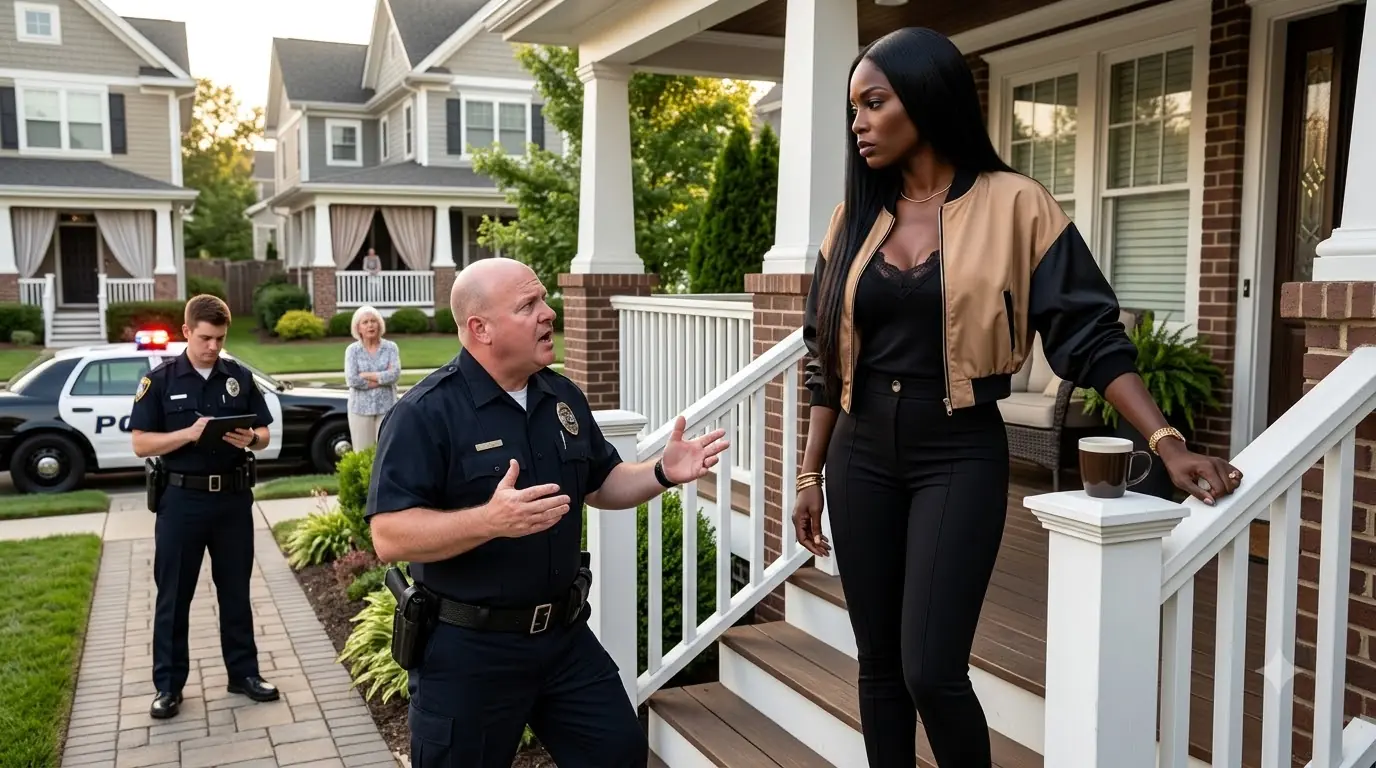
People who hired landscaping companies to make shrubs look naturally symmetrical.
The kind of place where delivery trucks were more common than patrol cars and disagreements usually involved property lines, barking dogs, or the color of someone’s new shutters.
The woman had spent most of Saturday morning working.
That was her first mistake.
Not legally.
Personally.
She had promised herself she would not open her laptop until Monday.
Instead, at 7:15 a.m., she had responded to one email.
One became three.
Three became a sixty-page motion she convinced herself she only needed to skim.
By noon she was still sitting at the kitchen island wearing black fitted lounge pants, a black lace-trim camisole, and a loose tan-and-black bomber jacket she had thrown on when the house felt cool.
Her long straight black hair fell past her chest.
She had done nothing to it beyond brushing it after her shower.
No courtroom suit.
No government badge clipped to a belt.
No leather briefcase.
No assistant standing nearby.
No professional title announced by clothing.
Just a thirty-nine-year-old woman at home on a Saturday.
That distinction would become important.
At 12:43, she finally closed the laptop.
She poured coffee.
Walked onto the front porch.
Then remembered the coffee was already three hours old.
She drank it anyway.
That was when the patrol car arrived.
It stopped directly in front of her house.
Red and blue lights flashed against the windows across the street.
The woman frowned.
The driver's door opened.
A heavyset bald white officer in his late forties stepped out.
Dark navy uniform.
Body camera.
Utility belt.
Broad shoulders.
Expression already tense.
A younger white officer got out of the passenger side.
He carried a tablet.
He looked toward the house number.
Then toward the woman.
The older officer began walking up the path.
The woman remained beside the porch railing.
A ceramic mug rested near her hand.
She glanced toward the neighboring lawns.
An elderly white woman stood near the edge of one driveway with her arms folded.
The woman on the porch recognized her.
Not well.
They had exchanged polite greetings.
Borrowed a package once.
Discussed a tree trimming service another time.
Nothing more.
The older officer stopped at the bottom of the porch stairs.
“Ma’am.”
The woman looked down at him.
“Officer.”
“Can you come down here?”
She glanced toward the younger officer.
Then back.
“Why?”
The older officer seemed surprised.
“We received a call.”
“About?”
“Suspicious person.”
The woman looked toward the street.
Then toward herself.
“Where?”
“This residence.”
She slowly looked behind her at her own front door.
Then back at him.
“I live here.”
The officer’s expression barely changed.
“Come down here and we’ll sort that out.”
The woman placed one hand on the porch post.
“I can hear you perfectly well from here.”
His jaw tightened.
“I asked you to come down.”
“And I asked why.”
The younger officer looked toward the address numbers mounted beside the garage.
Then began typing on his tablet.
The older officer stepped closer to the stairs.
“We got a report of someone entering this house who may not belong here.”
The woman stared.
“I entered my own house.”
“That’s what we’re checking.”
She looked toward the elderly neighbor.
The neighbor immediately looked away.
Understanding arrived.
Not certainty.
Enough.
The woman looked back toward the officer.
“Was the caller the woman standing over there?”
The officer glanced toward the neighbor.
“That’s not relevant.”
“It is to me.”
“Ma’am, step down here.”
The woman did not move.
“I am standing on my porch.”
“I know.”
“Then why would I need to come onto the sidewalk for you to verify that?”
His face tightened again.
“Because I gave you a lawful instruction.”
The woman’s expression changed slightly.
There it was.
Not yet a confrontation.
The shape of one.
She had spent fifteen years inside courtrooms.
She understood how quickly language could move from request to command and from command to justification.
She knew the difference between inconvenient police contact and unlawful police contact.
More importantly, she knew that knowing the law did not automatically make an encounter safer.
So she did something she had learned long before becoming a prosecutor.
She slowed down.