Cruel laughter rolled across the Pecos River Valley as Katrina Foster stirred the enormous cast-iron pot beside the chuck wagon. Nearly a dozen cowboys stood behind Jeb Rollins, laughing hard enough to bend at the waist while he pointed at her stained apron and broad figure. Katrina kept her gaze on the stew, but her grip tightened around the wooden spoon until her knuckles paled. Across the camp, Trail Boss Wilmer Morales watched the humiliation with one hand resting beside his revolver.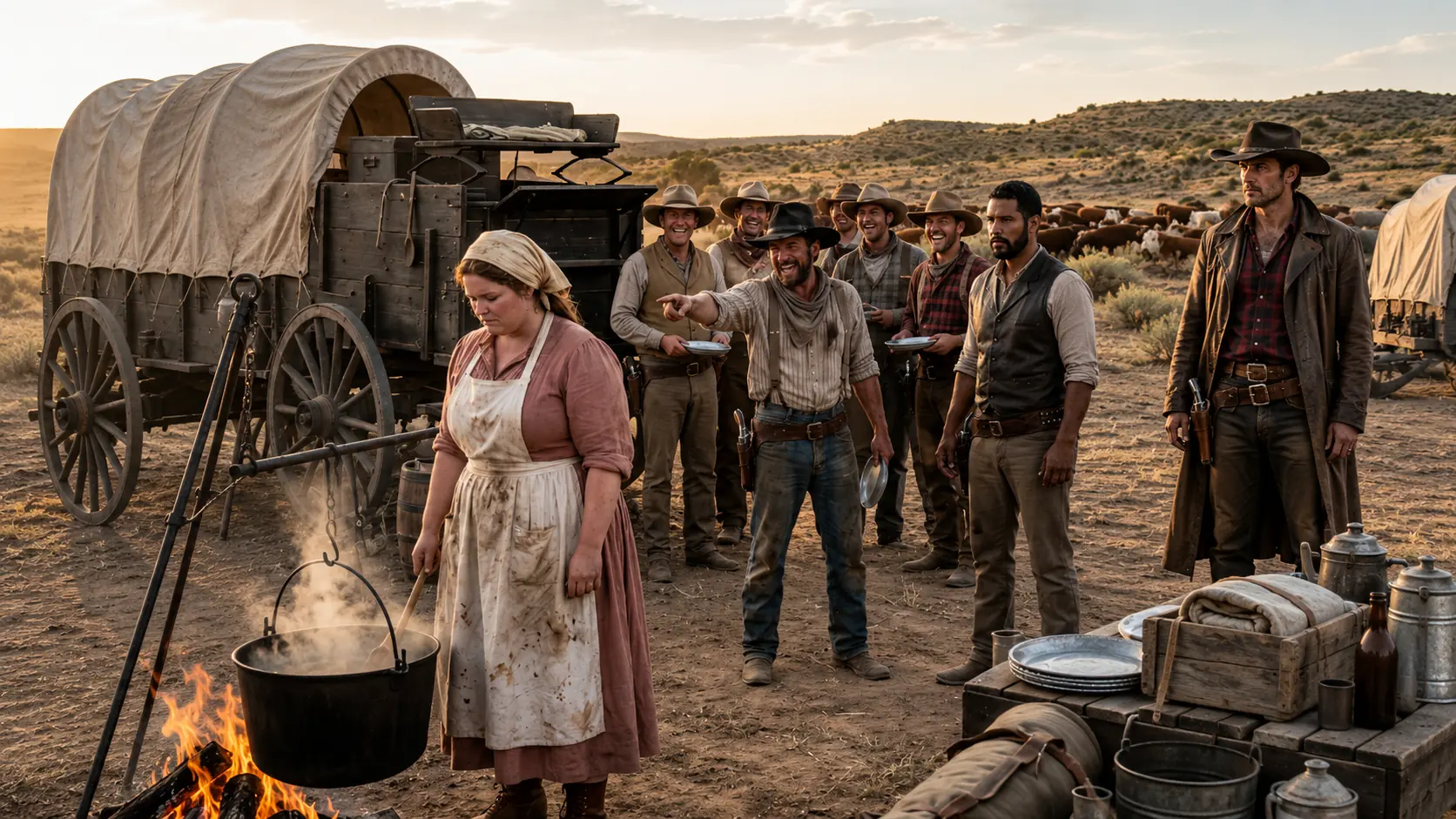
The year was 1878, and the combined Double H and Cross Tie outfits were driving almost three thousand longhorn cattle north through West Texas. A hundred cowboys depended on the chuck wagon for every biscuit, cup of coffee, and hot meal they received along the trail. Their former cook had died from illness only days before departure, leaving Wilmer desperate enough to hire the first capable person willing to endure the journey. Katrina had been the only applicant who did not flinch when he described the work.
She was twenty-six years old, tall, heavily built, and stronger than most men expected. Her broad shoulders and thick arms came from years spent helping her father inside his Fort Worth butcher shop, lifting sides of beef, carrying flour sacks, and breaking down heavy bones. He had taught her to use every part of an animal and waste nothing. He had also taught her that a strong body was a blessing, even when the rest of the world insisted on treating it as a joke.
Katrina had proved her strength on the day Wilmer hired her. Without asking for help, she lifted a fifty-pound sack of flour into the Studebaker wagon and stacked it neatly beside the coffee tins. Wilmer had watched her balance the weight, then checked the order list she had prepared before arriving. She had calculated enough beans, bacon, cornmeal, dried fruit, coffee, and salt to feed the outfit for the first three weeks.
“You have done this before,” he said.
“I have fed hungry men before,” she answered. “Cattlemen are only louder about it.”
Wilmer had offered her the position immediately.
The cowboys were less impressed. By the end of the first day, Jeb Rollins had begun calling her Big Kat. By the third, he suggested that the chuck wagon needed an extra horse because Katrina’s weight was slowing it down. Other men joined his laughter, not because every one of them hated her, but because cruelty became easier when performed as a group.
Katrina answered none of it. She rose before dawn, rekindled the fire, and baked sourdough biscuits while the men saddled their horses. She prepared bacon crisp enough to break cleanly and brewed coffee so rich that even the most exhausted drovers returned for a second cup. At night, she served beans thickened with salt pork, onions, and peppers from a private box beneath the wagon.
The same men who mocked her scraped their plates clean.
Jeb always returned for more.
That evening beside the Pecos, his mockery finally crossed a line. He approached the pot after everyone else had eaten and slammed his tin plate against the wagon’s wooden tailgate. Katrina did not look up immediately.
“More stew,” he ordered.
“There is enough,” she said. “Ask properly.”
Jeb glanced toward his companions, eager for another laugh. “What do I call you? Miss Foster, or do I just whistle like I’m calling hogs?”
The nearby cowboys fell quiet.
Katrina slowly turned toward him. Tears threatened behind her dark eyes, but her voice remained steady.
“You call me the woman who has fed you every day since Fort Worth.”
Jeb stepped nearer. “You should be grateful we leave anything for you.”
A gloved hand closed around his shoulder.
Wilmer spun him around with enough force to nearly tear his shirt. The trail boss did not raise his voice. He never needed to.
“You will apologize.”
Jeb tried to laugh. “Boss, we were only having fun.”
“I did not hear her laughing.”
The camp became silent enough to hear the stew bubbling.
Jeb looked around for support, but the other men avoided his eyes. Wilmer’s expression warned that another careless word might end with Jeb eating dirt instead of supper.
“Sorry, Miss Foster,” he muttered.
“Louder.”
“I am sorry.”
Wilmer released him. “Take your plate beyond the remuda. You will eat alone tonight.”
Jeb stared at him. “You are punishing me over a cook?”
“I am punishing you because a man who humiliates the person feeding him is too stupid to sit beside the herd.”
Jeb snatched his plate and walked away beneath the embarrassed silence of the crew.
Wilmer remained beside the wagon. Katrina turned back to the pot, pretending the steam was responsible for the moisture in her eyes. He removed his hat.
“You run a fine camp, Miss Foster.”
“Thank you.”
“Do not let the barking of small dogs trouble a woman of your stature.”
Katrina looked at him.
No one had ever used that word about her size before. Large, heavy, fat, enormous—she had heard them all. Stature sounded different. It made her body seem like something built to stand rather than something she was expected to hide.
Wilmer replaced his hat and walked toward the herd.
For the first time since joining the drive, Katrina smiled after him.
During the next month, the outfit settled into a hard but reliable rhythm. The cowboys drove cattle from sunrise until the light disappeared, while Katrina moved ahead with the chuck wagon to establish the evening camp. She selected level ground, found water, stacked fuel, and prepared enough food for a hundred exhausted men.
The mockery did not disappear, but it weakened. Men who spent fifteen hours in the saddle learned quickly that insulting the person who controlled the coffee was a poor strategy. Several began offering to carry water or split wood. Others thanked her quietly when Jeb was not close enough to hear.
Wilmer continued watching from a distance.
He noticed that Katrina always saved the softest biscuits for younger cowboys nursing saddle sores. When an older drover lost two teeth after being thrown from a horse, she cooked his portion until it required no chewing. When supplies began running short, she adjusted the meals without letting the men realize how close they had come to hunger.
One evening, Wilmer found her repairing a split flour sack with twine.
“You should have told me we were running low.”
“You already have three thousand cattle, a hundred men, and a river crossing to worry about.”
“Food is my concern too.”
“Then stop sending riders back for coffee before dawn.”
He almost smiled. “They say it keeps them alive.”
“They say many foolish things.”
“Some of them say you make the best biscuits west of the Mississippi.”
Katrina glanced toward him. “Do they say it where I can hear?”
“No.”
“Then they are cowards.”
This time Wilmer did smile.
The weather changed without warning in early May.
The morning began warm, with open blue sky stretching over the plains. By afternoon, a dark wall of clouds appeared in the north, and the temperature dropped so quickly that sweat froze beneath the cowboys’ shirts. Wind struck the camp like a charging animal.
Wilmer looked toward the blackening horizon and shouted for the men to tighten the herd.
A blue norther descended upon them.
Sleet tore across the valley sideways. Thunder cracked above the longhorns, driving panic through the animals. Thousands of cattle pressed together, their horns striking as the herd began to surge.
Cowboys rode the perimeter, singing loudly through frozen lips to keep the longhorns turning in a circle. A single break could become a stampede powerful enough to crush horses and men beneath it. Wilmer remained in the saddle for nearly twenty hours, moving from one weak point to another while the storm erased the landscape around him.
Katrina fought her own battle beside the chuck wagon.
She wrapped canvas around the fire and used her body to shield it from the wind. Every time a half-frozen rider returned, she forced hot coffee into his hands and made him swallow bacon grease spread over thick pieces of bread. She dried gloves over the flames, changed soaked bandages, and dragged heavy logs across freezing mud.
The storm lasted two days.
When the clouds finally broke, the cattle still stood, but the camp looked destroyed. Canvas shelters had collapsed. Horses shook beneath blankets. Men stumbled back from the herd with blue lips, swollen fingers, and coats frozen stiff against their bodies.
Wilmer dismounted beside the wagon and nearly fell.
Katrina caught him beneath the arms.
“I am fine,” he insisted.
“You cannot stand.”
“I have stood through worse.”
“Then sit through this.”
She pushed him onto an overturned barrel and wrapped a blanket around his shoulders. Wilmer was too exhausted to argue. Katrina placed a cup of hot broth into his hands and watched until he drank.
“You stayed awake the entire storm,” he said.
“So did you.”
“I had a saddle beneath me.”
“I had a hundred foolish men to keep alive.”
His eyes held hers. “You count me among them?”
“You are their leader. That makes you the greatest fool here.”
Wilmer gave a weak laugh.
The sickness began the following day.
At first, it seemed like ordinary exhaustion. Men coughed, shivered, and complained of aching joints. Then fevers climbed, breathing became difficult, and cowboys who had faced stampeding cattle without fear began gasping beneath their blankets.
By the second evening, forty men were unable to rise.
Doc Abernathy moved from patient to patient, but his supply of medicine had been ruined during the storm. The remaining whiskey could dull pain but would not stop the illness spreading through the camp. Several men began showing signs of severe pneumonia.
Jeb Rollins lay among the sickest.
His lean body shook violently beneath two blankets, and every breath produced a wet rattle. The man who once filled the camp with mocking laughter could barely whisper Katrina’s name.
Wilmer stood beside the chuck wagon, staring across the rows of suffering men.
“We are losing them,” he said.
Katrina followed his gaze. The healthy riders could barely manage the herd. If more men fell ill, the outfit would be stranded. If the fever continued unchecked, they would soon be digging graves in frozen earth.
“What does the doctor need?” she asked.
“Medicine he does not have. Heat, nourishment, anything that gives their bodies a chance.”
Katrina removed her apron and tied it again more tightly.
“Then move away from my wagon.”
Wilmer looked at her.
“If the doctor cannot strengthen them, the cook will.”
She opened the hidden storage compartment beneath the wagon. Inside were dried chilies, wild mushrooms, garlic, prairie onions, herbs, and several packets of seasoning purchased with her own wages. Her father had taught her recipes used during hard winters when sickness moved through poor neighborhoods faster than doctors could follow.
Katrina needed more than herbs.
She needed marrow, fat, meat, and bone.
“Kill one of the younger steers,” she ordered.
A nearby cowboy stared at her. “We cannot butcher company cattle.”
“You can bury forty men instead.”
The cowboy looked toward Wilmer.
The trail boss nodded. “Give her the steer.”
For the next twenty-four hours, Katrina barely stopped moving. She supervised the butchering, claimed the marrow bones, joints, neck, and every rich cut the drovers normally ignored. She roasted the bones beside the fire until the marrow softened, then lowered them into the largest cauldron.
Water, meat, garlic, onions, mushrooms, chilies, and herbs followed. She skimmed the surface, adjusted the flame, and stirred until the broth became dark, thick, and fragrant. Steam surrounded her while soot marked her cheeks and strands of brown hair escaped beneath her headscarf.
The aroma spread through the camp.
Even men too weak to open their eyes reacted to it.
Wilmer watched Katrina lift the cauldron’s lid. Firelight moved across her broad arms and determined face. In that moment, he did not see the woman the cowboys had mocked. He saw the strongest person on the entire trail.
Katrina filled tin cups and carried them among the sick.
Her first stop was Jeb.
His eyes opened when her shadow crossed him. Shame replaced feverish confusion as he recognized the woman kneeling in the mud beside his blanket.
“You should leave me,” he whispered.
“Drink.”
“After what I said—”
“Your punishment is surviving long enough to regret it.”
She slipped one hand behind his neck and raised his head. Jeb drank. The chili burned his throat and made him cough, but Katrina held him steady until he swallowed the entire cup.
“Again in one hour,” she said.
Tears gathered in his eyes. “Why are you helping me?”
“Because I know the difference between a cruel man and a dying one.”
She moved to the next patient.
All night, Katrina carried broth from the cauldron to the sick men. She fed those too weak to hold their cups, changed sweat-soaked blankets, and forced stubborn cowboys to drink. Wilmer brought water and firewood, refusing to leave her alone.
Near dawn, the camp changed.
The violent shivering eased. Men began sweating heavily as their fevers broke. Their breathing remained rough, but the terrible rattling weakened.
Doc Abernathy examined one patient, then another.
“I do not understand it,” he said.
Katrina continued filling cups. “Understanding can wait.”
By sunrise, no one had died.
Wilmer found Katrina beside the pot, scrubbing it with coarse salt. Her dress was stained, her boots buried in mud, and exhaustion bent her shoulders.
He took the cleaning bucket from her hands.
“You saved them.”
“They are not recovered yet.”
“They are alive.”
She looked across the camp. “For now.”
“Katrina.”
It was the first time he had spoken her name without formality. She turned toward him.
“Jeb called you a burden,” Wilmer said. “Those men laughed at the space you occupied. Last night, your strength carried every one of them.”
Katrina lowered her eyes.
“All my life, people acted as though there was too much of me,” she said. “Too much body. Too much appetite. Too much space taken from prettier women and thinner ones.”
Wilmer stepped closer.
“There is not too much of you.”
She looked up.
“There is exactly enough to stand when everyone else falls.”
Before she could answer, hoofbeats thundered from the ridge.
A young night rider named Silas galloped into camp, blood running from a graze along his shoulder.
“Rustlers!” he shouted. “Twelve riders coming from the arroyo. They know half the camp is sick.”
Wilmer’s expression hardened.
Only six men were strong enough to fight. The rest could barely sit upright. Losing the herd would destroy both ranches financing the drive, but resisting could lead to a massacre.
“Healthy men, rifles,” Wilmer ordered. “Use the wagons for cover.”
Katrina returned to the chuck wagon.
Brazos Bill and his rustlers appeared along the ridge moments later. Their faces were covered, rifles resting across their saddles. They rode into the camp laughing at the sight of feverish men lying beneath blankets.
Brazos stopped thirty yards away.
“Morales, your outfit looks ready for burial. Drop your weapons, and we take the cattle without killing anyone.”
Wilmer stepped into the open with his revolver drawn.
“You will leave with nothing.”
“I count six guns.”
“Then count the bullets carefully.”
Brazos raised his rifle.
A massive shadow moved beside Wilmer.
Katrina stepped forward holding the double-barreled ten-gauge shotgun she kept beneath the chuck wagon seat. Her broad shoulders were squared, and her soot-streaked face carried no fear.
She cocked both hammers.
The sound silenced the rustlers.
Brazos laughed uneasily. “Go back to your cooking, woman.”
“The only thing cooking next will be whichever fool rides closer.”
“You think being large makes you frightening?”
“No,” Katrina said. “The buckshot does.”
Brazos aimed at her.
Wilmer shifted beside her. “You will lower that rifle.”
The outlaw ignored him. “Move, fat woman.”
Katrina stepped in front of Wilmer, shielding him completely.
“At this distance, one barrel removes you and the man beside you. The second catches whoever still thinks stealing these cattle was wise.”
A weak voice rose behind her.
“She is not just the cook.”
Jeb Rollins had dragged himself against a wagon wheel. His face was pale, his hands shaking, but he held a carbine pointed toward the rustlers.
“She saved every man in this camp,” he wheezed. “Touch her, and we spend our last breath killing you.”
One by one, the sick cowboys pushed themselves upright.
Rifles appeared from beneath blankets. Revolvers rested against crates and wagon wheels. Forty fever-weakened men aimed at the ridge.
Their hands trembled, but their loyalty did not.
Brazos looked from Katrina’s shotgun to the line of armed men behind her. The arithmetic had changed.
One of his riders leaned close. “Not worth dying for, boss.”
Brazos lowered his rifle.
“You got lucky, Morales.”
Wilmer looked at Katrina. “No. I hired well.”
The rustlers turned and rode away.
Only after they disappeared did Katrina lower the shotgun. Her knees weakened as the fear she had refused to feel finally reached her.
Wilmer caught her around the waist.
“I have you,” he whispered. “You carried everyone else. Let me carry you for one minute.”
A ragged cheer rose from the camp.
Jeb began crying openly.
Two weeks later, the outfit delivered the herd to Fort Sumner. Despite the storm, sickness, and attempted theft, nearly all the cattle arrived in strong condition. The buyers paid Wilmer a generous bonus after hearing how the camp survived.
That evening, the cowboys gathered beside the Pecos River.
Jeb approached Katrina alone. He held his hat between both hands and could barely meet her eyes.
“I was cruel because making the others laugh made me feel important.”
Katrina waited.
“You saved me when you had every reason not to.”
“I had one reason.”
“What?”
“You were alive.”
Jeb swallowed. “I will spend the rest of my days remembering that.”
“Spend them behaving better.”
He nodded.
Later, Wilmer asked Katrina to walk with him along the river. Spring had returned, softening the cold earth with patches of green. He carried something inside his vest but remained silent until they reached a cottonwood away from the celebration.
“I have driven cattle through storms, droughts, and outlaw country,” he said. “I believed strength looked like a man who never fell.”
Katrina watched him.
“Then I saw you feed the people who mocked you, stand between bullets and men who did not deserve your mercy, and hold this outfit together while the rest of us broke.”
He removed a silver locket from his pocket.
“Katrina Foster, you are the strongest heart I have ever known.”
Her eyes filled with tears.
“I am not the kind of woman men usually ask.”
“I am not asking for the kind men usually want.”
“What are you asking for?”
“You.”
Wilmer took her hand.
“Build a ranch with me. Run the kitchen, the accounts, the herd, or all three if that pleases you. Argue with me when I am wrong. Feed me when I am foolish. Let me spend my life making certain no one ever convinces you to become smaller again.”
Katrina laughed through her tears.
“You make marriage sound like managing a difficult camp.”
“With fewer cattle, I hope.”
She closed her fingers around the locket.
“I will marry you on one condition.”
“Name it.”
“I cook the wedding meal.”
Wilmer smiled. “I would not trust anyone else.”
When they returned to Texas, they established the Morales Ranch beside a reliable creek north of Fort Worth. Jeb became their foreman and enforced one unbreakable rule with every new cowboy: no person working beneath the Morales brand would be mocked for the body carrying them through the world.
Katrina became known across the territory for her cooking, but that was not why people respected her. They remembered the storm, the fever, the cauldron, and the shotgun held steady before twelve armed men. They remembered that when the camp laughed at her size, she answered with dignity.
When they fell, she used that same strength to lift them.
The cowboys once claimed Katrina Foster took up too much space.
By the end of the drive, every man among them understood the truth.
Without her, none of them would have lived to fill that space at all.