“I don’t care who you work for. Step away from that truck.”
Deputy Sheriff Wade Mercer planted one hand against Captain Ethan Cole’s chest and pushed him back toward the olive-green military transport. Heat shimmered above the highway outside Fort Irwin, California, while two more Army vehicles waited behind them with their engines running. Mercer’s mirrored aviator sunglasses concealed his eyes, but the contempt in his voice was impossible to miss.
Captain Cole did not move.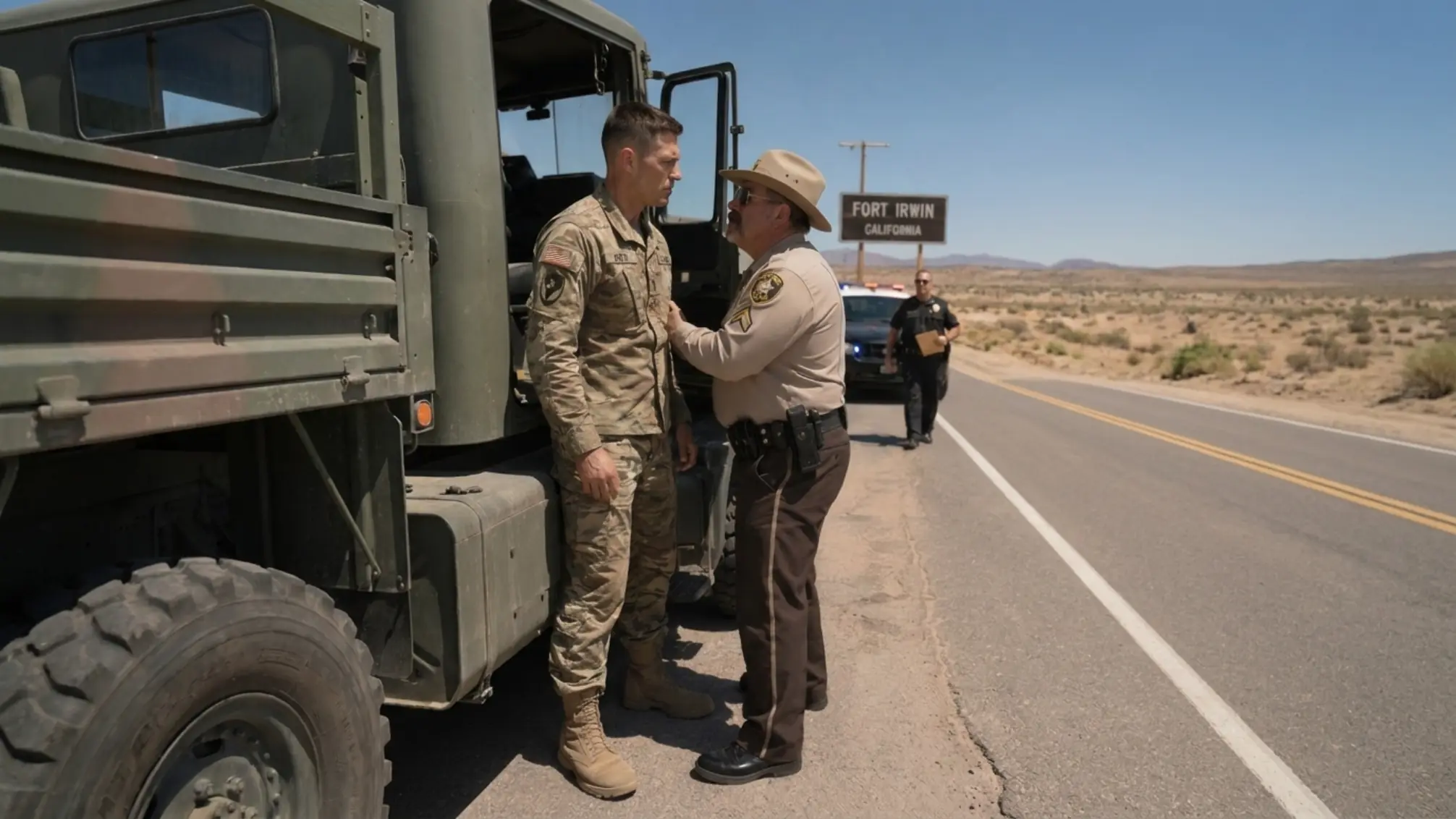
He was thirty-eight, tall and athletic, with short dark-brown hair, steady hazel eyes, and the restrained posture of a man trained not to react emotionally when someone else lost control. His camouflage uniform was clean despite the desert dust, and the silver bars on his chest clearly identified his rank. He kept both hands visible near his sides while Mercer tightened his grip on his sleeve.
“You are interfering with a classified military convoy,” Cole said.
Mercer laughed. “Out here, your rank means nothing.”
The deputy had stopped the three-vehicle convoy twelve minutes earlier after claiming the lead truck exceeded the speed limit by nine miles per hour. Captain Cole had immediately provided his military identification, transport authorization, and the telephone number of the civilian liaison coordinating the convoy’s route with county authorities. Mercer barely glanced at the documents before ordering every soldier out of the vehicles.
Cole refused.
The sealed orders prohibited unauthorized personnel from accessing the rear compartments. Only individuals listed on the transport manifest could inspect the cargo, and Mercer’s name was not there. Cole offered to wait while the deputy contacted dispatch, the military police liaison, or Fort Irwin command.
Mercer had contacted no one.
Instead, he parked his cruiser across the road, switched on its emergency lights, and began treating the soldiers as though they were smugglers using uniforms as disguises. He demanded keys to the rear compartment and threatened to arrest Cole for obstruction.
“You can verify the orders through the number printed on the first page,” Cole said.
“I don’t need permission from some base clerk to search a vehicle on my road.”
“This is a federally authorized military movement.”
“This is San Bernardino County.”
“And federal law still exists inside it.”
Mercer stepped closer until their faces were only inches apart. “You Army boys spend too much time behind gates. You forget what happens when you enter the real world.”
Several soldiers inside the transport shifted uneasily.
Staff Sergeant Lucas Harper stood near the second truck, watching his captain carefully. He had served with Cole in Afghanistan and knew the officer’s calmness did not mean weakness. It meant Cole was calculating every possible outcome and choosing the one least likely to escalate the situation.
Harper also knew what the convoy carried.
Inside the sealed rear compartment was a prototype battlefield communication system designed to restore secure medical and command networks after cyberattacks or infrastructure failures. It was scheduled for a demonstration at a remote testing facility before sunset. The equipment itself was classified, but the more urgent concern involved the temperature-controlled batteries powering it.
If the convoy remained stationary much longer beneath the desert sun, the battery-management system would activate emergency shutdown procedures. Restarting the system required a secure technical team that was already waiting forty miles away.
Cole checked his watch.
“We have been here long enough,” he said. “Contact your supervisor.”
“I am the authority on this road.”
“No. You are one deputy refusing to verify lawful documents.”
Mercer’s jaw tightened.
He had joined the sheriff’s department twenty-two years earlier and spent most of his career in remote desert communities where backup could be thirty minutes away. Over time, that isolation had changed the way he understood authority. He no longer saw his badge as permission to enforce the law; he saw it as proof that his judgment was the law.
Drivers knew his reputation.
Mercer stopped tourists for minor lane violations, ordered commercial truckers to open cargo without warrants, and enjoyed humiliating young soldiers leaving nearby bases. Most people complied because challenging him seemed more expensive than accepting the delay.
Captain Cole was different.
Mercer pulled the transport authorization from Cole’s hand and unfolded it again. Red lettering across the top read: FEDERAL MOVEMENT ORDER—RESTRICTED ACCESS. Beneath it appeared signatures from Army command, the Department of Defense transportation office, and local coordination officials.
Mercer pointed toward the signature page. “This could be printed anywhere.”
“It contains a verification code.”
“You expect me to trust a code?”
“I expect you to call the number.”
“I don’t take orders from you.”
Cole’s eyes hardened. “Then take them from your dispatcher.”
Mercer crumpled the corner of the document.
Harper stepped forward. “Deputy, be careful with that.”
Mercer turned sharply. “Get back in line.”
“He is protecting government property,” Cole said.
“I’m warning you once, Captain. Tell your men to stay quiet.”
“You have already been given every opportunity to handle this correctly.”
Mercer removed one handcuff from his belt. The metal flashed beneath the sun.
“I think you’re confused about who is in trouble.”
Cole looked at the cuff, then at the deputy. “If you arrest me after refusing verification, every second will appear on your body camera.”
Mercer smiled.
He tapped the dark device mounted on his uniform. “Battery died twenty minutes ago.”
Cole’s expression did not change, but Harper felt something cold settle in his stomach. A disabled body camera transformed the stop from arrogance into something more dangerous. Mercer believed he could control the official version of whatever happened next.
A black county vehicle appeared in the distance.
Mercer glanced toward it and relaxed slightly. “Good. Maybe now you’ll understand how this county works.”
The vehicle pulled behind the cruiser. A tall Black American woman in a dark command uniform stepped out carrying a sealed folder. Her silver-streaked hair was pulled into a tight bun, and the insignia on her collar identified her as Chief Elena Ramirez, head of the county’s regional public-safety coordination division.
She had supervised joint operations involving military police, sheriff’s deputies, fire departments, and emergency-management teams for almost fifteen years. Every agency operating near Fort Irwin knew her. Captain Cole had spoken with her by secure conference call that morning.
Mercer had not expected her personally.
“Chief,” he called, “I stopped these vehicles for speeding. The captain refused a lawful search and threatened me with federal authority.”
Ramirez approached without answering.
She looked first at the cruiser blocking the highway, then at the waiting convoy. Her gaze moved to Mercer’s hand gripping Cole’s arm and finally to the crumpled movement order.
“Remove your hand,” she said.
Mercer released Cole immediately.
Ramirez held out her palm. “Give me the document.”
“It may be fraudulent.”
“Give it to me.”
Mercer passed it over.
Ramirez smoothed the bent corner and examined the verification marks. She then opened the sealed folder she had brought from her vehicle. Inside was a duplicate movement order, a county route authorization, and a memorandum distributed to local command twenty-four hours earlier.
Mercer’s name appeared on the distribution list.
Ramirez looked at him slowly. “Did you receive yesterday’s operational bulletin?”
“I receive dozens of bulletins.”
“That was not my question.”
“I may have seen it.”
“It identified three military vehicles traveling this road between thirteen hundred and fifteen hundred hours.”
Mercer glanced toward the convoy. “They were speeding.”
“The lead vehicle’s tracking system reports forty-eight miles per hour in a fifty-five zone.”
“Military equipment can malfunction.”
“The county traffic camera two miles south confirms the same speed.”
Mercer’s confidence began to fracture.
Ramirez continued reading. “The bulletin instructed deputies not to stop, delay, search, photograph, or approach the cargo compartments except during an immediate public-safety emergency.”
“I believed the convoy might be impersonating military personnel.”
“You were given the captain’s identification and a verification number.”
“I had concerns.”
“Did you call dispatch?”
“No.”
“Military police?”
“No.”
“Your watch commander?”
“No.”
“Then you did not investigate your concern. You used it as an excuse.”
The soldiers behind Cole remained silent. Mercer could feel every one of them watching.
He pointed toward the trucks. “I still have legal authority to determine what is being transported through the county.”
Ramirez closed the folder. “No, you do not.”
“This is a public highway.”
“The cargo is protected under federal transportation and national-security authority. You were informed of the route specifically so you would not interfere with it.”
Mercer lifted his chin. “I cannot allow someone’s uniform to intimidate me out of doing my job.”
Cole finally spoke. “Nobody asked you to be intimidated. We asked you to make one telephone call.”
Mercer turned toward him. “Stay out of this.”
Ramirez stepped between them. “Captain Cole is the person you detained. He is already in this.”
She removed her phone and called the secure coordination center. After giving a code, she handed the device to Mercer.
A man’s voice came through the speaker.
“Deputy Mercer, this is Colonel Nathan Brooks at Fort Irwin. Confirm your badge number.”
Mercer hesitated.
Ramirez waited.
He gave the number.
Colonel Brooks continued. “You are currently delaying a classified system required for a time-sensitive national-defense test. You have no authorization to inspect the cargo. Release the convoy immediately.”
Mercer looked toward Ramirez. “How do I know that’s really a colonel?”
The chief stared at him.
Even Cole appeared surprised by the question.
Ramirez took back the phone. “Thank you, Colonel. I will handle the deputy.”
She ended the call and turned toward Mercer.
“Give me your badge.”
His expression changed completely. “Chief?”
“Your badge and service weapon.”
“You cannot suspend me in the middle of a traffic stop.”
“This stopped being a traffic matter when you ignored a direct operational bulletin, disabled your body camera, blocked a federal convoy, and attempted to open classified cargo.”
“I did not disable my camera. The battery failed.”
Ramirez reached toward the device and pressed the side indicator. A red light blinked.
“It has forty-three percent battery.”
Mercer looked down.
Ramirez removed the camera from his uniform and checked its status. The device had been manually placed in standby seventeen minutes earlier—the exact time the convoy was stopped.
Captain Cole said nothing.
He did not need to.
Mercer’s own equipment had answered for him.
Ramirez held out her hand again. “Badge and weapon.”
“Chief, think about what you’re doing. You’re taking the word of an Army officer over one of your own.”
“No. I’m taking verified records over the word of a deputy who refused to verify anything.”
“I have twenty-two years in this department.”
“And those years should have taught you where your authority ends.”
Mercer’s face darkened. “You’re humiliating me in front of soldiers.”
“You humiliated yourself before I arrived.”
The words struck harder than a shout.
He removed his sidearm reluctantly, cleared it, and passed it to Ramirez. Then he unpinned his badge and placed it in her palm. She ordered a second unit to transport him to headquarters for immediate administrative review.
Mercer looked toward Cole as another patrol vehicle approached.
“This isn’t finished.”
Cole met his stare. “You’re right.”
Ramirez turned to the captain. “How long has the convoy been delayed?”
“Twenty-seven minutes.”
“Any equipment damage?”
“Not yet, but we need to move.”
She stepped aside and signaled for the cruiser blocking the highway to be repositioned. Officers cleared the lane within two minutes.
Before climbing into the transport, Cole stopped beside Ramirez.
“Thank you.”
“You should never have needed me.”
“Most people in his position would have supported him automatically.”
“That is how misconduct becomes culture.”
Cole nodded once and entered the truck.
The convoy pulled away, leaving Mercer standing beside the highway without his weapon or badge. Dust rose behind the final vehicle and drifted across the road.
He had expected the Army captain’s rank to become smaller outside the base.
Instead, his own authority disappeared because he had never understood its limits.
The official investigation began that afternoon.
Investigators recovered Mercer’s body-camera logs and discovered that he had manually disabled recording during thirty-seven traffic stops over eighteen months. In many cases, the camera resumed only after drivers consented to vehicle searches, paid towing fees, or signed citations.
Several complaints had already been filed against him.
A young Army medic reported that Mercer had emptied her luggage onto the roadside while mocking her military identification. A Latino truck driver claimed Mercer threatened to seize a shipment unless he paid an immediate inspection charge. A local family said Mercer detained their teenage son for forty minutes because the boy questioned why he had been stopped.
Each complaint had been reviewed separately and dismissed as a misunderstanding.
Together, they revealed a pattern.
Mercer selected people he believed were unlikely to challenge him. He isolated them, disabled his camera, inflated minor concerns, and pressured them into compliance. When complaints followed, his twenty-two-year reputation protected him.
The convoy incident was the first time he had chosen someone with immediate institutional support.
Yet Captain Cole refused to make the investigation about military status.
During his interview, an investigator asked whether Mercer’s behavior offended him as an Army captain.
“It offended me as a citizen,” Cole answered. “A civilian truck driver should have received the same verification and restraint.”
“Did he disrespect your rank?”
“He disrespected the law. My rank only made his mistake easier to expose.”
That statement reached Chief Ramirez.
She requested permission to quote it during Mercer’s disciplinary hearing.
Three weeks later, the hearing took place inside the regional public-safety building. Mercer arrived with an attorney and several former colleagues who planned to describe his years of service. Captain Cole attended by video from Fort Irwin, while Ramirez sat before the review panel with the movement orders, camera logs, and witness statements.
Mercer’s attorney argued that the deputy faced a confusing security situation. Military impersonation was possible, the convoy traveled through an isolated area, and Mercer had acted out of caution.
Ramirez asked one question.
“What did he do to confirm the danger?”
The attorney began discussing Mercer’s experience.
Ramirez repeated the question.
“What call did he make? What database did he check? What supervisor did he contact?”
No answer existed.
Mercer had done nothing because caution was never his purpose. Control was.
The panel played audio recovered from the body camera before Mercer placed it in standby. His words filled the room.
You Army boys forget what happens when you enter the real world.
Then came Cole’s calm response.
Contact your supervisor.
Mercer’s voice answered.
I am the authority on this road.
The hearing room became silent.
Chief Ramirez opened the sealed orders and read the final paragraph aloud.
“Local officers will support safe passage while recognizing that operational authority remains with the designated military commander. No local employee may delay the convoy except in response to an immediate and independently verifiable threat.”
She closed the document.
“Deputy Mercer was not asked to surrender his authority. He was instructed to use it correctly. Instead, he treated cooperation as weakness and verification as an insult.”
The panel sustained every major allegation.
Mercer was dismissed from the department for insubordination, misconduct, falsification of official activity, and repeated unauthorized deactivation of recording equipment. Separate criminal investigations began into several previous roadside searches.
Two cases resulted in charges for unlawful detention and evidence tampering. Other victims filed civil claims against the county.
Mercer insisted the department had sacrificed him to protect relations with the military. Ramirez rejected that explanation publicly.
“We did not dismiss a deputy because he challenged a captain,” she said during a press conference. “We dismissed him because he refused lawful verification, abused his position, and concealed his conduct. The uniform of the person he targeted is not what made his behavior wrong.”
The statement changed the public conversation.
The story had initially spread online under headlines about a deputy confronting an Army captain. Veterans praised Cole, while others focused on competition between local and federal power.
Cole declined every interview that attempted to frame the incident as the Army defeating a sheriff’s deputy.
“This was not one uniform outranking another,” he told a local reporter. “It was one public servant following the law and another believing he stood above it.”
The classified system reached the test site with thirteen minutes remaining before its thermal shutdown deadline. Engineers stabilized the batteries and completed the demonstration successfully.
Months later, the technology was deployed during a major hurricane on the Gulf Coast. When local communication networks failed, mobile units restored secure connections between hospitals, rescue teams, and emergency shelters.
Captain Cole watched news footage of the response from an operations center at Fort Irwin. Staff Sergeant Harper stood beside him.
“That’s the equipment Mercer wanted to open,” Harper said.
“Yes.”
“Think he knows what it was for now?”
“He never cared what it was for.”
“What did he care about?”
Cole looked toward the screen, where emergency workers coordinated helicopter evacuations through the restored network.
“Being obeyed.”
Chief Ramirez later invited Cole to speak during a joint training session for sheriff’s deputies, military police, and emergency personnel. He stood before more than one hundred officers in an auditorium near the base.
He did not describe Mercer as evil.
That surprised many people.
“Most serious abuses do not begin with someone deciding to become corrupt,” Cole said. “They begin when a person stops believing they need to explain themselves.”
He showed the audience the crumpled movement order.
“Deputy Mercer had several safe options. He could call dispatch, contact military police, request a supervisor, or compare the convoy against the bulletin he had already received. Every option protected public safety.”
Cole placed the document on the podium.
“He rejected all of them because verification might prove him wrong.”
Ramirez spoke after him.
“A badge does not make your instincts correct,” she said. “It gives you a duty to test those instincts before using force.”
She looked across the room.
“Authority is not the freedom to avoid questions. It is the responsibility to answer for your decisions.”
After the session, a young deputy approached Cole.
“Captain, what would you have done if Chief Ramirez hadn’t arrived?”
Cole considered the question.
“I would have continued refusing the search.”
“Even if Mercer arrested you?”
“Yes.”
“Why?”
“Because the easiest time to defend a boundary is before someone crosses it.”
The deputy nodded thoughtfully.
Cole added, “But I would also have remained calm. Being right does not remove your responsibility to prevent unnecessary harm.”
One year after the checkpoint incident, Cole traveled along the same desert highway with another convoy. The route bulletin had been updated since Mercer’s dismissal.
Local deputies now received mandatory electronic confirmation before protected movements. Every officer assigned near the route acknowledged the restrictions digitally, and dispatch tracked body-camera status automatically.
At the checkpoint, a young sheriff’s deputy waited beside her cruiser.
She raised one hand as the convoy approached—not to stop it, but to hold civilian traffic while the military vehicles crossed an intersection safely.
Cole lowered his window.
“Everything clear?”
“Yes, Captain. Your route is open.”
“Thank you, Deputy.”
She nodded and stepped back.
No conflict.
No humiliation.
No argument over whose uniform mattered more.
Only two public servants performing different responsibilities within the same law.
As the convoy entered the desert, Cole remembered Mercer’s hand gripping his arm beside the transport truck.
Out here, your rank means nothing.
Mercer had intended the words as an insult.
In one sense, he had been right.
Cole’s rank did not give him permission to ignore local law, mistreat civilians, or demand blind obedience. But the deputy’s badge did not grant those powers either.
The lesson Chief Ramirez taught on that highway had never been about which uniform outranked the other.
It was simpler.
Every authority has a boundary.
And the moment a person believes the badge erases that boundary is the moment they have stopped deserving to wear it.