“Excuse me, mister. Do you know anyone who wants a child?”
She was seven years old, with marks on her arms, dirt on her face, and shoes two sizes too big, untied and still wet from the desert road. 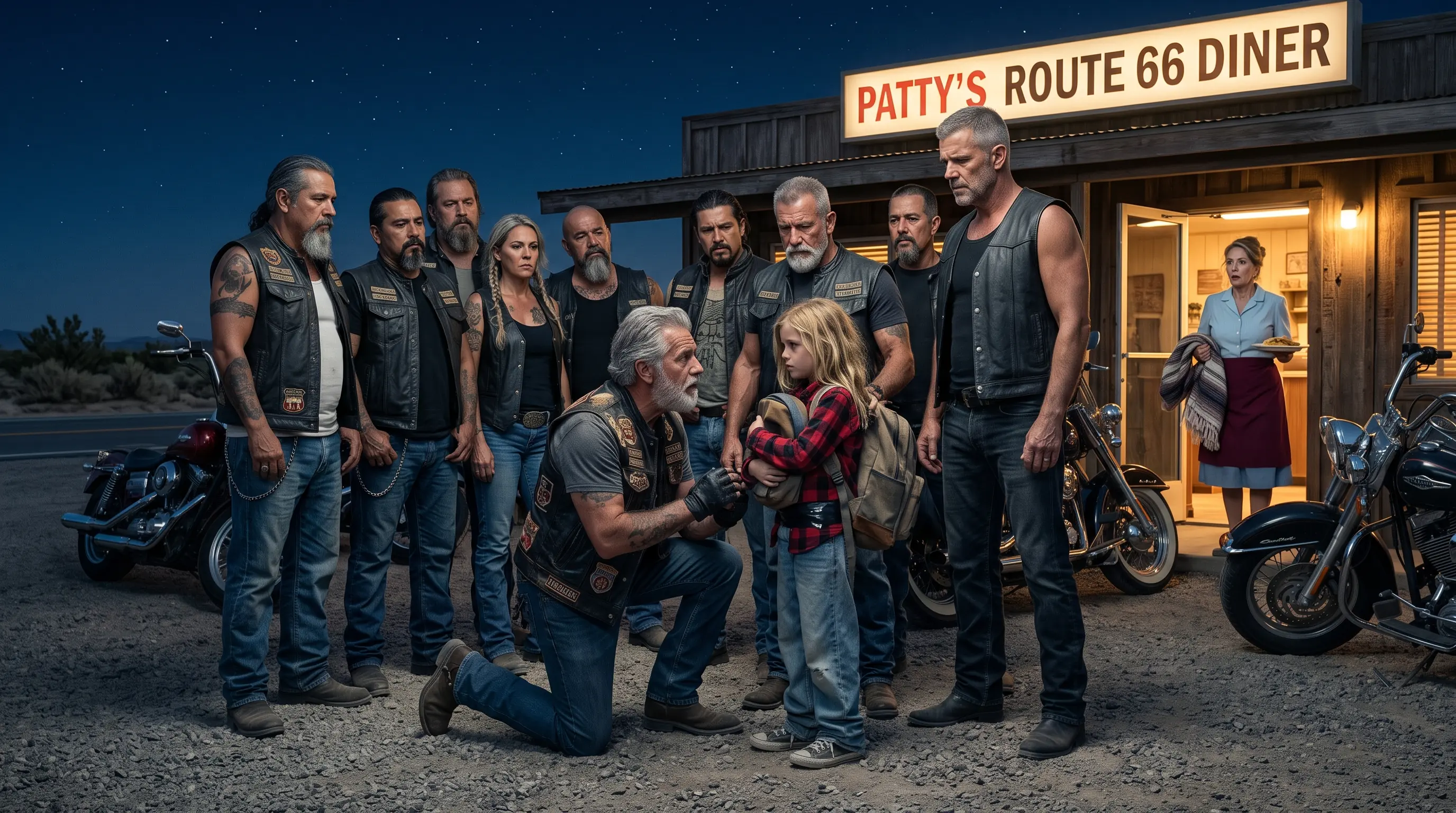
She walked straight past every adult in that diner, past the truckers, past the waitress, past the man by the register, and stopped in front of the one person nobody in their right mind would approach.
A Hells Angel.
Six foot two, two hundred and forty pounds of scar tissue and hard miles.
She tugged his leather vest, looked up, and asked the question that broke the whole room in half.
Iron Jack did not scare easily. In thirty-one years of riding with the Hells Angels Mojave chapter, he had sat across the table from cartel enforcers, federal agents, and men whose names alone made grown bikers check their rearview mirrors twice. He had buried brothers. He had absorbed blows that would have dropped most men like wet paper. He had stared down the barrel of a revolver in a parking lot in Needles, California, and never once blinked.
So when the front door of Patty’s Route 66 Diner swung open at 11:03 on a Tuesday night in late October, and a cold desert wind rolled through the place, Jack did not look up. He was working on his second cup of black coffee and his third cigarette, a half-eaten plate of eggs pushed to the side.
His leather vest, the one with the stitched death head and the road miles of a thousand hard nights, was draped over his broad shoulders. His gray-streaked beard rested against his chest. He was tired, not the kind of tired sleep fixes, but the kind that settles into a man’s bones and lives there.
He did not look up when the bell above the door jangled.
He did look up when the room went quiet.
Not just quiet.
Still.
The kind of stillness that happens when something is wrong and every animal instinct in every human being in the room fires at once.
Two truckers at the counter stopped mid-sentence. Patty, the sixty-year-old owner, who had seen everything that stretch of Route 66 could throw at a person, stopped wiping down the counter and held her rag frozen in both hands. Even Dutch, Jack’s vice president and road sergeant, who had been halfway through a joke about a sheriff in Barstow, let the punchline die in his throat.
Jack turned.
Standing just inside the door, letting the wind push it shut behind her, was a little girl.
She was small. Too small for her age, whatever that age was. Blond hair that might have been pretty once was matted now into clumps against the side of her face. Her clothes were wrong: a man’s flannel shirt rolled up at the sleeves, jeans so big she had cinched them with a strip of what looked like electrical tape, and sneakers two sizes too large and untied.
She had a backpack hanging from one strap, the kind of backpack kids took to school, except this one looked like it had been dragged through a ditch.
She was covered in road dust. Her face was streaked where tears had cut channels through the dirt, and she was shaking. Not the shaking of cold, though the desert night was cold enough. It was the shaking of a person whose body had been running on pure adrenaline for hours and was only now starting to understand that her legs might give out.
She stood in the doorway for three full seconds, her eyes scanning the room with a kind of desperate calculation that no seven-year-old child should know how to do.
She was looking for something.
Assessing.
Then her eyes landed on Jack, and she walked straight toward him.
Dutch actually pushed back his chair. Not aggressively, more like a man who had just seen something confusing and needed a moment to recalibrate.
“Hey, uh…”
Jack held up one hand. One finger.
“Wait.”
The girl stopped in front of his table.
Up close, she was worse. Her lower lip was split, scabbed over, but recent. There was a shadow under her left eye, not fresh, maybe four or five days old, fading yellow at the edges over a deep purple center. Her right forearm, the one not covered by the rolled flannel, had marks on it that Jack recognized immediately, and he felt something cold press against the inside of his chest.
Those were not accident marks.
She looked up at him.
Her eyes were blue. They should have been the eyes of a child. They were not. They were the eyes of someone who had already learned that the world was not safe, that adults lied, that help was not guaranteed, and that the only thing standing between her and whatever came next was her own nerve.
She was using every bit of that nerve right now.
Her voice, when it came, was barely above a whisper, but in that dead-silent diner, it carried perfectly.
“Excuse me, mister. Do you know anyone who wants a child?”
The silence that followed that question was the loudest silence Jack had ever heard.
Patty made a small sound, half gasp, half sob, and pressed the rag against her mouth. Dutch stared at the girl like she had just materialized from thin air.
Jack did not move.
He kept his face exactly where it was.
He had learned a long time ago that a man’s face in the first moment of a crisis is either an anchor or an accelerant. If he reacted with shock, she would panic. If he reacted with coldness, she would run.
He set down his coffee cup very slowly. He folded his hands on the table and looked at her, just looked for a long moment.
“Sit down,” he said.
His voice was low, rough from decades of cigarettes and road wind, but calm. Completely calm.
She did not move immediately. Her eyes searched his face.
She was checking, he realized. She was doing that terrible calculus that frightened children do. Is this safe? Is this safer than what I came from? Is this man going to hurt me? Can I trust this?
“Sit down,” he said again, softer this time. “You’re not in trouble. Sit.”
Slowly, like a bird that was not sure the branch would hold, she pulled out the chair across from him and sat down. She kept the backpack looped through both arms, hugging it against her chest like a shield.
Jack looked at Dutch over the girl’s head.
Dutch read it in one glance. Twenty years of riding together made words unnecessary. He was already standing, already moving toward the door. He flipped the deadbolt, turned the sign from Open to Closed, then looked at Patty.
“Kitchen open?”
Patty lowered the rag from her mouth. She was still processing, but she was a woman who had raised four kids alone, buried a husband, and kept a diner running on a stretch of highway God seemed to have forgotten.
She swallowed. She nodded.
“What does she want?”
Dutch looked at the girl.
“You hungry, sweetheart?”
Something in the girl’s face cracked for just a moment, a tremor across the jaw. She pressed her lips together, looked down at the table, and nodded.
“Pancakes,” Dutch said to Patty. “And orange juice. Maybe some hot chocolate if you got it.”
He paused.
“Please.”
Dutch saying please in that tone, Dutch who had once told a highway patrolman in twenty-two words what he could do with his ticket, was the thing that broke the two truckers loose from their paralysis. The older one put a ten-dollar bill on the counter, nodded at Patty, and the two of them slipped out the back without a word.
They understood the way people on the margins of society understand that whatever was happening at that table was not their business and was also, in some way they could not name, exactly right.
Jack waited until the kitchen door swung shut behind Patty. Then he leaned forward, elbows on the table, and kept his voice low and level.
“What’s your name?”
She looked up.
“Lily.”
“How old are you, Lily?”
“Seven. Almost eight.”
A beat.
“In December.”
He nodded slowly.
“Okay. Lily, my name is Jack.”
He did not offer his hand. Too formal. Too sudden.
“Where did you come from tonight?”
Her jaw tightened.
“The trailer park on Old Yucca Road.”
He knew the one. Twelve, maybe fifteen units. Half of them abandoned, the other half occupied by people who did not want to be found.
“Three miles down the highway,” he said. “Maybe four.”
“You walked here?”
“Some. I ran some.”
Four miles alone at night in the dark desert. He thought about what that said about what she was running from and filed it away in the place where he kept the things that made him want to break something.
“Does anyone know you’re here?”
Her eyes dropped. She shook her head.
“The person you left,” Jack said carefully. “Is that person going to come looking for you tonight?”
She did not answer right away. When she did, her voice was so small he almost missed it.
“He might. He was…”
She stopped, then started again.
“He was drinking, so maybe not until morning.”
“He who?” Jack asked.
“Tommy.”
She said the name the way you would say the name of a disease, with a kind of flat, exhausted familiarity.
“He’s my mom’s boyfriend.”
“Where’s your mom?”
The girl’s face did something complicated, something old.
“She went to Phoenix with her friend. She said she’d be back in three days.”
A pause stretched.
“That was eleven days ago.”
The kitchen door swung open, and Patty came out with a plate of pancakes, a glass of orange juice, and a mug of hot chocolate. She set them down in front of Lily with the practiced gentleness of a woman who had fed frightened children before.
She did not say anything. She just put a hand briefly on top of Lily’s head, the lightest possible touch, and went back to the counter.
Lily stared at the food. Her hands were in her lap.
She was not eating.
Jack pushed the syrup toward her.
“Go ahead.”
She picked up the fork. He noticed the hand, the way it shook just slightly before she got it under control. He noticed the way she cut the first bite of pancake, then paused and looked at him as if waiting for permission.
“It’s yours,” he said. “Eat.”
She ate.
Not delicately. She was starving, and her body knew it. After the first two bites, the social performance fell away and she just ate.
Jack watched and did not say anything. He let her eat because the food mattered, and also because he needed a moment to think.
Dutch had drifted back to the table and taken a seat to Jack’s left, angled so he could see the door and the girl at the same time. He was doing what Dutch always did: reading the room, running calculations, being ready.
But his face in the spaces between the readiness held something Jack had not seen on Dutch’s face in a long time.
Worry.
Real worry.
The kind that does not come from danger. The kind that comes from something being wrong in a way a man’s fists cannot fix.
Lily ate half the pancakes, drank all the orange juice, and wrapped both hands around the hot chocolate mug. The shaking in her hands was better now. Some of the terrible tension in her small shoulders had eased fraction by fraction with each minute she sat at the table and nothing bad happened.
“Lily.”
He kept his voice even.
“Can you tell me why you came in here tonight? Why you came to me and asked that question?”
She looked at the table. Then slowly, she looked up at him.
The blue eyes were steady now. Whatever it had cost her to walk in that door, she had already paid it.
“I saw you before,” she said. “About a month ago. You and your friends. You were at the gas station on Route 66, and there was a man yelling at a lady and her kid, and you made him stop.”
She paused.
“He was big. Bigger than you, almost. And you just walked up, and he stopped.”
Jack remembered. An altercation at the Chevron. A drunk trucker getting loud with a woman who was clearly terrified. Jack had said exactly four words to the man.
The man had gotten back in his truck and driven away.
It had taken forty seconds.
“You protected them,” Lily said. “I saw you do it.”
“I remember that,” Jack said carefully.
“So I thought…”
She swallowed.
“I thought maybe you were the kind of person who helps even if you look scary.”
She said the last part without any apology in her voice. Just as a fact.
“And I don’t have anyone else.”
Dutch made a sound that he immediately covered with a cough.
Jack was quiet for a moment.
“Lily,” he said, “when you asked me if I knew anyone who wants a child…”
He chose the next words carefully.
“What did you mean by that?”
She put both hands flat on the table, a gesture that looked almost adult. Grounding herself. Preparing herself.
Then she reached into the collar of the oversized flannel shirt and pulled out a folded piece of paper. She smoothed it on the table and pushed it toward him.
Jack looked at it.
It was a photograph printed from a phone onto regular paper, already creased and handled. It showed a man in his forties, overweight, wearing a T-shirt, standing in what looked like a trailer interior.
On the back of the paper, handwritten in a man’s careless scrawl, was an address in Mexicali and a number.
Just a number.
Five figures.
“What is this?” Jack asked, though a part of him already knew.
The cold thing in his chest was pressing harder.
“I found it,” Lily said. “In Tommy’s things three days ago.”
She pointed at the number.
“That’s what he’s going to get for me.”
The diner was absolutely silent.
Dutch stopped breathing.
Jack kept his eyes on the paper. He kept his face neutral by the sheer force of thirty years of discipline.
Inside him, something ignited slow, white, and very, very hot.
“Tommy showed you this?”
Jack’s voice was completely controlled.
“He doesn’t know I found it.”
She pulled the paper back, folded it, and tucked it away.
“But he told me last week when he was drunk. He told me he owed money to someone, and that I was going to help him pay it back, and that I should get used to the idea because nobody was coming for me.”
She said it without inflection, the way children repeat things they have been told enough times to memorize, and the flatness of it was worse than tears would have been.
“He told you he was going to sell you,” Jack said.
Not a question.
“He said I was going to Mexico to live with a family.”
She looked at him directly.
“But I’m not stupid.”
“No,” Jack said quietly. “You’re not.”
“I took the paper, and I took some money from his drawer. Sixty-two dollars. And I took the bag of stuff he keeps under the bed because I thought if I had it, he might not come after me right away. He’d have to find some more first.”
A pause.
“I don’t know what it is, the stuff in the bag, but it’s in my backpack.”
Dutch leaned forward slowly.
“Lily,” he said, “the bag he keeps under the bed. Is it like a big plastic bag tied at the top?”
She nodded.
Dutch looked at Jack.
Jack looked at Dutch.
Tommy was not just an abusive lowlife. Tommy was holding an illegal package for someone. And Lily had walked out of that trailer with sixty-two dollars, a transaction note, and what was almost certainly contraband that belonged to someone who was going to want it back.
The situation had just become considerably more complicated.
Jack sat back. He laced his fingers together on the table. He looked at the girl who had walked four miles in the dark desert alone, terrified enough to ask a biker she had seen once at a gas station if he knew anyone who wanted a child.
He thought about what it had taken to do that. What that kind of courage cost when you were seven years old and the world had already shown you its worst face.
He thought about his daughter.
He tried not to.
She was thirty-two now, lived in Sacramento, and they spoke on her birthday and Christmas and sometimes in between. But he thought about her at seven. He thought about the hypothetical of a world where no one had been there.
He let himself think about it for exactly one second.
Then he put it away.
“Lily,” he said. “You’re not going to Mexico.”
She looked at him.
Something moved in her face, the first hairline fracture in the wall she had built around whatever hope she had left.
“You’re going to stay here tonight,” he continued. “Patty is going to stay with you. You’re going to be safe.”
He held her gaze.
“Do you understand what I’m telling you?”
She nodded very slowly.
“I need you to tell me one more thing,” he said. “How long until Tommy realizes you’re gone and comes looking?”
She thought about it.
“He drinks until he passes out. It’s usually around midnight. He won’t wake up until eight, maybe nine.”
Jack checked the clock above the counter.
11:47.
He looked at Dutch. Dutch was already pulling out his phone.
“Okay,” Jack said, and his voice had shifted now. Not softer, not harder, but different. The way a gear shifts when the road changes.
“Then we have some time.”
He stood up from the table. He was a large man, and the standing up of him filled the space, but he was careful about it. Careful in a way he had not had to be careful about himself in a long time.
He looked down at Lily.
“You did a brave thing tonight,” he said. “Coming here.”
She looked up at him, and for the first time since she had walked through that door, something in her face was young.
Just for a moment.
Just a glimpse of the seven-year-old she was supposed to be.
“Are you going to help me?” she asked.
Jack picked up his coffee cup. He drained the last cold inch of it, then set it down.
“Already started,” he said.
He stepped away from the table and moved toward the back of the diner, phone in hand. Patty came out from behind the counter and sat down across from Lily, then started talking to her in the low, practiced voice of a woman who knew how to make a child feel, for the first time in a long time, like the world had not entirely abandoned her.
Dutch fell into step beside Jack, and the two men stood near the back hall, voices low.
“How bad is this?” Dutch asked.
“Bad,” Jack said. “The bag belongs to somebody.”
“Which means?”
“Which means Tommy isn’t operating alone.”
Jack looked back at the girl. She was holding the mug of hot chocolate again, both hands wrapped around it. Patty was talking, and Lily was listening with the careful attention of someone who had not had many adults speak to her like she mattered.
“And whoever Tommy owes money to, whoever that address in Mexicali belongs to, they don’t just deal in contraband.”
Dutch was quiet for a moment.
“Then she’s not the first one.”
“No,” Jack said. “She’s not.”
The words landed between them like a stone dropped into still water, and the ripples spread.
“Who do we call?” Dutch asked.
Jack thought about it.
He thought about the local police. Sheriff Briggs, who had been known to lose paperwork when the right people made the right calls. He thought about the county social services office that had been understaffed since the budget cuts, three years running.
He thought about the systems that were supposed to exist for exactly this situation, and he thought about a seven-year-old girl who had walked four miles in the dark rather than trust any of them.
“Us,” Jack said. “We call us.”
Dutch looked at him for a long moment. Then he nodded once and unlocked his phone.
Jack walked back to the table.
Lily looked up at him. Patty gave him the nod. She’s okay. She’s holding.
Then Patty stepped back.
Jack sat down again.
“I’m going to ask you some questions,” he said. “And I need you to tell me everything you remember. Everything. Even the things that seem small.”
He paused.
“Can you do that?”
Lily straightened in her chair. She set down the mug. She looked at him with those blue eyes that had no business being so steady.
“Yes,” she said.
Outside, in the cold desert night, the Mojave wind moved through the highway scrub and pushed against the windows of Patty’s diner. Somewhere three miles down Old Yucca Road, a man named Tommy slept off his drunk in the dark trailer he thought still held a secret.
He was wrong.
And the clock on the wall above the counter ticked forward toward midnight.
Lily talked for forty-seven minutes straight.
Jack did not interrupt. He did not write anything down. He just sat across from her with his hands folded on the table and his eyes on her face, and he listened the way a man listens when he understands that every word matters. Not just what is said, but how it is said, where the voice drops, where the eyes go, where the pauses live.
Dutch had stepped outside to make calls. Through the diner window, Jack could see the orange ember of Dutch’s cigarette moving back and forth in the dark, the low murmur of his voice carrying through the glass without words.
Patty had quietly refilled the hot chocolate and then disappeared behind the counter, doing dishes she had already done once, giving the table the kind of distance decent people instinctively offer when something private and terrible is unfolding nearby.
Lily talked about Tommy moving in eight months ago. She talked about how it started with small things, the kind of small things children notice and adults explain away. Food missing from her plate. Being sent to her room during conversations. The way he looked at her sometimes across the kitchen, long and assessing, the way you look at something you are trying to decide what to do with.
Then it escalated.
Jack let her tell it at her own pace, and he did not let his face change.
She talked about the first time Tommy hit her. Not a slap, not the ambiguous kind of contact that could be argued about later, but a closed fist, deliberate, because she had spilled a glass of juice and the sound of it breaking had woken him from a nap.
She was wearing a long-sleeved shirt in October, and not because of the cold.
She talked about her mother. She talked about it carefully, with the particular precision of a child who loves someone and is also terrified of that someone and has spent a great deal of time trying to reconcile those two facts.
Her mother was not bad.
Her mother was weak.
Her mother had a problem with pills that made her soft and distant and easy to lead away.
Tommy led her away. First across town, then to Phoenix, then farther and farther. The gaps between phone calls got longer, and the calls themselves got shorter. Now it had been eleven days, and the last text Lily had received from her mother’s number said, Be good for Tommy.
That was it.
When she said that part, just those four words, “Be good for Tommy,” something happened to her voice.
Not a crack. Not tears.
It was worse than that.
It flattened. All the life went out of it for exactly one sentence. Then she pulled it back and kept going.
Jack understood that she had already grieved this particular thing and put it in whatever compartment a seven-year-old builds for griefs too large to carry in the open.
He understood that compartment.
He had built one himself a long time ago.
He hated that she knew how.
“The man in the picture,” Jack said when she paused. “On the paper you found. You said it was printed from a phone. Did you see the phone?”
She nodded.
“It was Tommy’s. He left it on the kitchen table when he went to the bathroom. The picture was already open.”
“Did you see any other pictures? Any names? Any other numbers?”
She thought hard. She pressed her lips together, eyes moving slightly the way people do when replaying a visual memory.
“There was a name at the top of the screen. Like a contact name. Where the text came from.”
She paused.
“It said RS.”
Jack kept his face perfectly neutral.
“Just the letters RS?”
“Just the letters.”
He nodded slowly. Filed it. Said nothing more about it.
“You said Tommy told you he owed money to someone,” Jack said. “Did he say a name? Did you ever hear him on the phone say a name?”
Lily hesitated. Her fingers tightened around the mug.
“Once. Maybe two weeks ago. He was on the phone in the back room, and he didn’t know I was in the hall. He was scared. I could tell because his voice went different. He said…”
She concentrated.
“He said, ‘I told you I’m working on it, Mr. Sterling. I swear I’ll have it sorted by the end of the month.’”
The name landed on the table between them like a dropped knife.
Sterling.
Jack heard it, and he did not move. He did not blink.
The thing that moved through his chest was cold and precise, and he recognized it from the worst moments of his life: the recognition of a danger larger than the room you are standing in.
He knew that name.
Everyone in the Mojave Valley knew that name, though not everyone knew it the same way.
To most people, Richard Sterling was a developer, a philanthropist, a man whose name was on the side of a medical clinic, two youth sports fields, and a scholarship fund at the high school. He was handsome and silver-haired, and he attended the right events and donated to the right campaigns. He had the right kind of handshake, firm and direct, the handshake of a man who had nothing to hide.
Jack knew the other Richard Sterling.
The one Dutch had first mentioned four years earlier, piecing together information from brothers in Riverside, San Bernardino, and as far out as Tucson. The one whose name appeared always at a distance, always insulated by three or four layers of men.
Men like Tommy.
Desperate men. Addicted men. Men who owed too much to too many.
The one that two different people Jack trusted had said in two different years in two different cities was running something that went beyond contraband.
He had never been able to prove it.
Nobody had.
Sterling was too careful, too clean, too well connected to the people who were supposed to be looking.
But Lily had just connected Tommy to Sterling with her own two ears.
At age seven.
The cigarette ember outside the window stopped moving. Dutch came back inside. He looked at Jack, and Jack looked at Dutch, and in that half second of eye contact, twenty years of friendship passed a message that needed no translation.
This just got bigger than Tommy.
“Lily,” Jack said, and his voice was gentle but different now, focused in a way it had not been before. “The bag you took from under the bed, the one in your backpack. I need you to put it on the table.”
She reached back, unzipped the main pocket, and pulled out a large sealed plastic bag. She set it on the table and pushed it toward him, then looked at him with those eyes that kept reminding him she was smarter than any adult in her life had bothered to notice.
Dutch leaned over and looked at the bag without touching it. He made a low, controlled sound, the sound of a man recalibrating the severity of a situation.
He straightened up, walked three steps away, turned his back, and stood there for a moment with his hand on the back of his neck.
“Okay,” Dutch said, mostly to himself.
Jack looked at the bag.
He looked at Lily.
“You did the right thing taking this,” he said. “You understand me? You did exactly the right thing.”
“I thought if he didn’t have it, he’d have to find more before he could…”
She stopped.
“Before he could do anything about the other thing.”
“You bought yourself time,” Jack said. “That was smart.”
She said nothing. She wrapped her arms around herself and looked at the table.
“Can I ask you something?”
Her voice was quieter now. The adrenaline was running out. Jack could see it happening in real time, the way her shoulders were drooping by small degrees, the way her blinks were getting slower.
She had been running for hours, and her body was presenting the bill.
“Ask,” Jack said.
“Why are you helping me?”
She looked up at him. There was no challenge in it. It was a genuine question, the kind that comes from a child who has learned that adult kindness always has a condition attached.
“You don’t know me. I just walked in here.”
Jack was quiet for a moment, not because he did not have an answer, but because the answer was real, and real answers take a second to organize.
“When I was about your age,” he said, “something bad happened to someone I cared about. And nobody helped. Not because nobody could, but because nobody chose to.”
He paused.
“I’ve been choosing ever since.”
Lily looked at him steadily. Then she nodded, the nod of someone who accepted an answer at face value because she had developed a good ear for lies, and this was not one.
“Try to sleep,” Jack said. “Patty’s got a couch in the back. You’ll be in the same building as us the whole time.”
“You’re not leaving?”
“We’re not leaving.”
She slid off the chair.
Patty materialized from behind the counter. The woman had the instincts of a field medic and led Lily toward the back with a hand resting lightly between her shoulder blades.
At the doorway to the back hall, Lily stopped and looked back at Jack.
“His name is Tommy Briggs,” she said. “In case you need that.”
Then she was gone through the door.
Dutch came back to the table the moment she disappeared. He sat down hard, put his elbows on his knees, and put his face in his hands for exactly two seconds, the Dutch equivalent of a full emotional breakdown.
Then he came back up, eyes clear, jaw set.
“Talk to me,” Jack said.
“Called Reyes in Barstow. Called Shepherd in Victorville,” Dutch said, keeping his voice low and even. “I’ve got eight guys who can be here in under ninety minutes.”
“That’s not the move yet,” Jack said.
Dutch looked at him.
“You want to tell me what the move is, then? Because right now, a seven-year-old girl is sleeping on a diner couch with a transaction note in her shirt pocket and an illegal package in her backpack that belongs to the most protected man in the valley.”
“Sterling didn’t get protected by being stupid,” Jack said. “If we go at Tommy tonight, straight loud, eight bikes rolling up to a trailer park at two in the morning, Tommy disappears. Somebody makes a call. Sterling knows. And whatever else is in that transit chain, whatever other kids, whatever other arrangements, it all goes quiet for six months and then starts up somewhere else.”
Dutch stared at him. Then he sat back.
“So what do you want?”
“I want to know what Sterling is running. Not Tommy. Tommy is an errand boy with a habit. I want to know the whole structure.”
Jack’s voice was flat and precise.
“Because Lily said Tommy told her she was going to a family in Mexico. That’s a buyer. That’s retail. Sterling isn’t retail. Sterling is wholesale.”
The word wholesale dropped into the quiet diner, and both men sat with it for a moment. Neither of them looked at each other because some things are too ugly to share eye contact over.
“You think there are more kids?” Dutch said.
“I think there’s an operation,” Jack said. “And I think it’s been running a long time because the man behind it has the names and numbers of everyone in this county who could stop him.”
Dutch picked up his coffee, realized it was cold, and put it down.
“So how do we do this without tipping Sterling?”
“We start with Tommy,” Jack said. “But quiet. We need Tommy to talk, and we need him to think he has a reason to, which means he can’t see us coming and he can’t know what we already know.”
“He’s going to wake up in…” Dutch checked his watch. “Six, seven hours. When he sees the girl is gone and the bag is gone, he’s going to panic.”
“Good,” Jack said. “Panicked people make calls. And when Tommy makes his call, I want to know who he calls first. Does he call the buyer in Mexicali, or does he call Sterling?”
Dutch looked at him slowly.
“Because if he calls Sterling first…”
“Then Sterling already knows something went wrong,” Jack said. “Which means Sterling is already cleaning up.”
“And we won’t have until morning.”
“We’ll have until whenever Sterling decides his exposure is too high and starts cutting loose ends.”
“Tommy’s a loose end.”
“Tommy’s the first loose end,” Jack said. “Lily’s the second.”
The word hit Dutch like something physical. He straightened up.
“Then we don’t wait.”
“We don’t wait,” Jack agreed. “But we don’t stampede either. I need two men on Tommy’s trailer right now, watching, not moving, not being seen. I need to know when he wakes up and who he calls. And I need somebody I trust running a quiet search on Richard Sterling’s properties in the county.”
He paused.
“Not the public ones. The ones that aren’t on the website.”
Dutch already had the phone out.
“Reyes can do the surveillance. For the property search, you want me to call the accountant?”
The accountant was a man whose real name Jack had not used in so long, he sometimes had to think about it. He was fifty-eight years old, lived in a rented house in Palmdale, and had once, in a former life, worked for a federal agency that he never named and that had never officially employed him.
He and Jack had an understanding that went back fifteen years and had been paid for in the currency that mattered most in their world.
Silence kept when it counted.
“Call him,” Jack said.
Dutch stepped outside again.
Jack sat alone at the table.
The diner was quiet. Patty moving softly somewhere in the back. The hum of the refrigerator case. The occasional gust of wind pressing at the windows.
He stared at the surface of the table and let himself, for exactly one moment, feel the weight of what Lily had walked into this diner carrying.
A child who had been told her worth was a number on a piece of paper. Who had been failed by every adult in her life. Who had decided on her own, at seven years old, that her only option was to walk through the dark toward the scariest-looking man she could find because at least the scary man had once, one time, stopped something bad from happening.
He thought about Sterling at some fundraiser, shaking hands, smiling, his name on a scholarship fund. He thought about the gap between the name on the building and the number on the paper in Lily’s shirt pocket.
That gap was where children like Lily disappeared.
His jaw tightened.
Dutch came back in and sat down, and they spoke for twenty minutes in low, precise voices, building the shape of it. By the time they were done, the calls were made.
Reyes and a man called Ortega were already pulling off the highway onto Old Yucca Road in a single dark truck, no headlights, going in slow.
The accountant had been woken up, and after one long exhale and a pause that meant he understood the stakes, he had said he would have preliminary property information within three hours.
It was 12:41 in the morning.
Jack stood up and stretched, and his back cracked in three places. He walked to the counter and poured himself a fresh cup of coffee because the night was nowhere near done.
He was standing at the counter with the cup when Patty came out of the back hall, pulling the door softly shut behind her. She came to the counter and stood across from him. They looked at each other.
Patty said very quietly, “She was asleep in about thirty seconds. Poor baby’s been running on empty for days.”
She paused.
“Her left shoulder. I saw it when I helped her with her shirt. There’s a burn mark, Jack. Cigarette. Old one, healed over, but…”
She stopped, pressed her lips together, and looked at the counter.
Jack said nothing. He wrapped both hands around the coffee mug.
“She asked me something before she went to sleep,” Patty said.
“What?”
Patty looked up at him. Her eyes were bright.
“She asked me if I thought you’d keep your word about not leaving.”
A beat.
“I told her yes.”
“You were right,” Jack said.
Patty nodded and went back to her dishes.
Jack drank his coffee and looked at the door. Through the glass, the highway was empty, just the double yellow line disappearing into the dark in both directions, the Mojave sitting silent and enormous all around it.
His phone buzzed.
Reyes.
He picked up.
“Talk to me.”
Reyes’s voice was low and tight.
“We’re on the trailer. Lights still off, nobody moving. But Jack…”
A pause.
“There’s another trailer two units down. Lights on. Curtains. And there’s a padlock on the outside of the door.”
Jack set down the coffee cup very carefully.
“A padlock on the outside,” he repeated.
“Yeah,” Reyes said. “Like something’s being kept in.”
Everything Jack had been building in his mind, the careful measured plan, the quiet surveillance, the controlled timeline, shifted on its axis in that single sentence.
Because a padlock on the outside of a door at one in the morning in a trailer park connected to a man who had been preparing to sell a seven-year-old child did not mean Tommy Briggs had started his operation last week.
It meant it was already in progress.
“How many units between Tommy’s trailer and that one?” Jack asked.
“Two. They’re on the same side of the row.”
“Is there a vehicle outside it?”
“Older pickup. Hasn’t moved, judging by the dust. Maybe two or three days.”
Jack turned his back to the diner, put his hand against the wall, and breathed once through his nose.
The calculation was immediate and brutal.
Wait for more information and risk whoever was behind that locked door, or move now with what he had and risk tipping Sterling.
Except there was no calculation.
There never had been.
Not really.
“Don’t touch the door,” Jack said. “Don’t touch anything. I’m coming. Tell Ortega to watch Tommy’s trailer and don’t move regardless of what he hears. You understand me?”
“Copy.”
Jack hung up and turned around.
Dutch was already standing. He had only heard one side of the conversation, but he had heard enough. He reached for his jacket.
Jack looked at him.
“Two guys. Quiet. We don’t know what we’re walking into, and we can’t walk in loud.”
“Agreed.”
“Call Shepherd. Tell him to get his people moving toward Old Yucca Road, but hold two miles back. Engine off. Wait for my call.”
Dutch was already dialing as they moved toward the door.
Jack paused at the counter and looked at Patty, who had come out of the kitchen again and was standing with her arms crossed and her face set.
“Lock everything,” Jack said. “Don’t open for anyone except my call.”
“I know the drill,” Patty said quietly. “Then bring them home, Jack.”
He did not ask what she meant by them.
He already knew.
He pushed through the door into the cold desert night, and the wind hit him like a held breath finally released. Somewhere down Old Yucca Road, a padlock was keeping a secret the darkness had been hiding for too long.
The truck was dark and fast, and Dutch drove it the way he drove everything, like the road belonged to him and the night was just a courtesy. Jack rode passenger with his phone face down on his thigh and his eyes straight ahead.
Neither man spoke for the first two minutes.
There was nothing to say that the silence was not already saying.
Old Yucca Road came up on the left, and Dutch took it without slowing much. He rolled the truck onto the dirt and immediately cut the headlights, letting his eyes adjust, reading the dark the way men who had spent their lives operating in uncomfortable places learn to read it.
The trailer park sat about three hundred yards in, a cluster of units along a gravel strip. Most of them dark, the desert pressing in on all sides like it was waiting for permission to take the land back.
Reyes materialized from the shadow beside a dead mesquite tree, low and quiet, and fell into step beside the truck as Dutch rolled it to a stop. Jack was already out before the engine cut.
“Same as I told you,” Reyes said, his voice barely above a breath.
He was a compact man, former Army, twelve years with the Mojave chapter, and he had the particular stillness of someone who had spent a great deal of his life waiting in the dark for things to happen.
“Lights still on in the far unit. No movement since I called.”
“Tommy?” Jack asked.
“Dead quiet. No lights.”
Jack looked at Dutch. Dutch looked back.
“Ortega’s on Tommy’s side,” Reyes said. “He won’t move unless you call it.”
They moved on foot, the three of them staying wide of the gravel strip, keeping to the softer ground along the edge. The cold was harder out here than it had been at the diner. The desert at two in the morning held nothing back, the kind of cold that got into the hands and the marrow and reminded a man that the Mojave was beautiful and would kill you without any particular malice.
Jack felt none of it.
He was running entirely on something else.
The taut, focused energy he recognized from the worst nights of his life, the nights where everything mattered and the margin for error was zero.
They stopped twenty feet from the padlocked unit. The light inside was a single lamp by the quality of it, nothing overhead, pressing soft yellow at the edges of the curtain on the single window.
The padlock was a heavy combination model, the kind you buy at a hardware store when you want something that will hold against a person who does not have tools.
It was on the outside hasp.
The outside.
That single detail kept hammering at Jack the way a wrong note hammers at a musician. Insistent. Impossible to ignore.
He put his mouth close to Reyes’s ear.
“You hear anything from inside at any point since you’ve been watching?”
Reyes hesitated for exactly one second, which told Jack the answer before the words came.
“Once. About ten minutes ago.”
“What did it sound like?”
Reyes stopped.
“Like a kid coughing.”
Jack straightened up.
He looked at Dutch. Dutch’s jaw was set so hard the muscle in his cheek was jumping.
“Bolt cutters,” Jack said.
Dutch went back to the truck at a low run. He was back in ninety seconds. Reyes took the cutters. He was the most precise with his hands.
Jack stood to one side, Dutch on the other, and Reyes worked the bolt cutters onto the lock shackle and leaned into it.
The lock gave with a sharp metallic snap that seemed to split the night in half.
All three men froze.
Listened.
Tommy’s trailer stayed dark.
Jack put his hand on the door handle. He kept his voice just above silence.
“I go in first. Both of you hold unless I call.”
He opened the door.
The smell hit him before anything else. Stale air. Fast food wrappers. The particular staleness of a closed space that had not had fresh air in days.
The lamp was actually a plug-in nightlight, a small amber oval plugged into the baseboard, the kind sold for children who are afraid of the dark.
In its light, Jack saw the interior of the unit in pieces.
A bare mattress on the floor. A plastic bag of food. An empty water jug on its side.
And on the mattress, pressed against the far wall, arms wrapped around each other, were two children.
A boy and a girl.
The boy looked about ten. The girl was younger, maybe eight, maybe less. Both of them stared at Jack with wide, frozen eyes, the eyes of small animals who had been in cages long enough that they no longer reacted to danger with sound.
They had learned, in whatever time they had been in this room, that making noise made things worse.
The boy moved in front of the girl. Automatic. Protective. His chin was up, even though every other part of him was shaking.
“Hey,” Jack said.
He kept the door mostly closed behind him and crouched down, immediately bringing himself to their level, making himself smaller, which was not easy to do, but which he understood was the only right thing.
“Hey, my name is Jack. I’m not going to hurt you. Okay? I’m not going to hurt you.”
The boy said nothing. He did not lower his arms from in front of the girl.
“I know you don’t know me,” Jack said. “And I know you have no reason to trust me. But I have a little girl at a diner about four miles from here, and her name is Lily, and she did something really brave tonight. I think she’d want me to find you.”
He kept his voice completely even.
“Can you tell me your name?”
The boy’s chin wobbled just once. Then he steadied it.
“Marcus,” he said. His voice was hoarse.
“How long have you been in here, Marcus?”
Marcus looked at the girl behind him. Something passed between them, the wordless communication of children who had been through something together.
“Three days,” he said. “I think. It’s hard to tell.”
“Is anyone else in here with you?”
“There was another boy,” Marcus said. “They took him yesterday. Or I think yesterday. In a car.”
He paused.
“He was crying.”
Jack absorbed that. He did not let it show. He held Marcus’s eyes and kept his voice steady.
“I’m going to get you out of here, both of you, right now. My friend Dutch is right outside that door, and he’s going to help me. Is that okay?”
The girl behind Marcus made a small sound and pressed her face against his back. Marcus reached behind himself and found her hand.
“Is Lily okay?” Marcus asked.
Jack blinked.
“You know Lily?”
“She was here.”
Marcus’s voice shifted, something cracking in the careful composure he had been holding.
“She was in here with us two nights ago, but she got out through the window on the other side. She bent the screen back. We couldn’t fit.”
He swallowed hard.
“We told her to go. She didn’t want to. She kept saying she’d send someone back.”
The full weight of it landed on Jack all at once.
Lily had not just run.
She had not just escaped for herself.
She had escaped on purpose with a plan, knowing she was the smallest one and the only one who could fit through the window, with the explicit intention of sending help back.
The money she had taken from Tommy’s drawer. The illegal package to slow him down. Walking four miles in the dark to find the scariest-looking man she could remember who had once done something good.
She had not been asking Jack to save herself.
She had been asking him to save them.
He stood up. He opened the door behind him.
“Dutch, come in slow.”
Dutch came through the door and stopped when he saw the two children. He did what he always did when something hit him hard. He went very still. Then he crouched and said, “Hey, guys,” in the voice Jack almost never heard. Quieter. Younger. Completely without armor.
They got Marcus and the girl, whose name Jack learned as Dutch helped her up, was Amber, out of the unit and moving within three minutes.
Marcus held Amber’s hand the entire time.
He did not let go once.
Jack walked behind them, pulled out his phone, and called Ortega.
“Wake up Tommy,” he said when Ortega picked up. “I don’t care how you do it. Get him to the door. I’m coming to you.”
He could hear Ortega pause, processing the instruction and the weight of it.
“Copy,” Ortega said.
Jack looked at Reyes.
“Get them to the truck. Get them warm. Call Shepherd. I need his people here now. Not two miles back. Now.”
He paused.
“And call the diner. Tell Patty to wake Lily up. Tell her… tell her we found them.”
Reyes’s face did something complicated. He nodded and said nothing. Then he turned and walked toward the truck with Marcus and Amber.
Jack turned toward Tommy’s trailer and let the cold anger he had been holding on a very short leash take exactly as much slack as it needed.
The light was on in Tommy’s trailer by the time Jack reached the door. Through the thin wall, he could hear Ortega’s voice and another voice, higher, confused, the voice of a man jerked out of drunk sleep who did not have his bearings yet.
Jack did not knock.
He turned the handle and walked in.
Tommy Briggs was forty-three years old, and he looked sixty.
He was sitting on the edge of a pull-out couch in a stained T-shirt, squinting against the overhead light, unshaven, with the chemical pallor of someone who had been running hard on bad fuel for too long.
Ortega stood against the far wall with his arms crossed, his face neutral, his eyes on Jack the second he came in.
Tommy looked at Jack. He looked at Ortega. He looked back at Jack.
“Who the hell are you?”
His voice had the thick, cottony quality of someone who was not fully awake yet, but underneath it, Jack could already hear the fear beginning to ignite.
Tommy was stupid about a lot of things, but he had the particular animal intelligence of a man who had spent his life surrounded by dangerous people and had learned to recognize the specific quality of danger that means this is not a conversation.
“My name doesn’t matter,” Jack said.
He pulled the one chair in the room away from the wall, turned it around, and sat on it backward, arms folded over the back, completely relaxed.
It was the most threatening thing he could do, and he knew it.
“What matters is that I know your name, Thomas Briggs. I know your arrangement. And I know who you owe money to.”
Tommy’s face went through three expressions in about two seconds.
Bravado.
Calculation.
Then the first edge of real fear.
“I don’t know what you’re talking about.”
“The children in the padlocked trailer two units down,” Jack said. “I know about those.”
All the color left Tommy’s face.
“The girl you were going to sell to settle your debt with Richard Sterling,” Jack said. “I know about that, too.”
Tommy’s mouth opened and closed. He looked at Ortega like Ortega might be an exit, which was nearly funny.
“Lily,” Tommy said.
And the way he said her name, not with guilt, not with shame, but with the dawning anger of a man who had just realized a piece of property had gone missing, lit something in Jack’s chest that he had to work to keep contained.
“Here’s where we are, Tommy,” Jack said. “Two children are out of that trailer right now and on their way somewhere safe. Lily is already safe. The bag you keep under the bed is gone. And I have a piece of paper with a Mexicali address and a dollar figure on it that, with the right phone call, will make your life very complicated.”
He leaned forward slightly.
“What I don’t have yet is Sterling.”
Tommy’s eyes went wide.
The name spoken that plainly in this context visibly terrified him in a way none of the rest of it had.
“Keep his name out of your mouth,” Tommy whispered. “You don’t understand what you’re…”
“How many children, Tommy?”
Tommy looked at the floor.
“How many children has Sterling moved through this location? Lily, Marcus, Amber, the boy they took yesterday in a car. Who else? How many times?”
“I want a lawyer,” Tommy said.
Which was almost darkly funny under the circumstances.
“You’re not under arrest,” Jack said. “I’m not a cop, which means what happens in the next ten minutes depends entirely on how cooperative you decide to be. I would encourage you, very sincerely, to think about that.”
Tommy’s chin was working. His hands were clasped between his knees, and his knuckles were white. He was calculating the way cornered men calculate, weighing the danger in the room against the danger outside it, trying to find an angle, a door, anything.
“Sterling will kill me,” Tommy said.
Not dramatically.
Just as a fact.
“Sterling will kill you whether you talk to me or not,” Jack said. “You’re already a loose end, Tommy. The second this thing unravels even one layer, you’re the first one he cuts. You know that.”
He paused.
“The only question is whether you have anything to trade.”
Tommy looked up. His eyes were bloodshot and afraid, and underneath all of it, exhausted in the way of a man who had been doing terrible things for a long time and had stopped being able to not know it.
“How many kids?” Jack said again, quieter this time. More direct.
Tommy’s throat worked.
“Since last spring,” he said. “I don’t… I didn’t count.”
The number hung there unspoken, and somehow that was worse than any specific figure.
“Where does Sterling keep them before transport?” Jack asked.
Tommy shook his head.
“I only know this location. That’s how he runs it. Nobody knows the full chain. Just their own link.”
“But you have his number.”
Tommy went still.
“RS,” Jack said. “In your phone. You called him to tell him you were handling Lily. You called him when your debt was getting too big.”
He watched Tommy’s face.
“And when you wake up this morning and find that bag gone and that girl gone, the first call you make is to R. Sterling, isn’t it?”
Tommy did not answer.
“That’s what I thought,” Jack said.
He stood up.
“Here’s what’s going to happen. You’re going to make that call right now while I’m standing here. You’re going to tell Sterling there’s a problem, that you need to meet.”
Tommy’s head came up.
“Are you out of your mind?”
“You’re going to arrange a meeting,” Jack continued. “You’re going to show up to it, and I am going to be close enough to hear every word that is said.”
He held Tommy’s eyes.
“If you do that, I will make sure that when the legal part of this catches up, and it will catch up, Tommy, I promise you, I will make sure the people who decide what happens to you know you cooperated fully.”
“And if I don’t?”
Tommy’s voice had gone very small.
Jack looked at him for a long moment.
“Then I walk out of here, and I will make a different set of calls. The people I call won’t be as interested in giving you options.”
The silence in the trailer stretched out for fifteen seconds that felt like fifteen minutes.
Tommy picked up his phone from the table beside the pull-out couch. His hand was shaking badly. He found the contact, just two letters, RS, and looked at Jack one more time with the eyes of a man standing at the edge of something he could not come back from.
“Speaker,” Jack said.
Tommy pressed the button and put the phone on the table between them.
The dial tone rang once.
Twice.
Three times.
Four.
Then a voice answered, smooth even at 2:47 in the morning. Unhurried. The voice of a man who controlled enough things that being woken in the middle of the night was never a surprise, only a variable.
“This better be important, Thomas.”
Tommy swallowed. He looked at Jack.
Jack nodded once.
“There’s a problem,” Tommy said. “I need to see you.”
A pause.
Three seconds.
Controlled the way a man controls a pause to remind you who has the power.
“What kind of problem?”
Tommy opened his mouth.
Then something happened that Jack had not anticipated, and it changed everything in the space of a single sentence.
Because Tommy looked at Jack, and his face went through something. Not bravery. Nothing that generous. But some wretched, cornered decision of a man who had decided there was only one card left.
Instead of giving the answer Jack had just told him to give, Tommy said, voice cracking straight down the middle, “The girl got out, Richard. She found the Angels.”
The line went dead.
Tommy dropped the phone, and it clattered on the table. He put his face in both hands and made a sound that was half sob and half the sound of a man who had just understood he had about six hours to live.
Jack grabbed the phone off the table before the screen locked. The call history. The duration.
Thirty-one seconds.
He looked at Ortega.
“Get him up. He goes with us. Now.”
Ortega had Tommy by the arm before the sentence finished.
Jack was already outside, already dialing Dutch, already calculating the new timeline.
Because Sterling had just been told two things.
The operation was compromised.
And the Hells Angels were involved.
Which meant Sterling was not going to run immediately. Sterling was going to clean. He was going to move fast and methodical through every loose end in his chain. He had the resources and the connections to do it, and Tommy Briggs was just one name on a list.
Dutch picked up on the first ring.
“Sterling knows,” Jack said. “He just hung up. We’ve got maybe two hours before he starts moving.”
“Moving how?”
“Moving everything.”
Jack was walking hard toward the truck now, the desert air cutting through his vest, the stars overhead indifferent and cold and enormous.
“The kids in transit. The evidence. The people who can talk.”
He stopped walking for one second.
“Dutch, the accountant. Where are we on Sterling’s properties?”
He heard Dutch take a breath.
“Just got the text while you were inside. Sterling owns a commercial property on Sage Road registered to a shell company, not to him. Six acres. Warehouse structure. Off the county maintenance grid.”
Sage Road.
Jack knew it.
Industrial corridor. Largely empty. The kind of location that exists in desert counties for no other purpose than to provide square footage to things that do not want to be looked at.
“How far?” Jack asked.
“Fourteen minutes from here.”
Jack reached the truck.
Marcus and Amber were in the back seat. Reyes was beside them, and both kids were wrapped in emergency blankets from the truck’s kit. Marcus was eating a granola bar Reyes had found somewhere with the focused, exhausted intensity of a boy running his body on empty.
Amber had her eyes closed, but Jack could see by the tension in her small face that she was not sleeping.
Jack put his hand on the top of the door frame and looked at Marcus.
“You doing okay?”
Marcus looked at him. He still had the granola bar in his hand and crumbs on his chin. He looked like exactly what he was, a ten-year-old boy who had been through something no ten-year-old boy should ever go through and who was holding himself together by the sheer stubbornness of someone who had decided a long time ago that falling apart was not an option.
“Is Lily really safe?” Marcus asked. “You’re sure?”
“I’m sure.”
Marcus nodded and looked down at the granola bar.
Then, very quietly, more to himself than to Jack, he said, “She said she’d come back for us. She said it when she was climbing out the window. I told her not to make promises she couldn’t keep.”
He paused.
“She said, ‘I keep my promises.’”
Jack stayed with that for a moment.
Seven years old.
A burn mark on her shoulder.
Eleven days without her mother.
Four miles in the desert dark.
I keep my promises.
He got in the truck. He looked at Dutch.
“Sage Road,” he said.
Dutch already had it in gear.
Behind them, in Tommy’s trailer, the phone on the table sat dark and silent. Somewhere far away, in a house in the hills, Richard Sterling was making calls of his own, moving pieces on a board he had always believed only he could see.
He was about to find out he was wrong.
Fourteen minutes felt like four.
Dutch pushed the truck hard through the empty highway, no headlights once they turned off the main road, running on moonlight and the faint glow of the instrument panel. Shepherd’s crew was behind them somewhere in the dark, eight bikes and two trucks, engines cut to minimum, rolling in loose formation, the way the chapter moved when the situation required silence over speed.
Jack could feel them back there without seeing them.
Twenty-three years of riding had given him a sense for the weight of his people, the way a ship captain develops a sense for his crew below deck.
They had Tommy in the back seat between Ortega and Reyes. Tommy had not said a single word since they left the trailer park. He sat with his elbows on his knees and his face down, the posture of a man who had made his last bad decision and was only now beginning to understand the full architecture of what it cut down.
Jack was not watching him.
He was watching the road and running numbers in his head.
Sterling had thirty-one seconds of warning. The question was what a man like Sterling did with thirty-one seconds.
Jack knew the type. He had known the type his whole life in different configurations, wearing different faces. Men who built their safety in layers. Men who never touched anything directly. Men who kept enough distance between themselves and the ugliest parts of their operation that they could look you in the eye at a county commissioners’ meeting and feel nothing.
Those men, when the layers started to peel, did not panic.
They executed.
They had contingencies because contingencies were the whole architecture of how they stayed untouchable.
Sterling’s first call would not be to run.
It would be to clean.
“How many do you think he’s got at that property?” Dutch asked.
“Enough,” Jack said. “He’s not going to leave children in a location he’s just been told is compromised without moving them, which means there are people there right now receiving instructions.”
“So we’re not walking into an empty building.”
“No.”
Dutch absorbed this without changing his expression. He adjusted his grip on the wheel.
“Shepherd’s got four with carry permits. Legal. The rest of them are resourceful.”
“I know what we’ve got,” Jack said. “I don’t want a firefight, Dutch. I want the kids out first. Everything else is secondary.”
“Agreed.”
Dutch paused.
“You think Sterling is there himself?”
Jack considered it.
“No. Men like Sterling don’t go to their own fires. They send someone to make sure the fire looks like an accident.”
He looked out the window at the dark desert flying past.
“But I want a record of this place. I want photographs. I want the accountant’s documentation of that shell company. I want everything in a package that can go to someone we trust before Sterling can call anyone he owns.”
“Who do we trust?” Dutch asked.
It was not cynical.
It was a real question, and in this county, at this hour, it was a hard one.
“Federal,” Jack said. “Not local. Not county. There’s an agent I know out of the Riverside field office. We’ve had an understanding for about six years. She’s never burned me. I’ve never burned her.”
Dutch glanced at him sideways.
“A fed?”
“A fed who has been trying to build a case on trafficking in the Inland Empire for three years and keeps hitting walls she can’t explain.”
Jack pulled out his phone.
“I think I know why her walls are so thick.”
He found the contact.
Diane Marsh. Riverside FBI.
He held the phone and looked at it for a moment because making this call changed things permanently. It changed the nature of the night. It changed what role the chapter was playing. He had made decisions tonight without a full playbook, and every one of them had been right, and he trusted that streak.
But he also understood that calling Diane Marsh was the last decision that could not be undone.
He pressed call.
She picked up on the second ring, which meant she was either awake or she slept light. Either was consistent with what he knew of her.
“Jack,” she said. Her voice was alert and careful. “It’s three in the morning.”
“I know what time it is,” he said. “I need you to listen to me very carefully for the next two minutes and ask your questions after.”
He paused.
“Can you do that?”
A beat.
“Go.”
He talked fast.
He gave her the shape of it, not everything, but enough. Lily. The trailer. Marcus and Amber. Tommy’s admission. The recording of the call to Sterling. The accountant’s documentation on the Sage Road property registered to a shell company.
He gave her Sterling’s name and heard the quality of her silence change when he said it. Not surprise, exactly, but the sound of a piece fitting into a space that had been waiting for it.
“How many children at the Sage Road location?” she asked when he finished.
“I don’t know. That’s where we’re headed.”
“Jack, you cannot go in there as—”
“I know what I am,” he said. “But those kids don’t have until morning for you to get a warrant. Sterling just got a heads-up thirty minutes ago.”
Another silence. Longer this time.
He could hear her thinking. Not hesitating. Thinking, which was different and one of the reasons he had called her specifically.
“I can have people there in forty minutes,” she said.
“We’ll be there in three,” he said. “And we’re going in. But I need you there to make it stick. I need the chain of custody. I need the documentation. I need this to go somewhere Sterling can’t reach.”
He held the phone tighter.
“You’ve been trying to build this case for three years, Diane. Someone’s been protecting him. I need you to not call anyone in the county system before you call your own people. Do you understand me?”
A pause that was barely a pause at all.
“Don’t destroy anything,” she said. “Don’t touch anything you don’t have to touch. And Jack, get those kids out safe. The rest of it, I can work with.”
The call ended.
Jack put the phone down.
Dutch was looking at him.
“Forty minutes,” Dutch said.
“Thirty-seven now.”
“That’s tight.”
“Yes,” Jack said.
The truck slowed.
Dutch said, “There.”
Jack saw it.
The property sat back from the road. A chain-link fence with a sliding gate. A warehouse structure beyond it. Two vehicles parked on the near side of the building. Interior lights pressing through the high, narrow windows.
Someone was awake and moving inside.
Someone was working.
Dutch pulled the truck off the road and cut the engine. Thirty seconds later, Shepherd’s vehicles ghosted up behind them, engines dying, doors opening quiet. The chapter moved with the practiced efficiency of men who had spent a long time doing difficult things together.
Jack felt the weight of them assembling behind him and felt something he almost never allowed himself to feel in the middle of an operation.
Grateful.
He got out.
Shepherd was already at his side, a tall, raw-boned man from Victorville, fifteen years riding, iron-calm in every situation Jack had ever seen him in. Behind Shepherd were eleven men fanning out into loose positions, everyone taking their read from the terrain and from each other without being told.
“Two vehicles at the building,” Jack said quietly. “Sterling’s people are already moving. We don’t know how many adults inside, and we don’t know how many children. Priority is the children. Nobody does anything that risks a child. Am I clear?”
Murmurs of assent.
No bravado. Just a tight, focused readiness of men who had agreed on what mattered.
“Shepherd, take four and secure the gate. Don’t cut it yet. If they hear bolt cutters, they start moving faster. Wait for my signal from the fence line.”
Jack looked at Dutch.
“You’re with me. Ortega, stay with Tommy. He goes nowhere.”
Tommy, standing beside the truck with Reyes’s hand on his arm, looked up when he heard his name. His face was gray.
“They’ll have people in there,” he said. His voice was barely working. “Sterling’s transport team. Usually two, three guys. They’re not…”
He stopped.
“They don’t leave witnesses.”
Jack looked at him directly.
“How do you know that?”
Tommy’s jaw worked.
“Because last spring there was a driver. He got picked up for a DUI, and he had to give a statement. He wasn’t supposed to know the full route, but he’d put it together.”
He looked at the ground.
“They said it was a car accident on the news.”
Jack held Tommy’s eyes for a moment.
Tommy met them for about two seconds and then looked away.
That was all the confirmation needed.
“Then we move before they move,” Jack said.
He and Dutch went to the fence. The ground was flat, and the night was bright enough by starlight that Jack could read the building in pieces. Single-story metal construction. Two loading bay doors on the side facing them, both closed. A personnel door near the far end, where the light was strongest, where the movement was.
He pulled out his phone and typed a single word to Diane Marsh’s number.
Now.
Then he put it away and looked at Dutch.
Dutch nodded once.
They moved.
The gate gave without bolt cutters. It had been left unlatched, which meant whoever was inside had been in a hurry when they arrived. Which meant Sterling’s call had rattled them.
Which meant they were rushing.
Which meant they were making mistakes.
Jack noted this, filed it, and pushed through the gate at a low run.
They reached the personnel door, and Jack put his hand on the handle and listened. Voices inside. Two male adults, both speaking fast and low, the tone of men under pressure executing a task they wanted done with.
And beneath that, underneath the adult voices, something else.
Not a sound exactly.
The suggestion of small presences. The held-breath quality of children who had learned that staying invisible was the safest way to exist.
Jack opened the door and went in.
The two men inside were in the middle of the warehouse floor with a rolling cart and several large duffel bags. They turned the instant the door opened, and the larger one, heavy, close-cropped hair, the look of a man who did this professionally, reached immediately for his hip.
“Don’t,” Jack said.
His voice was absolutely flat, and the single word carried everything it needed to carry about what would happen if the instruction was disregarded.
The man’s hand stopped.
Dutch was inside and to the right. Shepherd had come through the loading bay door on the left with two men. In the professional calculus of the two Sterling employees, the situation resolved itself in about three seconds.
They were outnumbered.
They were surrounded.
And the men they were looking at had the particular quality of people with nothing to lose and very specific intentions.
The large man took his hand off his hip and raised both hands.
“On the ground,” Shepherd said. “Both of you. Now.”
They went down.
Jack was already moving past them toward the back of the warehouse because the voices were back there. The adult voices he had heard had been near the door, but there was another area sectioned off by a temporary partition, and behind it, the held-breath quality of the children was stronger.
He pushed through the partition.
There were five children.
Five children in an improvised holding area. Cots. A portable toilet. Cases of bottled water. The infrastructure of a transit stop. The terrifying logistics of people who had done this enough times to know what supplies were needed.
The children were between approximately six and twelve years old. Three girls and two boys. They were all awake and all staring at him with the same eyes Marcus and Amber had used back at the trailer park.
The eyes of children who had been inside fear for so long that the arrival of a new adult triggered threat assessment before anything else.
Jack stopped in the doorway.
He did not advance.
He crouched.
“My name is Jack,” he said, and his voice was the same voice he had used with Lily, with Marcus, with Amber. Steady. Low. Empty of everything except the one message he needed to convey.
“I’m here to get you home.”
Nobody moved for a moment that lasted a long time.
Then one of the girls, the youngest, with dark hair and a tear-tracked face, said in a voice like a thread pulled almost to its breaking point, “Are you a policeman?”
“No,” Jack said.
He did not lie to children.
“But there are police coming, and you are safe right now. I promise you that.”
The girl looked at him. She looked at the walls. She looked at the door behind Jack, where she could hear movement and voices.
“My mom is going to be so worried,” she said.
Something cracked all the way through Jack’s chest with a clean, irreversible fracture.
Not pain exactly.
The thing underneath pain. The bedrock that pain comes from. The deep human recognition of what it costs to be small and alone and frightened and uncertain whether anyone is looking for you.
“I know,” he said. “We’re going to fix that.”
He stood and turned to find Dutch right behind him. Dutch was looking at the five children and doing what Dutch always did when hit hard, going very still, very controlled, the stillness of a man managing something that would otherwise be unmanageable.
“Get them out,” Jack said quietly.
Dutch stepped forward and started speaking to the children in the tone he had used with Marcus and Amber. Shepherd was already organizing the extraction with the quiet precision Jack relied on him for.
Jack walked back through the partition to where the two Sterling employees were still face-down on the warehouse floor with two of Shepherd’s men watching them.
He crouched beside the larger one and took the man’s phone from his pocket.
The man said, “You can’t—”
“I just did,” Jack said.
He checked the call log.
Three outgoing calls in the last twenty-five minutes.
One to a number labeled only with a single initial S.
One to a number with no label.
One to a Mexicali area code.
He photographed the screen. He put the phone in his vest pocket.
Then he stood and walked to the warehouse door and looked out into the desert night, where his people were moving children toward the trucks.
He thought about Richard Sterling somewhere in this county making his own calls, pulling his own levers, all confident that the machinery he had built was strong enough, well-oiled enough, protected enough to survive a single night’s disruption.
His phone buzzed.
Diane Marsh.
“I have three vehicles en route,” she said. “Twenty-two minutes.”
“How many?” she asked.
“Five here,” Jack said. “Plus two we already have. Total seven children accounted for, plus one boy taken by vehicle earlier tonight. Origin and direction unknown.”
He heard her writing.
“Adults?”
“Two detained. I have one cooperating witness, Tommy Briggs, Old Yucca Road trailer park. He’s agreed to talk.”
He paused.
“Diane, Sterling’s people made a call to a Mexicali number about twelve minutes ago, before we got in. That could be a transport already in motion.”
“I’ll flag it through the proper federal contacts,” she said immediately. “Do not let Briggs go anywhere. Do not let those two detainees make any calls.”
“Already handled.”
“Jack.”
Her voice shifted slightly. Still professional, still controlled, but with something underneath it.
“The shell company on Sage Road. The accountant sent a document package to my field office email twenty minutes ago. I opened it while I was driving.”
A pause.
“There are fifteen shell entities, not one. Fifteen. Three of them have connections to county infrastructure: a road contracts firm, a property management company, and a nonprofit that administers foster care placements in two counties.”
The last one landed like a physical blow.
A nonprofit that administers foster care placements.
Jack stood in the doorway, looked at the sky, and breathed once through his nose, slow and controlled.
Because that was the thing he had not let himself think about yet.
Not just where the children in this warehouse came from.
But how.
How a man like Sterling, running an operation this size, managed to source the inventory quietly enough that it had been going on for years without triggering enough alarm to reach the right desks.
A foster care placement nonprofit.
He thought about Lily, about her mother drifting further away on a chemical tide, about Tommy moving in eight months ago, about the specific vulnerability of children whose protective adults had been eroded away.
“She found you for a reason,” Dutch said quietly from behind him.
Jack had not heard him come up.
He turned.
Dutch was looking at the children being loaded into the trucks, Shepherd organizing them with practiced gentleness, and his face in the starlight was the face of a man who had been carrying something heavy for a long time and had just set it down.
“Lily,” Dutch said. “She didn’t just find the nearest adult. She found someone outside the system. Someone who couldn’t be called off.”
He paused.
“Because she understood at seven years old that the system wasn’t going to save them. She understood that the people who were supposed to help were either broken or bought.”
Jack looked at his hands. His knuckles were scraped from the bolt cutters, from the fence, from the night. He had not noticed.
“She was right,” he said.
Dutch nodded.
“What do we do when Marsh gets here?”
“We give her everything,” Jack said. “All of it. Tommy. The two men. The phones. The accountant’s documents. The paper Lily took from Tommy’s drawer. We hand her a case that’s already built, and we let the federal process do what the federal process is supposed to do.”
He looked at Dutch.
“And we make absolutely sure that when it goes up the chain, it goes up the federal chain. Nothing county. Nothing local. Nothing that has a chance of hitting a wall.”
“And Sterling?”
Jack looked out at the highway, at the dark empty road that led back toward the valley, back toward the towns and the buildings with good names on them.
“Sterling is going to get a call from his people in about ten minutes telling him it all went wrong,” Jack said. “And he’s going to run. Men like that always run. They have plans for running. Money moved. IDs ready. A direction already decided.”
He paused.
“But he’s going to try to run through a county where, in about twenty minutes, every road is going to have a federal presence on it. Because I’m going to tell Diane exactly which direction he’ll go.”
Dutch looked at him.
“You know which direction?”
“His property management company has a holding in Nevada near Laughlin. That’s the direction.”
“How do you know that?”
“Because the accountant told me forty minutes ago,” Jack said. “And because men who build their escape routes always build them toward the thing they think they control.”
He dialed Diane again.
She picked up on the first ring, driving hard, the sound of the vehicle engine behind her voice.
“Nevada border highway toward Laughlin,” Jack said. “Silver BMW registered to a holding company. Accountant has the plate. That’s your man.”
He heard her relay the instruction immediately to someone in the vehicle with her, not hesitating, not questioning his source, the trust between them spending itself on something that mattered.
“Jack,” she said, coming back. “When I get there, your people, I need them to cooperate with my team.”
“They will.”
“And then I need them to go home.”
“We’ll be gone before you’re fully on scene,” Jack said. “You’ll have Tommy, you’ll have the two men, you’ll have the children, and you’ll have everything you need.”
He paused.
“The rest is on you, Diane.”
A silence.
Then, “The children. Are they okay?”
He looked at the trucks where five frightened kids were being wrapped in emergency blankets and given water and spoken to in the careful, kind voices of men who did not know how to do this and were doing it anyway.
“They will be,” he said.
He ended the call and stood in the doorway for one moment more. In the quiet between actions, the pause between the hard thing and the next hard thing, he thought about Lily asleep on Patty’s couch four miles away with her arms around her backpack.
He thought about the seven-year-old who had looked at a padlocked door and a window and made the brutal calculation that she was the only one small enough to fit, and that meant she was the one who had to go.
He thought about what she had asked him when she first sat down across from him.
Do you know anyone who wants a child?
He had heard the question the way she meant it, as a desperate offer, the words of a child who had been made to feel like a burden, a problem, a liability to be resolved.
But standing here now, with seven children loaded into trucks, a federal agent twenty minutes out, and Richard Sterling driving fast toward a net he did not know was already drawn, Jack heard the question differently.
He heard it the way it should have been heard all along.
Not as an offer.
As a plea.
Does anyone in this world want me?
Does anyone choose me?
Is there anyone who will come?
He turned back inside the warehouse.
There was work still to do.
He had a little girl to get back to.
Diane Marsh arrived in seventeen minutes, not twenty, which told Jack something about how hard she had pushed her vehicle through the desert dark.
He watched her from the truck as she pulled in with two black SUVs behind her. Watched her get out and scan the scene with the practiced efficiency of someone who had arrived at compromised locations before and knew how to read what had already been done.
She was in her mid-forties, short hair, the kind of face that gave nothing away until it chose to. She took in the warehouse, the two detained men zip-tied near the loading bay, Shepherd’s crew loading into their vehicles with disciplined quiet, and the five children sitting with water bottles and emergency blankets near the truck.
She looked at Jack.
He walked to her.
They met halfway across the gravel, and she looked up at him. She was a full foot shorter, with the expression of a woman who had just received confirmation of something she had suspected for three years and was managing the emotional weight of that confirmation in real time.
“Seven children total,” Jack said without preamble. “Two at this location already transported to our vehicle. Five here. One male child transported by Sterling’s people earlier tonight, direction unknown. Mexicali connection flagged.”
He reached into his vest and pulled out the phone he had taken from Sterling’s man.
“Call log. Three outgoing in the last forty minutes. Photographed but not deleted. Chain of custody starts with you.”
She took the phone and did not look at it yet.
She was looking at him.
“Tommy Briggs is in the truck. Cooperative. Scared enough to stay that way.”
He paused.
“He’s going to need protective custody the moment this goes formal. Sterling has people in local law enforcement. We don’t know how many. We don’t know how high.”
Her jaw tightened.
“I know,” she said. “The document package your associate sent my office, the foster care nonprofit, I’ve already called my supervisor. This is going federal task force by morning. Nobody in the county system gets read in until we know who’s clean.”
“Good.”
She looked at him for a moment, the look of a woman calibrating something, measuring the distance between gratitude and professionalism, and deciding where to land.
“You went in before I had a warrant.”
“I had probable cause and children in imminent danger,” Jack said. “You know what you can use and what you can’t. I trust you to build it correctly.”
She almost smiled.
Almost.
“You always did trust me to clean up after you.”
“I trust you to do your job,” he said. “There’s a difference.”
She looked at the children near the truck. Something moved in her face, fast and controlled, a professional managing a very human reaction.
“The little girl,” she said. “The one who started this. Where is she?”
“Safe,” Jack said. “She’s not here tonight. She doesn’t need to be here tonight.”
Diane nodded.
She understood that, too.
“Sterling,” Jack said.
She pulled out her own phone, checked it, and the quality of her expression shifted tighter, sharper.
“Nevada Highway Patrol made a stop twenty minutes ago on US 95 north of Needles. Silver BMW. Driver matching Sterling’s description. He had a bag in the trunk with two hundred thousand dollars in cash and a passport in a different name.”
The desert air was cold and still, and Jack stood in it and absorbed this, letting the pieces settle into the shape of a completed thing.
Richard Sterling, whose name was on a clinic, a scholarship fund, and two youth sports fields, whose handshake was firm and whose smile was easy, whose machinery had been quietly consuming children for years, was sitting on the side of a Nevada highway watching his life collapse from the inside out.
“He’s done,” Jack said.
“He’s done,” Diane confirmed.
She extended her hand.
He shook it.
“Go home, Jack.”
He walked back to the truck, got in, looked at Dutch, and said, “Drive.”
Dutch drove.
They rode in silence for a few minutes, the highway unrolling in the headlights, the desert sitting enormous and indifferent on both sides.
Tommy was in the follow vehicle with Ortega, heading to meet Diane’s people. Marcus and Amber were in the back seat. Marcus had his eyes open, staring at the ceiling of the truck with the exhausted processing look of someone whose mind was running far ahead of his body’s ability to keep up.
Amber was asleep with her head against his shoulder, and he had not moved so as not to wake her.
Jack turned around and looked at Marcus.
“Your family,” Jack said. “Who do we call?”
Marcus blinked.
Something moved across his face, the word family landing in a place that had been braced for impact and was not sure how to receive something that was not a blow.
“My grandma,” he said. “In Fontana. Her name is Ruth. I know her number.”
“Tell Dutch,” Jack said.
Marcus recited the number, and Dutch already had the phone out, already dialing. Jack turned back to face the front while behind him he heard a phone ring three times, then a woman’s voice, sleep-rough and immediately, fiercely awake the moment her grandson said, “Grandma, it’s me.”
Then came a sound no screenwriter or novelist could adequately describe because it was the specific sound of a grandmother who had been praying into a silent phone for days and had just heard the prayer answered.
Marcus talked for two minutes, and his voice cracked exactly once when Ruth asked if he was hurt and he said, “I’m okay, Grandma.”
The way he said it, not performing bravery, not suppressing fear, just stating what he needed to be true until it was true, cracked something open in the cab of the truck that neither Jack nor Dutch commented on.
Dutch cleared his throat once and looked very intently at the road.
They pulled into Patty’s Diner at 4:17 in the morning.
The lights were on.
Through the window, Jack could see Patty behind the counter moving around. He knew she had not slept and he knew she never would have, and he thought there was a specific kind of courage in that. The courage of staying and waiting and keeping the light on, which is sometimes the hardest kind.
He got out of the truck. He walked to the door. He pushed it open.
Patty looked up from the counter. She read his face in one second and put her hand over her mouth. She looked at the ceiling for a moment, then looked back at him and said very quietly, “How many?”
“Seven,” Jack said. “All accounted for.”
Patty exhaled a breath that seemed to have been held for hours. She nodded, pressed her lips together, and turned back to the counter because Patty was not a woman who fell apart in front of people, and she already had eggs on the griddle.
Patty had known, with the bone-deep pragmatic faith of a woman who had seen enough of the world’s worst and best, that there would be hungry people coming through her door before this night was done.
Jack walked to the back hall. He pushed open the door softly.
Lily was awake.
She was sitting cross-legged on the couch with the emergency blanket around her shoulders and her backpack in her lap. She looked up when Jack came in, and her face did the thing seven-year-old faces do when they are trying very hard to look older than they are and have almost completely succeeded.
“You were gone a long time,” she said.
“I know.”
“Did you find them?”
She asked directly, with the deliberate levelness of someone who had prepared herself for a bad answer.
Jack sat down on the edge of the couch.
“I found them,” he said. “Marcus and Amber are in the truck outside right now.”
Something broke open in Lily’s face. Not theatrically. Not in a flood of tears. But in the specific way of a person who had been holding a structure together by sheer will and was only now allowing one wall to come down.
Her chin went for just a second. She pressed her lips together hard. Her eyes filled but did not spill.
“The others,” she said.
“Five more at a different location,” Jack said. “All safe. Federal agents are with them right now.”
She nodded. She looked at the backpack in her lap. Her hands were very still.
“Tommy,” she said.
“Cooperating with federal authorities,” Jack said. “He won’t be coming after you.”
“Sterling.”
He looked at her.
A seven-year-old saying that name while sitting on a couch in a diner at four in the morning. The same name that had made grown men go quiet.
“Arrested about forty minutes ago,” he said. “It’s over, Lily.”
She looked at him for a long moment. The blue eyes were steady, processing, running through the architecture of what he had just said and testing each wall of it for load-bearing truth.
“You kept your word,” she said.
“I told you I’d start it,” he said. “I don’t start things I don’t finish.”
She looked at him for another moment.
Then she slid off the couch, blanket still around her shoulders. Jack stood, and she walked straight into him and put her arms around his midsection, pressing her face against his vest.
Jack put one hand very carefully on the back of her head, the way you hold something that has been through a great deal and deserves enormous gentleness.
He stood there in the back room of a Route 66 diner while the desert outside began its slow turn from dark to dark blue.
He stood there for a long time.
Marcus came in from the diner with Dutch behind him, Amber still half asleep on Dutch’s shoulder because she had refused to be put down.
Marcus saw Lily and stopped.
The two of them looked at each other across the small room with the particular intensity of people who had been through something together that only they fully understood.
“You did it,” Marcus said.
Lily pulled back from Jack and looked at Marcus. She wiped her face with the back of her hand, the quick, practical gesture of someone who was not interested in being seen crying.
“I told you I would,” she said.
Marcus sat down on the couch. He looked at his hands. Then he looked at Jack.
“Is Ruth coming?”
“She’s driving from Fontana now,” Jack said. “Three hours. Maybe less, knowing her.”
Marcus nodded. He looked at Lily again.
“Where are you going to go?”
The question landed in the room and sat there.
Lily did not answer immediately.
Jack looked at the floor for a moment because it was the question he had been carrying since the moment she walked into the diner. The question underneath all the other questions, the one the night’s work had not resolved.
Lily had no one.
Her mother had drifted away on a chemical tide. Tommy was gone. The system, the one that was supposed to catch children who fell, had a nonprofit inside it with Sterling’s fingerprints on it, which meant the catch net had a hole cut into it by design.
Lily had nowhere to go.
She seemed to understand this. She sat back on the couch, pulled the blanket tighter, and did not look at Jack or Marcus. She looked at the wall with the expression of someone doing math they already knew the answer to.
It was Dutch who spoke.
Dutch, who never said the extra thing, who communicated in minimum words and maximum precision, who had once gone three days without a non-operational sentence on a run to Arizona and seemed entirely comfortable with the silence.
“There’s a process,” Dutch said.
Jack looked at him.
Dutch was looking at the ceiling with his arms crossed.
“For foster licensing. For people who want to provide a safe placement while a permanent situation gets sorted.”
He paused.
“I know because Reyes went through it four years ago for his nephew.”
Another pause.
“It’s not as complicated as it sounds if someone has a stable home and a background that could be managed.”
He looked at Jack sideways.
“Hypothetically.”
The room was quiet.
Jack looked at Dutch for a long moment. Dutch looked back at him with the absolute neutral expression of a man who had said precisely what he meant to say and was waiting for the response without applying any pressure.
Jack looked at Lily.
She was looking at Dutch with the careful assessing expression he had come to recognize, the one that checked for conditions, for strings, for the catch adult kindness usually had attached.
“You’d have to go to school,” Jack said.
He said it the way a man says a thing he is testing out loud for the first time, turning it over, checking the edges of it.
“Regularly.”
Lily looked at him.
“I like school,” she said.
“There would be rules.”
“What kind of rules?”
“Reasonable ones,” he said. “Bedtime. Homework. Meals that don’t come from a gas station.”
A beat.
“That doesn’t sound like rules,” she said. “That sounds like a normal life.”
Something moved through Jack’s chest. Old and enormous and completely unexpected. The feeling of a door he had bricked up a long time ago developing a crack of light around its edges.
He looked at Dutch.
Dutch was studying the ceiling with great concentration.
“It’s not decided tonight,” Jack said carefully. “There are processes, like Dutch said. There are people who will be involved in where you go and how.”
He held her eyes.
“But I want you to know that whatever happens next, you are not alone. You understand me?”
Lily looked at him for a long time.
The blue eyes that had walked four miles in the dark, told the most dangerous man in the diner the truth, and climbed out a window to save children she barely knew.
“Okay,” she said simply.
Without drama.
The way a person says a word when they mean it completely and do not need to decorate it.
Patty appeared in the doorway.
“Pancakes,” she announced in the tone of a woman who had decided the time for sitting with difficult feelings was over and the time for eating was now. “All of you. Up. I made enough for an army, and I will be genuinely offended if it goes cold.”
Marcus stood up immediately, which was the appropriate response to Patty’s particular brand of authority. Dutch unfolded himself from the wall.
Amber stirred, looked around, and said, “Where are we?”
In the groggy, ground-zero voice of a child waking somewhere unfamiliar.
“Somewhere safe,” Dutch said.
She looked at him and apparently decided that was enough because she slid off his arm and walked toward the smell of pancakes.
Lily stood up.
She still had the backpack.
Jack looked at it.
“You can put that down,” he said. “You don’t need to carry that anymore.”
She looked at the backpack.
She had been carrying it since she fled the trailer, the weight of it across her back like a second skin. The money. The illegal package. The paper with the address. The whole evidence of the night she decided to stop waiting for someone to save her and go find the saving herself.
She slipped it off her shoulders.
She set it on the couch.
Then she walked into the diner.
Jack stood in the back room for a moment alone. He looked at the backpack. He looked at the couch with its rumpled emergency blanket.
He thought about a seven-year-old who had slept here for a few hours holding herself together in the dark, waiting to find out if the word of a man she had met once at a gas station meant anything.
He thought about what it cost to trust when trust had been broken down to the studs.
He thought about what it meant that she tried anyway.
His phone buzzed.
Diane Marsh.
Sterling in custody. Full booking. Federal charges filed. Judge contacted. No bail on arraignment. Flight risk with cash and secondary ID. It holds, Jack. It all holds.
He read the message twice.
Then he typed back two words.
Thank you.
He put the phone in his pocket and walked into the diner.
Lily was at the table. Not the table he had been sitting at when she first walked in, but the booth by the window. The one that caught the first edge of the desert dawn coming up pale and cold over the highway.
She was sitting across from Marcus, and Marcus was talking with his mouth slightly full of pancakes. Lily was listening with the quiet attention she gave to everything.
For just a moment, just a split second, she looked exactly like what she was.
A child at a table eating breakfast.
Dutch sat down beside Jack, poured himself a coffee, and said nothing. Patty refilled Jack’s cup without being asked, put her hand on his shoulder for exactly two seconds, then took it away and went back to the kitchen.
Outside, the highway was beginning to show the first thinning of the dark, that particular pre-dawn quality of light that was not quite light yet, just a promise of it. The desert held its breath before the sun decided to show up and make everything visible again.
Jack drank his coffee and watched the two kids eat pancakes.
He thought about the night behind him.
The padlock.
The warehouse.
The seven children.
Tommy’s shaking hands.
Sterling’s voice on the phone, smooth, even, controlled. The voice of a man who had built a perfect machine for doing a monstrous thing.
He thought about Diane Marsh on the side of a Nevada highway with handcuffs and a passport in a different name.
He thought about Lily walking through that door at 11:03 on a Tuesday night. Dirt on her face. Someone else’s shoes on her feet. More courage per pound than anyone Jack had ever met in thirty-one years of riding with men who called themselves fearless.
She had looked at the most dangerous man in the room and decided he was her best option. She had looked at a locked door and a small window and done the brutal arithmetic of her own body and chosen to go.
She had walked into the dark with sixty-two dollars in a stolen bag, the names of the children she was leaving behind, and the intention of coming back for them.
She had come back for them.
Jack set down his coffee cup. He looked across the booth at Lily.
She was looking back at him already.
She was always looking. Always reading the room. Always calculating.
But her face in this early morning light, with pancakes in front of her and Marcus beside her and the long, terrible night finally releasing its hold on the hours, was different.
Not relaxed exactly. Not unguarded.
But something in the vicinity of both.
The face of someone who had been running a very long time and had, for the first time, stopped to see if the ground would hold.
It held.
“More pancakes,” Patty called from the kitchen.
Lily looked at Jack.
“Can I?”
He looked at her, this small, impossible, entirely real person who had walked through his door and changed the course of the night, and if he was being honest with himself, the course of something larger than the night. Something that had to do with the portion of his heart he had decided a long time ago to leave closed because closed was easier, and easier had seemed for a long time like the same thing as safe.
It was not the same thing.
“Yeah,” Jack said. “You can.”
Outside, the Mojave dawn finally broke over the highway, and the light came across the desert floor, long and indifferent to everything that had happened in the dark.
Inside Patty’s diner, a little girl who had once asked if anyone in the world wanted her was eating her second stack of pancakes at a table where, for the first time in longer than she could remember, nobody was coming to take anything away.
Some stories end in courtrooms. Some end in handcuffs on a Nevada highway. Some end in the quiet bureaucratic language of federal charges filed, bail denied, and a machine dismantled piece by piece in the clean fluorescent light of justice finally arriving.
But this one, the real one, the one that mattered, ended here.
In a booth by the window, with pancakes going cold and a little girl laughing at something Marcus said while Dutch pretended very hard not to smile.
It ended with a child who had been told she had no value discovering, in the most brutal possible way, that she had enough courage for all of them.
It ended with an outlaw who thought his heart was bulletproof finding out at three in the morning on a desert highway that a seven-year-old girl had walked straight through every wall he had ever built.
And it ended the only way a story like this deserves to end. Not with the villain destroyed, though he was. Not with justice served, though it was. But with a small hand wrapped around a fork, a plate full of pancakes, and the particular quality of safety a child feels when she finally, finally knows that someone chose her.
Iron Jack had spent thirty-one years being the most feared man in every room he walked into.
He had never been more certain of anything in his life than this:
The bravest person he had ever met was seven years old.
She had walked through his door.
And he was not going to let her walk back into the dark alone.
Not today.
Not ever again.