The storm reached Granger’s Hollow, Montana, just after sunset, swallowing the valley beneath sleet, freezing wind, and a wall of gray that erased the mountains beyond the Merrick farmhouse. Seventy-two-year-old Willa Merrick stood at her kitchen window watching branches bend while her husband, Thaddeus “Thad” Merrick, checked the generator for the third time. They had lived in that house for nearly fifty years and knew exactly what Montana weather could do when winter decided to remind people how small they were. Neither of them expected the sound that suddenly rose beneath the wind.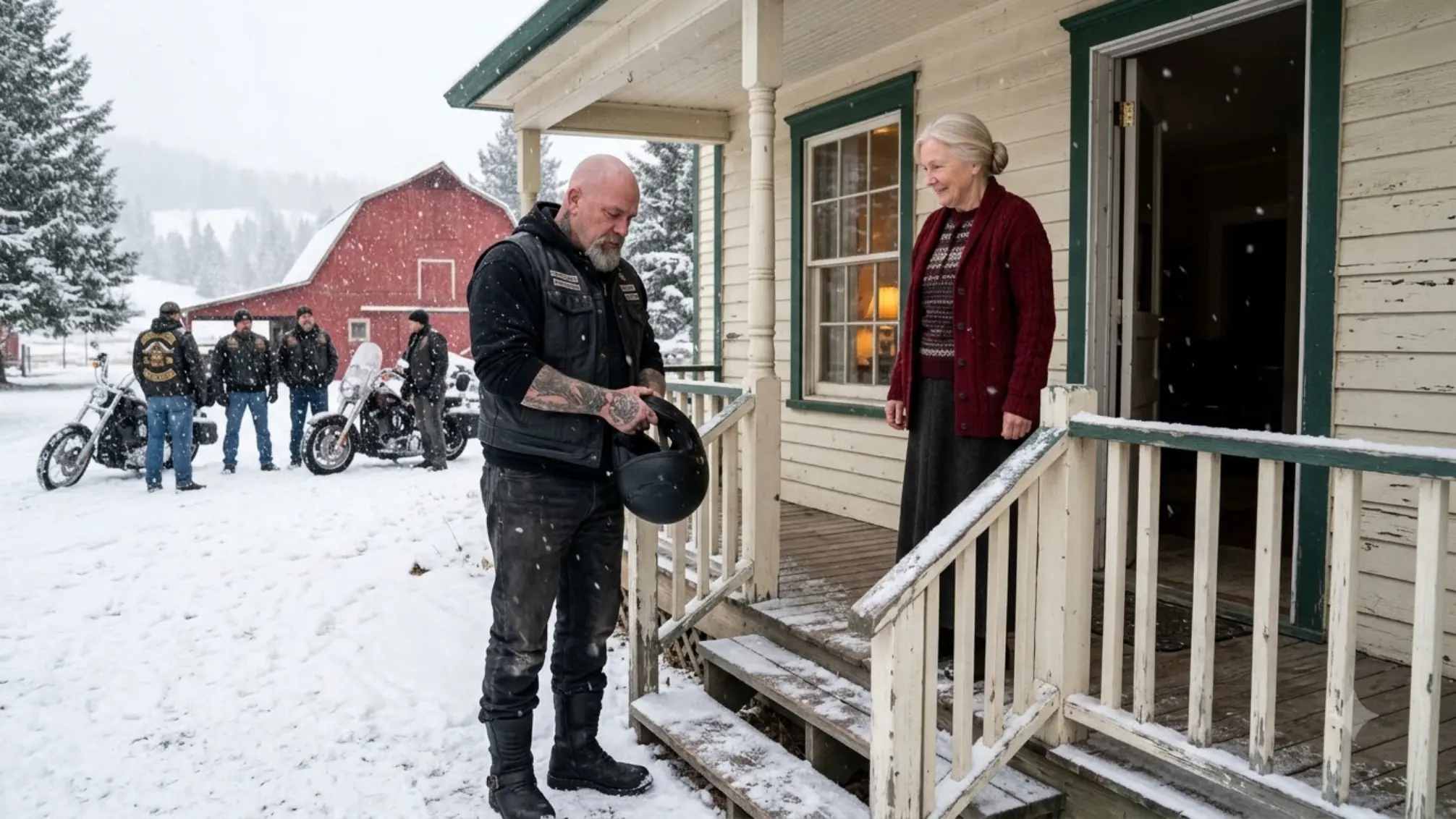
At first Thad thought it was thunder, but the sound never faded. It grew stronger, mechanical and rhythmic, until headlights appeared around the bend on Route 14. One motorcycle became five, then twelve, then a column stretching farther down the road than Willa could see through the sleet. Slowly, the riders stopped near the Merricks’ long gravel driveway.
Thad moved beside his wife. “Those aren’t tourists.” Willa could already see the heavy motorcycles, leather vests, soaked jackets, and enormous men stepping carefully into the storm. Several riders remained hunched over their bikes, while one man sat beside the road as though standing had become too difficult.
Thirty bikers had been trapped by a landslide that blocked Route 14 behind them and flooding that made the lower road impossible. They had tried several places in Granger’s Hollow, but doors remained closed once people saw their motorcycles and patches. By the time they reached the Merrick property, the temperature had dropped below twenty degrees. Their leader, Cormac “Reaper” Ashford, expected another refusal.
Willa opened the front door.
“Willa,” Thad warned quietly.
She looked back at him. “They’re freezing.”
“We don’t know them.”
“We know enough.”
The wind pushed snow through the doorway as Willa stepped onto the porch. Cormac stood at the bottom of the steps holding his black helmet against his stomach, an intimidating six-foot-four man with a shaved head, gray beard, tattooed arms, and a black leather vest soaked by the storm. Behind him, dozens of riders waited without moving closer.
“We’re not here for trouble, ma’am,” Cormac said. “The highway’s gone behind us. We just need somewhere covered until the storm passes.”
Willa looked past him.
One rider held his ribs. Another leaned against a motorcycle while someone supported him. Several younger men were trembling despite pretending otherwise.
“Are any of them badly hurt?”
Cormac seemed surprised by the question. “A couple took hard falls when the road washed out. Nothing we think is serious.”
Willa opened the door wider.
“Bring them inside.”
Cormac stared at her.
“Ma’am, you understand who we are?”
Willa looked at the leather vest and then back into his tired eyes. “I understand you’re standing outside in nineteen-degree weather.”
She stepped aside.
“No one should sleep hungry in a storm. Get inside before I lose all the heat.”
For several seconds, nobody moved. Then Cormac lowered his head with a respect that looked almost old-fashioned. “Yes, ma’am.”
The Merrick farmhouse had never contained thirty strangers before. Wet boots filled the entryway, leather jackets hung from every available hook, and men who looked enormous outdoors suddenly seemed almost embarrassed by the amount of room they occupied. They stood close to walls, careful around furniture, apologizing whenever muddy water touched the wooden floor.
Willa went straight to the kitchen.
She removed beef, potatoes, onions, carrots, bread flour, and everything else she could turn into enough food for thirty exhausted men. Thad watched her for perhaps ten seconds before surrendering to the inevitable. He pulled down the largest cooking pot.
A young biker with a black eye stepped forward.
“Sir, can I get that?”
Thad studied him.
The kid could not have been older than twenty-two. His patch identified him as Declan, and despite the bruised face and leather vest, he spoke with the careful manners of someone who had once been taught that entering another person’s home was a privilege.
“Top shelf,” Thad said.
“Yes, sir.”
Declan retrieved the pot and handed it to him with both hands.
Thad nodded.
“Thank you.”
Something passed across Declan’s face at those words. It was small, but Willa noticed. She had spent more than three decades working with children at the local library and had learned to recognize people who were unused to hearing genuine approval.
The first aroma of beef hitting the skillet changed the house.
Conversation gradually replaced silence. One rider asked whether he could bring firewood from the porch. Another noticed a broken chair against the wall and quietly repaired the loose leg after Thad handed him wood glue.
Declan returned to the kitchen.
“Mrs. Merrick?”
“Yes, dear?”
“Can I help?”
“Can you set a table?”
“Yes, ma’am.”
“Then start there.”
He arranged every fork and knife with almost ridiculous precision.
Willa smiled.
“You’ve done that before.”
“My grandmother cared about tables.”
“Smart woman.”
“She was.”
Declan’s voice became quieter.
“She passed away when I was sixteen.”
Willa did not ask for details.
She only handed him another stack of plates.
By ten that night, steaming bowls of beef stew covered the table. Willa added cornbread, butter, and hot coffee, insisting the most exhausted riders eat first. Cormac waited until everyone else had a place before accepting a bowl for himself.
“You should sit,” Willa told him.
“I’m fine.”
“That wasn’t a suggestion.”
Several bikers tried not to laugh.
Cormac looked at the tiny elderly woman ordering him around and finally surrendered.
“Yes, ma’am.”
Thad treated the rider who had hurt his ribs, wrapping him carefully and making sure his breathing remained steady. The man introduced himself as Boone and repeatedly insisted he was fine. Thad ignored him with the practiced patience of someone who had spent decades around stubborn working men.
“No lifting tomorrow.”
Boone almost protested.
Thad looked at him.
Boone changed his mind.
“Yes, sir.”
After midnight, the farmhouse had become something neither Merrick could have predicted. Some bikers slept on the living-room floor beneath spare quilts while others occupied chairs or leaned against walls. The men who remained awake spoke quietly enough not to disturb anyone.
Cormac stood alone in the hallway.
He was studying one of the old photographs hanging beside the staircase.
Thad noticed but did not approach immediately.
The photograph showed Thad as a young carpenter standing beside three other men outside an unfinished bridge project in northern Montana almost fifty years earlier. Their hair was dark, their clothes were dirty, and all four were laughing at something the camera had failed to preserve.
Cormac stared especially hard at the man standing beside Thad.
The following morning, Willa woke before six and found Declan already in the kitchen.
“You’re awake early.”
“So are you.”
“I’m seventy-two. We stop sleeping eventually.”
He smiled.
“Can you teach me breakfast?”
Willa stared at him.
“Breakfast?”
“Eggs.”
“You don’t know how to cook eggs?”
Declan looked genuinely embarrassed.
“I know how to buy them in sandwiches.”
Willa placed a skillet in front of him.
“We’re fixing that immediately.”
When Thad walked into the kitchen forty minutes later, he stopped in the doorway. Declan stood beside Willa carefully folding scrambled eggs while she corrected his heat control like a patient instructor. The young biker looked more nervous about overcooking breakfast than he had during the storm.
“Morning, sir,” Declan said.
Thad poured coffee.
“You surviving the lesson?”
“Barely.”
Willa pointed a spatula at Thad.
“Don’t distract my student.”
Thad sat down.
“Yes, ma’am.”
Laughter spread through the kitchen.
Then Thad noticed Cormac standing in the hallway again.
Still looking at the photograph.
He walked toward him.
“You’ve been studying that picture since last night.”
Cormac hesitated.
“The man beside you.”
Thad looked at the photograph.
“Roark Ashford.”
Cormac closed his eyes.
For a moment, the intimidating club president looked completely different.
“That was my father.”
Thad turned toward him.
“Roark was your father?”
Cormac nodded.
“He died when I was eleven.”
Thad stared at the photograph.
Memories returned.
A spring flood.
An unfinished bridge.
A timber support failing without warning.
Roark trapped beneath a collapsed frame while the river rose around him.
Thad had crawled beneath unstable timbers with a rope tied around his waist while everyone else shouted that the structure might come down completely. He reached Roark, cut his trapped boot free, and dragged him through waist-deep water before another section collapsed behind them.
Thad had barely thought about it afterward.
Roark apparently had.
“My father told that story all my childhood,” Cormac said. “He said some carpenter named Merrick went underneath that bridge when nobody should’ve gone in.”
Thad looked down.
“Anybody would have done it.”
“No.”
Cormac’s voice became firm.
“They didn’t.”
Silence filled the hallway.
Cormac looked again at his father’s young face.
“He used to tell me, ‘You’re here because somebody decided my life mattered more than his fear.’”
Thad swallowed.
“He was a good man.”
“He talked about you like you were family.”
Cormac’s eyes became wet, though he refused to wipe them.
“I spent years wondering whether I’d ever find you.”
Thad looked toward the kitchen where Willa was teaching Declan to make toast without burning it.
“And you found us because your motorcycle got trapped in a snowstorm.”
Cormac gave a quiet laugh.
“Life has a strange sense of humor.”
By eight-thirty, the storm had weakened enough for the bikers to leave using a longer valley route. One by one, they thanked the Merricks. Boone carefully hugged Willa and told her his mother would have loved her.
Declan shook Thad’s hand.
Then suddenly pulled him into a hard embrace.
“Thank you, sir.”
“For what?”
Declan stepped back.
“For acting like I belonged in your house.”
Thad had no immediate answer.
Cormac was last.
He stood at the porch with his helmet in both hands.
“Ma’am,” he said to Willa, “everyone else closed their doors when they saw us.”
Willa smiled gently.
“I didn’t see bikers, dear. I saw people standing outside in the cold.”
Cormac’s voice became rough.
“You have no idea what it means to be welcomed when you’re used to being feared.”
Willa reached for his hand.
“Then remember this house, Cormac.”
She squeezed his fingers.
“As long as we’re here, this door stays open.”
Cormac looked toward Thad.
Then at the photograph visible through the hallway.
He placed a card on the table beside the door.
One name.
One phone number.
“If either of you ever needs anything, call.”
“We’re fine,” Thad said.
Cormac smiled.
“I know.”
He pulled on his gloves.
“Call anyway.”
The motorcycles disappeared down Route 14.
Willa and Thad returned inside.
Their house looked as though a storm had occurred indoors as well as outside.
Thirty coffee mugs.
Blankets everywhere.
Mud across the entryway.
Furniture shifted.
Willa looked around.
“Well.”
Thad nodded.
“That happened.”
They laughed.
Then they cleaned.
Two mornings later, Willa was kneading bread when the kitchen windows began vibrating.
She stopped.
The sound was familiar.
Engines.
Many more engines.
Thad appeared from the living room.
“You hear that?”
“I hear it.”
They walked to the window.
Motorcycles poured around the curve on Route 14.
Dozens became hundreds.
Pickup trucks appeared among them carrying lumber, fencing, roofing material, ladders, tools, generators, and equipment.
The procession kept coming.
Willa stared.
“What did that man do?”
Thad looked equally stunned.
“I think he made some calls.”
The first motorcycles entered the Merrick driveway.
Others filled the field beside the barn.
Trucks parked in organized rows.
Within fifteen minutes, the quiet farm looked like the staging ground for the largest community repair project Granger’s Hollow had ever seen.
Cormac climbed the porch.
Willa opened the door before he could knock.
“Young man.”
He removed his sunglasses.
“Yes, ma’am?”
“What is happening?”
Cormac looked over his shoulder.
“This is what happens when several hundred people hear that someone fed their brothers during a storm and asked for nothing.”
Willa stared at the crews unloading materials.
“That is entirely excessive.”
Cormac almost looked worried.
“Should we leave?”
Willa narrowed her eyes.
“No.”
His shoulders relaxed.
“But if all those people are staying through lunch, somebody better start organizing food.”
Cormac smiled broadly.
“We brought Maeve.”
A red-haired woman climbed from a catering truck and waved.
“I was told to prepare for five hundred!”
Willa looked at Cormac.
“Fine.”
She rolled up her sleeves.
“Tell Maeve she’s using my kitchen.”
The farm transformed before noon.
A roofing crew climbed onto the old barn and removed the sections Thad had been patching for years. Another crew replaced leaning fence posts along the eastern pasture.
Carpenters repaired porch boards.
Electricians checked wiring.
Mechanics serviced the generator.
Nobody asked for money.
Thad repeatedly tried to work.
Every time, somebody stopped him.
Finally a contractor named Flint Bishop handed him a clipboard.
“You supervise.”
“I can still swing a hammer.”
“I believe you.”
“Then give me one.”
“No.”
Thad stared.
Flint stared back.
“You’re enjoying this.”
“A little.”
The most important discovery happened beneath the house.
A contractor checking the furnace noticed something wrong with the ventilation system. Further inspection revealed a dangerous exhaust leak that had likely been affecting the house for weeks.
Thad stood beside the old unit in silence.
“You’re certain?”
Flint nodded.
“You need this replaced.”
“How soon?”
“We already ordered one.”
Thad almost laughed.
“Of course you did.”
The reality reached him more slowly.
For months he and Willa had both complained about headaches and unusual fatigue.
They blamed age.
The furnace offered another explanation.
When Thad told Willa, she sat on the couch.
For several minutes neither spoke.
Then she reached for his hand.
“If they hadn’t come back…”
“I know.”
“If the storm hadn’t happened…”
“I know.”
She looked through the window at hundreds of strangers repairing their farm.
“We opened the door for them.”
Thad squeezed her hand.
“And apparently they opened one for us.”
By afternoon, people from Granger’s Hollow began arriving.
Sheriff Morrison came first.
Then Pastor Green.
Then the Daugherty family from the feed store.
Several had refused the bikers shelter during the storm.
Morrison removed his hat when he reached Thad.
“We were wrong.”
Thad waited.
“I saw the motorcycles and decided trouble was coming.”
Pastor Green looked ashamed.
“I preach every week about helping strangers, and when strangers actually needed something, I locked my church.”
Willa stepped onto the porch.
“You came today.”
Green looked at her.
“That doesn’t erase what happened.”
“No.”
She smiled.
“But it gives you somewhere better to start.”
The townspeople joined the work crews.
Something remarkable happened.
People who had feared one another forty-eight hours earlier began working shoulder to shoulder.
A tattooed biker and Sheriff Morrison reset fence posts together.
Pastor Green helped unload roofing material.
Mrs. Daugherty joined Maeve and Willa preparing lunch.
Declan taught two teenagers how to use a drill properly.
No speeches were needed.
The work did what speeches could not.
Near sunset, the barn roof was finished.
Fences stood straight.
The porch had new boards.
The furnace was safe temporarily while the replacement was being delivered.
Cormac gathered everyone near the farmhouse.
He carried a small wooden box.
Thad looked uncomfortable.
“Cormac, what are you doing?”
“Something my father would’ve wanted.”
He opened the box.
Inside was an old carpenter’s measuring rule, worn smooth from decades of use.
Thad recognized it immediately.
“That was Roark’s.”
Cormac nodded.
“My father kept this until the day he died.”
He turned it carefully.
Small lettering had been scratched into the wood.
T. MERRICK – BRIDGE, 1969
Thad’s breath caught.
Cormac explained.
“My father said you used that rule to measure the opening before crawling underneath the collapsed bridge. Afterward, you left it in his truck.”
Thad touched the worn wood.
“I forgot about it.”
“He didn’t.”
Cormac looked toward the hundreds gathered around them.
“My father got thirty-two more years because Thad Merrick decided he wasn’t leaving another man behind.”
The yard went silent.
Cormac turned toward Willa.
“Two nights ago, Willa Merrick made exactly the same decision.”
Her eyes filled.
“She saw thirty strangers in a storm and decided nobody was being left outside.”
Cormac handed the measuring rule to Thad.
“My father wanted this returned someday.”
Thad accepted it with shaking hands.
Cormac’s voice softened.
“I think today is someday.”
Thad looked at the tool.
Then at Cormac.
“I couldn't help everybody that day.”
“You helped him.”
“That never felt like enough.”
Cormac stepped closer.
“It was enough for me.”
Thad’s face broke.
Cormac opened his arms.
The two men embraced.
Willa covered her mouth as tears came freely.
Around them, hundreds of people remained completely silent.
Then Cormac walked toward Willa.
She reached for him before he could speak.
The enormous biker bent carefully and hugged the tiny elderly woman.
“You fed us like family,” he whispered.
“You were hungry.”
“That’s really all you thought?”
“What else was I supposed to think?”
Cormac laughed through tears.
Willa pulled back.
“Listen to me.”
“Yes, ma’am.”
“You don’t owe us anything.”
Cormac looked toward the repaired barn, new fences, and people filling the yard.
“I know.”
“Good.”
She touched his cheek.
“Because kindness that comes with a debt isn’t kindness.”
Cormac nodded slowly.
“Then consider today something else.”
“What?”
“Family showing up.”
Willa smiled.
“That I’ll accept.”
Engines began starting as evening settled over Montana.
The convoy left gradually.
Hundreds of motorcycles rolled down the drive while Willa and Thad watched from their repaired porch.
Cormac waited until nearly everyone else had gone.
He put on his helmet.
“You still have my number?”
Thad touched his shirt pocket.
“Yes.”
“Use it.”
“We probably won’t.”
Cormac looked toward Willa.
“She will.”
Willa laughed.
“You know me too well already.”
Cormac started the motorcycle.
Before leaving, he looked once more toward the farmhouse.
“Door stays open?”
Willa folded her arms.
“Always.”
He rode away.
The engine sound faded into the valley.
That evening, Willa and Thad sat alone at their kitchen table.
The house suddenly seemed impossibly quiet.
Thad placed Roark’s old measuring rule beside the faded photograph.
Willa brought two cups of tea.
“He found you.”
Thad nodded.
“After all those years.”
“He found us.”
Willa sat beside him.
Outside, freshly repaired fences crossed the pasture.
The barn roof reflected moonlight.
The furnace hummed safely beneath the floor.
Thad reached across the table and took his wife’s hand.
“I almost stopped you from opening that door.”
“I know.”
“I was scared.”
“So was I.”
He looked surprised.
“You didn’t look scared.”
Willa smiled.
“Courage doesn’t mean you aren’t scared, Thad.”
She squeezed his hand.
“It just means fear doesn’t get to make every decision.”
Months passed.
The bikers returned.
Not hundreds.
Sometimes two.
Sometimes ten.
Sometimes only Declan, carrying groceries and pretending he happened to be nearby.
Cormac called every Sunday.
The Merrick farmhouse gradually became a place where people arrived knowing coffee would be waiting.
The following Thanksgiving, dozens returned to help families across Granger’s Hollow with roofs, heating systems, food, and winter repairs.
Thad supervised.
Willa cooked.
Declan made the eggs.
He had become surprisingly good at them.
Years later, people would argue about what actually started the tradition.
Some said it began when Cormac discovered his father’s photograph.
Others said it began when hundreds of bikers returned to rebuild the Merrick property.
Willa always disagreed.
“It started with cold people standing outside,” she would say.
“And somebody opening a door.”
That was all.
A door.
A pot of stew.
Thirty strangers allowed inside.
Nothing about the act seemed extraordinary when Willa did it.
She simply refused to let fear decide who deserved warmth.
But kindness rarely ended where it began.
It traveled.
Through Cormac.
Through Declan.
Through the townspeople who had once been afraid.
Through every family later helped by the Thanksgiving crews.
Through the farmhouse that became known throughout the valley as the place where nobody remained outside during a storm.
And every winter, when snow covered Route 14 and wind moved down from the Rockies, one small porch light remained burning beside the Merrick door.
Not because Willa expected company.
Because someone might need it.
And beside that door, Thad eventually hung a simple wooden sign.
COME IN FROM THE COLD.
No club name.
No explanation.
No conditions.
Just five words that said everything Willa Merrick had understood from the beginning.
The door stayed open.