He stepped inside, moving slowly, deliberately.
His shoes, scuffed from years of wear, tapped against the polished marble floor, a quiet defiance against the gleaming, untouched perfection around him.
The air carried a crisp, artificial chill, thick with the scent of wealth, the kind of wealth that was not merely possessed, but displayed. Every inch of the space exuded luxury.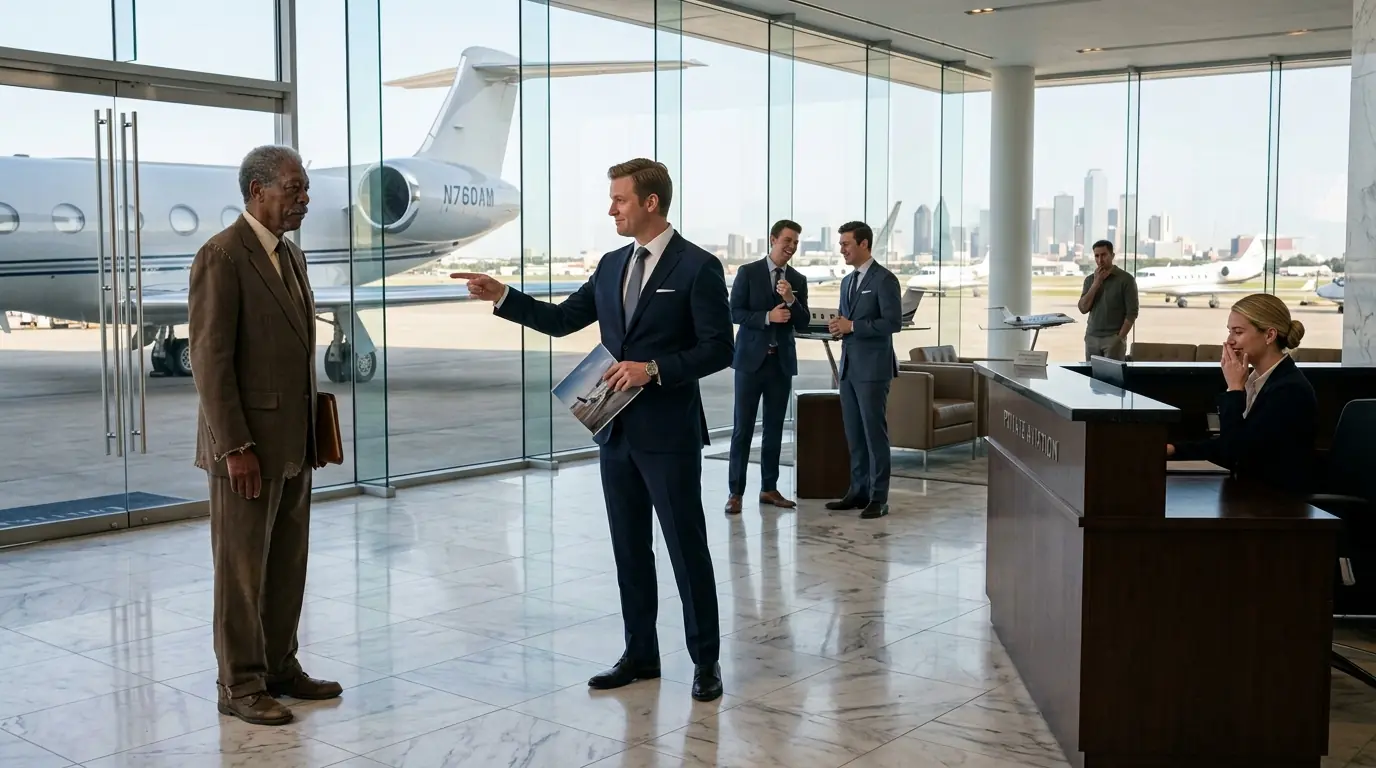
Towering floor-to-ceiling windows framed the tarmac outside, where sleek private jets glistened under the Texas sun. A massive silver Gulfstream model dominated the center of the showroom, its wings stretching outward like the arms of giants.
A silent proclamation of power.
This was a place for the elite.
The untouchable.
The ones who did not ask for price tags.
James Carter did not belong.
He knew it the moment he stepped through those glass doors.
And so did they.
The first look came from the receptionist, her painted smile faltering for half a second before she regained her composure.
Then came the second look from a young salesman adjusting the cuff of his thousand-dollar suit, his eyes flicking up from his phone only to widen with barely concealed amusement.
The third came from deeper inside the showroom, where two men in tailored jackets stood near a display, exchanging a glance before one of them let out a low chuckle.
The laughter was subtle at first, tucked behind smirks, behind polite disinterest.
But James had spent a lifetime reading rooms.
He felt the shift, the hum of condescension growing, curling through the space like a slow-moving current ready to pull him under.
He walked forward, undeterred.
Each step measured.
Each movement a quiet testament to a lifetime of perseverance.
A voice cut through the air.
“Sir, are you lost?”
Not a genuine question.
A performance.
The young salesman from before now stood directly in his path, an easy grin spreading across his face.
James met his eyes.
There was no anger in his gaze.
No indignation.
Just patience.
“I’d like to inquire about purchasing a jet,” he said.
His voice was calm.
Steady.
Silence followed.
For a moment, just a moment, the salesman hesitated, as if his mind needed a second to register the words.
Then came the exhale.
The barely perceptible scoff.
The amusement flickering across his face like a ripple in still water.
One hand rested on his hip. The other gestured vaguely toward the showroom.
“I’m sorry, sir, but these jets aren’t for window shoppers.”
His tone was light, teasing, as if he were indulging a child in a game of make-believe.
“Maybe we can find you a nice tour instead.”
Laughter followed.
Louder now.
Unrestrained.
Someone from the back let out a whistle. Another voice, more distant, muttered something under his breath, a joke James could not quite hear, but it sent another wave of amusement through the staff.
James did not react.
He let them speak.
Let them look at him and see only what they wanted to see.
An old man in a faded suit.
A curiosity.
A momentary joke in their otherwise polished day.
They did not see the decades of sacrifice etched into his hands.
They did not see the weight of experience in his stance.
They did not see him at all.
And that was fine, because James Carter had never been the kind of man to demand recognition.
He had spent his life building, creating, lifting others up while staying in the background. He had seen wealth in all its forms, had known men who wore power like a weapon and men who carried it with quiet grace.
He understood both.
He nodded slowly, absorbing the moment, committing it to memory.
Then, with the same quiet resolve that had carried him through every challenge, he turned.
The laughter followed him as he walked away.
The doors shut behind him.
The sound was final.
They thought that was the end of it.
They thought they had seen the last of him.
They thought he was just another man who had stepped into the wrong world.
They were wrong.
Because tomorrow, he would return, not as a customer, but as their boss.
James Carter had always believed in the power of humility, in hard work, in quiet generosity.
He was not a man of flashy suits or expensive watches. He did not drive a car that announced his wealth before he even stepped out of it.
No, James had built his fortune the way a man builds a house.
One brick at a time.
One sacrifice after another.
His story was not one of overnight success or inherited privilege. He had grown up in Birmingham, Alabama, in the heart of the segregated South, where dreams for men like him were often snatched away before they could take flight.
His father, a janitor in a textile factory, had once told him, “Son, life won’t ever hand you a thing. You take what you need with work, with faith.”
James had taken those words and carried them into every room he had ever walked into.
He worked his way through school, taking night shifts at a trucking yard, eating just enough to keep going so he could save every extra dollar.
By the time he was in his early twenties, he had launched his first small freight business.
A single truck.
One employee.
And a determination that no amount of adversity could shake.
The years were hard, filled with obstacles that would have broken lesser men.
But James was not just any man.
He expanded his business slowly but surely. One truck became five. Five became twenty. He moved into logistics, then real estate, then technology.
And as his wealth grew, so did his purpose.
He did not hoard his success. He used it to fund churches, support single mothers, and provide scholarships for kids who never thought college was possible.
But there was one dream he had never pursued.
A private jet.
Not for extravagance.
Not for the sake of status or comfort.
James had spent years watching pastors, missionaries, and struggling community leaders fight to get from place to place, turning down opportunities to preach and to serve simply because travel was too expensive, too difficult.
And so he had made a promise to himself.
One day, when the time was right, I’ll make sure they never have to say no again.
That day had come.
So, dressed in the same simple brown suit he had worn for years, worn at the elbows, slightly frayed at the cuffs, the fabric softened by time, James had walked into Wellington Jets in Dallas, Texas, with quiet determination.
He was not looking for a favor.
He was not asking for permission.
He was there to make a purchase.
But the moment he stepped inside, he could feel it.
The shift in the air.
The weight of glances thrown his way.
The judgment.
He did not need to hear the words to know what they were thinking.
He doesn’t belong here.
He’s wasting our time.
Another old man with big dreams and an empty wallet.
The receptionist barely looked up before giving him a dismissive nod toward the showroom floor.
The sales team, a group of young men in sharp suits and polished shoes, stood near one of the display models, murmuring to one another as they watched him.
One of them, Brandon Walker, his name tag red, straightened his jacket and sauntered over, a smirk already pulling at the corner of his mouth.
“Sir, are you lost?”
The words were smooth, polite on the surface, but the undertone was unmistakable.
Condescending.
A joke that had not been spoken yet.
James met his gaze, unwavering.
“I’d like to inquire about purchasing a jet.”
The amusement in Brandon’s eyes flickered for just a second, as if the answer had caught him off guard.
Then came the exhale.
The barely-there scoff.
“I see. Well, these jets start at about fifty million dollars, but maybe we can find something smaller for you.”
Behind him, a few of the other salesmen chuckled.
Another leaned over and muttered something that sent more laughter through the group.
James did not react.
He had been here before.
Not in this showroom.
Not in this exact moment.
But in this feeling.
This experience.
Being underestimated.
Being dismissed.
He had spent his life proving men like these wrong.
Not with words.
Not with arguments.
But with action.
And so he nodded as if considering their words.
He did not argue.
Did not demand respect.
He simply turned, walking toward the door, the laughter following him like a shadow.
They thought they had seen the last of him.
But what they did not know, what they never could have guessed, was that in less than twenty-four hours, they would not just be greeting him differently.
They would be working for him.
The laughter was sharper now, less restrained, more confident.
James Carter stood there, his hands resting lightly at his sides, the warm brown of his worn-out suit blending into the muted tones of the showroom.
He had spent his entire life in spaces where men like these thought they held all the power. He had seen their kind before, the smugness, the blind confidence that came from never having struggled, never having been overlooked.
They saw his tired shoes and the gentle wrinkles on his face.
They saw the suit softened by time, not tailored for show.
What they did not see was the man beneath it all.
Brandon Walker smirked, adjusting his silk tie as he gave James a once-over, amusement dancing in his eyes.
“Sir, these jets aren’t for window shoppers.”
His voice carried through the space, light and casual, but with an edge.
His colleagues, now emboldened, chuckled from their positions near the gleaming aircraft displays.
James did not flinch.
Instead, he took a step forward, his gaze unwavering.
“I’d like to see your financing options.”
The room went still for half a second.
A pause.
A brief hesitation before another round of snickers filled the air.
Brandon tilted his head slightly, feigning interest.
“Oh, you want to finance a jet?”
James nodded.
“That’s right.”
Brandon pressed his lips together, fighting back a grin. Then, with a practiced air of professionalism, he turned and gestured toward the luxury seating area nearby.
“Well, sir, let me explain. These jets start at around fifty million dollars. Of course, we offer payment options, but—”
Another salesman, a lanky man in a navy suit, cut in with a smirk.
“Maybe you can afford a paper plane.”
The laughter hit harder this time.
Brandon chuckled, shaking his head. Another staff member stifled a laugh behind his hand. Even the receptionist, who had been trying to stay professional, bit her lip to hold back a grin.
But James did not laugh.
Instead, he let out a quiet breath.
A slow, steady exhale.
Then he turned his gaze directly toward Brandon and the others, his expression unreadable.
“I may not look like much to you,” he said, his voice calm, steady, unshaken. “But God knows my worth.”
The laughter stopped for a brief, flickering moment.
Something in his voice shifted the air in the room.
It was nothing loud.
Nothing angry.
Just a simple, quiet certainty.
James turned without another word and made his way toward the exit, his steps unhurried, his posture straight.
The salesmen watched him go, their amusement now tinged with something else.
Something they could not quite name.
A strange discomfort.
Because most men, when mocked, fight back.
They argue.
They get angry.
They demand respect.
But James had done none of that.
And somehow, that unsettled them more than if he had.
Meanwhile, somewhere deep inside Wellington Jets corporate offices, a different conversation was taking place.
A boardroom.
High ceilings.
A long glass table.
At its head sat Richard Langston, the CEO of Wellington Jets, his face grim. Across from him, the company’s senior executives shuffled in their seats, tension hanging thick in the air.
A corporate shakeup was in motion.
Langston’s voice was low and deliberate.
“The board has made its decision. We’re finalizing a full ownership transfer by morning.”
Murmurs rippled through the room. Some executives shifted uncomfortably. Others exchanged knowing glances.
“Who’s the buyer?” someone asked.
Langston exhaled sharply, glancing down at the document in front of him.
Then, after a pause, he said two words that would change everything.
“James Carter.”
Silence.
The name meant nothing to most in the room.
But for the ones who knew, the ones who had followed industry whispers, the weight of those words was undeniable.
James Carter.
A man known not for boasting, not for flashing his wealth, but for making quiet, strategic moves that reshaped entire industries.
A man who never announced himself before taking over.
Langston closed the folder in front of him.
He could already hear the faint echoes of laughter from the showroom downstairs, where his employees, his unknowing, arrogant employees, were making a mistake they would regret by morning.
James Carter was not a window shopper.
By this time tomorrow, he would be their boss.
James Carter’s story did not begin with wealth, privilege, or even opportunity.
It began in a place where doors were closed before he could even knock.
Born in Birmingham, Alabama, during the height of segregation, James learned early that the world did not offer fairness to men like him.
He was the son of a janitor and a housekeeper, parents who worked long hours scrubbing floors and cleaning up after others just to put food on the table.
His childhood was filled with echoes of struggle.
He watched his father leave before the sun rose and return long after it set, hands calloused, back bent, but spirit unbroken.
His mother, a woman of deep faith, would read the Bible by candlelight, whispering prayers over her children.
“God has a plan for you, James,” she would say. “Never let this world tell you what you’re worth. Let God decide that.”
But faith alone did not put food on the table.
By the age of ten, James was shining shoes on the dusty streets of Birmingham, earning pennies just to help his mother afford bread and milk.
He faced rejection daily.
Some men walked past him as if he were invisible. Others scoffed, tossing him coins as if doing him a favor.
But James never pitied himself.
He watched.
He listened.
And most importantly, he learned.
He studied the men who walked confidently into businesses, their suits pressed, their words commanding respect. He memorized the way they spoke, the way they carried themselves.
And deep down, he made a promise to himself.
One day, I won’t just work for these men. I will become one of them.
At eighteen, James left Birmingham with nothing but fifteen dollars in his pocket and an unshakable faith in Jesus Christ.
He arrived in Houston, Texas, sleeping in cheap boarding houses, taking on any job that would pay. He worked at a shipping dock during the day and attended night school, surviving on little sleep and sheer determination.
Then, at twenty-four years old, James saw an opportunity where others saw failure.
A small freight company was on the verge of shutting down. Its owner, an older man burdened by debt, was willing to sell for almost nothing.
James had no money to buy it outright.
But he had something even greater.
A vision.
He negotiated a deal to take over the company with just a handshake, promising the owner he would pay off the debt within two years.
Then James worked harder than ever.
He drove trucks himself.
He made deliveries.
He knocked on doors, securing contracts with small businesses.
While other men his age were settling into comfortable jobs, James was building an empire from the ground up.
Within five years, the company expanded beyond Houston.
Within ten years, it became one of the leading logistics firms in Texas.
Within twenty years, James Carter was a multimillionaire.
But while money changed his circumstances, it never changed his heart.
Unlike the greedy businessmen around him, James believed in something greater than wealth.
He believed in purpose.
He poured his money into scholarships for underprivileged students, funding churches, and building orphanages across the country.
When struggling pastors could not afford to keep their ministries running, James stepped in.
Not for recognition.
Not for publicity.
But because he believed blessings were meant to be shared.
What the staff at Wellington Jets did not know was that James Carter had already changed the course of their futures before he ever stepped foot in their showroom.
Wellington Jets was just one part of a much larger empire, a subsidiary of Falcon Aeronautics, one of the top private aviation firms in the country.
And while the young, arrogant salesmen laughed at him, their own CEO, Richard Langston, was sitting in an office preparing for a major corporate announcement.
Because James Carter had just acquired a controlling stake in Falcon Aeronautics.
It had not been a planned acquisition.
It had not been a move for power or prestige.
Months earlier, Langston himself had come to James seeking guidance. Falcon Aeronautics had been struggling under mismanagement. The company was sinking, and investors were losing faith.
Langston had heard of James not just as a businessman, but as a man of integrity, a man whose financial wisdom had saved companies from collapse.
James did not rush into decisions.
He prayed.
He sought wisdom.
And then, after much deliberation, he agreed.
He did not buy Falcon Aeronautics for profit.
He did not see it as just another business move.
He saw an opportunity to create something meaningful, something lasting.
But James never flaunted his wealth.
He believed humility was the greatest strength a man could have.
So when he walked into Wellington Jets in his worn-out brown suit, he did not tell them who he was.
He did not announce himself as their future boss.
He simply walked in as a customer to see them, to test them, to learn who they truly were.
And in less than twenty-four hours, their laughter would be silenced.
Because James Carter did not just own a jet.
He owned the company.
The halls of Wellington Jets were usually filled with confidence, arrogance even.
Salesmen strolled in with their designer suits, their polished shoes clicking against the marble floors, their minds focused on one thing.
Closing deals.
Earning commissions.
But today, something felt off.
The air was heavier. The usual morning banter was replaced by hushed conversations. Phones buzzed more than usual. Secretaries whispered behind their desks.
Employees who usually took their time getting coffee were now checking their emails with furrowed brows.
Something was wrong.
In the break room, Jason, one of the junior salesmen, sat hunched over his laptop, his eyes darting across the screen as he read an internal memo.
His fingers trembled slightly as he reached for his coffee, barely registering the heat that burned his fingertips.
He swallowed hard before turning to Brandon Walker, who sat across from him, casually leaning back in his chair, tossing a stress ball into the air.
“I’m telling you, man, something’s up. I heard from accounting that the company changed hands overnight.”
Brandon caught the ball midair, his lips curling into a lazy smirk.
“Relax. Probably just some corporate restructuring. Happens all the time.”
Jason shook his head, lowering his voice.
“No, you don’t get it. A full buyout. The execs are freaking out. New ownership. New leadership.”
Brandon rolled his eyes, stretching his arms behind his head.
“So what? Some rich guy bought the company. Big deal. We sell jets to billionaires every day. Nothing’s going to change.”
The rest of the sales team, who had been eavesdropping from nearby, chuckled in agreement.
“Yeah,” one of them added. “Whoever it is, they’re going to love us. We’re the reason this company makes money.”
They were used to rubbing shoulders with the wealthy. They had pitched to CEOs, oil tycoons, celebrities. They had dined in the most expensive steakhouses in Dallas, shaking hands with men who owned entire empires.
What did they have to fear?
Brandon shrugged, standing up and straightening his silk tie.
“Mark my words, fellas. Whoever this guy is, he’ll be just like the rest of them. Easy to impress, easy to sell to, and easy to get on our side.”
A few of the salesmen laughed, the tension in the room easing.
They were not worried.
Why would they be?
Meanwhile, across town, a different preparation was taking place.
While Wellington Jets was filled with speculation and arrogance, James Carter was in a quiet study lined with old books and framed scriptures.
He was on his knees.
The early morning light spilled through the window, illuminating the worn pages of the Bible that lay open before him.
His fingers traced the familiar verse he had read countless times.
Proverbs 16:18.
“Pride goes before destruction, and a haughty spirit before a fall.”
James exhaled deeply, closing his eyes.
The events of the previous day replayed in his mind.
The laughter.
The mockery.
The condescending smirks.
For a brief moment, his flesh wanted justice.
A part of him wanted to return to Wellington Jets and watch as those same men who ridiculed him realized who he was.
But then another voice, a still small voice, reminded him.
This is not about revenge, my son. This is about revelation.
James opened his eyes, his spirit at peace.
He was not going back to Wellington Jets to humiliate those men.
He was not going back to throw his power in their faces.
He was going back to teach them, to show them that power was not in money, nor in status.
True power was in humility.
James closed his Bible and stood, his back straight, his heart prepared.
Today, he would not be walking into Wellington Jets as a dismissed old man in a brown suit.
Today, he would be walking in as their boss.
The moment James Carter stepped through the doors of Wellington Jets, the air changed.
This time, there was no arrogant smirk from Brandon.
No mocking glances.
No dismissive looks at his brown suit and worn-out shoes.
Because this time, James was not alone.
Behind him, walking with deliberate steps, was Richard Langston, the former CEO of Falcon Aeronautics. His face was unreadable, his posture tense.
Flanking Langston were two senior executives, both holding folders marked Corporate Transition.
The front desk receptionist, the same woman who had giggled at the jokes the day before, sat frozen in her chair, her hands hovering over the keyboard.
She swallowed hard.
“Mr. Carter,” she stammered, her voice barely above a whisper.
James gave her a polite nod before continuing forward, his step steady, his expression unreadable.
As he entered the main sales floor, a ripple of unease spread through the employees.
Conversations died mid-sentence.
Coffee cups were set down, half-drunk.
Brandon, standing near his usual spot by the luxury model display, felt his stomach tighten.
Why was Langston here?
And why was that old man, the one they had mocked, walking beside him like he belonged?
Brandon cleared his throat, forcing a smile.
“Good morning, gentlemen. Can we, uh… help you?”
Langston did not respond.
Instead, he simply stepped aside.
And all eyes fell on James.
The same man they had laughed at.
The same man they had dismissed.
The same man they had belittled.
But today, James Carter’s posture was not hesitant.
His presence was not meek.
He walked past them calm, composed, completely in control.
James Carter did not just own a jet.
He owned the company.
And in a few moments, everyone in that room would know it.
Silence.
The showroom of Wellington Jets, usually alive with the sounds of business, deals, and arrogant laughter, had become unnervingly quiet.
The employees, once full of confidence and bravado, now stood frozen, eyes wide, mouths slightly open.
The old man in the worn-out brown suit, the same man they had mocked and dismissed, was now their boss.
James Carter stood in the center of the room. His posture was relaxed, but his presence commanding.
His calm, steady gaze swept across the faces of those who had laughed at him, ridiculed him, looked down on him.
And yet, there was no anger in his eyes.
No malice.
No smugness.
Just wisdom.
He had lived long enough to know what this moment meant, not just for him, but for them.
Brandon Walker, the arrogant young salesman who had led the mockery the day before, felt a tightness in his chest.
He was not used to feeling small.
For years, he had built his identity around power, his smooth words, his charm, his ability to close deals and manipulate people.
But now, none of that mattered.
Still, he was not ready to accept the reality before him.
He needed to push back.
Brandon forced a smirk onto his face, stepping forward with slow, measured strides, as if this was all some sort of misunderstanding, as if he could talk his way out of it.
“Can we help you, sir?” he said, his voice still laced with that same condescending tone.
His eyes flickered toward his colleagues, hoping for support.
But they did not laugh this time.
They did not nod in agreement.
They just stood there watching, waiting.
Brandon cleared his throat and crossed his arms, trying to project an air of casual confidence.
“Back to look at jets you can’t afford?”
The words left his lips before he could stop them.
A mistake.
Because the moment they were spoken, he felt it.
A shift.
A realization.
His own words, the very ones he had used to humiliate this man, now felt like a noose tightening around his own neck.
He had miscalculated.
James did not need to say anything in response, because the look in his eyes, the quiet, knowing gaze, said everything.
But James did speak.
Softly.
With patience.
With grace.
“No, son,” he said, his voice steady. “I’m here to discuss my company’s future.”
Brandon’s smirk faltered.
The words did not make sense.
My company.
Brandon blinked, shaking his head slightly, trying to piece together what was happening.
“Your company?” he scoffed.
He let out a small, nervous chuckle, looking around at his colleagues for reassurance.
But no one was laughing.
James did not answer because he did not need to.
Someone else did.
From the side of the room, a deep, authoritative voice cut through the silence.
“That’s right.”
All heads turned.
Standing near the entrance was Richard Langston, the former CEO of Falcon Aeronautics.
Brandon’s stomach dropped.
Langston adjusted his tie, stepping forward with the air of a man who had seen empires rise and fall.
His expression was unreadable, but his eyes carried a quiet finality.
He was not here for games.
He was not here for discussions.
He was here to make an announcement.
Langston glanced at James, then turned his gaze to the stunned employees of Wellington Jets.
“Ladies and gentlemen,” he said, his voice steady and clear, “allow me to formally introduce your new majority owner, Mr. James Carter.”
The room froze.
No one moved.
No one spoke.
It was as if time itself had stopped.
Brandon felt his breath catch.
His throat tightened.
He opened his mouth, but no words came out.
This could not be real.
The old man, the one they had laughed at, mocked, humiliated, was the most powerful man in the room.
The realization crashed over them like a tidal wave.
James watched the reactions around him.
Shock.
Disbelief.
Fear.
And deep down, shame.
It was written all over their faces.
The slow realization that they had misjudged him, that their arrogance had blinded them.
James exhaled, glancing down at his worn-out brown suit.
Funny, was it not?
They had looked at this suit, these shoes, this aged face, and assumed he was beneath them.
But now, they could not even look him in the eye.
James took a step forward, the quiet weight of the moment pressing down on everyone in the room.
Then, with the same patience, the same wisdom that had carried him through decades of struggle, he spoke.
“God has a funny way of humbling the proud.”
The words landed with undeniable weight.
No anger.
No malice.
Just truth.
Brandon swallowed hard, his hands clenching into fists at his sides. His mind screamed at him to say something, do something, but there was nothing he could do.
Nothing any of them could do.
James Carter owned everything now.
And everyone in that room knew it.
A heavy silence followed.
The entire sales team stood frozen, their fates dangling in the air.
James could fire them on the spot, and no one would question it.
After all, they had treated him like he was nothing.
But James was not like them.
He was not ruled by revenge or bitterness.
He was ruled by faith, by humility, by something far greater than money or power.
That was why this moment was not about punishment.
It was about revelation.
James studied the faces before him.
Some were ashamed.
Some were afraid.
Some were still too proud to fully grasp what was happening.
But none of that mattered now.
What mattered was what happened next.
And the lesson they were about to learn about humility, grace, and the power of faith would be one they would never forget.
The air in Wellington Jets remained thick with tension.
The revelation had been made.
James Carter, the man they mocked, dismissed, and humiliated, was now their boss.
The weight of it pressed down on every single employee like a judgment they never saw coming.
But James stood there calm, unmoved.
He was not reveling in their shame.
He was not basking in power.
Instead, there was something deeper in his eyes, something that went beyond this moment.
This was not just business to him.
It was a lesson.
A calling.
A test of character.
Not for himself, but for them.
James took a deep breath, then turned toward the receptionist.
“Call everyone in. I want the entire staff here.”
She blinked, unsure for a moment if she should move.
Then, with trembling hands, she reached for the intercom.
Within minutes, the entire Wellington Jets team had gathered.
Executives.
Salesmen.
Secretaries.
Maintenance workers.
All of them.
Some stood with their arms crossed, trying to mask their unease. Some avoided eye contact. Some still looked stunned, unable to process what was happening.
And in the center of them all stood James Carter.
The man they had looked down on just yesterday.
The same man they had thought did not belong.
James took a step forward, looking at each of them, not with anger, but with understanding.
Then, in a voice steady as a rock, he began to speak.
“I wasn’t born into wealth,” he said. “I didn’t grow up with privilege or easy opportunities.”
His words were slow, deliberate.
“I was born in Birmingham, Alabama, a place where, as a young boy, I was told I wouldn’t amount to much.”
Silence.
Not a single sound in the room.
No one dared to interrupt.
“My family was poor. My father worked sunup to sundown just to put food on the table. And my mother, she taught me the most valuable lesson I’ve ever learned.”
James paused, his eyes growing distant, as if he could still hear his mother’s voice.
“She said, ‘Son, the world may judge you by what you wear, where you live, and how much money you’ve got. But God, He judges the heart.’”
A few people shifted uncomfortably.
Brandon, standing near the back of the room, felt his chest tighten.
James continued.
“I didn’t have fancy shoes. I didn’t have money for school. But what I did have was faith. And faith told me that if I worked hard, if I honored God, and if I treated people right, He would make a way.”
He let the words settle before continuing.
“So I worked. I started a small freight business with nothing but an old truck and a dream. I worked long nights. I prayed harder than I worked. And little by little, God did what He promised.”
James let out a small chuckle, shaking his head.
“Now I own companies. I help ministries. I fund churches. And I don’t say that to boast. I say it because everything I have, God gave it to me.”
Another pause.
Then James’s voice dropped lower.
Sharper.
“And yet, when I walked into this building yesterday, a building I now own, I was treated like a beggar. Like I didn’t belong.”
The silence grew even heavier.
Some lowered their heads.
Some clenched their fists.
And one man standing at the back felt his heart begin to race.
Brandon Walker.
For the first time in his entire career, Brandon felt small.
Not because of power.
Not because of wealth.
But because, for the first time, he saw himself for who he really was.
Arrogant.
Proud.
Blind.
All his life, he had judged people based on what they looked like, what they wore, how much they had.
But none of that mattered now.
None of it could change what he had done.
His mouth felt dry.
His chest was tight.
And suddenly, he could not hold it in anymore.
He broke in front of everyone.
Brandon Walker, the smooth-talking, arrogant salesman, fell apart. His head lowered. His hands trembled. Tears, real, painful, humbling tears filled his eyes.
Then, in a voice so broken it barely came out, he spoke.
“Mr. Carter, I… I was wrong.”
Gasps rippled through the room.
Brandon, the man who never admitted weakness, who never showed humility, was weeping.
“I judged you. I mocked you. I let my pride blind me.”
His knees nearly buckled.
“I was a fool, and I’m so, so sorry.”
His voice cracked on the last word.
Then silence.
No one breathed.
No one moved.
Brandon’s fate hung in the balance.
Would James do what any other man in his position might do?
Would he fire him?
Humiliate him?
Make an example out of him?
He had every right to.
But James Carter was not like other men.
He was a man of faith.
A man of grace.
And so instead of speaking with anger, he spoke with something far more powerful.
Mercy.
James stepped forward.
Brandon braced himself for the worst.
Then James said something no one expected.
“I was given chances in life.”
His voice was firm but gentle.
“Now I give you one.”
Brandon’s head snapped up, his red, tear-filled eyes locking onto James.
“You have a choice,” James continued. “You can stay here, but things will change. You will change. You will treat people with dignity no matter what they wear, no matter where they come from. Or you can walk away and keep living as you have been.”
Brandon’s chest rose and fell with heavy breaths.
He did not deserve this.
He did not deserve kindness.
He did not deserve a second chance.
And yet, James was giving it to him.
The whole room waited.
Would he take it?
Would he humble himself?
Brandon swallowed hard.
Then he nodded.
“I… I want to change.”
And for the first time in his life, he meant it.
The atmosphere inside Wellington Jets had changed, but not in the way most expected.
When a company is bought out, the usual response is fear. People worry about their jobs, their salaries, their futures.
But what happened inside those walls was something different.
It was not just about business.
It was about transformation.
It was about redemption.
And transformation always begins in the heart.
James Carter did not come in swinging the hammer.
He did not fire employees out of revenge.
He did not strip the company down in a rage-filled display of power.
That was not how God operated.
Instead, he rebuilt.
He reshaped.
And in doing so, he laid the foundation for something that would change the aviation industry forever.
The first thing he did was listen.
He sat down with employees, everyone from top executives to janitors, and he listened.
He heard their concerns.
Their frustrations.
Their fears.
Then he made a bold move.
He rewrote the company’s mission statement.
No longer was Wellington Jets just a company for the elite. No longer was it a place where wealth alone determined respect.
Now, Wellington Jets would stand for something bigger.
They would still sell luxury jets, yes.
They would still cater to high-profile clients, yes.
But their core values would be different.
James implemented mandatory ethics training. Employees would be trained not just in customer service, but in human decency.
He rewrote the company’s customer interaction policies, ensuring that every person, regardless of appearance, background, or bank account, was treated with dignity.
Then he did something that made the entire industry take notice.
He announced that Wellington Jets would partner with Christian ministries. They would offer low-cost flights for pastors, missionaries, and church leaders, helping those who dedicated their lives to spreading the gospel.
The moment the announcement was made, the backlash began.
Critics called it bad business. Analysts on financial networks scoffed.
“This is a billionaire having a midlife crisis.”
One journalist wrote, “You don’t mix faith and business. It never works.”
People mocked it.
The world laughed.
But James Carter did not flinch.
“Let them talk,” he said with a smile. “I don’t answer to them. I answer to God.”
Then something unexpected happened.
The numbers began to rise.
Customer loyalty skyrocketed. New clients flocked to the company, not just because of their faith, but because they respected a business that stood for something more than profit.
In the months that followed, Wellington Jets did not just survive.
It thrived.
While the world was focused on Wellington Jets’ new mission, something deeper was happening inside the heart of Brandon Walker.
Brandon had always been the golden boy.
The best salesman.
The fast talker.
The man who could sell ice to an Eskimo, as his colleagues joked.
But now, something was different.
People noticed he spoke less.
He listened more.
He no longer walked through the showroom with his usual arrogance. He no longer laughed at customers behind their backs. He no longer measured a person’s worth by the shoes they wore or the watch on their wrist.
One afternoon, an older gentleman walked in wearing a simple, worn-out brown suit.
Months ago, Brandon would have smirked. He would have dismissed him like he once dismissed James Carter.
But today, Brandon stood up.
He shook the man’s hand.
He greeted him with kindness.
And when the man began asking questions, Brandon took his time. He answered every single one with patience, respect, and sincerity.
James, watching from a distance, smiled.
This was God at work.
But the biggest change came one morning when Brandon knocked on James Carter’s office door.
When James looked up, he saw something he never expected.
Brandon was holding a Bible.
“Sir,” Brandon said, his voice steady. “I want to learn.”
James set his papers down.
“Learn what, son?”
Brandon exhaled.
“About faith. About Jesus. About what made you different.”
James studied him for a long moment.
This was not a ploy.
This was not an act.
This was a man who had been broken and rebuilt.
A man searching for truth.
James nodded slowly.
“Pull up a chair,” he said. “Let’s talk.”
Brandon started reading the Bible.
At first, it felt foreign. The words felt distant.
But as he kept reading, something stirred inside him.
He began attending church. He sat quietly in the back pew, listening. Week after week, he absorbed the messages.
Then one Sunday morning, as the choir sang and the pastor preached on humility and grace, the moment happened.
The pastor read aloud Romans 12:21.
“Do not be overcome by evil, but overcome evil with good.”
Brandon felt something inside him break.
A lifetime of pride.
A lifetime of arrogance.
A lifetime of self-righteousness.
All of it crumbling.
That morning, as the altar call was given, Brandon Walker, the man who once thought he had it all, fell to his knees.
For the first time in his life, he surrendered.
Tears rolled down his face as he whispered, “Lord, I need You.”
James, sitting beside him, felt his own eyes well with tears.
This was why God had sent him to Wellington Jets.
Not to prove a point.
Not to flaunt power.
But to change hearts.
To save souls.
Because in the end, this was never about a company.
Never about money.
Never about revenge.
It was always about the kingdom.
And as Brandon rose from that altar, his heart forever changed, James knew the mission was just beginning.