“Get inside before that storm freezes you all to death!”
Martha Bennett’s voice was thin compared with the thunder rolling across the Oklahoma countryside, but somehow all thirty men heard her.
They stood beyond the sagging porch of her farmhouse, soaked from head to boots, surrounded by motorcycles half-buried in mud along the flooded county road. Lightning split the sky behind them, briefly turning every wet leather vest, chrome handlebar, and exhausted face silver-white. At seventy-eight, Martha looked impossibly small standing beneath the leaking awning with one hand gripping the doorframe and the other stretched toward a group of strangers most people would have locked their doors against.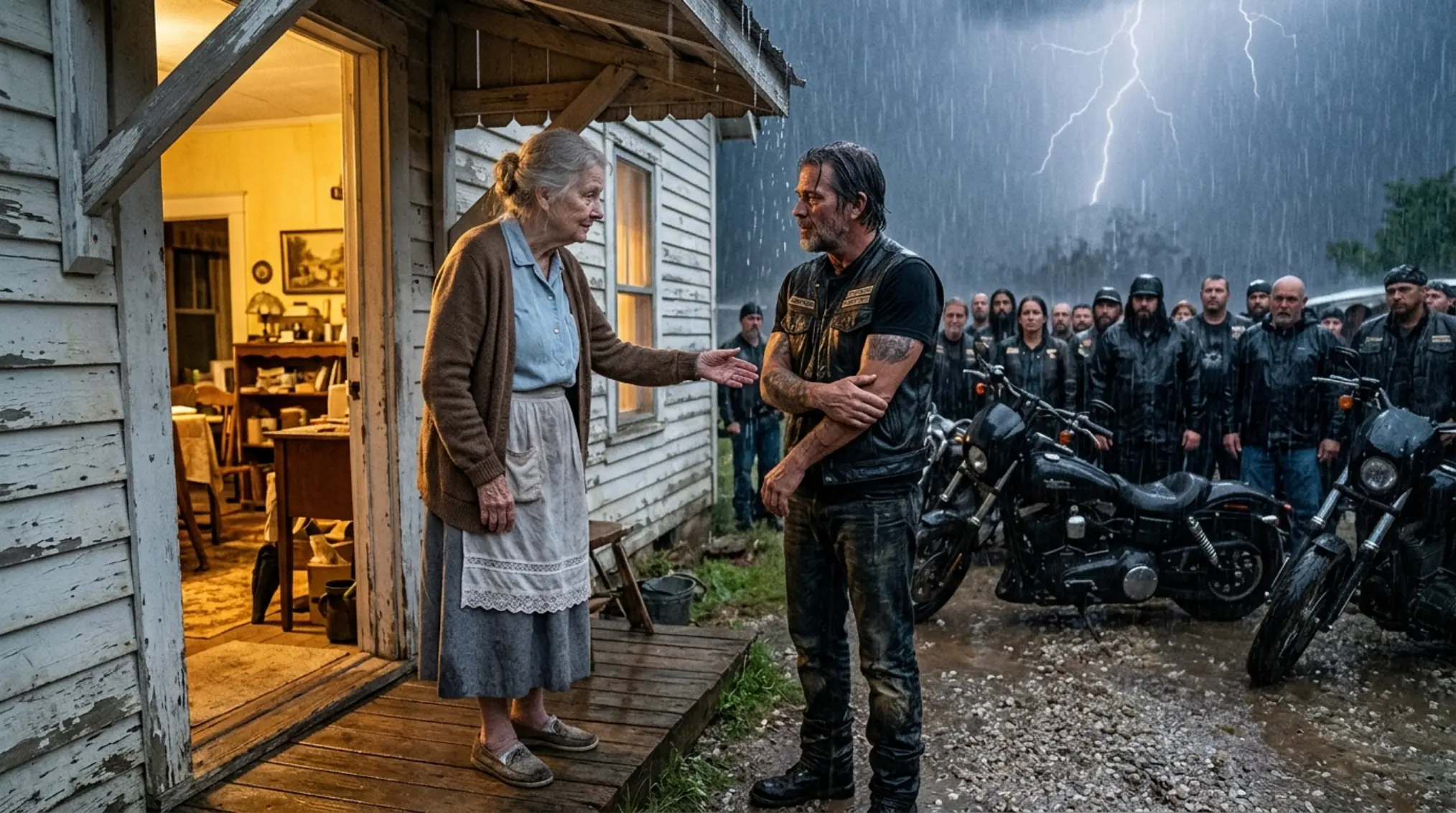
The biggest man among them stepped forward.
Ray Dawson was forty-seven, broad across the shoulders, with tattooed arms, rain-soaked dark hair streaked with gray, and the rough face of someone who had spent more years on highways than behind desks.
“Ma’am,” he said gently, “there are thirty of us.”
Martha glanced past him.
“I can count.”
A few tired men laughed.
Ray looked toward the farmhouse.
The porch leaned slightly to one side. Water dripped through three holes in the roof. One window had been repaired with clear plastic and tape, and a rusted gutter hung from the eaves like it had given up years ago.
“You don’t have to do this,” Ray said.
Martha frowned at him.
“You planning to stand out there arguing until lightning makes the decision for you?”
Ray almost smiled.
Martha opened the door wider.
“I don’t have much, but nobody goes hungry under my roof.”
That ended the discussion.
One by one, thirty bikers removed muddy boots, ducked beneath the broken awning, and entered Martha Bennett’s farmhouse.
The storm had trapped them several miles outside Tulsa after a creek flooded over the highway and turned the lower road into moving brown water. Their motorcycles had become useless in the mud, cellular service was unreliable, and the nearest tow company had told them nobody would reach them until the water dropped.
They expected a miserable night.
Instead, they found Martha.
Her kitchen was barely large enough for six people.
She fit thirty.
Men sat on mismatched chairs, overturned milk crates, old benches, the stairs, and even the floor. Two folding tables came from George’s old workshop, though one had to be supported by a stack of magazines because a leg had broken years earlier.
Martha moved among them as though she had been waiting all her life to feed an army.
She emptied the pantry.
Every egg went into cast-iron skillets.
She fried potatoes with onions.
She heated two large pots of chicken soup she had frozen for winter.
She opened beans.
She cut the last loaf of bread into slices so thin Ray wondered how she managed it.
When one biker quietly offered to pay for groceries, Martha slapped his hand away from his wallet.
“Put that nonsense back.”
The man looked startled.
“Martha, you’re feeding thirty grown men.”
“And?”
“You’ll have nothing left tomorrow.”
Martha shrugged.
“Tomorrow knows where I live.”
The man stared at her.
Then slowly put his wallet away.
Ray noticed the house while the others ate.
He noticed things Martha had probably stopped seeing years ago.
A bucket beneath the ceiling caught water every thirty seconds.
A cabinet door had been repaired with twine.
A crack ran diagonally across one kitchen window.
The refrigerator made a grinding noise each time the compressor started.
Beyond the kitchen was a dark hallway where peeling wallpaper curled from the walls.
A framed photograph hung beside the stairs.
Martha stood in it thirty or forty years younger beside a tall man with a broad smile, grease on his hands, and the kind of face that seemed built for laughter.
Ray pointed.
“Your husband?”
Martha followed his eyes.
“George.”
“How long?”
“Six years.”
Ray nodded.
“I’m sorry.”
Martha’s expression softened.
“Don’t be. I got fifty-one good years. Some people don’t get five.”
She poured more coffee.
Ray watched her carefully.
“You live here alone?”
“Me and the memories.”
Something about that answer stayed with him.
Later, after everyone had eaten, several men volunteered to clean.
Martha protested.
Nobody listened.
Within minutes, enormous tattooed bikers were washing dishes beneath a leaking faucet, sweeping mud from her kitchen floor, carrying empty pots, and wiping down counters.
Martha stood in the doorway watching them.
“You boys are going to make me spoiled.”
Ray glanced at the ceiling bucket.
“You deserve a little spoiling.”
Martha waved him away.
“I’ve survived worse than a leaky roof.”
Ray looked toward the dark hallway.
“Does everything leak?”
“Only when it rains.”
“It’s raining inside.”
“Then I suppose the house wanted to join the party.”
He laughed despite himself.
But the smile faded when another drip landed in the bucket.
Near midnight, the storm weakened.
The men spread blankets and jackets across the living room floor.
Martha insisted Ray take George’s old recliner.
He refused until she threatened to make him sleep on the porch.
By two in the morning, nearly everyone was asleep.
Ray wasn’t.
He sat quietly listening to rain tapping the failing roof.
The room smelled faintly of coffee, wet leather, fried potatoes, and old wood.
Martha appeared from the hallway carrying another blanket.
“You should sleep.”
Ray accepted it.
“So should you.”
“I’m old. Sleeping became optional twenty years ago.”
She sat across from him.
For a moment, neither spoke.
Then Ray asked, “Why did you open the door?”
Martha seemed confused.
“You were wet.”
“Thirty strangers showed up after dark.”
“Yes.”
“Some people would have called the sheriff.”
Martha considered that.
“George used to say you could learn more about a person from what they needed than what they looked like.”
Ray looked toward George’s photograph.
“He sounds like a good man.”
“He was stubborn.”
“That usually comes with good men.”
“He brought home every injured dog, broken tractor, hungry kid, stranded driver, and fool who ran out of gasoline within twenty miles.”
Ray smiled.
“Sounds expensive.”
“It was.”
“Did you ever get mad?”
“Constantly.”
They both laughed.
Then Martha’s eyes moved toward the photograph.
“But the house never felt empty.”
For reasons Ray could not explain, that sentence hurt.