Eleanor Williams sat by the window of her small, sunlit kitchen, carefully clipping coupons from a stack of newspapers.
Her hands, weathered by years of work and sacrifice, moved with a precision that spoke of habit and necessity.
The kitchen, though modest, was warm and inviting. The scent of freshly brewed tea lingered in the air, mingling with the faint aroma of lavender from a candle burning on the windowsill.
Shelves lined with jars of homemade preserves and neatly folded dish towels told the story of a woman who found joy in simplicity. Her eyes lingered on a picture frame perched on the counter, a black-and-white photo of a young couple on their wedding day.
Eleanor smiled softly, tracing the edge of the frame with her finger. Her late husband, Clarence, had always teased her about her love for coupons.
“You could find a deal on air if they sold it,” he used to joke, his deep laugh filling the room.
Those had been good times, she thought, though they had not been without their struggles. Raising three children on Clarence’s factory wages and her teaching salary had meant making every penny count.
Coupons were not just a habit. They were a lifeline.
The rhythmic snip of her scissors paused as Eleanor’s gaze shifted to her old coupon organizer, its edges frayed from years of use. Inside were neatly arranged slips of paper, each representing a small victory against the rising cost of living.
She sighed, thinking about how much prices had climbed since she first started using them. Every dollar saved meant a little more room for the unexpected, like helping her neighbor’s daughter pay for school supplies or donating to the local food pantry.
Eleanor had always believed in stretching what little she had so there would still be something left to help someone else. That belief had shaped nearly every decision she made.
Outside, the neighborhood was beginning to stir. The sound of children laughing echoed down the street, and the faint rumble of cars signaled the start of another day.
Eleanor folded the last coupon into her pouch and stood, her movements deliberate and unhurried. She picked up her canvas shopping bag, its handle worn but sturdy, and draped it over her arm.
Today was grocery day, and she had planned her trip with the care of a seasoned strategist. Before leaving, she glanced at her reflection in the hallway mirror.
Her silver hair was neatly pinned back, and her dress, though simple, was pressed and tidy. She adjusted the deep-purple scarf around her neck, the color a striking contrast to her warm brown skin.
“Ready as ever,” she murmured to herself.
Grocery shopping had once been a task she and Clarence did together. Now it was one of many routines she tackled alone.
As Eleanor stepped onto the porch, the crisp autumn air greeted her. The sun hung low in the sky, spreading soft light across the rows of houses that lined the street.
A young woman walking by with a stroller waved cheerfully.
“Good morning, Mrs. Williams. Heading to Harper’s?”
Eleanor nodded, a kind smile softening her features.
“Morning, dear. Yes, just a quick trip today.”
The young mother chuckled. “Bet you’ll find better deals than anyone else in town.”
Eleanor’s smile widened, and she waved as the woman continued down the sidewalk. She clutched her bag a little tighter, her heart swelling with quiet pride.
She might not have much, but what she had, she knew how to make last.
As she walked toward the bus stop, her mind wandered to a conversation she had overheard at church the previous Sunday. A friend had mentioned how the store’s manager, Greg Harper, had been treating customers poorly lately, especially those who did not spend much.
Eleanor had shrugged it off then because she had shopped at Harper’s Groceries for years without serious trouble. Still, the warning remained in the back of her mind.
“Times change,” she mused aloud, the words carried away by the breeze.
The bus ride was uneventful, filled with the hum of conversation and occasional laughter from teenagers in the back. Eleanor gazed out the window as the city moved past her.
Tall buildings loomed over the streets, their glass facades catching the morning light, while clusters of small businesses along the sidewalks bustled with activity. She liked this route because it gave her a sense of connection to the wider world.
When the bus slowed near Harper’s Groceries, Eleanor rose and steadied herself against the rail before descending the steps. The store stood across the street beneath its familiar bright-red sign.
It was not the fanciest grocery store in town, but it was well stocked and close enough for Eleanor to reach without trouble. Adjusting her scarf against the light chill, she crossed the street with her canvas bag swinging gently at her side.
The automatic doors slid open with a soft hiss, and Eleanor stepped into the familiar store. The scent of freshly baked bread mingled with crisp produce and the faint hum of refrigeration units.
She paused briefly, taking in shoppers moving purposefully between aisles. She had been there countless times before, but that morning something felt slightly different.
A young woman in a sharp suit stood near the customer service desk speaking animatedly with Greg Harper. Eleanor’s gaze lingered on him for a moment.
Greg was in his thirties, with a sharp jawline and a demeanor that always seemed rushed. He moved through the store barking short instructions to employees and rarely spoke with customers unless there was a problem.
Even then, his tone often bordered on impatience. Eleanor dismissed the interaction and made her way toward the carts, shifting her focus to her shopping list.
She moved through the store methodically, checking prices and crossing items from her list. Every purchase was weighed against what she needed and what she could afford.
“Eighty-nine cents for the generic,” she murmured, slipping a can of green beans into her cart.
Her cart was not full because Eleanor never bought more than she needed. Every item was carefully chosen to stretch her limited budget without sacrificing quality where it mattered.
The atmosphere remained calm, punctuated by the occasional squeak of a cart and children pleading for snacks. Eleanor did not rush because shopping was also her time to think and plan.
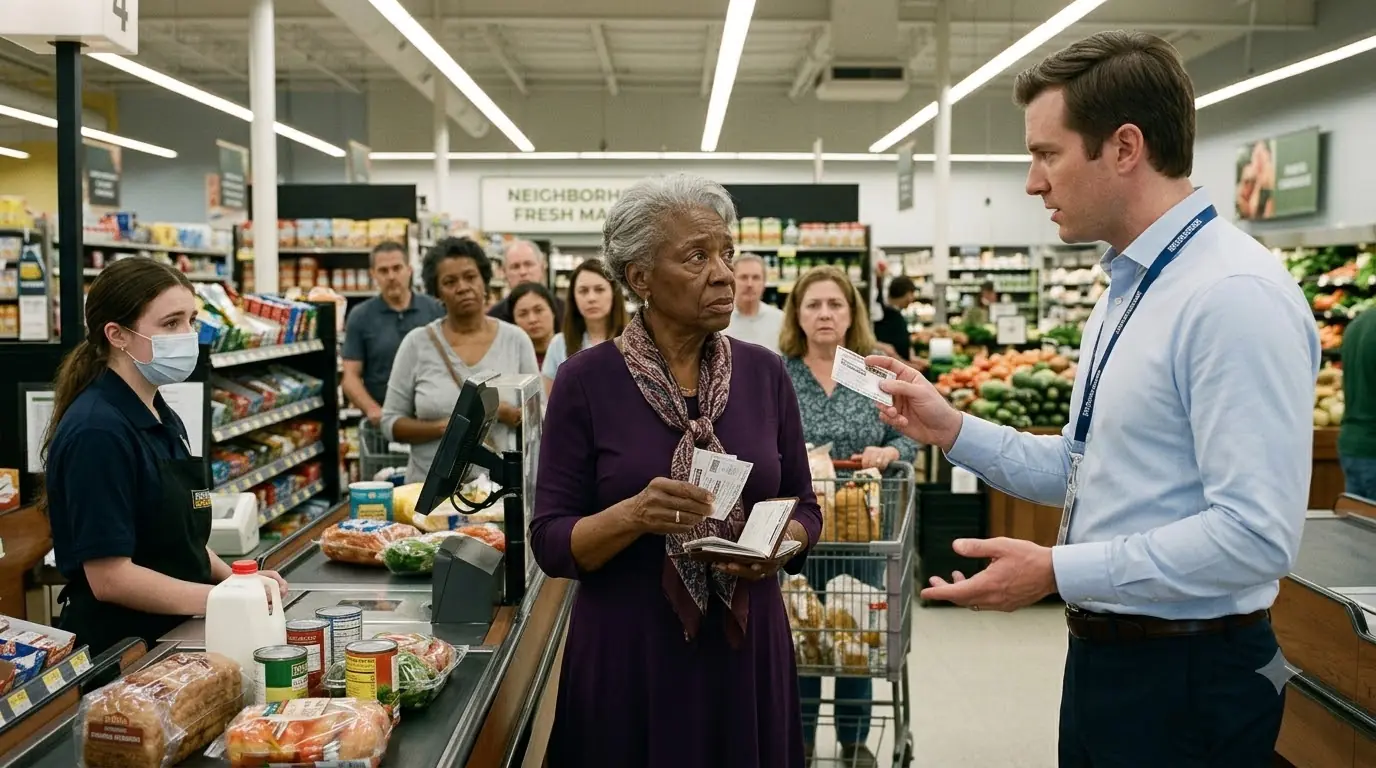
When she reached the checkout counter, she placed her items on the conveyor belt with care. Her coupons were stacked neatly and ready in her hand.
The cashier, a young woman with a friendly smile, began scanning Eleanor’s items. She accepted the coupons with practiced ease.
Before the transaction could continue, Greg Harper appeared behind the counter. His arrival was abrupt, and his posture stiffened when he saw the stack of coupons.
“What’s going on here?” he asked sharply.
The cashier hesitated.
“Just processing these, Mr. Harper. They’re valid.”
Greg leaned over the counter and inspected the coupons with exaggerated scrutiny. He held one up between two fingers as though it were a nuisance rather than an ordinary discount.
“These things are more trouble than they’re worth,” he said. “They slow the line down and confuse the system.”
Then he turned his attention to Eleanor. His voice became condescending.
“Ma’am, maybe next time stick to regular purchases. These discounts aren’t really meant to cover everything, you know.”
Eleanor’s face remained calm, though a flicker of indignation crossed her eyes. “These discounts are meant for people who need them, and they’re valid.”
Greg shrugged.
“I suppose. But don’t hold up the line again.”
“We’ve got paying customers waiting.”
The cashier flushed and fumbled with the coupons. Eleanor felt the weight of other customers’ eyes turning toward her.
Their expressions ranged from curiosity to discomfort. Eleanor’s hands tightened slightly on the edge of her shopping bag, but she said nothing more.
Dignity, she reminded herself, was something no one could take unless she allowed it. She gathered her items and walked toward the exit.
The sting of humiliation settled in as she stepped outside into the crisp morning air. It was not the first time someone had treated her as though she did not belong or as though her presence were an inconvenience.
But as she walked away from Harper’s Groceries, she made herself a quiet promise. She would not let this become another moment she simply swallowed and forgot.
Eleanor walked down the street with slow, deliberate steps, her shopping bag swaying lightly against her side. Greg Harper’s words stayed with her.
They lingered not because she had never faced such treatment before, but because they touched something deeper. A familiar ache mixed with a quiet, growing determination.
She had spent a lifetime swallowing indignities for the sake of peace. This time felt different.
Maybe it was the way Greg spoke as if she did not matter. Maybe it was the way other customers had looked away rather than acknowledge what had happened.
Either way, Eleanor knew the feeling would not disappear quickly. She turned into the small park she often passed on her way home.
A bench beneath a large oak tree beckoned, and she sat down, setting her bag beside her. Sunlight filtered through the branches, scattering patches of light across the ground.
Eleanor took a deep breath, letting the cool air fill her lungs, and closed her eyes for a moment. Memories of Clarence surfaced without warning.
She could almost hear his deep voice telling her to stand tall. She remembered the laughter that could lighten even the heaviest day.
“Eleanor, you’ve never let anyone tell you what you’re worth. Don’t start now.”
A smile tugged at her lips, but it faded quickly. She opened her eyes and watched children playing near the swings.
Her thoughts turned to the young mother she had spoken to earlier that week, juggling bills and groceries while raising two children. How many other people in the neighborhood relied on the same coupons Eleanor used?
How many had been made to feel small for simply trying to survive? The question sat heavily with her.
A small bird hopped near her feet. Eleanor reached into her bag, tore a tiny piece from the end of the loaf she had bought, and scattered a few crumbs on the ground.
The bird pecked eagerly while Eleanor watched. The simple act gave her a moment of clarity.
She was not angry, not exactly. Anger was temporary, but purpose was something she could hold onto.
Eleanor straightened her shoulders and tightened her grip on the shopping bag handles. For years, she had lived frugally, setting aside whatever she could for emergencies.
Clarence’s pension had helped after his death, but she had never touched the modest inheritance he had left her except for occasional charitable gifts. It was not a fortune by wealthy standards, but it was enough to matter.
A thought formed slowly, like a seed taking root. What if she could do something more than defend herself?
What if she could make sure no one else in the neighborhood had to endure the same humiliation? The idea seemed bold, almost absurd at first.
The longer she considered it, however, the more practical it became. Eleanor had always been resourceful and determined, and now she realized she might actually have the means to act.
She rose from the bench with lighter steps and a sharper mind. The hum of traffic and children’s laughter faded into the background as one thought took hold.
It was time to stop letting other people decide her worth. It was time to change the story not only for herself, but for everyone who had ever been made to feel invisible.
She did not yet know exactly how she would do it. But she knew where she wanted to begin.
It would begin with a grocery store.
The next few days passed in a blur of phone calls, research, and quiet determination. Eleanor told almost no one what she was planning.
It was not the kind of idea she wanted weighed down by other people’s doubts before she had even begun. Eleanor had always preferred to act first and explain later.
She spent hours at the local library going through business guides, property information, and legal documents. Buying a store, she quickly learned, was not simple.
But it was not impossible either.
Eleanor understood household finances well. Clarence had managed many of their financial decisions when he was alive, and over time she had learned to handle bills, taxes, budgets, savings, and investments on her own.
Running a grocery store would be more complicated, but she was not starting from nothing. She knew discipline, patience, and how to stretch limited resources.
Her research confirmed something else she had suspected. Harper’s Groceries was struggling.
The neighborhood store had existed for decades, but years of poor management were beginning to show. Customer complaints about high prices and rude service had grown more frequent.
Greg’s father, the original owner, had become increasingly distant from the business. Greg had inherited responsibility for daily operations without showing much interest in improving the store.
He seemed content to let the place decline as long as it continued producing enough revenue to remain open. That neglect had created an opportunity.