The first engineer laughed when he saw the tractors.
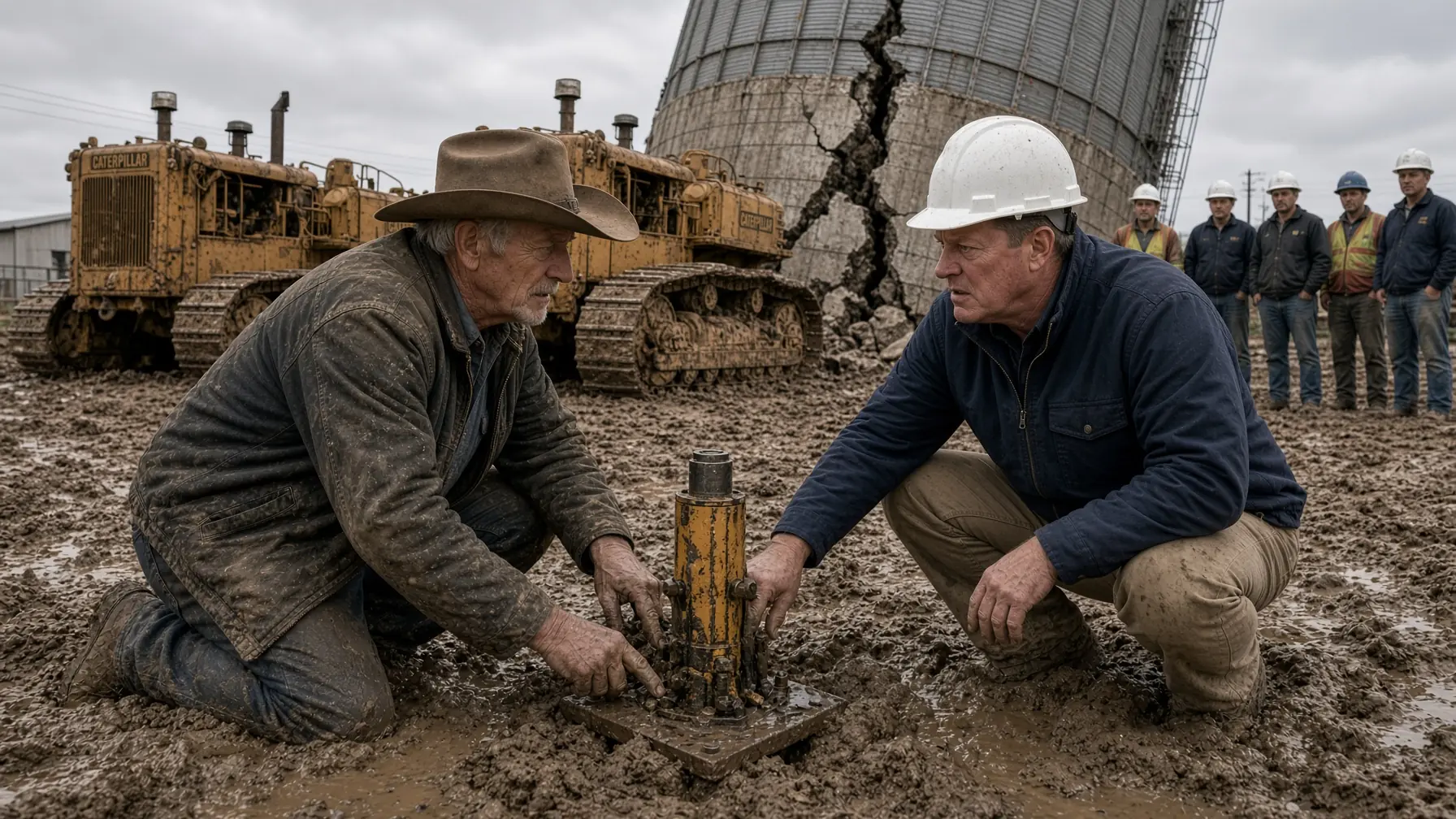
The second one stopped laughing when Gideon Thorne asked a single question.
“Where do you think the water is going?”
No one answered.
Behind them, Titan 9 groaned again.
The one-hundred-foot grain silo leaned farther toward the south.
Steel screamed against steel.
Concrete cracked.
A thin stream of muddy water pushed through the broken edge of the foundation pad.
Chief engineer Sterling Hayes stared at Gideon’s two ancient Caterpillar D8 crawlers.
Both were older than half the men standing around them.
Paint faded.
Steel scarred.
Tracks worn shiny at the edges.
No computers.
No GPS.
No load cells.
No hydraulic leveling package.
One of OmniGrain’s younger engineers actually laughed.
“You brought museum pieces?”
Gideon looked at him.
“No.”
He climbed down from the lead tractor.
“I brought weight.”
Then he looked toward Sterling.
“And unlike your jacks, they don't need concrete under them.”
Sterling’s face was gray.
Not from age.
Fear.
The Titan 9 was now leaning fifteen degrees.
Its southern footing had dropped nearly three feet.
The upper shell contained thousands of tons of winter wheat.
Thirty houses sat beyond the lower ridge.
If the structure fully rotated, it would not simply collapse in place.
It would fall downhill.
The McCreary house would be first.
Then Miller.
Then whatever remained after thousands of tons of grain and twisted steel tore through the valley.
Sterling looked at Gideon.
“You have ninety minutes at best.”
Gideon shook his head.
“Less.”
Sterling’s expression tightened.
“You said two hours.”
“That was before your hydraulic jacks punched another hole into the clay.”
Sterling glanced toward the ruined lifting system.
Three enormous bridge jacks now sat half-buried in mud.
One steel reaction plate had vanished so deeply that only a corner remained visible.
Gideon pointed.
“You didn't support the tower.”
“You loaded the bad ground harder.”
Sterling snapped:
“We were trying to redistribute the load.”
“Into what?”
Gideon pointed toward the bubbling water.
“That?”
Sterling’s jaw clenched.
Gideon did not wait.
He turned toward three local equipment operators.
“Bring the beam.”
Six months earlier, Gideon Thorne had tried to prevent all of this.
No one had listened.
Oak Hollow Valley did not look dangerous.
That was exactly the problem.
The land was broad.
Flat enough for industrial construction.
Close to rail.
Close to highway.
Surrounded by grain farms.
OmniGrain AgriTech had purchased eighty-seven acres on the south edge of town for a regional storage and transfer facility.
The company planned six silos.
A rail spur.
A dryer complex.
A truck scale.
A control building.
Titan 9 was the first major structure.
The company brochure called it:
The Future of High-Efficiency Grain Storage.
Gideon called the location foolish.
At seventy-two, he had farmed the valley almost all his life.
His father had farmed it before him.
His grandfather had run cattle along the same ridge when the county road was still gravel.
Gideon knew things about the land that did not appear on OmniGrain’s promotional maps.
The south side stayed green during drought.
The lower hollow grew cattails after wet winters.
Fence posts installed too deep sometimes came out smelling like swamp.
And forty years earlier, Gideon had helped his father pull a combine from a patch of ground that looked perfectly dry until the machine broke through and sank to its axle.
His father had pointed toward the hillside.
“Old seep.”
Gideon remembered.
Water entered from the north ridge.
Moved through sand lenses beneath the clay.
Then became trapped.
In ordinary weather, nobody noticed.
After prolonged rain, pressure built below the surface.
The upper soil could remain firm enough to walk on while deeper layers lost strength.
Gideon told OmniGrain.
Twice.
The first time, he attended a county planning meeting.
Sterling Hayes sat at the front.
Forty-six.
Civil engineer.
Two graduate degrees.
Twenty years in industrial foundations.