Inside the crowded service bay of Apex Iron Works in Oakland, California, four-year-old Leo Hayes stood on an overturned wooden crate beside a dismantled black motorcycle. His faded tan shirt hung loosely from his small shoulders, grease marked one round cheek, and his worn sneakers barely reached the edge of the crate.
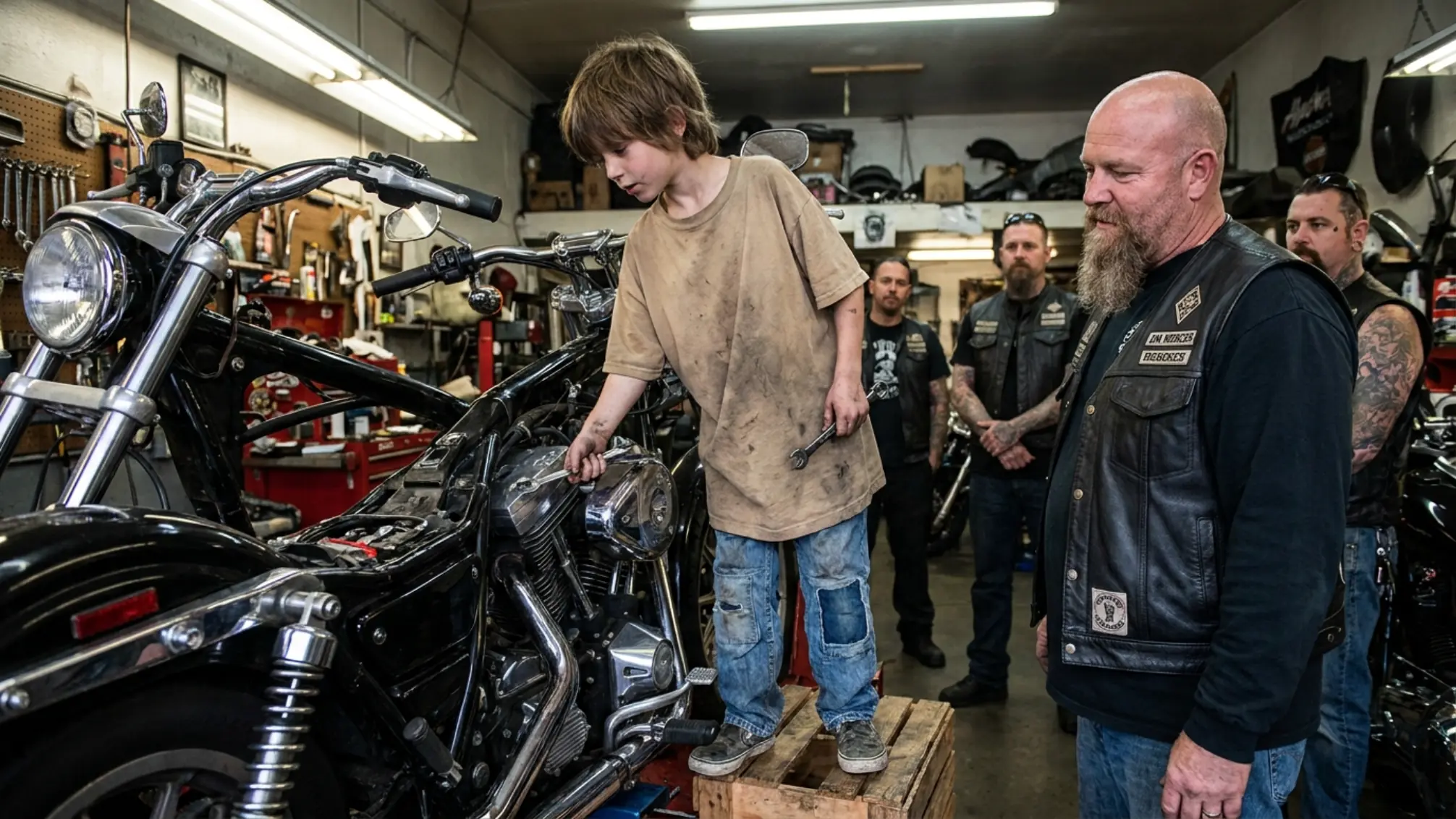
Leo was far too young to lift the heavy tools surrounding him. He could not rebuild an engine, calculate ignition timing, or understand the complicated diagrams spread across the workbench.
But he remembered his father’s voice.
Four large bikers stood behind him, their tattooed arms folded as they watched the little boy point toward a tiny symbol stamped on the motorcycle’s exposed gear.
Jim Mercer rested one broad hand on the old leather seat.
“That bike belonged to my brother,” he said softly. “Every mechanic says she’s gone.”
Leo looked up with wide blue eyes.
“My daddy said she only looks asleep.”
Jim slowly knelt in front of him. “Your daddy was Arty Hayes?”
Leo nodded and held up a battered toy wrench his father had once given him.
“He said Dutch’s bike was tricky. But he said tricky isn’t broken.”
Jim’s hard expression softened.
“And did your father tell you how to wake her?”
Leo pointed beneath the motorcycle’s left fuel tank.
“He said, ‘Find the little switch before you ask the old girl to sing.’”
Three days earlier, the motorcycle had arrived at Apex Iron Works strapped to a flatbed truck.
Six bikers followed it into the parking lot beneath the unforgiving afternoon sun. Their engines rumbled deeply enough to vibrate the shop windows, and two customers waiting near the front counter stepped outside through another door.
Jim Mercer dismounted first.
He was fifty-eight, broad-shouldered, and weathered by decades of long roads. A thick steel-gray beard covered his jaw, and sorrow had settled behind his hard gray eyes.
The black motorcycle on the truck was a forty-year-old custom machine that had belonged to Dutch Sullivan, Jim’s closest friend.
Dutch had died three months earlier.
He had spent most of his life riding beside Jim, helping struggling members of their road club and treating men without families as though they were his brothers. Dutch had once given Jim a place to sleep when he had nowhere to go. Later, he helped him find work and stood beside him through years Jim rarely discussed.
Hundreds of riders planned to attend Dutch’s memorial procession on Saturday.
His motorcycle was supposed to lead them down the California coast.
But the engine would not start.
Rusty Dawson, owner of Apex Iron Works, had already assigned his three most experienced mechanics to it for nearly two weeks. They cleaned the fuel system, rebuilt the carburetor, replaced damaged wiring, tested compression, and installed a new battery.
According to every measurement, the motorcycle should have run.
It did not.
The engine turned without catching. The kick lever snapped backward violently whenever anyone attempted to use it. A fully charged battery lost its power within minutes.
Rusty stood near the main workbench when Jim entered.
A dirty red rag moved nervously through his hands.
“Tell me she’s running,” Jim said.
Rusty looked toward the motorcycle.
“I wish I could.”
Jim’s jaw tightened. “What did you find?”
“That’s the problem. Everything looks correct.”
“Then why is it dead?”
“We don’t know.”
Jim walked toward the machine and touched its leather seat. The surface was cracked and worn from thousands of miles, but nobody had attempted to replace it.
Dutch’s shape still seemed to remain in the leather.
“The memorial is Saturday,” Jim said.
“I know.”
“His daughter will be there. His grandson will be there.”
Rusty lowered his eyes.
Jim’s voice became quieter.
“I promised them they would hear this engine one final time.”
“We have done everything the service manual says.”
“Dutch never cared much for manuals.”
“That may be exactly why nobody can understand what he built.”
Jim looked toward him.
“Are you giving up?”
Rusty took a slow breath.
“I am telling you that replacing more parts without knowing the cause could destroy the engine permanently.”
The bikers behind Jim exchanged uneasy glances.
Nobody wanted to tell a grieving man that the last machine carrying his friend’s touch might never move again.
Then a tiny voice came from beside the office door.
“My daddy knew that bike.”
Everyone turned.
Four-year-old Leo stood holding a small plastic truck against his chest.
His mother, Maria Hayes, cleaned the shop’s office during late afternoons. She could not afford regular childcare, so Leo often waited in a safe corner near the front room with toys, picture books, and a small box of harmless old motorcycle parts Rusty had given him.
Leo had been listening from the doorway.
Maria immediately hurried toward him.
“Sweetheart, stay inside the office.”
But Leo stared at the black motorcycle.
“That’s Dutch’s bike.”
Jim removed his sunglasses.
“How do you know that?”
Leo pointed toward the faded red stripe beneath the fuel tank.
“My daddy showed me pictures.”
Maria placed both hands on her son’s shoulders.
“I’m sorry. His father repaired motorcycles here before he became ill.”
Jim looked directly at her.
“What was his father’s name?”
“Arthur Hayes.”
“Arty Hayes?”
Maria nodded.
The bikers became silent.
Arty had been the only independent mechanic Dutch trusted with his motorcycle. The two men spent countless nights experimenting with old parts, handmade modifications, and unusual repairs no ordinary shop would have attempted.
Arty died from cancer two years earlier, when Leo was only two.
Jim crouched in front of the child.
“You remember your daddy working on motorcycles?”
Leo thought carefully.
“I remember sitting on his lap.”
Maria’s eyes became wet.
Arty had known his time was limited. During his final months, he recorded short videos for Leo and filled a wooden box with photographs, notes, and small objects connected to stories he hoped his son would one day understand.
One photograph showed Arty kneeling beside Dutch’s motorcycle while Leo sat on his shoulders.
Leo could not remember the day clearly.
But he had watched the video connected to that photograph dozens of times.
“My daddy called it the sleepy black bike,” Leo said.
Jim glanced toward Maria.
“Did Arty leave any notes about it?”
“I don’t know. Most of his things are stored in our apartment.”
Leo tugged his mother’s sleeve.
“The book with the bird.”
Maria looked down. “What book?”
“Daddy’s dirty book. The one with the flying bird on it.”
She understood.
Arty had kept a grease-stained notebook inside the wooden memory box. Its cover carried a faded drawing of a bird made by Leo when he was barely old enough to hold a crayon.
Maria had never read the technical pages.
Jim stood.
“Would you allow us to see it?”
She looked at the large bikers surrounding her, then toward the motorcycle.
“My husband loved that machine.”
“So did Dutch.”
Maria hesitated before nodding.
“I can bring the box tomorrow.”
Leo shook his head urgently.
“The little switch.”
Rusty frowned. “What switch?”
Leo pointed at the fuel tank.
“My daddy said you have to find the little switch before the old girl sings.”
The adults stared at him.
Maria crouched beside her son.
“When did he tell you that?”
“In the movie.”
She realized Leo meant one of Arty’s recorded videos.
In it, Arty had probably been describing Dutch’s strange security system as a funny story for his son.
Rusty approached the motorcycle.
“Where is the switch, Leo?”
The child pointed uncertainly beneath the left side of the tank.
“Under there. Where fingers hide.”
Rusty reached beneath the curved metal.
His hand searched along the frame.
For several seconds, he found nothing.
Then his fingertip touched a tiny recessed toggle.
The faint click it produced sounded impossibly loud.
Rusty pulled his hand back.
“There is a switch.”
Jim stared at Leo.
Rusty connected a testing meter to the electrical system. With the hidden switch in one position, power drained directly into the frame instead of reaching the ignition coil.
“That explains the dead batteries,” he said.
One of the mechanics stepped closer.
“You’re telling me Dutch installed a secret grounding circuit?”
“Arty probably helped him.”
Jim looked at the little boy.
“Your daddy just solved something six grown men could not find.”
Leo smiled shyly.
“Daddy was good at fixing.”
“Yes,” Jim said. “He was.”
They did not attempt to start the motorcycle.
The engine’s timing problem remained, and Rusty refused to risk internal damage until they studied Arty’s notebook.
The following morning, Maria returned carrying a wooden box.
Leo walked beside her holding his father’s notebook against his chest.
He wore the cleanest clothes he owned: a pale blue shirt, patched jeans, and sneakers Maria had scrubbed carefully the night before.
Jim and the mechanics were already waiting.
Maria placed the box on a workbench away from the heavy equipment.
Inside were old photographs, measuring tools, handwritten diagrams, and several short letters addressed to Leo.
Rusty opened the notebook.
Arty’s writing covered each page in tight lines. He recorded unusual engine combinations, customized measurements, and warnings about machines he considered too strange to trust to memory.
Near the middle, Rusty found a page labeled:
Dutch’s Black FXR: Do Not Use Factory Marks.
The men gathered around him.
Arty had documented how he and Dutch combined components from two different generations of engines. The factory timing marks no longer matched the modified internal parts.
Rusty had followed the manual perfectly.
That was why the engine failed.
“Advance it twelve degrees,” one mechanic read.
Rusty shook his head slowly.
“The child was right again.”
Leo stood beside his mother, understanding only that the adults were finally listening to his father.
Jim walked over and lowered himself to Leo’s height.
“Did your daddy teach you what those numbers mean?”
Leo shook his head.
“He said numbers were for when I got big.”
“That sounds sensible.”
“But I know the bird mark.”
“What bird?”
Leo pointed toward a drawing in the notebook. Arty had marked one modified gear with a small wing-like symbol so he could identify it during future repairs.
Rusty removed the engine cover.
The mechanics rotated the gear assembly slowly while Leo watched from behind a bright safety line painted on the floor.
Nobody allowed him near the tools or moving parts.
When the symbol appeared, Leo pointed excitedly.
“There. Daddy’s bird.”
Rusty shone a work light across the gear.
A tiny engraved mark matched the notebook exactly.
The shop owner released a stunned breath.
“This is not factory equipment.”
The mechanics began correcting the timing according to Arty’s measurements.
Leo sat on a chair beside Maria, swinging his legs and watching them work. Whenever he became tired, he played with his plastic truck or asked for crackers.
He did not direct the repair.
He did not understand every mechanical step.
He simply carried memories the adults did not possess.
That afternoon, the mechanics discovered several bent internal rods damaged by repeated attempts to start the mistimed engine.
Rusty placed one on the workbench.
It rolled unevenly.
“We cannot reuse these,” he said.
“Can you order new ones?” Jim asked.
“They were custom-made. Standard parts will not fit.”
The fragile hope inside the garage disappeared.
Even with the correct timing information, the engine could not be completed without replacement rods.
Jim looked toward Arty’s notebook.
“Did he write down measurements?”
“Yes, but machining new pieces could take weeks.”
“The memorial is in two days.”
Leo had fallen asleep against Maria’s shoulder. His small fingers remained curled around the plastic truck.
The adults tried not to raise their voices near him.
Rusty turned another page.
Nothing.
Then Leo stirred.
“Daddy’s treasure box,” he murmured sleepily.
Maria brushed hair from his forehead.
“What treasure box?”
“The one downstairs.”
Rusty looked at her.
Maria’s expression changed.
“Arty rented a storage locker beneath the old paint room. We stopped paying for it after he died. I assumed everything had been discarded.”
Rusty hurried toward the basement stairs.
“Which locker?”
Maria could not remember.
Leo opened his eyes.
“Forty-two.”
“How do you know?”
“Daddy said it was the answer.”
Arty had loved an old science-fiction joke about the number forty-two. Maria remembered him repeating it whenever he forgot where he placed something.
Rusty carried bolt cutters into the basement.
Locker forty-two stood behind several broken cabinets. Its padlock had rusted, but the contents remained untouched because nobody had bothered clearing the damp storage area.
Inside were old tools, motorcycle magazines, and a heavy wooden crate wrapped in plastic.
Leo remained upstairs with Maria while the mechanics lifted the crate onto a cart.
When Rusty opened it, neatly wrapped engine components appeared beneath layers of oiled cloth.
Each package carried Arty’s handwriting.
Near the bottom were four custom rods labeled:
Dutch’s Black Bike. Spare Set.
Jim turned away.
He covered his mouth with one hand as emotion tightened his face.
Arty had prepared for a failure he might never live to repair.
Rusty looked toward Leo.
“Your father left us everything we needed.”
The little boy smiled.
“I told you he was good.”
The mechanics worked through Wednesday and Thursday.
They installed the spare components, adjusted the modified timing, repaired worn wiring, and tested each system independently.
Leo spent only short periods inside the service area. Maria kept him safely near the office, where he colored pictures of motorcycles and occasionally fell asleep on a small couch.
The bikers brought lunch for him and his mother.
One massive rider with tattooed arms sat cross-legged on the office floor while Leo explained the difference between his red toy truck and his blue one.
The frightening men who had entered like a storm became gentle around the child.
On Thursday evening, the motorcycle stood fully assembled beneath the shop lights.
Rusty reached toward the starter.
Jim stopped him.
“No.”
Everyone looked at him.
“Dutch’s family should hear it first.”
The mechanics agreed to wait until Friday, when Jim would return with Dutch’s daughter and grandson.
Before leaving, Jim found Leo drawing at the office desk.
The picture showed a black motorcycle beneath a large yellow sun. A smaller figure stood beside it holding the hand of a taller man.
“Is that you?” Jim asked.
Leo nodded.
“And the tall man?”
“My daddy.”
Jim sat carefully in the chair opposite him.
“You miss him?”
“Mommy says he’s not sick anymore.”
“She’s right.”
Leo looked at the picture.
“Do you miss Dutch?”
“Every day.”
“Maybe he’s with Daddy.”
Jim’s eyes filled unexpectedly.
“Maybe they’re already arguing about that engine.”
Leo giggled.
Friday morning arrived with low clouds hanging over Oakland.
At eleven forty-five, motorcycles began entering the parking lot. This time, nearly twenty riders came, followed by a car carrying Dutch’s daughter Rebecca and his ten-year-old grandson, Mason.
Rebecca looked pale when she saw her father’s motorcycle standing in the center of the shop.
She touched the old seat.
“He always refused to replace this.”
Jim nodded. “Said every crack had a story.”
Mason circled the machine slowly.
“Does it run?”
“We’re about to find out.”
Maria stood near the office with Leo in her arms. The boy had become nervous after seeing so many people, so he buried his face against her shoulder.
Jim approached him.
“You ready to help me remember the trick?”
Leo peeked over Maria’s arm.
“The little switch.”
“That’s right.”
Jim mounted the motorcycle.
Rusty and the mechanics stood near their workbenches, every face tense. Rebecca placed one hand on her son’s shoulder.
Jim turned the ignition key.
The headlight glowed.
He pressed the starter.
The engine rotated but did not catch.
Several riders lowered their heads.
Rebecca’s hopeful expression collapsed.
Then Leo called from his mother’s arms.
“Mr. Jim, you forgot to wake her.”
Jim froze.
He looked toward the boy.
Leo reached one small hand beneath his own chin, pretending to flip an invisible switch.
“Where fingers hide.”
Jim smiled through his fear.
He reached beneath the left side of the fuel tank and found the tiny toggle.
Click.
The hidden grounding circuit closed correctly.
Jim placed both hands on the handlebars.
“Come on, Dutch.”
He pressed the starter again.
The engine exploded into life.
A deep, uneven thunder filled the garage. Tools vibrated inside metal drawers, dust drifted from the rafters, and the entire building seemed to shake around the sound.
Rebecca covered her mouth.
Mason’s eyes widened.
The motorcycle did not sound new or polished. It sounded exactly as Dutch’s family remembered: heavy, stubborn, powerful, and slightly wild.
Jim twisted the throttle once.
The roar moved through his chest.
Tears disappeared into his beard.
Rebecca began crying openly. She wrapped one arm around Mason while the boy stared at his grandfather’s motorcycle as if the dead had found a voice.
Jim allowed the engine to idle for nearly a minute before switching it off.
The silence afterward carried no disappointment.
Only memory.
Jim stepped away from the motorcycle and walked toward Maria and Leo.
He knelt on the shop floor.
“Your daddy gave Dutch his voice back.”
Leo shook his head.
“The big men fixed it.”
Jim smiled.
“They used the tools. But you brought us the clues.”
Leo touched the toy wrench in his pocket.
“Can Daddy hear it?”
Jim’s voice became rough.
“I believe both of them heard every second.”
He removed a small silver pendant from his neck. It was shaped like a simple wheel surrounded by wings.
Jim showed it to Maria first.
“This belonged to Dutch. I would like Leo to have it someday, when he is old enough to understand.”
Maria looked surprised.
“You don’t have to do that.”
“I know.”
She accepted the pendant and closed her fingers around it.
Jim then handed Leo a small wooden model motorcycle built by one of the riders.
“This one is safe for a four-year-old mechanic.”
Leo smiled and held it against his chest.
Rusty approached Maria.
“Arty’s locker still contains valuable tools and parts. They belong to you and Leo.”
“We don’t have room for all of it.”
“I do.”
Rusty looked toward the child.
“I would like to preserve his father’s workbench here. When Leo is older, he can learn safely, one small lesson at a time.”
Maria’s eyes filled with tears.
“He’s four.”
“I’m patient.”
Jim stood beside them.
“Our riders’ community foundation can create an education account in Leo’s name. Nothing extravagant. Just enough so that when he grows up, money does not decide whether he can study engineering.”
Maria stared at him.
“Why would you do that for us?”
“Because Arty spent years helping our family. Because Leo helped us when nobody else could. And because kindness should travel in both directions.”
The following morning, Dutch’s motorcycle led the memorial procession.
Jim rode it slowly at the front while hundreds of motorcycles followed down the coast. Rebecca and Mason watched from the first gathering point, surrounded by people who had known Dutch during different parts of his life.
Maria held Leo near the roadside.
As the black motorcycle passed, its engine thundered beneath the open sky.
Jim raised one hand.
Leo lifted his wooden motorcycle above his head.
“Daddy’s bike is singing!” he shouted.
Maria kissed his hair.
“No, sweetheart. Dutch’s bike is singing.”
Leo considered that.
“Daddy helped.”
“Yes,” she whispered. “Daddy helped.”
Months later, a small framed photograph appeared above a preserved workbench inside Apex Iron Works.
It showed Arty Hayes kneeling beside Dutch’s motorcycle with baby Leo sitting on his shoulders.
Beneath the photograph, Rusty placed a metal plate:
ARTHUR HAYES
He Left the Answer Behind
Leo continued visiting the shop with his mother, but he was never treated like a working mechanic. He colored in the office, played with safe wooden parts, and occasionally watched from behind the safety line while Rusty explained simple ideas.
When he turned six, Rusty taught him the names of basic tools.
At eight, he showed him how engines used air, fuel, and spark.
At twelve, Leo opened his father’s notebook and began understanding the numbers that once looked like meaningless marks.
He did not become Arty Hayes.
He became himself.
But he carried his father’s patience, curiosity, and belief that strange machines should be understood before they were discarded.
The motorcycle had not been repaired by the physical strength of a four-year-old child.
It was repaired because a little boy remembered a sentence adults had forgotten, recognized a symbol connected to his father, and pointed toward a hidden switch nobody else knew existed.
The mechanics supplied the knowledge and capable hands.
Arty supplied the forgotten design.
Leo connected them.
Every expert in the garage had searched for an answer in manuals and replacement parts. The final answer waited inside a child’s memory, protected by love long after the man who placed it there was gone.
The old motorcycle carried Dutch one final time.
And in doing so, it showed a grieving four-year-old that his father’s voice had not disappeared.
It was still there, hidden inside stories, notebooks, small switches, and the people willing to listen.