By three o’clock that October afternoon, everybody on the Miller farm had already begun speaking about the corn in the past tense.
Not harvested.
Not sold.
Lost.
Forty-two acres of mature corn still stood across the low field behind the house, its dry brown leaves rattling beneath a wind that had been strengthening since morning.
To the west, the sky had turned the color of dirty steel.
The weather radio on the kitchen windowsill repeated the warning every fifteen minutes.
Severe thunderstorms.
Straight-line winds potentially exceeding sixty miles per hour.
Heavy rain.
Possible hail.
Arrival before midnight.
And the Miller family’s only working combine sat dead beside the machine shed with its feeder drive opened across the gravel.
The replacement bearing was ninety miles away.
The dealership truck would not arrive until tomorrow morning.
Too late.
Seventeen-year-old Caleb Miller stood beside the broken machine while his father stared across the field.
His father, Mark, was fifty-three and had farmed the same ground since he was old enough to reach the clutch on an old Farmall.
He did not panic easily.
That frightened Caleb more than shouting would have.
Mark simply removed his cap.
Rubbed one hand across his thinning gray hair.
Then said:
“We’re done.”
Caleb looked at him.
“What?”
“The bottom field.”
“Dad—”
“If that wind lays it flat tonight, we're not getting half of it.”
“We can pick down corn.”
“With what?”
Caleb looked toward the combine.
Mark pointed at it.
“That?”
No answer.
The gathering chain was worn.
The feeder bearing had disintegrated.
Metal filings were inside the housing.
Even if they somehow found the right bearing, putting the drive back together before dark would be nearly impossible.
Mark continued.
“Corn's dry enough now that the stalks are brittle.”
“Rain softens the ground.”
“Wind catches the tops.”
“You know what happens.”
Caleb did.
The field sat in heavier soil near the creek.
A storm after harvest maturity could push entire sections sideways.
Once stalks lodged, harvesting slowed to a crawl.
Ears touched wet soil.
Mold followed.
Wildlife found them.
Some could still be saved.
But not all.
And this was not an ordinary year.
The Millers needed this crop.
Fertilizer had cost more.
Fuel had cost more.
The transmission on their second tractor had needed rebuilding in June.
Then Mark’s wife, Rachel, had spent six weeks driving her mother to cancer treatments two counties away.
Nobody complained about that expense.
But money did not care whether an expense was justified.
The operating note still came due.
Forty-two acres would not bankrupt them.
But losing it would hurt badly enough that everybody around the farm already knew.
Mark’s older brother Dean had driven over.
So had their neighbor, Frank Wilson.
Both men stood beside the disabled combine.
Dean finally said:
“We can get what’s standing after the storm.”
Mark nodded.
“Whatever's left.”
Frank looked toward Caleb.
“You hear the boy?”
Caleb had said nothing.
He was staring past them.
Not toward the field.
Toward the north end of the property.
Beyond the grain bins.
Behind the old barn.
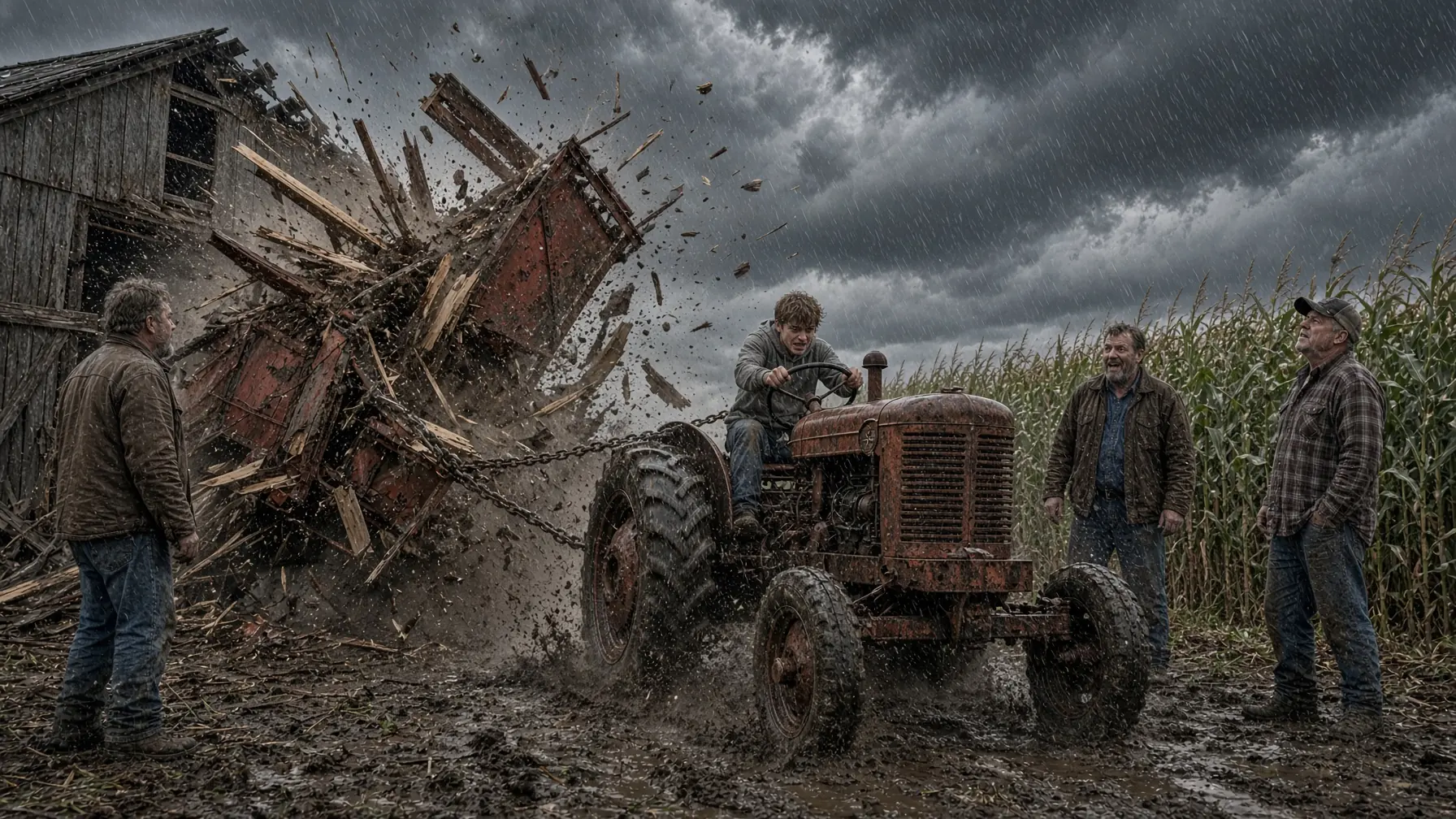
At a shed nobody used anymore.
Half of its roof had collapsed four winters earlier.
One wall leaned outward.
Cottonwood limbs had punched through the tin.
Nobody stored anything valuable there.
At least—
nobody thought they did.
Caleb started walking.
His father called after him.
“Where are you going?”
Caleb kept moving.
“The old shed.”
“For what?”
He did not answer.
Because he had just remembered something.
The machine had been sitting there since before Caleb was born.
An old pull-type two-row corn picker.
Not a combine.
It did not shell kernels into a grain tank.
It picked ears from stalks and delivered them into a wagon.
Old-fashioned ear corn.
The kind Mark’s father had harvested when corn cribs still stood behind every farmstead.
Caleb remembered seeing the machine as a child.
Red paint faded almost brown.
Gathering snouts half buried beneath boards.
Chains hanging stiff with rust.
One tire completely flat.
His grandfather Walter had always called it:
“The machine we'll never need again.”
Mark wanted to scrap it after Walter died.
Rachel stopped him.
“It was your father’s.”
“It’s six thousand pounds of tetanus.”
“Then let it rust quietly.”
So it remained.
First beneath a roof.
Then beneath half a roof.
Then beneath broken rafters when a snow load collapsed the eastern side of the shed.
Caleb had crawled around it when he was thirteen.
He knew where the PTO shaft was.
Knew the gearbox turned then.
At least with enough persuasion.