On Tuesday morning, October 9, 1984, the Holt County farm auction hall in Mound City, Missouri, was packed tightly enough that men stood along the walls behind rows of folding chairs. Farmers in work jackets sat beside bankers in suits. Land agents whispered with attorneys. Two representatives from Heartland Consolidated Agricultural Partners occupied seats near the front, their polished shoes and tailored jackets making them look slightly out of place among seed caps, denim, and dust-stained boots.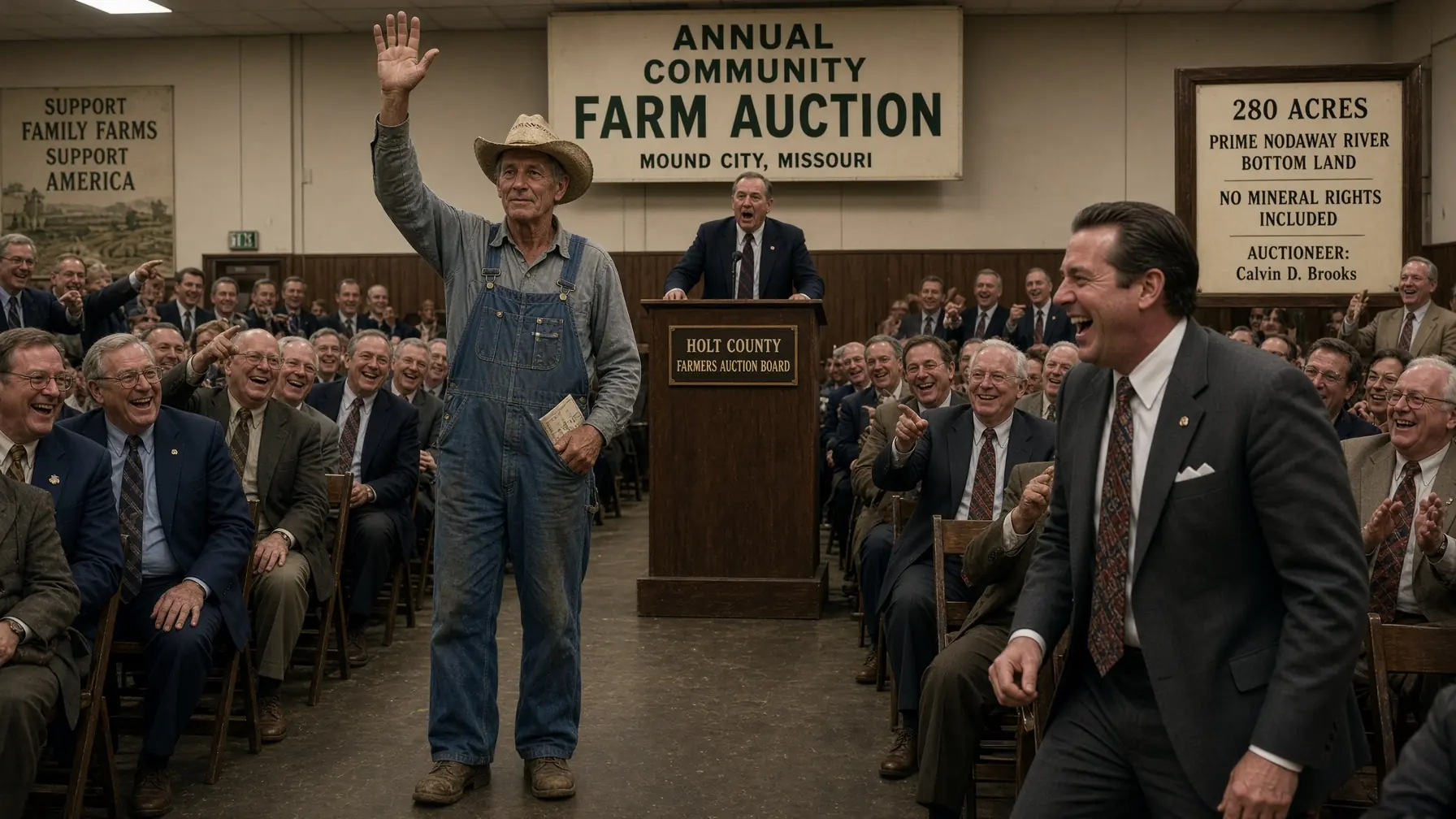
At the back of the room sat Earl Pruitt.
He was fifty-three years old, thin from decades of physical work, with weather-darkened skin, graying hair beneath a faded hat, and hands that looked as if they had spent half a lifetime wrapped around steering wheels, wrenches, fence posts, and seed bags.
His clothes were clean.
They were not expensive.
His pickup outside had a cracked windshield.
His bank balance was smaller than the amount several men in the room were prepared to increase their bids by without thinking twice.
But Earl had come anyway.
The property being sold was not ordinary farmland.
It was 280 acres of prime Nodaway River bottom ground belonging to the estate of Ray Kindred, a respected farmer who had died the previous spring.
The Kindred family had worked the parcel for three generations.
Its soil was dark, deep, and productive, built over centuries by the river.
Some sections carried nearly twenty-eight inches of topsoil.
The land grew corn at yields that made upland farmers envious.
Ray Kindred had cared for it carefully.
He had maintained old drainage tile instead of allowing it to collapse.
He had protected river-edge ground with permanent cover.
He rotated crops conservatively.
He understood that a field could be exhausted by greed just as easily as a bank account.
By 1984, those 280 acres represented exactly the kind of property institutional buyers wanted.
The Midwest farm crisis had already forced many families to sell.
Interest rates were punishing.
Commodity prices had weakened.
Operating debt had become a trap.
Across Holt County, farmers who had worked the same land for decades were losing properties to banks, investment groups, and larger operators.
Heartland Consolidated Agricultural Partners had been quietly purchasing land throughout the region for almost three years.
Its executives saw opportunity where families saw disaster.
Every foreclosure created another acquisition.
Every farmer forced to quit gave the company another chance to expand its portfolio.
The Heartland representative sitting near the front was named Patrick.
He was in his early forties and dressed in a dark suit with a tie that probably cost more than some farmers in the room spent on work clothes in a year.
Patrick had arrived with financing already arranged.
His internal authority reportedly allowed him to go significantly above the estate’s estimated value if necessary.
Heartland wanted the land.
Patrick expected to get it.
A Kansas City property speculator named Dennis Claridge also wanted it.
Dennis had spent years purchasing rural property for investment and development. He had inspected the Kindred parcel twice, brought in a soil consultant, calculated potential appreciation, and arrived with a bidding ceiling of roughly $320,000.
Other registered bidders included local farmers hoping to expand, a young couple trying to secure enough ground to build a future, and several people who knew from the beginning they probably could not compete once the professional buyers started raising their cards.
Then there was Earl.
Earl farmed 160 acres of upland ground roughly six miles east of Mound City.
He had purchased his own property in 1965 for $42,000.
He had no corporation behind him.
No investment fund.
No portfolio.
No private lender waiting on the telephone.
He had $112,000.
Every dollar of it had taken nineteen years to save.
Earl’s father, Gene Pruitt, had taught him to treat debt like dangerous weather.
You could not avoid every storm.
But you never invited one onto your farm without understanding what it could destroy.
Gene had once carried a Farm Credit loan for eleven years and talked about those years with the seriousness other men reserved for war.
He maintained equipment instead of replacing it.
He fixed what still had useful life.
He avoided borrowing for expenses that could wait.
Earl learned the same habits simply by watching.
When Earl bought his own acreage, he followed rules that sometimes made neighbors think he was excessively cautious.
He did not borrow for routine operating expenses.
He ran older machinery longer than dealers recommended.
He rotated corn, soybeans, and winter wheat.
Most importantly, every year he put part of his net income into a savings account at Mound City State Bank.
That money was not for tractors.
Not for pickups.
Not for household improvements.
Not for vacations.
It was for land.
Earl did not know what land.
He only believed another opportunity would eventually come.
By October 1984, that account had grown to $112,000.
Nineteen years of harvests.
Nineteen years of skipped purchases.
Nineteen years of repairs done by hand because replacing something would have been faster but more expensive.
Nineteen years of discipline sat behind one number.
$112,000.
And that morning, Earl intended to put all of it on the Kindred farm.
The auction began with equipment.
Old implements changed hands.
Bidders moved in and out.
The auctioneer, Dale Fitch, had spent twenty-one years conducting farm sales throughout Holt County.
He knew most of the room.
He knew who had money.
He knew who was bluffing.
He knew which farmers had come because they truly hoped to buy and which had come partly to see who ended up owning a neighbor’s land.
By late morning, the equipment portion ended.
Dale Fitch adjusted the papers on the podium.
The hall grew quieter.
“Now,” he announced, “we come to the Kindred real estate.”
Everyone sat straighter.
Patrick barely moved.
Dennis Claridge picked up his bidder card.
Earl folded his hands.
The opening figure was $250,000.
Patrick immediately raised his card.
Dennis responded.
The price moved rapidly.
$265,000.
$280,000.
$295,000.
$310,000.
Local farmers began lowering their cards.
A man two rows ahead of Earl shook his head and whispered to his wife.
The young couple who had hoped to buy the property stopped bidding.
The auction had become exactly what everyone expected.
Corporate money against speculative money.
Patrick raised the bid to $310,000 without hesitation.
Dennis pushed to $320,000.
He had reached his planned limit.
Patrick knew how auctions worked.
He did not pause long enough to suggest uncertainty.
“Three thirty-five,” he said.
$335,000.
Dennis stared at his notes.
For several seconds he considered stretching beyond the number he had promised himself he would not exceed.
Then he lowered his card.
Patrick leaned back.
He believed it was over.