The first hay baler came home behind a tractor moving so slowly that three farmers followed it down the gravel road just to watch the spectacle.
They were not helping.
They were laughing.
The sixteen-year-old farm boy sat upright on the tractor seat with both hands steady on the wheel while the rusted machine bounced behind him, its faded paint barely recognizable beneath years of weather and dried hay.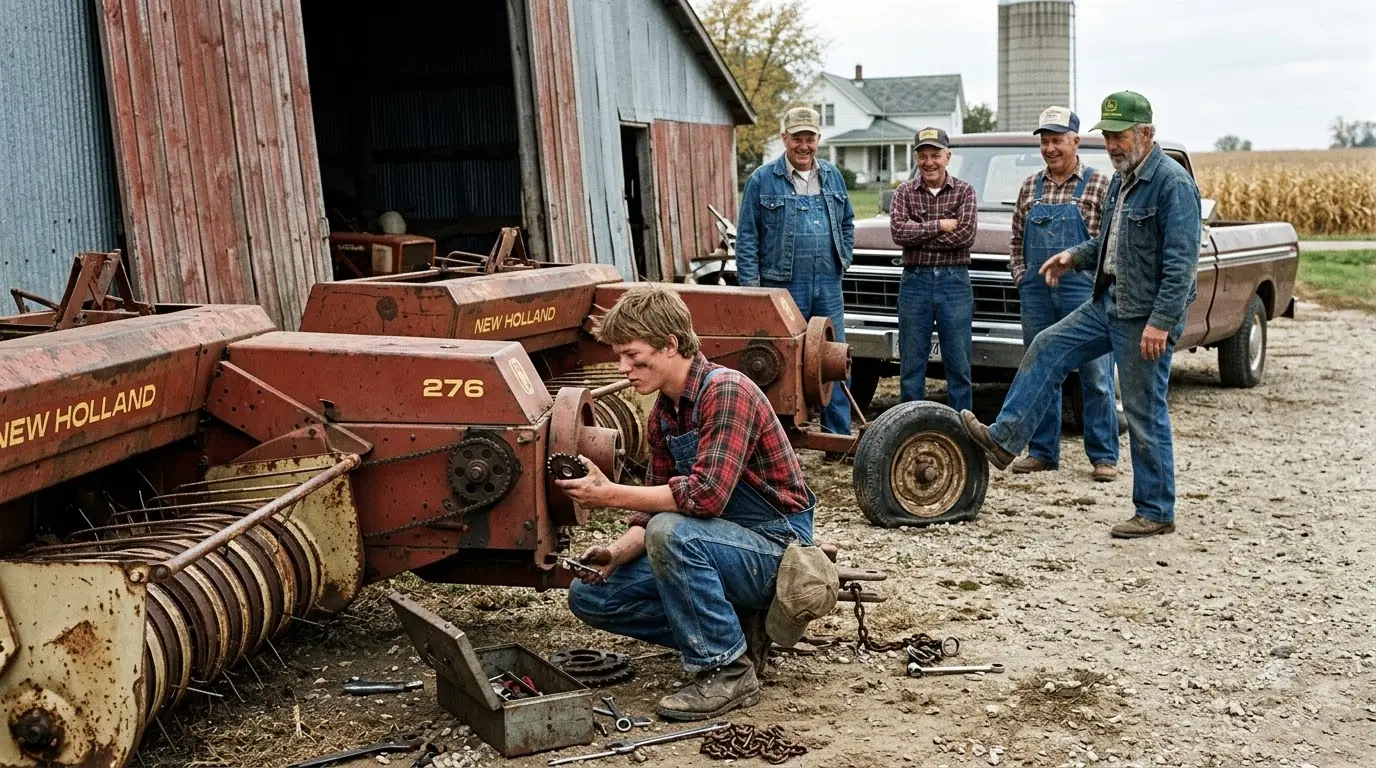
One side panel hung crooked.
The pickup teeth were bent.
A chain sagged loose beneath the frame.
To anyone who understood farm machinery, the baler looked finished.
Not tired.
Not neglected.
Finished.
The farmer who had given it away leaned against his pickup and shouted after the boy.
“You know scrap iron pays by weight, right?”
The men beside him laughed.
The boy lifted one hand without turning around.
That made them laugh harder.
By supper, everyone within five miles seemed to know about it.
A sixteen-year-old had hauled away a dead baler that had been sitting behind a barn for almost seven years.
His father heard about the joke before the machine even reached their own farmyard.
He stepped outside when the tractor came through the gate and stared at the thing following his son.
For several seconds, he said nothing.
The boy shut off the tractor.
Silence settled over the yard.
His father walked around the baler once.
Then again.
He crouched near one wheel, examined the rust, and stood slowly.
“You paid for this?”
“No.”
“That’s the first good thing I’ve heard.”
The boy grinned.
His father did not.
“What are you planning to do with it?”
The boy walked toward the baler.
“Find out what’s still good.”
His father stared.
“You know why it was free?”
“Yes.”
“Because it doesn’t work.”
“I know.”
“Hasn’t worked in years.”
“I know.”
“Parts are worth more than the machine.”
The boy nodded.
“Exactly.”
His father frowned.
“That wasn’t encouragement.”
The teenager ran one hand across the old metal housing.
“I know.”
The machine sat behind the shed that night.
The boy ate quickly, finished his chores, then returned outside before sunset.
He brought a flashlight.
A notebook.
A pencil.
Nothing else.
He spent almost an hour simply looking.
That surprised his father.
Most young people attacked broken machines immediately.
Remove something.
Turn something.
Hammer something.
Make progress visible.
The boy did none of it.
He traced chains.
Counted sprocket teeth.
Looked at shafts.
Studied the knotter assembly.
Checked wheels.
Peered beneath guards without forcing anything.
Then he wrote down what he saw.
His father watched through the kitchen window.
The boy’s mother joined him.
“What’s he doing?”
“Apparently beginning a career in scrap collecting.”
She looked toward their son.
“He looks serious.”
“That’s what worries me.”
The next morning, the boy returned before breakfast.
The first baler did not become a repair project.
It became an inventory.
One usable wheel.
Several brackets.
Sections of chain that might still have life.
Hardware.
Springs.
A gearbox that turned but needed further inspection.
One badly worn knotter assembly.
Several pickup components beyond saving.
He marked everything.
By noon, he had developed a theory.
The machine itself might be dead.
That did not mean every part on it was.
Three days later, he heard about another baler.
This one belonged to an older farmer two roads west.
It had not run properly in years.
The pickup had been damaged badly enough that repairing the entire machine made little financial sense.
The boy rode his bicycle over after chores.
The farmer was repairing fence when he arrived.
“You the kid collecting balers?”
The boy nodded.
The farmer started laughing immediately.
“So it’s true.”
“What?”
“You really dragged that old wreck home.”
“Yes.”
The farmer leaned against the fence post.
“What do you want with mine?”