“You just paid good money to haul off the county landfill.”
The laughter spread through the auction yard before nineteen-year-old Eli Stoltzfus had even lowered his bidder paddle.
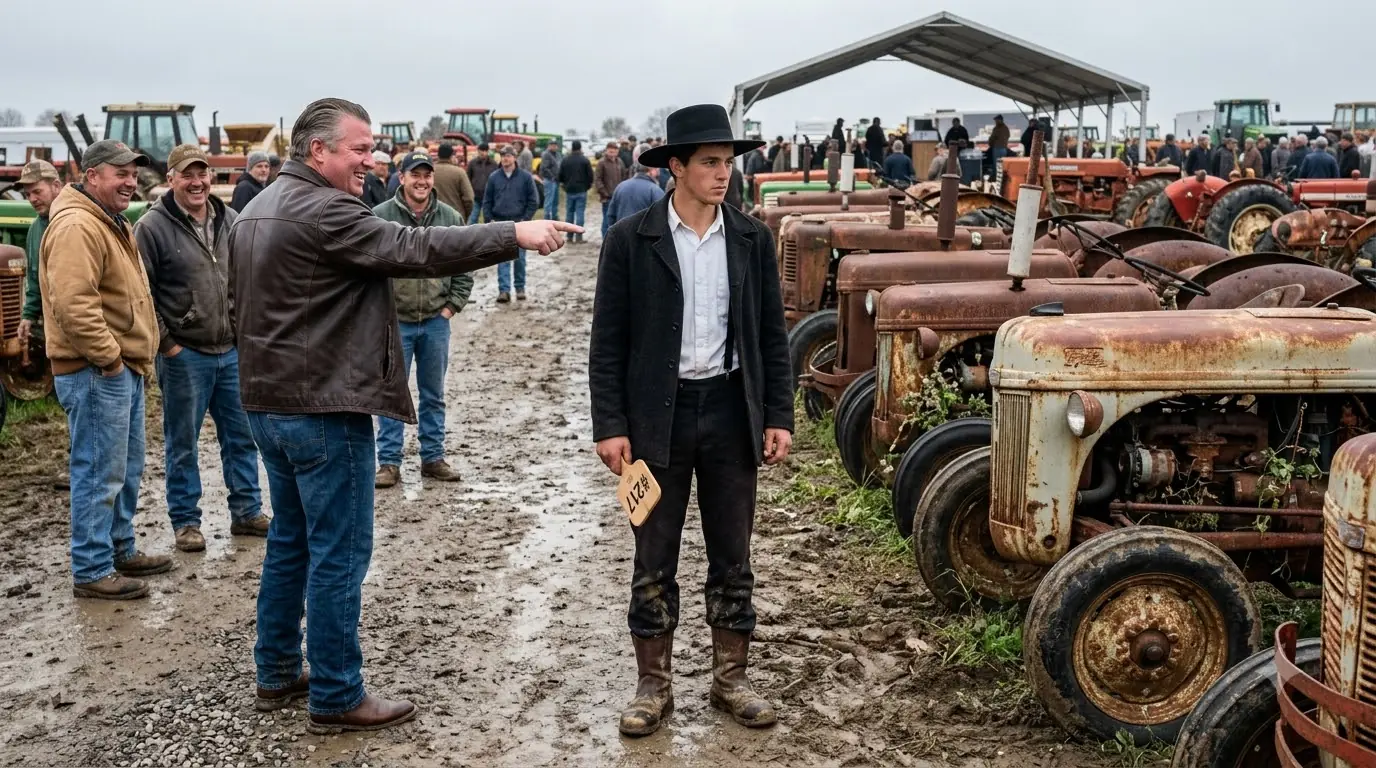
Cold October drizzle drifted beneath the steel roof of the Lancaster County Agricultural Fairgrounds, turning the gravel lot into gray mud and darkening the shoulders of Eli’s plain wool coat.
Behind the crowd sat Lot 74.
Fifty tractors.
Or what was left of them.
Weather-beaten orange and red sheet metal.
Flat tires sunk into Pennsylvania mud.
Broken headlights.
Missing hoods.
Cracked seats.
Rust climbing exhaust stacks that had been left uncovered for years.
Vines pushed through radiator grilles.
Some machines sat crooked because wheels had collapsed.
Others had trees beginning to grow around their rear axles.
Every professional dealer at the auction had walked past them.
Every serious buyer had already reached the same conclusion.
Scrap.
Martin Vance made sure everybody heard his.
Vance stood ten feet from Eli in polished leather boots and a clean brown jacket bearing the embroidered logo of VANCE AGRICULTURAL EQUIPMENT.
His dealership along Route 30 had a showroom larger than Eli’s family barn.
Vance sold new machines with heated cabs, touchscreens, satellite guidance, electronic transmissions and price tags that made small farmers visibly uncomfortable.
He threw his head back and laughed.
“Boy, if you wanted scrap that bad, I’ve got an old manure spreader you can push home for free.”
More laughter.
A farmer near the back muttered:
“Kid just bought himself fifty headaches.”
Another answered:
“Not headaches.”
“Boat anchors.”
The auctioneer looked relieved anyone had bid at all.
Five thousand had produced silence.
Three thousand did the same.
At twenty-five hundred, buyers began walking toward the coffee tent.
Then Eli raised his paddle.
“Two thousand.”
No one countered.
The hammer came down.
“Sold!”
The crowd laughed again.
Eli did not.
He walked to the clerk’s table.
Reached inside his coat.
And counted out one hundred crisp twenty-dollar bills.
Two thousand dollars.
Almost every dollar he had saved since he was fourteen.
Timber framing.
Milking cows.
Repair work.
Hay crews.
Long summer days when other boys his age were playing baseball or driving into town.
The clerk counted twice.
“You sure about this?”
Eli nodded.
“Yes.”
Behind him, Martin Vance called:
“Make sure he gets a receipt. He’ll need something to remember where all his money went.”
The laughter returned.
Eli folded the receipt.
Placed it carefully in his pocket.
Then walked back toward Lot 74.
He did not see fifty dead tractors.
That was the mistake everybody else had made.
Eli saw casting numbers.
Seven years earlier, when Eli was twelve, his grandfather Amos had handed him a brass wire brush inside a cold timber barn outside Gordonville.
“There.”
Amos pointed toward an old tractor engine sitting on wooden blocks.
“Clean that.”
Eli looked at the greasy block.
“Why?”
“So you can read it.”
“There’s nothing written on it.”
Amos gave him the look.
The one that meant Eli had spoken too quickly.
“Brush.”
Eli obeyed.
Grease came away.
Then dirt.
Then layers of black residue.
Slowly, raised characters appeared in the cast iron.
Numbers.
Letters.
A manufacturing code.
Amos leaned closer.
“That is the machine telling you where it came from.”
Eli frowned.
“It’s just a number.”
“No.”
Amos tapped the iron.
“That number tells you what foundry poured it.”
“Which platform it belongs to.”
“Sometimes what other tractors used the same block.”
He looked at his grandson.
“Paint lies.”
“Badges lie.”
“Dealers definitely lie.”
“But a casting usually tells the truth.”
Amos Stoltzfus had spent fifty years repairing agricultural machinery without ever owning a computerized diagnostic scanner.
He used micrometers.
Dial indicators.
Timing marks.
Compression gauges.
Handmade pullers.
And a memory Eli privately believed might contain every tractor built in America between 1945 and 1985.
Amos distrusted the modern idea that old meant useless.
“A dealership wants a farmer to believe a machine dies when the dashboard gets old.”
He would tap a cast-iron housing with one thick finger.
“But iron doesn't care about fashion.”
To Amos, tractors were not single machines.
They were families.
Manufacturers reused platforms.
Engine blocks.
Hydraulic pumps.
Transmission housings.
Gear sets.
Axles.
Clutches.
A tractor with a broken front end might contain a perfect transmission.
One with a frozen engine might have an undamaged differential.
A machine missing half its sheet metal could carry the exact crankshaft needed to revive another one ten years older.
Amos taught Eli to look beneath appearance.
That lesson became an obsession.