I was seventy-one years old the morning I bought ten acres of swamp for ten dollars.
Not ten thousand.
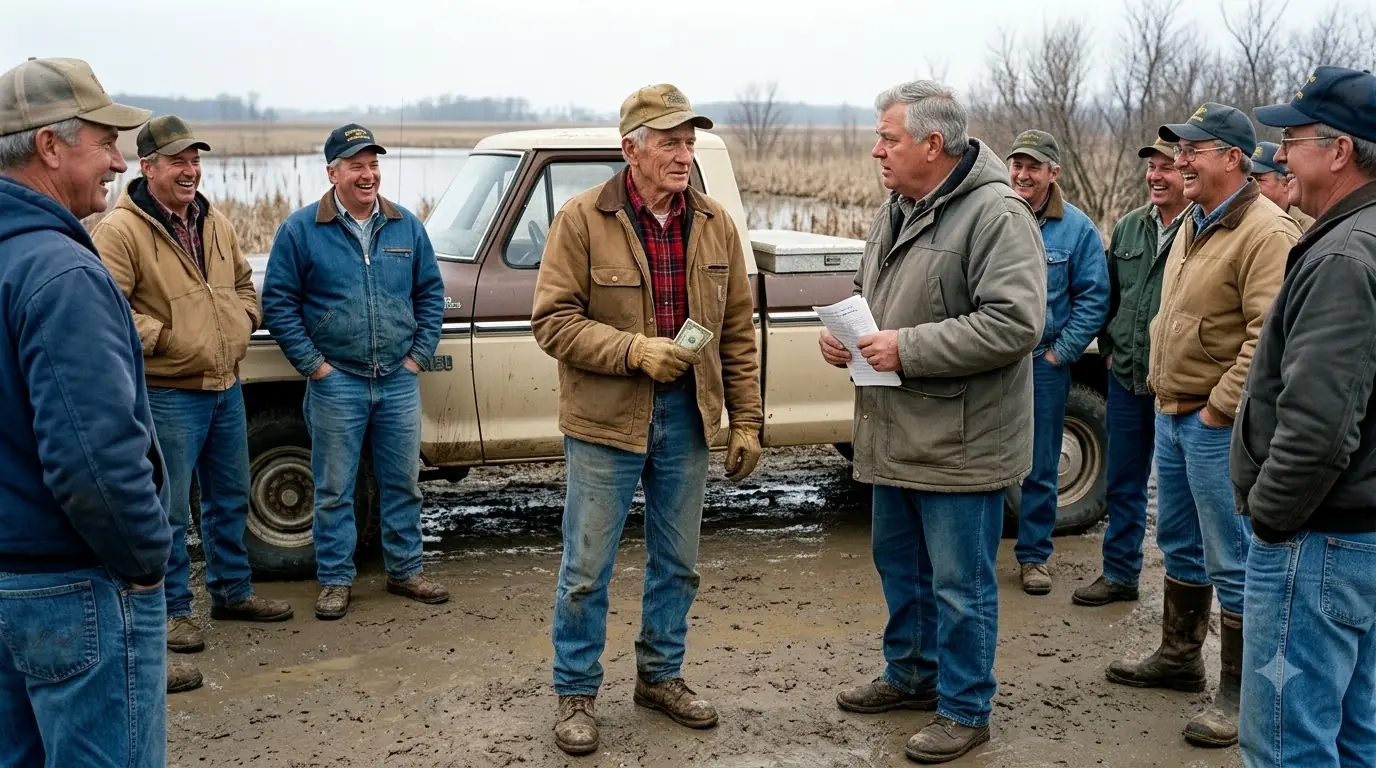
Ten.
One folded bill from my wallet.
The county auction took place beside the courthouse on a cold Tuesday morning in March of 1998.
Mud along County Road 14 had frozen overnight into ruts hard enough to break an axle.
Maybe thirty people stood around drinking coffee from paper cups while Harlan Voss worked through a stack of tax-seized properties.
Most parcels attracted somebody.
Farmers looking for adjoining ground.
Investors hunting cheap houses.
Young men hoping to buy storage sheds.
Then Harlan reached Lot 27.
He cleared his throat.
“Ten acres.”
Nobody moved.
“South of Ottumwa.”
Silence.
“Wapello County.”
Still nothing.
“Wetland parcel.”
That word finished it.
Wetland.
Everybody knew what that meant.
Standing water.
Mosquitoes.
Cattails.
Mud.
No corn.
No soybeans.
No basement.
No septic field.
Barely a road.
Harlan looked over the crowd.
“Opening at five dollars.”
Nobody raised a hand.
A few men laughed.
Harlan waited.
“Three?”
Nothing.
I studied the parcel map clipped to the board beside him.
Ten acres.
A narrow inlet from Stony Creek.
Old gravel access from the west.
Low ground.
Lots of cattail symbols in the assessor notes.
Something my father had told me nearly sixty years earlier came back to me.
I raised my hand.
“Ten.”
Harlan blinked.
“You're bidding ten dollars?”
“Yes.”
Someone behind me laughed.
Harlan looked around.
“Ten dollars.”
“Going once.”
No competition.
“Twice.”
A seed dealer named Carl Pritchard turned toward me with a smile that made me feel like an old dog trying to chase a truck.
Harlan dropped the hammer.
“Sold to Howard Hope for ten dollars.”
More laughter.
I paid cash.
Signed the deed on the hood of my 1979 Ford F-250.
Carl walked past on his way to his Suburban.
“Howard.”
I folded the deed.
“What?”
“What in God's name are you going to do with a swamp?”
The two men beside him laughed.
I put the deed into my jacket pocket.
“Guess I'll find out.”
Carl shook his head.
“At seventy-one?”
I looked at him.
“What age do you stop finding things out?”
He didn't answer.
He just laughed again and walked away.
I drove to the property that afternoon.
The access track was worse than the county description.
Washed-out gravel.
Deep clay ruts.
Willow brush growing through the middle.
I stopped the truck near the road before I buried it to the axles.
Walked the rest.
It took twenty minutes to reach the center.
Ten acres does not sound like much until every step sinks.
Black mud under a thin crust of ice.
Cattails everywhere.
Some six feet tall.
Brown seed heads rattling in the wind.
Willow scrub crowded the edges.
The air smelled like wet earth.
Rotting vegetation.
Cold water.
And something almost sweet underneath.
I stood there with mud climbing over my boots.
And thought about my father.
He had died in 1964.
Thirty-four years earlier.
But certain things a father tells a boy never really leave.
They sit somewhere quiet until life finally gives them a reason to come back.
I had been twelve the first time he showed me cattail root.
He pulled one from a ditch near our farm.
Thick.
Segmented.
Covered in black mud.
I remember wrinkling my nose.
“You eat that?”
He laughed.
“My family did.”
He told me about the winter of 1936.
Depression years.
His father—my grandfather—had taken work draining a marsh outside Ottumwa.
Fifty cents a day.
Three weeks of cold water and frozen boots.
At the end of the job, Granddad filled a burlap sack with roots the landowner wanted thrown away.
My grandmother boiled them.
They ate them with salt pork.
My father said those roots helped carry them until spring.
I had forgotten most of the details.
I had not forgotten one sentence.
“People call things weeds after they stop remembering what they're for.”
Standing in my ten-dollar swamp, I bent down.