The smell of onions, browned meat, and fresh rosemary drifted beneath the covered porch of Maddox Ranch, reaching the open grassland before the dinner bell ever rang.
Lydia Carter stood beside a rough wooden cooking table, turning thick slices of beef in a black iron skillet while a pot of potatoes simmered over the small outdoor stove. Flour marked the pale apron tied over her earth-brown dress, and cooking oil had darkened one cuff near her wrist. Loose strands of chestnut-blonde hair clung to her flushed cheeks, but her hands remained steady as she worked.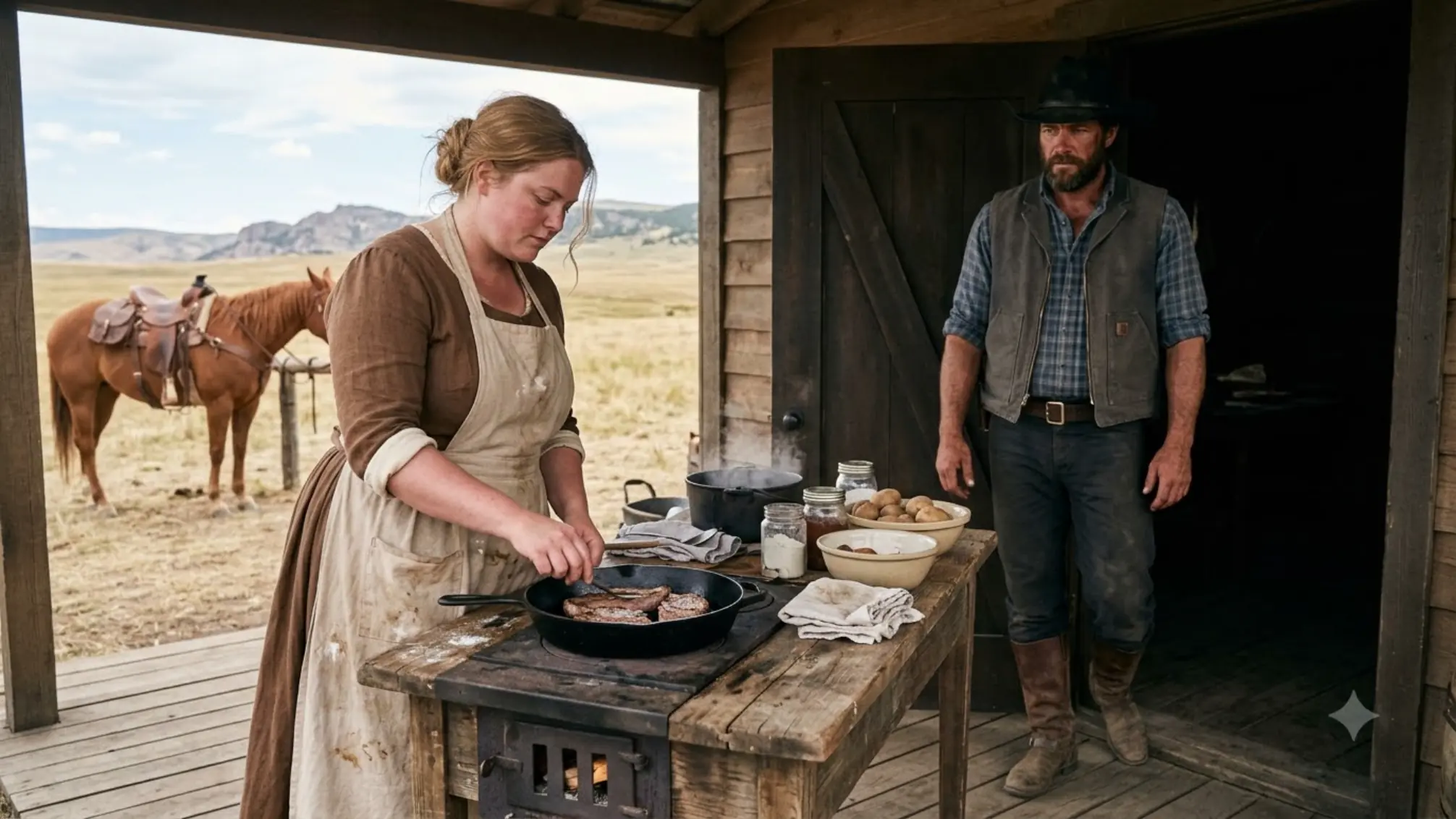
Cole Maddox stepped through the doorway behind her.
He was thirty-eight, tall and broad through the shoulders, with sun-weathered skin, blue-gray eyes, and a black beard that made his silence seem harder than it truly was. His dark hat sat low over his brow, and his sleeveless work vest revealed arms shaped by years of lifting saddles, timber, and injured cattle. He stopped several feet from Lydia and watched her place another piece of meat into the skillet.
Cowboy (softly, breathing in the aroma): “This smells wonderful, doesn’t it?”
Ranch Cook (shyly, stirring the skillet): “It is only supper, but I wanted this place to feel cared for again.”
Cowboy (gently, stepping beside her): “Nobody has cared whether this ranch felt like home in a very long time.”
Ranch Cook (tenderly, meeting his eyes): “Then perhaps neither of us arrived here by accident.”
Neither spoke for several seconds after that.
Cole looked toward the distant pasture as though the hills might provide a safer answer than the woman beside him. Lydia lowered her eyes to the skillet, suddenly aware of how close he stood and how softly he had spoken. She had been at Maddox Ranch for only twelve days, yet the quiet between them felt less like discomfort and more like something neither dared name.
Then the bunkhouse door opened.
Six hungry ranch hands stepped onto the yard, and the tender moment disappeared beneath boots, laughter, and demands for supper.
Lydia had learned long ago how quickly men could turn softness into entertainment. She lifted the skillet, carried it toward the long table, and resumed the practical expression that had protected her through most of her life.
Twelve days earlier, she had stepped off the stagecoach in Salvation Ridge with one carpetbag, eleven dollars, and a letter offering employment as a ranch cook.
The laughter began before both her boots reached the ground.
Three men stood outside the Golden Spur Saloon, passing a bottle between them despite the early hour. One whistled when he saw Lydia’s full figure descending from the coach. Another wagered she would consume Maddox Ranch’s winter stores before learning where the kitchen was.
The third man, Rafe Calder, laughed loudest.
“Cole asked for a cook,” he called. “Stage company sent him the whole pantry.”
Lydia straightened her brown traveling dress and looked directly at him. She was twenty-nine, with a round face, soft hazel eyes, and a body strangers considered public property whenever they wanted a joke. She had endured comments in churchyards, shops, boarding houses, and even at her mother’s burial.
Rafe was not original enough to hurt her.
“You must be the welcoming committee,” Lydia said. “I expected something taller.”
The men outside the saloon laughed at him instead.
Rafe’s smile vanished.
Cole Maddox stood beside a freight wagon across the street. He had come personally because the stage carried flour, lamp oil, medicine, and the new cook he had hired after exchanging only three letters. He did not laugh with the others. He studied Lydia with the exhausted caution of a man whose ranch had disappointed him too many times.
“Miss Carter?”
“That depends,” Lydia replied. “Are you planning to compare me to livestock too?”
“No.”
“Then I am Lydia Carter.”
Cole lifted her carpetbag into the wagon. He did not offer compliments, apologies for the town, or promises that Maddox Ranch would be different.
“The ride is fourteen miles,” he said. “The road is rough.”
“I have survived rough roads.”
His eyes rested on her face for a moment.
“I expect you have.”
During the journey, Cole explained that the ranch employed sixteen men during cattle season and nine through winter. The previous cook had left without notice after a fight with Rafe. The kitchen had not been cleaned properly in months, supplies were disorganized, and no one knew why the food budget kept increasing while the portions became smaller.
Lydia listened carefully.
“What happened to your wife?” she asked after noticing a child’s knitted scarf beneath the wagon seat.
Cole’s hands tightened around the reins.
“She died four years ago.”
“I am sorry.”
“So am I.”
He said nothing else for the next mile.
The main house appeared late in the afternoon, surrounded by barns, corrals, sheds, and a weathered bunkhouse. The ranch should have looked prosperous. Instead, fences leaned, shingles were missing from the stable roof, and two wagons stood broken beside the blacksmith shed.
A thin eight-year-old girl waited on the porch.
She had dark braids, solemn blue eyes, and a faded red dress that had been mended at both elbows. She stared at Lydia without smiling.
“This is my daughter, Emma,” Cole said.
Lydia stepped down from the wagon.
“Hello, Emma.”
The girl looked at her father. “Is she staying?”
“If she wants the work.”
Emma considered Lydia again. “The last cook shouted.”
“I sometimes shout,” Lydia admitted. “Usually when something is burning or someone deserves it.”
Emma’s mouth almost curved.
The kitchen was worse than Cole had described.
Grease covered the stove. Flour sacks lay open near mouse droppings. Three cracked jars contained different amounts of salt, and spoiled meat had been left in a wooden box beside the pantry door. The sink smelled of old water, and half the cooking utensils were broken.
Lydia placed both hands on her hips.
“When was this room last cleaned?”
Cole glanced around. “Yesterday.”
“By whom?”
“Rafe.”
Lydia looked at the blackened stove, the filthy floor, and the dead mouse beneath a bucket.
“Then Rafe and I define cleaning differently.”
She spent the remainder of the afternoon scrubbing. Emma silently brought water from the pump without being asked. Cole repaired a loose shelf after Lydia warned that it would collapse beneath the jars.
By sunset, Lydia had found enough usable ingredients for stew, biscuits, fried onions, and apple pudding. She rang the dinner bell and stood beside the stove while the ranch hands entered.
Rafe came last.
He looked at the clean counters and frowned. “You throw away my bacon?”
“I buried what remained of it.”
“That cost money.”
“So does treating nine men for food poisoning.”
Rafe sat at the far end of the table. “Big woman like you must know plenty about eating.”
Lydia placed a full bowl in front of him.
“And a man with a mouth like yours must know plenty about swallowing his own words.”
The others tried not to laugh.
Then they tasted the stew.
Conversation stopped.
Men who had mocked Lydia in town bent over their bowls and ate with stunned concentration. Biscuits disappeared faster than she could replace them. Even Cole, who had said little since arriving, looked up after the first spoonful.
“This is good,” he said.
Rafe tore a biscuit in half. “Too much pepper.”
Lydia reached for his bowl.
He pulled it closer. “I did not say I wouldn’t finish it.”
That first supper did not make the ranch hands respect her, but it forced them to reconsider the certainty with which they had dismissed her.
During the following days, Lydia reorganized the pantry, counted every sack, and created a written supply list. She washed blankets, repaired torn aprons, and discovered twelve pounds of dried beans hidden behind an empty flour barrel. She negotiated with a neighboring farmer for eggs and milk, reducing the kitchen expenses without shrinking a single meal.
Emma began appearing before dawn to help knead bread.
The girl rarely spoke about her mother. She watched Lydia’s hands and copied each movement with intense concentration. When Lydia showed her how to fold dough without pressing out the air, Emma smiled for the first time.
Cole saw it from the doorway.
His expression softened, then closed again.
Lydia did not try to become Rebecca Maddox. She never sat in the dead woman’s chair, never wore the blue shawl hanging beside the stairs, and never asked Emma to call her anything except Lydia. She understood that grief was not an empty position waiting for a replacement.
One afternoon, a young ranch hand named Thomas staggered into the kitchen with blood running down his leg. A broken fence wire had cut through his trousers and opened a deep wound beneath his knee.
Rafe wanted to pour whiskey over it and wrap it with an old cloth.
Lydia pushed him aside.
“My mother was a midwife,” she said. “Boil water. Find clean linen. If you bring me that filthy rag, I will wrap it around your mouth.”
She cleaned the wound, checked that the tendon remained intact, and stitched the cut with steady hands. Thomas gripped the table until his knuckles turned white, but Lydia spoke calmly until the final knot was tied.
Cole stood beside her holding the lamp.
“You have done this before,” he said.
“I spent six years helping my mother.”
“Why did you stop?”
Lydia glanced toward Thomas.
“Some stories belong somewhere more private.”
Cole nodded.
He did not ask again.
That restraint mattered more than Lydia wanted it to.
Her past belonged to a town called Fairwater, where her mother had delivered half the children and been blamed for the ones she could not save. Lydia had inherited her skill and her reputation for competence, but not the thin body expected of respectable young women.
At twenty-three, she became engaged to Samuel Pierce, the son of a store owner. He praised her cooking in private and ignored jokes about her in public. Two weeks before their wedding, Lydia discovered he had been using her mother’s savings to cover gambling debts.
When confronted, Samuel called her lucky any man had been willing to marry her.
She struck him with a sack of flour and left.
The story spread through Fairwater without the part about theft. By the time Lydia found work elsewhere, she had become the desperate heavy woman abandoned before marriage. She stopped correcting people because truth rarely entertained them as much as humiliation.
Maddox Ranch began changing under her care.
The men came to meals washed and on time because Lydia refused to serve anyone who arrived covered in manure. The kitchen ledger balanced for the first time in months. Emma gained weight, slept better, and no longer hid bread in her bedroom for fear there would be none the next day.
Cole noticed every change.
He also noticed things Lydia tried to hide.
She favored her left ankle after long days. She counted coins twice before purchasing anything for herself. She never ate until every other person had been served, and she kept a wrapped biscuit in her apron because some part of her still expected to be sent away without warning.
One evening, Cole found her standing alone in the pantry.
She was staring at a shelf containing flour, sugar, beans, coffee, and preserved fruit.
“Something wrong?” he asked.
“No.”
“You look troubled.”
Lydia touched the flour sack. “There is enough food here for two months.”
“Yes.”
“I have never worked anywhere that kept this much.”
Cole understood without requiring an explanation.
“You will eat at this ranch whether you work here or not,” he said.
Lydia looked at him.
“That is a dangerous promise.”
“It is not a promise. It is a rule.”
The kindness in his voice frightened her more than cruelty ever had. Cruel men were predictable. Kindness invited hope, and hope had once cost Lydia nearly everything.
She turned toward the shelves.
“You should not make rules you cannot afford.”
Cole’s expression changed. “What makes you think I cannot afford it?”
“The beef account is late. The flour merchant has stopped giving full credit. Three workers were paid with notes instead of cash, and someone has been removing coins from the kitchen expense box.”
Silence filled the pantry.
Cole closed the door behind him.
“How long have you known?”
“About the missing coins? Four days. About the ranch’s condition? Since I saw the barn roof.”
He rested both hands against the shelf. “The ranch had a poor winter.”
“This is more than one winter.”
Cole looked older under the pantry lamp.
“My father expanded too quickly. After he died, I inherited loans, bad grazing contracts, and land taxes he had delayed. I have spent eight years paying debts without understanding why they never shrink.”
“Who keeps the books?”
“My foreman.”
“Rafe?”
Cole nodded.
Lydia’s stomach tightened.
Rafe had been at Maddox Ranch for thirteen years. He had ridden beside Cole’s father, helped bury Rebecca, and stood near Emma during the funeral. Cole trusted him with wages, cattle counts, land contracts, and supply orders.
“Do you check his numbers?”
“He brings the ledgers every month.”
“That was not my question.”
Cole’s eyes hardened, but not at Lydia.
“No,” he admitted.
The following morning, Lydia began recording every kitchen purchase in a separate notebook. She marked the weight of flour, meat, coffee, and sugar when delivered. She counted meals and compared them with Rafe’s expense reports.
Within one week, she found thirty-eight dollars in false purchases.
Rafe claimed the difference came from spoiled goods.
Lydia asked to see the discarded supplies.
He told her to stay in the kitchen.
“Then stop bringing lies through my kitchen door,” she replied.
His face turned red. “Cole should never have hired you.”
“Yet you eat three portions every night.”
“That does not make you family.”
The words struck more deeply than Lydia expected.
Rafe saw it and smiled.
Cole entered before she could answer.
“What is happening?”
Rafe immediately changed his tone. “Lydia is confused about the supply costs.”
“I am not confused,” she said. “Someone charged the ranch for four sacks of coffee. Only two arrived.”
Rafe shrugged. “The merchant made an error.”
“The merchant’s receipt shows two.”
“Then I copied it wrong.”
“You copied the quantity wrong but doubled the price correctly?”
Cole looked between them.
Rafe stepped closer to Lydia. “Careful, cook.”
Cole moved between them.
“She asked a question.”
“She is accusing me of theft.”
“Are you stealing?”
Rafe’s expression became wounded. “After everything I have done for your family?”
Cole held his gaze. “Answer.”
“No.”
Lydia knew then that Rafe was guilty.
An innocent man might become angry, insulted, or defensive. Rafe had chosen betrayal as a shield, reminding Cole of grief and loyalty instead of explaining the numbers.
Cole ordered him to turn over the main ledger.
Rafe claimed it was in the bunkhouse. When Cole went to retrieve it, the book had vanished.
The next morning, Vivian Hartwell arrived.
She owned the neighboring Bar H Ranch and nearly every mortgage note between Salvation Ridge and the northern river. Vivian was forty-six, elegant, controlled, and dressed in burgundy riding clothes that had never touched barn mud.
She entered the house without waiting to be invited.
Lydia stood at the stove while Cole received her in the dining room.
“You missed another payment,” Vivian said.
“The cattle sale is next month.”
“The contract does not say payment comes when convenient.”
“It says I have thirty days.”
“You had thirty days.”
Cole’s voice remained low. “My father borrowed twelve thousand dollars. I have paid eighteen thousand.”
“Interest rewards patience.”
“Interest should not rebuild the debt after every payment.”
Vivian smiled. “Then perhaps you should have read the agreements more carefully.”
Lydia carried coffee into the room and noticed a silver emblem on Vivian’s document case. The same emblem appeared on delivery receipts Rafe had submitted for flour, tack, and equipment.
Hartwell Mercantile Holdings.
Vivian controlled the company billing Maddox Ranch for supplies that never arrived.
The door opened behind her.
Rafe entered and stopped when he saw Lydia looking at the emblem.
For a moment, fear crossed his face.
Then it disappeared.
Vivian left after giving Cole ten days to produce nine hundred dollars. If he failed, she would claim the eastern pasture under a collateral agreement signed by his father.
Afterward, Lydia found Cole in the stable.
He was brushing a horse with more force than necessary.
“Rafe is working with her,” Lydia said.
Cole did not turn around.
“You cannot know that.”
“Her company appears on his false receipts.”
“Many merchants buy through Hartwell.”
“He looked frightened when he saw me notice.”
“That is not proof.”
“No.”
Cole finally faced her. “Rafe held my wife’s horse while I carried her body home.”
Lydia’s anger softened.
Rebecca had died after falling from a wagon during a winter storm. Cole had been ten miles away. Rafe found her first and brought word to the ranch.
“He has been beside me through everything,” Cole said.
“Then you are not protecting a worker. You are protecting a memory.”
Cole stepped closer. “You have been here less than a month.”
“And I can still see what loyalty is preventing you from seeing.”
His face closed.
“You should return to the kitchen.”
Lydia’s throat tightened.
She removed her apron and placed it over the stall door.
“If that is where you believe my judgment belongs, perhaps you hired the wrong woman.”
She walked away before he could answer.
That evening, supper was quiet.
Lydia served the men, cleaned the kitchen, and packed her carpetbag. Emma found her folding the brown dress she had worn upon arrival.
“You are leaving.”
Lydia sat beside her on the bed.
“Your father and I disagreed.”
“People disagree and stay.”
“Sometimes.”
Emma’s eyes filled. “Mama left.”
“Your mother died, sweetheart.”
“She still left.”
Lydia pulled the child close.
Emma resisted for only a second before pressing her face against Lydia’s shoulder.
“I cannot promise never to leave,” Lydia whispered. “But I promise I will not disappear tonight.”
A noise came from outside.
Not the ordinary creak of boards or lowing of cattle. It was the quick scrape of a boot beneath the window.
Lydia extinguished the lamp and moved toward the curtain.
Rafe crossed the yard carrying a lantern.
He entered the feed shed instead of the bunkhouse.
Five minutes later, another lantern appeared beyond the fence. Vivian Hartwell stepped from a covered wagon and joined him.
Lydia woke Cole.
Together they approached the shed from opposite sides. Through a gap between the boards, they saw Rafe place a ledger on a crate.
“I changed the cattle count,” he told Vivian. “Maddox will appear two hundred head short.”
“Will he sign the emergency loan?” she asked.
“He will when the bank freezes his account.”
“And the cook?”
Rafe spat into the dirt. “She is leaving.”
Vivian opened the ledger. “Make certain of it. She is the only person at this ranch who can count.”
Cole’s face went still.
Lydia touched his arm before he entered the shed.
“Wait.”
“For what?”
“To hear how deeply he buried you.”
Rafe continued.
He had been falsifying cattle deaths, inflating supply purchases, and diverting wages for nearly four years. Vivian used the stolen money to purchase portions of Cole’s debt through shell companies. Every time Cole made a payment, Rafe altered the books to create another shortage.
Rebecca had discovered the first false ledger shortly before her death.
Cole stopped breathing.
Vivian lowered her voice. “You promised the woman would not reach town.”
“The storm handled that.”
Cole surged forward.
Lydia grabbed his coat with both hands, but he pulled free and kicked open the shed door.
Rafe turned.
The fear on his face lasted only a moment before his hand moved toward his holster.
A gunshot exploded outside the bunkhouse.
The bullet struck the doorframe beside Cole’s head.
Ranch hands rushed into the yard. Horses screamed inside the stable, and Emma appeared at an upstairs window.
Rafe raised the pistol again.
Lydia seized a shovel leaning against the wall and struck his wrist. The weapon fell into the dirt. Cole tackled him before he could recover it.
Vivian ran toward her wagon.
Thomas and two other men blocked her path.
Within minutes, Rafe lay facedown with his hands tied. Vivian stood beside the shed surrounded by men who had trusted both her wealth and his authority.
Cole picked up the false ledger.
His hands shook as he read the entry describing Rebecca’s final journey. Rafe had loosened a wheel pin on her wagon, expecting the accident to frighten her into silence. The wheel broke during the storm and sent the wagon down an embankment.
Rafe insisted he had not intended to kill her.
Cole struck him once.
Then he stopped.
Lydia stood beside him, holding the shovel.
“Do not give him a story where he becomes the victim,” she said.
Cole looked at Rafe for a long moment.
Then he ordered the men to lock him inside the root cellar until the sheriff arrived.
Vivian laughed bitterly. “The sheriff owes me more than he owes you.”
Lydia lifted the hidden ledger.
“Then perhaps we should send copies to the territorial marshal, the bank examiner, and every rancher whose debt you purchased.”
Vivian stopped smiling.
The investigation lasted months.
Rafe confessed after learning Vivian intended to blame every false document on him. His testimony exposed manipulated loans, stolen cattle, fraudulent supply contracts, and the deliberate destruction of Rebecca’s wagon.
Vivian’s companies had targeted six struggling ranches. She offered loans through separate businesses, inflated supply costs, and used dishonest foremen to create defaults. Once owners lost their land, she combined the properties into a single cattle operation.
Rafe received a long prison sentence for fraud, attempted murder, and his role in Rebecca’s death. Vivian was convicted of conspiracy, bribery, and financial fraud. Her assets were seized, and the false debts against Maddox Ranch were canceled.
Cole did not celebrate.
Truth returned the ranch, but it could not return Rebecca.
For weeks, he barely spoke outside necessary work. Lydia remained because Emma needed stability and because leaving during grief felt too much like confirming Rafe’s belief that she would never last.
She cooked, balanced the restored accounts, and helped Cole reorganize wages. She also made one condition clear.
“I am not staying as a favor.”
Cole looked at her across the kitchen table. “Why are you staying?”
“Because I have work worth doing.”
“That is all?”
Lydia’s cheeks warmed. “For now.”
Spring arrived slowly.
Grass returned to the eastern pasture. Calves filled the lower fields, and repaired fences stood straight beneath the open sky. Cole promoted Thomas to foreman and required two signatures on every financial transaction.
He also built Lydia a proper indoor stove.
She found him measuring the kitchen wall before sunrise.
“What are you doing?”
“Preventing another winter of you cooking on the porch.”
“I enjoy the porch.”
“You complain about the wind.”
“I complain about many things.”
“I have noticed.”
He spent three days installing the stove and another two pretending he had not built it because he cared about her comfort.
Emma knew better.
The girl began placing wildflowers beside Lydia’s plate and asking questions about weddings. Lydia ignored the questions. Cole nearly choked whenever they were asked.
One evening, after the ranch hands had finished supper, Lydia carried coffee onto the porch. Cole stood near the railing watching the sunset spread across the pasture.
She handed him a cup.
“You trusted me before you had proof,” she said.
“I should have trusted you sooner.”
“You barely knew me.”
“I knew you had nothing to gain by warning me.”
Lydia looked toward the bunkhouse. “People often distrust the person telling an uncomfortable truth.”
Cole turned toward her.
“I distrusted you because believing you meant losing the man I thought Rafe was.”
“I know.”
“That does not excuse it.”
“No.”
He waited.
Lydia smiled faintly. “But it explains why I did not leave.”
Cole looked down at his coffee.
“I have spent four years believing caring for someone means waiting to lose them.”
“Caring for someone always carries that risk.”
“That is not reassuring.”
“It was not intended to be.”
He laughed quietly.
Then his expression became serious.
“When you first arrived, I thought you would stay a week.”
“So did Rafe.”
“I thought the work would exhaust you.”
“It nearly did.”
“I thought Emma might reject you.”
“She is currently planning our wedding without consulting either of us.”
Cole nearly dropped his cup.
Lydia laughed.
His eyes remained on her face.
“And what do you think?” he asked.
“About Emma’s plan?”
“About staying.”
The question carried far more than employment.
Lydia looked at the ranch—the repaired barn, the open fields, the kitchen window glowing behind them, and the child inside who had stopped hiding bread beneath her pillow.
Then she looked at Cole.
“I spent years being told I should feel grateful whenever someone tolerated me,” she said. “Samuel made me believe marriage was a kindness he might withdraw if I became inconvenient.”
Cole’s jaw tightened.
“I do not want your gratitude.”
“What do you want?”
He stepped closer.
“You at the breakfast table. Your ledger beside mine. Your voice in this house, even when it is telling me I am wrong.”
“That happens often.”
“More often than I enjoy.”
Lydia’s eyes filled.
Cole removed his hat.
“I do not know how to make promises beautifully,” he said. “But I know this ranch was dying before you came. Emma was lonely. I was angry at everyone who still seemed capable of hope.”
“You saved the ranch too.”
“I kept the land. You reminded us why keeping it mattered.”
Lydia placed her cup on the railing.
Cole reached for her hand but stopped before touching it.
“May I?”
She nodded.
His rough fingers closed gently around hers.
“I love you, Lydia Carter,” he said. “Not because you fed my men, balanced my books, or exposed the traitor sleeping under my roof. I love you because you saw every broken part of this place and never treated any of us as worthless.”
Lydia swallowed.
“People have treated me that way often enough.”
“I know.”
“You cannot promise the town will stop laughing.”
“No.”
“You cannot promise life here will be easy.”
“No.”
She stepped closer.
“Then promise me something you can keep.”
Cole held her gaze.
“I will never ask you to become smaller so I can feel larger.”
The words broke the last defense around Lydia’s heart.
She touched his bearded cheek.
“I love you too,” she whispered. “Though your first kitchen was an insult to human civilization.”
He smiled.
“I will add that to the vows.”
They married at Maddox Ranch in early autumn.
Lydia wore a deep brown dress with cream lace at the collar. She chose the color because it reminded her of the clothes she wore when she first arrived—not ashamed, not hidden, and not trying to appear smaller for anyone.
Emma stood between them during the ceremony.
When the preacher asked who gave Lydia away, she answered before anyone else could.
“Nobody. She chose us.”
The ranch hands removed their hats.
Thomas cried openly and denied it afterward. Even men who had laughed outside the Golden Spur came to the reception and lowered their eyes when Lydia passed.
She did not require their shame.
Respect shown too late could not erase cruelty, but it could prevent the next person from standing alone.
Maddox Ranch recovered over the following years.
Lydia expanded the kitchen, hired two women from Salvation Ridge, and taught Emma medicine, accounting, and cooking. Cole rebuilt the bunkhouse and established written contracts so no foreman could ever again hide theft behind loyalty.
The ranch became known for fair wages, honest books, and meals travelers remembered for years.
People continued telling the story of the plus-size cook everyone expected to fail.
They said she saved the ranch because she found a hidden ledger. They said Cole rescued her by offering a home, or that Lydia rescued him by replacing the wife he lost.
Neither version was entirely true.
Lydia did not replace Rebecca. Cole did not rescue Lydia from herself. They met as two wounded adults inside a place already collapsing under lies.
He gave her trust before the rest of the ranch offered respect.
She gave him truth when comfort would have been easier.
And together, they built a home where no frightened child hid bread, no worker’s worth depended on appearance, and no cruel man could disguise betrayal as loyalty.
Years later, Lydia still cooked outdoors on clear afternoons.
One evening, Cole approached while she turned meat in the same black iron skillet she had used during her first weeks. His beard now carried silver, and her chestnut-blonde hair had begun to do the same.
He stood beside her and breathed in the aroma.
Cowboy (playfully, slipping an arm around her waist): “This smells wonderful, doesn’t it?”
Ranch Cook (affectionately, leaning against him): “It should. I have had years to correct your terrible taste.”
Cowboy (tenderly, kissing her temple): “The ranch felt empty before you.”
Ranch Cook (softly, covering his hand with hers): “Then it is fortunate neither of us arrived here by accident.”