The black walnut tree had been dead for three years.
Everybody agreed on that.
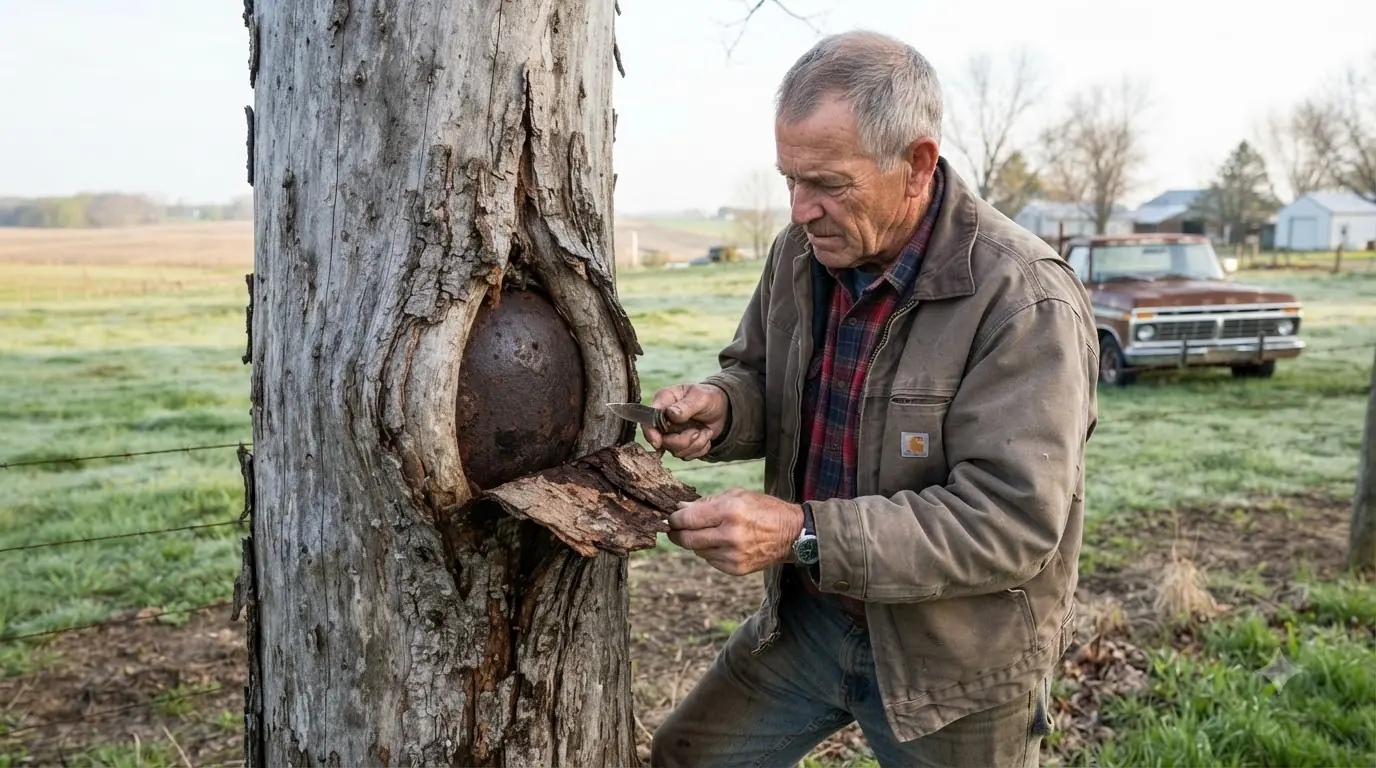
The county extension agent had tapped the gray bark the previous fall, stepped back, and looked up at the bare branches.
“You ought to take it down, Henry.”
Henry Walker had shoved both hands into the pockets of his faded canvas jacket.
“Why?”
“Because dead trees fall.”
Henry looked around the north pasture.
No cattle.
No equipment.
Nothing within fifty yards except fence posts and weeds.
“If it falls, it'll hit dirt.”
The extension agent laughed.
“Your funeral.”
Henry left it standing.
Not because he was sentimental.
At least that was what he told himself.
The truth was more complicated.
His grandfather, William Walker, had planted that tree in 1947.
He had come home from Europe after the war, married Henry’s grandmother, returned to the family farm in Hardin County, Illinois, and spent his first spring home planting things.
Apple trees.
Two maples near the house.
Windbreak pines.
And one black walnut standing alone near the north fence.
William had died when Henry was eleven.
Henry’s father never explained why that particular walnut mattered.
He only said:
“Granddad planted it himself.”
So Henry never cut it.
Even after it stopped producing walnuts.
Even after the leaves stopped coming.
Even after the bark loosened and the upper branches began turning silver-gray against the sky.
There were always more urgent problems anyway.
A leaking barn roof.
A tractor hydraulic line.
Property taxes.
A farm loan already two payments behind.
A bank letter sitting unopened on the kitchen table.
Henry had forty-three problems before he got to the dead tree.
Until one Tuesday morning in late April.
He was driving the old Ford along the creek checking fence posts when something on the south side of the walnut caught the light.
A lump.
About chest high.
Henry stopped the truck.
Backed up.
Looked again.
The growth was nearly the size of a basketball.
Smooth in places.
Split down the center.
At first he thought it was a burl.
But Henry had worked around trees his entire life.
Burls grew with the wood.
This looked wrong.
He climbed out.
Morning dew darkened his boots.
The neighboring fields smelled like turned soil and diesel.
Henry walked toward the walnut.
Put one hand against the lump.
Cold.
Hard.
He frowned.
Wood wasn't supposed to feel like that.
Henry pulled his pocketknife.
Worked the blade carefully beneath a loose edge of bark.
The dead bark peeled away in a thick sheet.
And underneath—
metal.
Henry stopped.
He touched it.
Dark.
Pitted.
Rusty.
But unmistakable.
He stepped backward and looked at the tree differently.
Really looked.
The way his father had taught him to look at a field before deciding what fertilizer it needed.
The metal object was not attached to the outside.
The tree had grown around it.
Decades of wood had curled over the edges until only the swollen outline remained.
Henry pulled his phone from his pocket.
Took one photograph.
Then another.
He almost called his daughter.
Almost called the county.
Instead he put the phone away.
“No.”
He looked at the tree.
“Not yet.”
Henry Walker was sixty-eight years old and three weeks away from losing the farm.
Nobody besides the bank knew that.
His daughter Rebecca suspected.
His granddaughter certainly did not.
To everyone else, the Walker place looked the same as it had for decades.
White farmhouse.
Red barn faded nearly brown.
Soybean ground toward the road.
Corn rotation farther east.
One hundred twelve acres remaining from what had once been almost two hundred.
What people could not see was debt.
Henry’s wife, Margaret, had died six years earlier.
Cancer had eaten through savings faster than insurance could keep up.
Then came two wet planting seasons.
Then a combine repair.
Then fertilizer prices.
Then a land-tax reassessment.
Henry borrowed.
Then borrowed again.
He hated doing it.
His father had distrusted banks on principle.
“Bankers lend umbrellas in sunshine and ask for them back when it rains.”
Henry used to laugh at that.
Not anymore.
The final notice from First County Agricultural Bank gave him until May 17.
$83,400.
Not the entire mortgage.
Just enough to cure the default and restructure what remained.
If he failed, foreclosure proceedings would begin.