The county auction lasted eleven minutes, and most of that time was spent waiting for someone to bid.
Parcel Seventeen consisted of sixty-three abandoned acres four miles outside Claremore, Oklahoma. The old file described it as former cattle pasture with poor access, collapsed fencing, and nearly forty years of unchecked brush. Cedar trees, blackberry thickets, wild grape, poison ivy, and thorny multiflora rose had swallowed the roads, the hills, and every trace of the family that once lived there.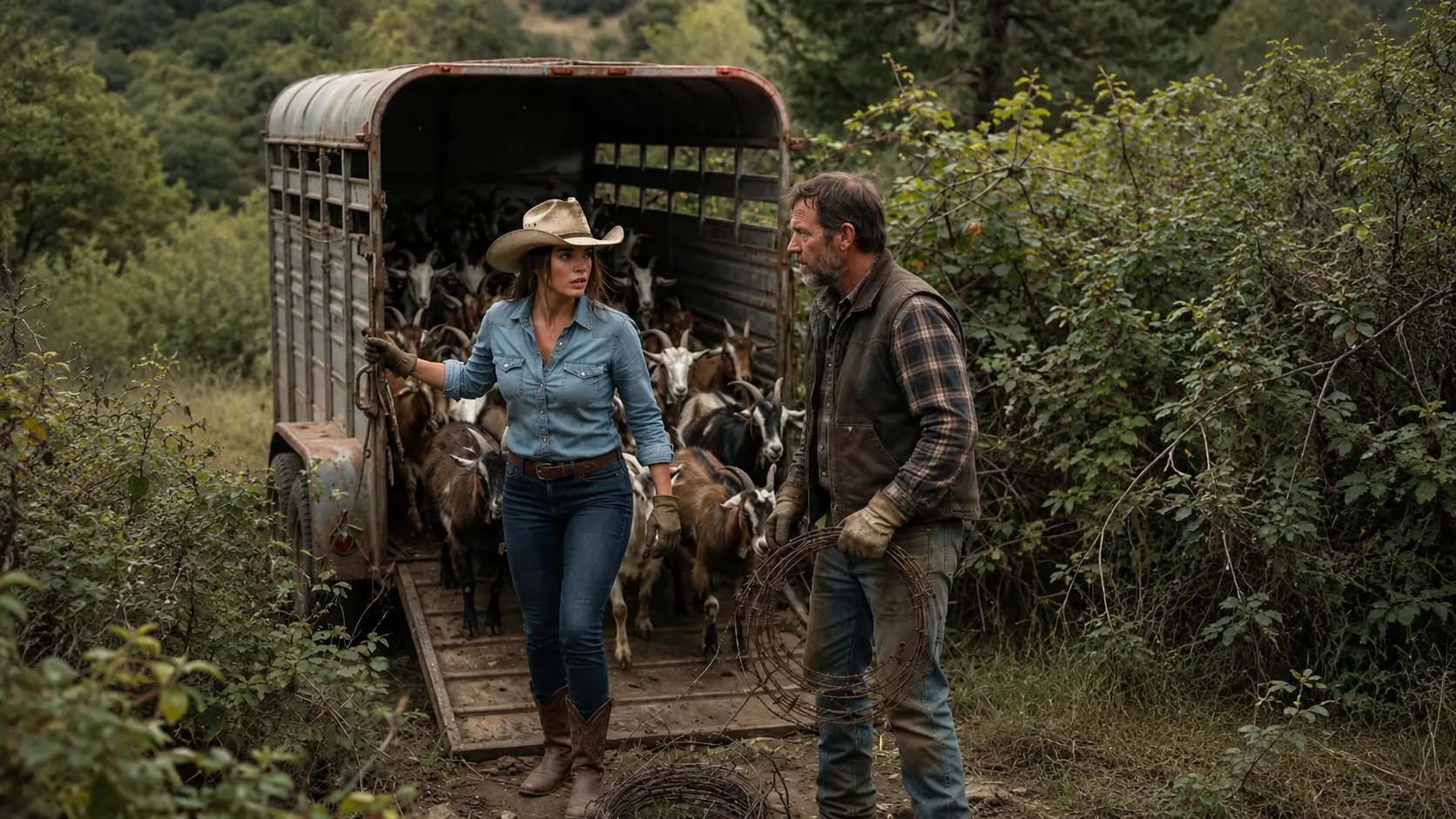
The auctioneer adjusted his spectacles and looked across the courthouse room.
“Opening bid?”
Nobody moved.
A rancher near the back coughed into his fist. Another man whispered something that made three people laugh. Everyone in the county knew the old Carson property, though few had seen more than the wall of vegetation surrounding its rusted gate.
“Any bid at all?” the auctioneer asked.
Margaret Hail raised her hand.
“I’ll take it.”
The room became quiet.
Margaret was twenty-nine, with sun-warmed fair skin, striking green eyes, and long dark-brown hair tucked beneath a cream cowboy hat. She wore a light-blue denim shirt, fitted jeans, and mud-stained boots, looking more prepared to mend a fence than purchase land at a courthouse auction. Several men turned toward her as though they had misheard.
The auctioneer blinked. “Opening bid accepted.”
No one countered.
Three taps of the gavel later, Margaret owned sixty-three acres that no one else wanted.
Outside the courthouse, Dale Harper caught up with her on the steps. He was a broad, weathered cattleman nearly twenty years older than Margaret, with a graying beard and the permanent squint of someone who distrusted any idea he had not invented himself.
“You actually bought that place?”
“I did.”
“There’s nothing there.”
Margaret folded the deed and slipped it into her jacket. “Then you won’t mind me owning it.”
Dale laughed. “You bought a forest without timber worth cutting. The soil is buried, the fences are gone, and the access road can barely fit a horse.”
“We’ll see.”
“I’m serious, Margaret. That parcel has gone through three tax auctions. Nobody touched it because clearing it would cost more than the land will ever be worth.”
She looked toward the distant hills. “Maybe everyone has been using the wrong equipment.”
Dale shook his head as she walked away.
The following morning, Margaret drove through the Carson gate with her younger brother Nathan beside her. Briars scraped both mirrors of the ranch truck, and young cedars crowded the old road so tightly that the branches dragged across the windshield.
Nathan leaned forward. “You bought a jungle.”
“Not for long.”
They stopped in a narrow opening where the brush rose above the truck hood. Nathan climbed out expecting to see a bulldozer, chainsaws, or an excavator following behind them.
Instead, Margaret unfolded a map.
“That’s it?” he asked.
“The equipment arrived yesterday.”
Nathan looked around. “I don’t see any equipment.”
Margaret pointed toward a weathered livestock trailer parked near the gate.
Inside stood 120 Spanish-and-Kiko-cross goats.
They pressed against the slatted sides, alert and hungry, already chewing anything close enough to reach. One small black-and-white doe had stretched her neck through an opening and was nibbling a vine growing beside the trailer.
Nathan smiled. “Of course.”
Their father, Samuel Hail, had taught them about managed grazing long before county officials began using the term. When Margaret was fourteen, she had followed him into a neglected pasture where blackberry vines and cedar saplings covered nearly every corner.
“We’ll have to clear all this,” she had said.
“Eventually.”
Samuel had knelt beside a thorny cane. “Do you know why brush wins?”
“Because nobody cuts it?”
“Because we keep removing the animals that used to eat it.”
Margaret had frowned. “What animals?”
“Goats.”
Fifteen years later, those words had returned to her while she studied the Carson auction file. The county saw sixty-three acres hidden beneath brush. Margaret saw sixty-three acres waiting for browsers.
By noon, portable electric netting enclosed the first paddock. Nathan checked the voltage while Margaret lowered the livestock ramp.
Before she could release the herd, a pickup rolled through the open gate.
Dale Harper stepped out carrying a coil of fencing wire.
“What are you doing here?” Margaret asked.
“Saving you some embarrassment.”
He dropped the wire beside her boots and looked into the trailer. “You’re really planning to clear this place with goats?”
“That’s why they’re here.”
Dale moved in front of the ramp. “You bought sixty-three acres of thorns and brought a herd that’ll scatter the first time a branch falls across that toy fence.”
Margaret stepped closer. “Move.”
“When this experiment ruins you, I’ll buy the property for pennies.”
“Then you should want me to begin.”
“You don’t know what you’re doing.”
Margaret’s green eyes hardened. “Touch my fence, Dale, and I’ll make sure you leave this land before they do.”
His mocking smile disappeared.
For several seconds, they stood almost chest to chest while the goats pushed restlessly behind Margaret. Nathan remained near the energizer, watching Dale’s hands.
Finally, Dale kicked the wire toward her.
“When they disappear into these hills, don’t ask me to help find them.”
Margaret grabbed the trailer latch. “Stand right there. When they clear that ridge, you’ll see what was buried beneath all your laughter.”
She pulled the gate open.
The goats surged down the ramp.
They ignored the grass entirely and rushed toward the blackberry vines, young cedars, poison ivy, wild grape, and honey locust saplings. Within minutes, leaves vanished beneath snapping teeth. Several goats rose onto their hind legs to reach higher branches, while others pushed beneath the thickets to strip vines from the ground upward.
Dale stared despite himself.
“They’ll never clear all of it,” he said.
Margaret watched a brown doe tear through a curtain of briars. “They don’t have to clear it all today.”
Dale returned to his truck without another word.
The first week produced little visible change from the road. The goats moved through small paddocks each evening, concentrating their browsing without remaining long enough to damage the recovering soil. Margaret checked their health twice daily, shifted the portable fencing, and marked each completed section on her map.
People in town began talking.
On Saturday morning, Margaret entered the county coffee shop carrying mineral blocks. Dale sat at the central table with several cattlemen.
“Well,” he called, “how’s the goat logging company?”
The room chuckled.
“They’re busy,” Margaret replied.
“You planning to clear all sixty-three acres before retirement?”
“They already started.”
A rancher named Rick Mason grinned. “Those goats will disappear before the land does.”
Margaret set the mineral blocks near the counter. “Come visit in a month.”
Dale folded his newspaper. “I’ve already seen enough.”
“No,” she said. “You’ve only seen what’s on top.”
The second week changed the land.
Blackberry canes stood stripped bare. Young cedars looked like brown skeletons. Sunlight reached patches of soil that had remained shaded for decades, and green shoots appeared beneath the dead vines.
Nathan walked through the first completed paddock holding a cedar branch.
“I didn’t think they’d eat this.”
“They’re browsers.”
“They barely touched the grass.”
“They eat dessert first.”
By the end of the month, the old ranch road had widened enough for the truck to pass without scraping its mirrors. Rotting fence posts emerged from the vegetation, and a line of flat stones appeared along the edge of a hillside.
Margaret knelt beside them.
The stones were hand-cut limestone, arranged too evenly to be natural. Moss covered their surfaces, but the line continued downhill beneath the remaining brush.
“Foundation?” Nathan asked.
“Maybe.”
They marked the location and moved the goats around it.
News of the transformation reached the county extension office. A grazing specialist named Paul Whitaker arrived in early summer expecting to inspect damaged soil and overbrowsed ground.
Instead, he found native grasses rising beneath the stripped brush.
He knelt and separated the new blades with his fingers. Small wildflowers grew among them, and several young oak seedlings stood where cedar shade had once blocked the sun.
“I wasn’t expecting this,” he admitted.
Margaret folded her arms. “What were you expecting?”
“Dead ground.”
“The goats didn’t destroy the grass.”
“No. They exposed it.”
Paul stood and looked across the paddock. “The seed bank was waiting beneath all that brush.”
Nathan glanced around in amazement. “So this was always here?”
“The land didn’t forget what it was,” Paul said. “It just couldn’t breathe.”
The project continued through summer.
Every week revealed another forgotten part of the property. Stone boundary markers emerged. Rusted wagon hardware appeared beside an old trail. A split-rail fence, collapsed but still recognizable, surfaced beneath a mass of grapevine.
Then the goats cleared a hillside covered in blackberry thickets.
Behind the vines stood seven old apple trees.
Their trunks were twisted and hollow in places, but green leaves still clung to the branches. Several trees carried small, sharp-smelling fruit.
Nathan reached up and picked one.
“I didn’t know these were here.”
“Neither did anyone else.”
Margaret bit into the apple. It was sour enough to tighten her jaw, but the flavor was strong and alive.
She smiled. “They’re still producing.”
The discovery attracted Edwin Shaw, the county historian. He arrived with faded aerial photographs rolled beneath one arm and walked among the trees with the excitement of a man entering a cathedral.
“This was the Carson orchard,” he said.
“There was a homestead?” Margaret asked.
“A house, a barn, a smokehouse, and a spring house.”
He unfolded one of the maps across the hood of her truck.
A cluster of hand-drawn structures occupied the southern slope. The orchard stood exactly where the goats had uncovered it. A narrow line ran from the buildings toward an unlabeled circle near the ridge.
“What’s that?” Nathan asked.
Edwin adjusted his glasses. “Possibly a well.”
“Where?”
He looked toward the brush-covered hill.
“That is the problem. Nobody remembers.”
By early autumn, the goats had cleared nearly forty acres.
Open pasture rolled across hills that had been hidden for decades. Quail returned to the recovering grasses. Wild turkeys moved through the orchard, and deer began feeding along the edges of the paddocks.
Dale Harper drove onto the property one evening.
Margaret found him standing beside the first field, staring silently at the land.
“I thought you’d already seen enough,” she said.
Dale did not respond immediately. The mockery had left his face.
“I would have sworn this place was ruined forever.”
“So did everyone else.”
He pointed toward the orchard. “You knew those trees were there?”
“No.”
“The county file never mentioned them.”
“The county file was written by people who never walked farther than the gate.”
Dale looked over the open hillside. “How much pasture have you recovered?”
“Forty acres so far.”
“That land could carry cattle.”
“Eventually.”
“You planning to sell?”
“No.”
“I’ll give you twice what you paid.”
Margaret smiled. “You said it was worthless.”
“I was wrong.”
“You weren’t wrong about the land. You were wrong about what neglect means.”
Dale’s expression hardened again. “Don’t become arrogant because some goats ate a few bushes.”
“Don’t become generous only after you see profit.”
He returned to his truck, embarrassed by the answer.
The following morning, Nathan climbed the southern ridge carrying two cups of coffee. The goats had entered a fresh paddock the previous evening, stripping leaves from a dense circle of briars.
Something gray showed beneath them.
At first, Nathan thought it was another foundation. Then he saw the curve.
“Maggie!”
Margaret hurried uphill.
A perfect ring of limestone emerged from the vegetation. Only the top edge was exposed, but each block had been cut and fitted by hand. Margaret brushed away leaves and loose soil.
The opening continued downward into darkness.
Cool air drifted upward.
Nathan crouched beside her. “Is that what I think it is?”
Margaret leaned closer.
Far below, she heard a faint sound.
Water.
“I think we found the well.”
Neither spoke for several seconds.
A truck approached along the newly uncovered road. Edwin Shaw stepped out carrying another rolled map. When he reached the stone circle, he stopped completely.
His eyes widened.
“You found it.”
“How old is it?” Margaret asked.
The historian brushed moss from the limestone. “Older than the Carson homestead, possibly. This style of hand-cut construction was common before modern drilling equipment.”
“How much older?”
“It could easily be more than 150 years.”
Nathan looked into the darkness. “Is there still water?”
Edwin smiled. “That sound says there is.”
The next morning, a county well contractor lowered an inspection light into the opening. The beam descended thirty feet, then forty, then fifty.
At last, it reflected from clear water.
“Nearly twenty feet deep,” the contractor said. “It never went dry.”
Margaret looked toward the brush-covered slope.
“So everyone forgot it.”
“That doesn’t mean it stopped working.”
The discovery spread rapidly.
By afternoon, trucks lined the old ranch road. County officials, neighboring landowners, and curious families came to see the limestone well the goats had uncovered. Some congratulated Margaret. Others examined the land with the sudden interest of people who regretted not bidding.
Dale arrived last.
He pushed through the crowd and stared into the restored opening.
“You knew this was here,” he accused.
Margaret turned toward him. “I bought the same county file everyone else saw.”
“You had inside information.”
Nathan stepped between them. “Watch yourself.”
Dale ignored him. “Nobody spends money on sixty-three useless acres without knowing there’s water beneath them.”
Margaret moved closer until only the stone well separated them.
“You laughed when I bought it.”
“Because the file described worthless brush.”
“And now you want the purchase invalidated because the land proved you wrong?”
Dale’s jaw tightened. “Undisclosed water rights could affect the sale.”
Edwin Shaw spoke from beside the contractor. “The well appears on maps more than a century old. Those documents were available in the public archive.”
Dale glanced at him.
“You could have found them,” Edwin continued, “if you had believed the property was worth researching.”
A few visitors began whispering.
Dale lowered his voice. “Sell me the northern forty acres.”
“No.”
“I’ll pay four times your auction price.”
“No.”
“You don’t have enough cattle to use all this pasture.”
“I have enough patience.”
His face darkened. “This county will bury you in permits before you draw one gallon.”
Margaret’s voice became cold. “Then stand beside the clerk who signs them and explain why you suddenly care about land you called worthless.”
Dale stepped forward, but Nathan blocked him.
For a moment, it appeared the two men might fight.
Margaret raised one hand. “Let him go.”
Dale pointed toward the well. “You think this makes you important?”
“No. It makes the land important.”
“You’ll lose it before you understand what you found.”
Margaret stared at him. “Try taking it, and you’ll learn how hard a woman fights for something everyone else abandoned.”
Dale left beneath the eyes of the entire crowd.
Margaret refused to rush the restoration.
Workers repaired the limestone wall one block at a time, returning each stone to its original position. The goats continued clearing the surrounding hillside while Edwin searched county archives for more information about the homestead.
Several weeks later, he arrived carrying another map.
“The well served more than the house,” he said.
A narrow channel had once carried water downhill toward the orchard. Most of it remained buried beneath briars, but the line could still be followed by unusually green grass.
Margaret and Nathan placed the goats in that paddock.
Within days, the thicket disappeared.
Beneath it lay a shallow stone water race extending nearly three hundred yards toward the apple trees. Before electric pumps, gravity had carried water from the well across the property.
A water specialist measured the depth, recharge rate, and quality.
“Have you pumped anything yet?” he asked.
“Not one gallon.”
“Why?”
“I wanted to understand it before using it.”
He nodded approvingly. “Most people reverse that.”
That summer brought unusually dry weather.
Pastures across the county turned brown. Dale Harper began hauling water to his cattle twice each week, while Margaret’s recovered acreage remained greener than anyone expected. Without dense cedar and thorn growth, rainfall reached the soil instead of being trapped in leaves and shallow roots.
The restored well supplied a livestock trough through a gravity-fed pipe.
No diesel pump.
No electricity.
Clear water flowed downhill exactly as it had more than a century earlier.
The goats had already repaid much of their cost through brush control. Now the pasture carried nearly three times the grazing capacity predicted by the county file.
Dale returned in August.
He stopped beside the trough and watched water spill steadily into it.
“My south pond is almost dry,” he said.
Margaret waited.
“I need water for forty head.”
Months earlier, he had threatened to buy her land after she failed. Now dust covered his truck, and exhaustion lined his face.
Nathan stood near the barn, clearly expecting Margaret to refuse.
She looked toward Dale’s cattle trailer.
“You can fill your tanks here.”
He blinked. “What?”
“Bring them after sunset when it’s cooler. Stay on the marked road.”
“You’d let me take water?”
“The cattle didn’t laugh at me.”
Dale lowered his eyes.
“I was wrong about you,” he admitted.
“You were wrong about the land.”
“That too.”
Margaret stepped closer. “But if I find one cut fence, one missing marker, or one county complaint filed behind my back, the water stops.”
“You have my word.”
“I’ll trust your actions.”
Dale nodded.
The drought broke several weeks later, but the relationship between the neighboring ranches had changed. Dale never became gentle, and Margaret never forgot his threats. Yet he began sending workers when a fence required repair, and he publicly corrected anyone who described the Carson parcel as a foolish purchase.
That autumn, the county conservation district organized a field day on the property.
More than two hundred landowners arrived to study rotational goat grazing, native-grass recovery, erosion control, and the restored homestead. University students mapped returning plants, while bird specialists documented quail nesting among the bunch grasses.
Margaret led the visitors toward the limestone well.
Fresh flowers grew around its restored wall. A handcrafted wooden roof protected the opening, and clear water shimmered far below.
A young farmer raised his hand.
“What was the greatest thing you discovered?”
Several visitors looked toward the well.
Margaret smiled. “The well wasn’t.”
They appeared confused.
She pointed toward the open hills.
“The grass was.”
Silence settled over the group.
“The land already knew how to heal,” she continued. “It only needed someone to remove what was keeping the sunlight away.”
The goats grazed quietly beyond the crowd.
Months later, the state agricultural department honored Hail Ranch for its managed-brush restoration project. Researchers returned each spring to document native plants, healthier soil, returning wildlife, and reduced erosion.
The orchard produced its largest apple crop in decades.
Edwin Shaw eventually gave Margaret a small framed photograph. It showed children filling wooden buckets beside the same limestone well more than a century earlier.
On the back, someone had written:
Carson Well—Summer of 1894.
Margaret placed the photograph inside the restored spring house.
By the second autumn, the property had become one of the most productive grazing areas on Hail Ranch. Visitors admired the orchard, the stonework, and the water system that functioned without a single electric pump.
Dale joined Margaret beside the well one evening as the goats moved across a distant ridge.
“I remember standing outside that courthouse,” he said.
“You told me there was nothing here.”
“I believed it.”
Margaret watched the sunlight move across the restored pasture. “That was the problem.”
“What was?”
“Everyone believed what neglect made the land look like.”
Dale nodded toward the goats. “And you saw something different?”
“I saw sunlight waiting to reach the ground.”
The abandoned property had contained no buried gold or secret fortune. Its treasure was older and quieter: living soil, native grass, an orchard that had refused to die, and a well that continued holding water long after everyone forgot its name.
The county had offered sixty-three overgrown acres nobody wanted.
Margaret Hail had brought 120 hungry goats and enough patience to look beneath the thorns.
And when the brush finally disappeared, the land proved it had never been worthless.
It had only been waiting for someone who knew the difference between ruined and hidden.