The men in the mill doorway laughed while Emma Whitaker drove her pitchfork into another mountain of corn husks. Dry leaves snapped beneath her boots, pale-gold fragments clinging to her red plaid shirt and wind-tangled brown hair. Behind her, the battered blue pickup sagged beneath a load so large that the rear suspension nearly touched the tires. To everyone watching, she looked like a desperate young woman filling her last working truck with garbage.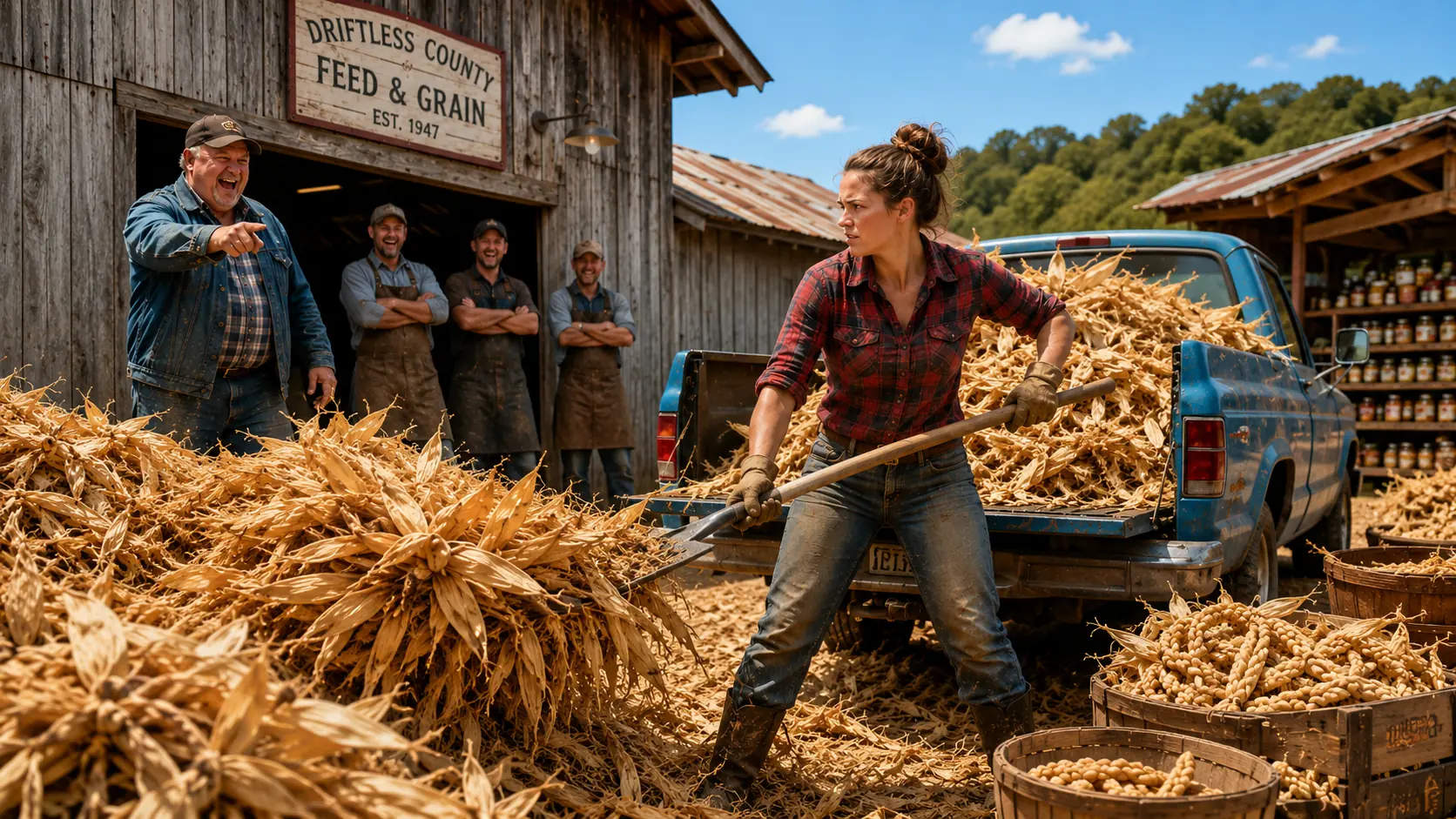
The loudest man was Wade Hollis, the fifty-three-year-old owner of Driftless County Feed and Grain. He stood outside the weathered building with one hand resting on his heavy stomach and the other pointing at Emma as though she were part of the afternoon’s entertainment. Three older mill workers in stained aprons stood behind him, laughing because their employer was laughing. None of them believed the twenty-five-year-old farm woman would remain on her grandmother’s land past winter.
Emma had inherited eighteen acres, a leaking farmhouse, two goats, eleven laying hens, and a debt large enough to keep her awake until dawn. Her grandmother, Verlene, had mortgaged the back portion of the property after a failed harvest and three years of medical bills. When Verlene died in May, the bank gave Emma eleven months to make the note current. Everyone in the county assumed she would sell before the deadline.
Wade knew the situation because nearly everyone did.
“You should spend your time finding a buyer,” he said. “Not hauling home something even the landfill doesn’t want.”
Emma lifted another forkful and threw it into the truck bed.
“How much do you pay to dump this?”
Wade’s laughter weakened. “Forty dollars a week.”
“Then I’m already saving you money.”
“You’re saving me forty dollars and destroying your truck.”
“That truck has survived worse men than you.”
The workers laughed again, but this time not entirely at Emma.
Wade’s expression tightened. “Take one load. After that, the hauling company returns Tuesday.”
Emma planted the pitchfork upright in the husks. “I want every load.”
“You couldn’t move half of what we throw out.”
“I’ll decide what I can move.”
“And when it starts rotting?”
“I’ll have used it.”
Wade looked toward the overflowing waste bins behind the shelling shed. Each week, the mill produced thousands of pounds of husks, leaves, broken cobs, and dry fibers. The material had no value in his books. It occupied space, attracted moisture, and cost money to haul away.
He extended a grease-stained hand. “Free removal. No liability. No complaints if you ruin your soil, poison your goats, or bury yourself alive.”
Emma shook his hand.
“Put it in writing.”
Wade laughed again. “You think this is a business deal?”
“It became one the moment you saved forty dollars.”
Three hours later, Emma drove away with the pickup bed stacked higher than the cab and a handwritten agreement folded inside her pocket. Wade watched the truck disappear along the county road, convinced he had found a foolish woman willing to perform his disposal work for nothing. He had no idea that Verlene Whitaker had stood in the same mill yard forty-five years earlier and made almost the same arrangement.
Emma discovered that history three nights later.
Rain hammered the farmhouse roof while she searched through her grandmother’s roll-top desk for old tax receipts. The lower drawer remained tied shut with a brittle rubber band, exactly as it had throughout Emma’s childhood. Verlene had once caught her attempting to open it and said only, “Not that one.” The quiet warning had been enough to keep Emma away for seventeen years.
Now the house belonged to her.
She cut the rubber band.
Inside the drawer rested a faded county map, a cigar box, and a small corn-husk doll with a braided neck and a skirt delicate enough to crumble beneath careless fingers. Beneath those items lay a notebook filled with Verlene’s careful handwriting. The first entry was dated October 4, 1978.
Went to Hollis Mill. Delbert laughed when I asked for husks. Told me to take all I wanted because nobody could use the mess. Filled the truck twice.
Emma read the sentence three times.
Wade’s grandfather had owned the mill then.
She turned the page.
Verlene had soaked whole husks in water, sorted them by length, and braided them into mats, packing material, baskets, and dolls. She sold the finished pieces through a farm cooperative, earning small amounts that eventually became enough to cover a tractor payment during a brutal winter. Every page contained measurements, drying times, failures, prices, and observations written with the seriousness of scientific work.
One sentence had been underlined twice:
Waste is usually something nobody has learned to value yet.
Emma carried the notebook into the kitchen and remained there until after midnight.
She had spent the previous months believing she inherited only debts and worn-out land. The notebook showed that Verlene had also left her a process, a marketable skill, and an unfinished idea. The husks piled inside the barn were not random trash.
They were raw material.
The following morning, Emma dragged two livestock troughs behind the barn and filled them with water. She separated the widest intact husks from narrow pieces and torn fibers. The whole leaves went into one trough beneath a concrete block, while damaged material went into another for testing as packing filler.
Her first attempt at braiding failed.
The wet fibers slipped apart, twisted unevenly, and dried into a warped strip that looked nothing like the mats pictured in Verlene’s notebook. Emma tried again and produced something worse. By sunset, her fingers were blistered, and the barn floor was covered with useless knots.
She nearly threw everything into the compost pile.
Then she reread a note written in the margin:
Patience before speed. If the braid fights you, the husk is too dry or your hands are too angry.
Emma stared at the sentence.
Her grandmother had anticipated frustration decades before Emma was born.
She soaked another bundle, waited until the fibers softened, and began again. This time she moved slowly. Three strands crossed, tightened, and held.
By midnight, she had completed one crooked mat.
It was not beautiful.
It was proof.
Emma placed the mat beside the produce stand the following Saturday with a handwritten price of twelve dollars. She expected curiosity but not a sale. An elderly woman named Margaret Ellis picked it up, studied the braid, and asked who had taught her.
“My grandmother’s notebook.”
“Verlene made these.”
“You knew her work?”
Margaret ran one finger across the fibers. “Half this county did.”
She purchased the mat and ordered two more.
By noon, three other customers had asked whether Emma could make table runners, baskets, or harvest decorations. One woman wanted husk dolls for a church fundraiser. Another asked whether the torn material could replace plastic filler in gift boxes.
Emma wrote every request inside a new notebook.
That evening, she calculated costs at the kitchen table. The raw material was free. Water, drying space, twine, labels, and labor carried expenses, but the potential margins were far better than selling vegetables at the roadside stand. More importantly, the supply renewed itself every week.
She returned to the mill Tuesday afternoon.
Wade stood near the loading shed with his arms folded.
“Back already?”
“You promised every load.”
“I thought you’d learn after the first.”
“I did.”
“What did you learn?”
“That the wide leaves braid better, so your men need to stop crushing them beneath the cobs.”
Wade stared at her. “My men don’t work for you.”
“No. But I’m removing the material for free, which means sorting saves both of us time.”
“You’re making demands over garbage?”
“I’m establishing quality standards.”
One worker laughed, but Wade did not.
“What are you doing with it?”
“Selling it.”
His face changed. “You found buyers?”
“Enough to return.”
Wade walked toward the pickup and examined several braided samples inside a wooden crate. Emma had made small mats, rope, and rough packaging cushions. The work remained imperfect, but it no longer resembled waste.
“You made these from our husks?”
“My husks. You signed them over.”
Wade picked up a braided cord. “Nobody will pay real money for this.”
“Then you won’t mind giving me the material.”
He dropped the cord back into the crate. “Take it.”
For the next two months, Emma collected husks every Tuesday and Friday. She transformed the barn into a sorting and drying area, hanging intact leaves from wire lines and stacking graded bundles inside wooden crates. She repaired an old wood stove to control moisture during cold weather and built simple pressing frames from discarded boards.
The work consumed almost every waking hour.
Emma fed the animals before dawn, loaded husks at the mill, braided until her hands cramped, and sold products at weekend markets. Some batches molded because she stored them too wet. Others became brittle after excessive drying.
She recorded every mistake.
By November, her products looked professional enough to enter a regional holiday craft fair. She paid the forty-dollar booth fee using money reserved for the electric bill. If the fair failed, she would have to ask the utility company for more time.
The night before the event, she packed thirty-two mats, seventeen baskets, forty husk dolls, and several bundles of biodegradable packing fiber into her pickup. Snow began falling before sunrise, covering the county road in a thin white layer. Emma drove slowly, heater barely functioning, terrified that nobody would attend.
Customers arrived anyway.
The dolls sold first.
Parents liked that each one was handmade and slightly different. Older customers remembered versions from their childhoods. Younger shoppers responded to the reclaimed agricultural material and the story of a farm turning mill waste into useful products.
A gift-shop owner purchased every remaining basket.
Before leaving, she asked Emma whether she could supply two hundred pieces by spring.
Emma thought she had misunderstood.
“Two hundred?”
“Possibly more if they sell.”
“I can do that.”
“Do you have wholesale pricing?”
“I will tomorrow.”
The fair earned Emma twelve hundred dollars in one weekend.
It was more than her produce stand made during the previous two months.
She returned home, placed the cash on the kitchen table, and opened Verlene’s notebook. On the final written page, her grandmother had added another line:
The first dollar proves somebody wants it. The next hundred prove you must learn to deliver.
Emma smiled until tears blurred the words.
The business grew through winter.
She named it Whitaker Huskworks and created simple tags explaining that every product was made from agricultural material diverted from disposal. A local print shop allowed her to pay for labels in installments. Margaret Ellis introduced her to the historical society, which invited Emma to demonstrate traditional braiding techniques.
Orders came from gift stores, wedding planners, and regional food companies seeking biodegradable packaging.
The torn husks became as valuable as the intact ones.
Emma shredded, dried, and compressed them into cushioning material for jars, candles, and fragile products. Tests showed the fibers protected glass better than loose paper and created less waste than plastic fill. A local honey producer placed the first commercial packaging order.
Emma needed more material.
She drove to the mill and found Wade reviewing invoices inside the loading office.
“I need your full weekly output.”
He looked up. “You already take half.”
“The hauling company takes what I cannot fit.”
“That is correct.”
“Cancel them.”
Wade laughed. “You expect me to depend on one woman with an old pickup?”
“I’ll bring a trailer.”
“You don’t own one.”
“I will Friday.”
“With what money?”
“My customers’.”
Wade leaned back. “You’re getting ambitious.”
“I’m getting orders.”
He studied the sales agreement she placed on his desk. It guaranteed that Emma would remove the husks twice weekly at no cost to the mill. In exchange, Wade would give her first access to all usable material for one year.
“You want exclusivity?”
“I want reliability.”
“And what happens when this little trend ends?”
“The same thing that happens if it grows. I keep working.”
Wade shook his head. “No contract.”
Emma folded the papers. “Then I’ll approach the mill in Grant County.”
His smile disappeared.
“That’s forty miles away.”
“They produce cleaner husks.”
“You inspected them?”
“Yesterday.”
Wade stood. “You went to my competitor?”
“You refused certainty. They offered it.”
The mill owner walked around the desk, anger building in his face. “I let you take material nobody else wanted.”
“And I saved you disposal fees for five months.”
“You would have nothing without this mill.”
“You would still be paying to bury something I turned into inventory.”
Wade stepped close enough that Emma could smell coffee on his breath. “Do not forget whose yard you walked into begging.”
Emma held his stare. “Do not forget who stopped begging.”
She left with the contract.
Wade called before sunset.
He signed.
By spring, Whitaker Huskworks employed four women from the county. Two were farm wives seeking additional income during slow months. One was a retired teacher. The fourth, Lena Brooks, had lost her factory job and needed hours that allowed her to care for her disabled father.
Emma trained them using Verlene’s notebook.
Three strands. Wet husk. Patience before speed.
The bank noticed the deposits.
Unfortunately, it also noticed the remaining debt.
The loan officer, Charles Danner, visited the farm in March wearing polished shoes inappropriate for the mud. He looked through the barn at hanging husks, worktables, packing crates, and employees braiding products.
“This appears active,” he said.
“It is a business.”
“That is not what I meant.”
Emma knew exactly what he meant. He had previously called her decision to keep the farm emotional rather than financial. Now he was searching for a way to describe success without admitting he had misjudged her.
“The note comes due in six weeks,” he said.
“I know.”
“You remain thirty-eight thousand dollars short.”
“I have pending wholesale invoices.”
“Pending income is not cash.”
“I have signed orders.”
“The bank cannot extend a loan based on seasonal crafts.”
Emma placed a file on the table. “These are purchase agreements from nine retailers, two packaging clients, and a regional home-goods distributor.”
Charles glanced at the pages but did not read them carefully. “The property remains more valuable than the business.”
“To the bank.”
“To any rational buyer.”
Emma’s employees stopped working.
Charles noticed their attention and lowered his voice. “Sell now, before the bank forces the matter.”
Emma stepped closer. “You will receive every dollar before the deadline.”
“If you do not?”
“Then come with the sheriff.”
He left without shaking her hand.
The threat spread through town by the following morning.
Someone at the bank told someone at the feed store, and by noon, people were discussing whether Emma would lose the farm. Wade heard the story and arrived during the Friday husk delivery with an expression too pleased to be sympathetic.
“I warned you,” he said.
“You predicted rotting husks.”
“I predicted failure.”
“You’re early.”
“The bank doesn’t bluff.”
“Neither do I.”
Wade pointed toward the workers. “When the farm goes, where does your little factory operate?”
Emma tightened the strap securing the husk bundles. “Here.”
“You need thirty-eight thousand dollars in six weeks.”
“I know.”
“You’ll never earn it braiding decorations.”
Emma looked at the loaded trailer. “These decorations saved your mill more than two thousand dollars in hauling fees this year.”
“That is not thirty-eight thousand.”
“No. But I’m not finished.”
The opportunity arrived eleven days later.
A packaging company in Madison contacted Emma after receiving a shipment cushioned with her shredded husk fiber. The company supplied eco-friendly packaging to regional food and cosmetics brands. Its purchasing director wanted samples, pricing, and proof that Emma could deliver consistent volume.
Emma drove through a spring storm to attend the meeting.
She brought compression tests, moisture records, contamination controls, and a sealed box containing glass jars protected entirely by processed husks. The executives expected a farmer with a craft operation. They found a woman who understood every step from mill waste to finished packaging.
The company offered a one-year contract worth ninety-six thousand dollars.
There was one condition.
Emma had to guarantee a stable husk supply.
She called Wade from the parking lot.
“I need a five-year agreement.”
He laughed. “You have one year.”
“I have a buyer requiring five.”
“What buyer?”
“One big enough to replace your hauling company permanently.”
Wade became quiet.
“How much material?”
“All of it.”
“That includes twenty-two tons during peak season.”
“I know.”
“You cannot process that.”
“I’m leasing equipment.”
“You don’t have capital.”
“I will after the contract.”
Wade recognized the leverage immediately. If he refused, Emma could secure supply elsewhere and leave him paying disposal costs again. If he agreed, the mill gained a public recycling partnership and predictable removal.
“What do I receive?”
“Free collection, quarterly diversion reports, and public credit as the source mill.”
“I want a percentage.”
“You already receive savings.”
“I want five percent.”
“You want ownership of value you called garbage.”
“I own the source.”
“You own corn processing. The farmers own the corn. You discard the husks.”
Wade’s voice hardened. “Three percent.”
“Zero.”
“Then find another mill.”
“I already did.”
Silence followed.
Emma continued, “They offered me seven years.”
Wade swore softly.
“You came to me first,” he said.
“My grandmother came to your grandfather first. Neither of you understood what she saw.”
“What do you want?”
“Five years. Exclusive access. No fee. No interruption without six months’ notice.”
“You negotiate like a thief.”
“No. Thieves take value without permission. I asked twice.”
Wade signed three days later.
The packaging contract allowed Emma to secure short-term financing against confirmed orders. She purchased a used shredder, drying unit, and compression press. The barn became a small manufacturing facility operating twelve hours a day.
The first major shipment left the farm two weeks before the bank deadline.
Payment arrived four days later.
Emma walked into Driftless Community Bank carrying a cashier’s check for the entire outstanding balance. Charles Danner stared at the amount, then at her mud-stained boots.
“You paid it off?”
“I said I would.”
“Where did this come from?”
“The seasonal crafts.”
He looked at her without speaking.
Emma slid the loan documents across the desk. “Release the lien.”
Charles signed.
When she returned to the farm, her employees had gathered outside the barn. Lena held a cake from the grocery store with PAID IN FULL written across the top in crooked blue icing.
Emma laughed, then cried so hard she could not speak.
They celebrated for twenty minutes.
Then the afternoon truck arrived, and everyone returned to work.
Whitaker Huskworks expanded rapidly over the next three years. The company supplied biodegradable filler, braided protective sleeves, decorative mats, baskets, and seasonal products to more than forty businesses. Emma leased six additional acres for drying and storage, restored the farmhouse roof, and rebuilt the barn’s electrical system.
She also began teaching free Saturday workshops.
Women from across the county learned the braiding method Verlene had preserved. Some worked for Emma. Others developed their own products using stalk fiber, straw, wool scraps, or orchard waste.
Emma shared her mistakes as openly as her successes.
“Mold comes from rushing,” she told every class. “Broken supply chains come from trusting promises instead of contracts. And bad prices come from being too grateful someone finally noticed you.”
Wade attended one workshop without announcing himself.
He stood in the back while Emma demonstrated how to soften, grade, and braid the husks. His mother had used similar techniques when he was a child, though he had not thought about them for decades.
After the class, he approached the worktable.
“My mother kept two barrels near our kitchen door,” he said. “One marked with chalk.”
“The good husks?”
He nodded. “My father used the rest for kindling.”
Emma handed him a finished braid.
“She knew their value.”
“I suppose she did.”
“You could have asked her.”
“I was thirteen when she died.”
The answer softened something in Emma.
Wade looked around at the busy barn. “I owe you an apology.”
“For laughing?”
“For thinking usefulness had to look familiar before it counted.”
Emma studied him.
“That sounds rehearsed.”
“I practiced in the truck.”
She smiled slightly. “Accepted.”
Their relationship did not become friendship, but it became honest. Wade improved handling procedures at the mill, separated clean husks from contaminated waste, and built a covered storage area to protect Emma’s supply.
Five years after he told her the material would rot inside her truck, Wade arrived at the farm carrying a formal proposal.
A larger grain company wanted to purchase his mill. The buyer planned to end the husk agreement and return to bulk disposal because its executives considered sorting inefficient. Wade could not block the sale without demonstrating that the partnership generated measurable value.
“I need your contract,” he said.
Emma looked up from an order sheet. “You already have one.”
“I need a new one. Ten years. Publicly announced.”
“Why?”
“Because the buyer values environmental contracts.”
She leaned back. “Your mill is begging for my agreement.”
Wade exhaled. “Yes.”
The sentence carried the weight of every laugh from that first afternoon.
Emma opened a blank document.
“My terms changed.”
“I expected that.”
“Your mill covers loading equipment, weatherproof storage, and quality sorting.”
Wade nodded.
“You pay Whitaker Huskworks for verified landfill savings above the current baseline.”
His eyes widened. “You want a portion of my savings?”
“You wanted a portion of my sales.”
He almost argued.
Then he remembered.
“What percentage?”
“Twenty.”
“Ten.”
“Eighteen.”
“Twelve.”
“Fifteen, with a ten-year guarantee.”
Wade extended his hand.
“Done.”
The announcement appeared in regional newspapers as an agricultural waste-reduction partnership. The grain company completed its purchase, retained Wade as plant manager, and invested in equipment that made husk collection faster and cleaner.
Whitaker Huskworks became one of its official sustainability partners.
Emma kept Wade’s original handwritten agreement framed in her office. The page contained grease stains, uneven lettering, and the sentence confirming she could remove whatever husks she could carry at no cost.
Beside it hung Verlene’s notebook.
Visitors often asked which document started the company.
Emma always pointed to the notebook first.
The business did not begin when Wade laughed or when the packaging company called. It began decades earlier when a farm woman with little money refused to accept that a discarded material possessed no purpose.
Verlene built the first pathway quietly.
Emma expanded it.
By her thirty-first birthday, Emma owned the farm free of debt, employed eighteen people, and purchased husks from three additional mills. She no longer drove the old blue pickup for commercial collections, though she kept it restored beside the barn.
Its tailgate still carried scratches from the first overloaded shipment.
One Tuesday morning, Emma found a teenage girl standing near the worktables after a school tour. The student held a torn husk and looked embarrassed.
“Can this piece still be used?”
Emma took it from her.
“Not for braiding.”
The girl looked disappointed.
Emma placed it inside the fiber bin.
“But beauty isn’t the only kind of value.”
Outside, trucks unloaded another week’s supply. Workers sorted the material by length, color, moisture, and strength. Nothing usable went to the landfill.
Wade’s mill no longer paid forty dollars each week to bury its husks.
It paid Emma for the privilege of guaranteeing where they went.
The men who once laughed from the doorway stopped laughing years earlier. Some later applied for seasonal work at Whitaker Huskworks. Emma hired those who respected the process and rejected those who believed they were doing her a favor.
Her grandmother’s words remained painted above the main workbench:
WASTE IS A CHOICE, NOT A FACT.
Emma had never transformed corn husks into gold.
She had done something more difficult.
She identified value before anyone else could see it, built a system capable of preserving that value, and refused to surrender ownership when powerful men finally noticed.
The mill owner said the trash would rot and take her farm with it.
Instead, the husks saved the land, paid the debt, employed the county, and created a contract the mill could no longer afford to lose.
Wade had once pointed at Emma while everyone laughed.
Years later, he stood inside her barn with his hand extended, waiting for her signature.