The hatchery tanker backed toward Marguerite Wooten’s pond on a bright Arkansas morning and opened its rear valve without waiting for permission. Thousands of silver fingerlings poured through the wide pipe, striking the water in a glittering stream that made the entire surface boil with movement. Five hatchery workers stood nearby with stunned expressions, staring at the pond, the refrigerated coolers, and the restaurant invoices stacked beside Marguerite’s boots. Roy Padgett stepped from his truck already angry, because he had finally understood that the fish he discarded had made the young widow richer than his hatchery.
Marguerite was thirty-one, with sun-touched fair skin, green eyes, and chestnut-brown hair tied beneath a faded olive work cap. She wore a sage-green farm jacket over a blue plaid shirt, dark jeans, and rubber boots coated with pond-bank mud. Four years earlier, nearly everyone in Lonoke County had quietly pitied her for inheriting an aging farm with an eleven-acre pond that produced no dependable income. Now chefs drove from Little Rock with coolers and checks, asking for fish Roy’s commercial customers once refused to buy.
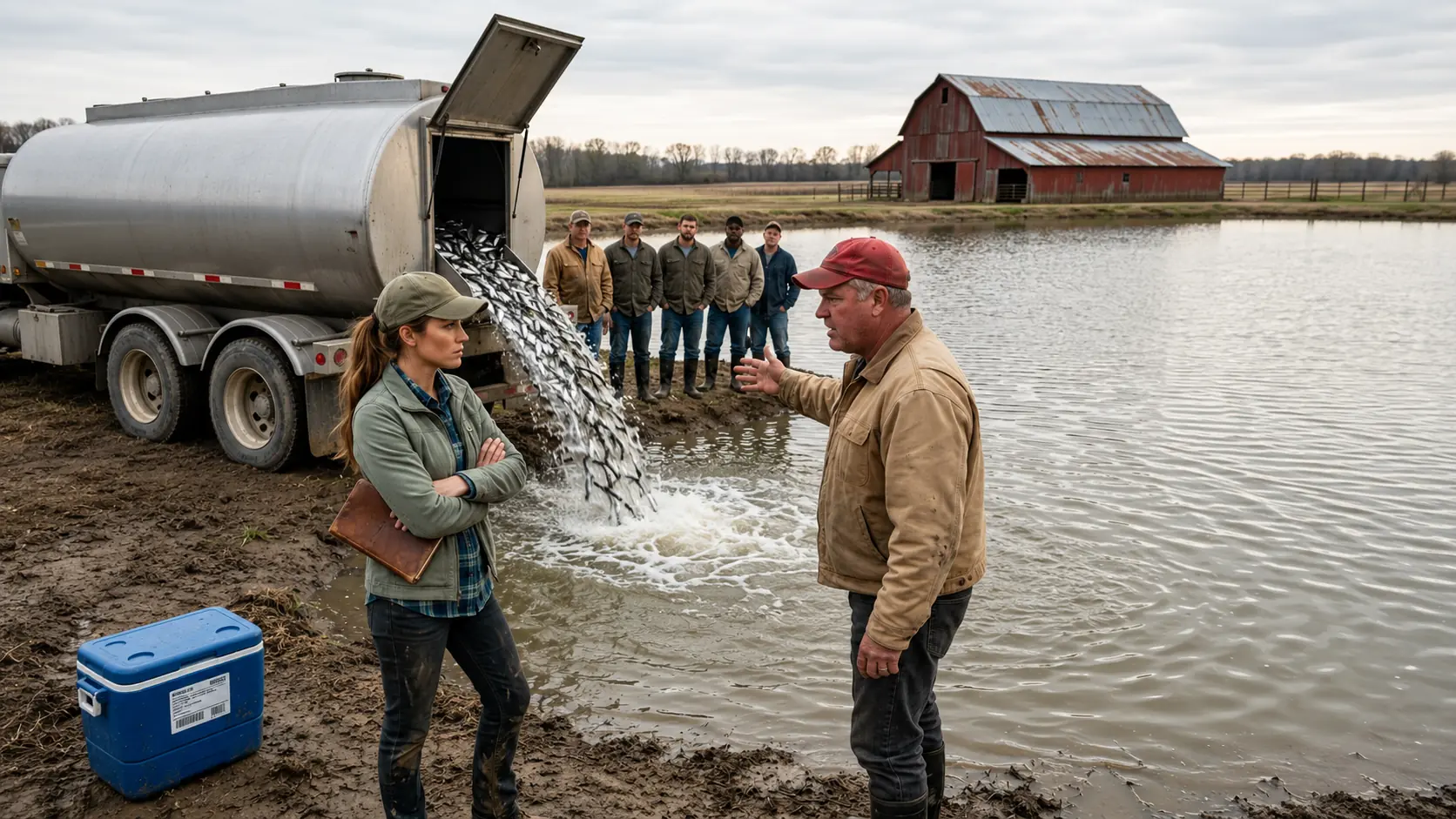
Roy marched across the bank and stopped inches from her.
“Those fish are mine.”
“You dumped them as garbage.”
“Give me the pond.”
Marguerite lifted the thick ledger beneath her arm.
“Touch my land—face four years of dumping.”
The workers behind Roy immediately stopped smiling. They knew how often the tanker had entered the Wooten property without a formal disposal manifest. They knew Roy had avoided destruction fees by unloading unwanted fingerlings into a private pond under an old handshake arrangement no regulator had ever reviewed. Most importantly, they knew Marguerite wrote down everything.
The arrangement began before Marguerite’s husband, Daniel, died. Roy operated Padgett Regional Hatchery two roads away, raising fingerlings under contracts for private catfish farms, recreational lakes, and state stocking programs. Each commercial batch produced fish that failed to meet a buyer’s exact specifications because they were too large, too small, lightly damaged, or mixed with another species. Destroying thousands of healthy fish bothered Roy, but paying for lawful disposal bothered him more.
Daniel allowed Roy to release the unwanted fish into the Wooten pond. No money changed hands, no contract was written, and neither man asked what might happen if the arrangement outlived one of them. Daniel believed the fish would either survive naturally or become food for larger animals already in the pond. Roy simply appreciated having somewhere inexpensive to empty his tanks.
After Daniel died in a tractor accident, the tanker kept coming.
Marguerite never received a phone call before the first post-funeral delivery. She heard the diesel engine from the farmhouse, walked down the lane, and reached the bank just as the truck drove away. Hundreds of small fish scattered through the pond beneath a cloud of churned mud. A handwritten note tied to the fence said only, “Same agreement as before.”
She should have called Roy that day.
Instead, grief made decisions feel heavier than they were. The mortgage payment was overdue, the barn roof leaked, and three pieces of equipment needed repairs she could not afford. Marguerite looked across the pond and saw another responsibility she had inherited without instructions. Telling Roy to stop seemed less urgent than simply surviving the week.
The tanker returned every few weeks.
Sometimes it released channel catfish. Other deliveries included bluegill, grass carp, tilapia, or mixed bait fish that had entered the wrong commercial tank. Roy’s drivers called them culls, rejects, and garbage stock. Marguerite noticed that most looked healthy when they struck the water.
Neighbors saw the trucks and assumed she was being used.
A widow named Louise Harper stopped beside the mailbox one afternoon and asked whether Marguerite wanted someone to speak to Roy. Another neighbor suggested filling the pond, selling the acreage, and removing the problem completely. People described the fish as waste without ever examining them. Marguerite began wondering whether the greatest mistake was not Roy’s dumping, but everyone’s certainty that the fish had no value.
The answer came from an old equipment shed.
Marguerite was sorting Daniel’s family belongings when she found a water-stained composition book beneath rusted tools and seed catalogs. The cover carried the name Silas Wooten, Daniel’s great-uncle, who had worked the pond during the 1950s and 1960s. His handwriting filled every page with stocking dates, water temperatures, feeding observations, and carefully measured ratios between species. He had managed the pond as a layered ecosystem rather than a tank holding one commercial fish.
Silas’s notes described how bottom-feeding catfish consumed settled material and leftover feed. Bluegill and similar species occupied the middle water, feeding on insects and smaller aquatic organisms. Grass carp controlled vegetation that would otherwise require chemicals or mechanical removal. When each species used a different part of the pond, the water produced more total fish without forcing them all to compete for the same food.
Marguerite read the ledger until midnight.
The next morning, she began comparing Silas’s notes with the species Roy had delivered. The hatchery’s mixed rejects resembled the exact combination the old farmer had worked years earlier. Roy considered them useless because no large buyer wanted an inconsistent batch. Silas would have considered that variety an advantage.
Marguerite called the county extension office.
The first agent listened politely and recommended she drain the pond before disease spread. The second admitted he knew little about mixed-species production but referred her to Dr. Evelyn Shaw, an aquaculture specialist at the University of Arkansas. Evelyn agreed to visit after Marguerite sent photographs of Silas’s ledger and two months of her own observations. She arrived expecting an amateur experiment and left with enough interest to return the following week.
“This is polyculture,” Evelyn explained beside the pond. “It has existed for centuries, but almost nobody here uses it commercially.”
“Why not?”
“Because processors want one species, one size, and one harvest schedule. Mixed production is harder to manage and harder to sell.”
“But can it produce more?”
“Potentially, yes. The challenge is finding buyers who value variety instead of uniformity.”
That challenge did not frighten Marguerite. She already owned the pond, the fish arrived free, and she was not tied to a processor demanding thousands of identical animals. Her greatest limitation was knowledge, and Silas had left decades of it inside the composition book. She began a second ledger beside his, continuing the work across a gap of more than fifty years.
She measured dissolved oxygen, water temperature, growth rates, and feed consumption. Each time Roy’s tanker arrived, she asked the driver which species and approximate numbers were inside. The drivers rarely knew precisely, so Marguerite began sampling every delivery herself. She photographed the fish, recorded their condition, and separated unusual species into smaller holding cages until Evelyn identified them.
Roy laughed when he heard about it.
“You’re counting garbage now?”
“I’m managing what enters my pond.”
“Those fish cost me money to haul away.”
“Then stop bringing them.”
Roy’s smile disappeared briefly.
“Your husband never complained.”
“My husband isn’t here.”
Roy looked toward the farmhouse and lowered his voice.
“You need those fish more than I need this pond.”
Marguerite remembered that sentence.
She also remembered Roy did not stop delivering.
The first deliberate stocking season went better than expected. Catfish gained weight along the pond bottom, bluegill multiplied, and grass carp reduced vegetation around the shallows. Marguerite purchased less formulated feed than a single-species operation would have required because more of the pond’s natural food web was being used. Water quality improved in several areas where uneaten organic matter had once accumulated.
She harvested a small test batch and took it to three independent fish markets. Two refused immediately because they wanted uniform orders. The third purchased the catfish but offered almost nothing for the smaller species. Marguerite returned home with several coolers and understood why the method had disappeared from commercial farms.
Production alone was not enough.
She needed the correct customer.
That customer arrived in the form of a Little Rock chef named Gabriel Moreau. He was searching for locally raised fish for a seasonal restaurant menu and had heard about the unusual pond from Evelyn. Gabriel inspected the water, reviewed Marguerite’s records, and asked whether she could provide several species in smaller quantities. Where processors saw inconsistency, he saw a changing menu.
His first order was modest.
He purchased catfish, bluegill, and a limited quantity of legally contained tilapia. He paid more per pound than the commodity market because the fish were fresh, traceable, and available in combinations his ordinary suppliers could not provide. Two weeks later, he returned with another cooler and a larger check.
Gabriel told another chef.
The second chef brought a restaurant owner. Within six months, Marguerite had four regular buyers who accepted mixed harvests based on what the pond produced naturally. They did not need tractor-trailer volumes or identical fish. They wanted quality, story, and variety.
The money did not make her wealthy overnight.
It repaired the barn roof first. Then it replaced the failing pump and paid the mortgage through winter. Marguerite bought testing equipment, improved the pond’s drainage structures, and installed simple aerators around the deepest sections. She refused to expand until the existing pond proved stable for a full year.
Then July nearly destroyed everything.
Three windless days trapped heat over Lonoke County. Warm water held less oxygen, and the crowded pond consumed what remained during the night. Marguerite woke before dawn, looked through her bedroom window, and saw hundreds of fish gasping at the surface. By the time she reached the bank, the water appeared to be breathing.
She called Evelyn and every neighbor who owned an aerator.
A generator arrived first, pulled behind a pickup by Louise Harper’s sons. Roy came later with two hatchery employees and portable equipment, because even he understood what a complete oxygen crash would mean. They worked until afternoon, pumping air through the pond and removing dead fish before decomposition worsened the problem. Still, Marguerite lost nearly one-third of her stock.
Her largest restaurant order was due the following week.
She canceled it personally.
Gabriel did not shout or demand compensation. He asked when the pond might recover and promised to return when it did. Marguerite spent that evening sitting beside the water with Silas’s ledger on one knee and her own notebook on the other, wondering whether everyone who had pitied her had been correct.
Roy stood nearby.
“You stocked too heavily.”
“I followed the ratios.”
“Ratios written before summers got this hot and before people pushed production this hard.”
Marguerite looked at him.
“Why are you helping me?”
Roy watched the aerator disturb the dark water.
“Because I’ve seen ponds die. It’s a terrible thing to watch.”
For three hours, they rebuilt the stocking plan.
Roy knew oxygen failures because his hatchery had experienced them. He showed Marguerite how to reduce density, position aerators, and recognize warning signs before fish reached the surface. It was the first time he treated her like an operator rather than a widow accepting his inconvenience. Their relationship improved, but it never became equal in his mind.
The pond recovered slowly.
Marguerite restocked conservatively, improved emergency power, and waited an entire season before increasing sales. Her restaurant buyers returned one at a time. The second year produced less total weight than she had originally hoped, but the survival rate was higher and the income more dependable.
Roy began calling before deliveries.
He separated healthier culls and told his drivers to identify species correctly. Marguerite occasionally paid for especially valuable batches, although Roy still saved money compared with formal disposal. Their arrangement benefited both operations, and for a time neither questioned it.
Then a regional farming magazine published an article about the Wooten pond.
The reporter described Marguerite as a young widow who had transformed unwanted hatchery stock into a profitable mixed-species operation. Photographs showed Gabriel collecting fish beside the water and Silas’s ledger resting beside Marguerite’s modern records. The article estimated that her profit per acre exceeded that of many conventional ponds in the county.
Roy read it three times.
The following week, he stopped all deliveries.
Marguerite called him.
“Did you lose a contract?”
“No.”
“Then why did the truck stop coming?”
“Because I’m reviewing ownership.”
“Ownership of what?”
“The genetic stock we supplied.”
Marguerite laughed once, believing he was joking.
He was not.
Roy’s attorney sent a letter claiming Padgett Regional Hatchery retained a commercial interest in fish descended from its original stock. It demanded a percentage of Marguerite’s sales, access to her customer records, and control over future stocking decisions. The letter described the deliveries as developmental contributions to a joint business venture.
Marguerite carried it directly to Evelyn.
“He called them garbage for years.”
“He now sees a successful business,” Evelyn replied.
“Can he do this?”
“Anyone can send a letter. Whether the claim survives evidence is another matter.”
Evidence was the one thing Marguerite possessed in abundance.
Her ledger contained dates, truck numbers, driver names, species estimates, water conditions, and photographs from every delivery. Roy had never issued an invoice, ownership certificate, joint-venture agreement, or restriction on the fish. Several drivers had written “disposal” on the informal slips they handed her.
Marguerite’s attorney responded with one question.
Was Padgett Hatchery claiming the fish had been transferred as valuable commercial inventory or dumped as unwanted waste?
If the fish were commercial inventory, Roy had transported and released them without sale documents, health certifications, or stocking agreements. If they were waste, he had surrendered ownership when they entered Marguerite’s private pond. He could not describe them differently simply because she had discovered their value.
Roy withdrew the legal demand.
But his anger grew.
He opened his own mixed-species pond beside the hatchery and contacted Marguerite’s restaurant customers. He promised lower prices and larger quantities, assuming his commercial scale would destroy her market. Gabriel purchased one trial order, then returned to Marguerite.
“His fish aren’t bad,” he said.
“Then why come back?”
“He harvests whatever he wants to sell. You harvest what I order.”
Roy’s operation was designed for volume, not careful mixed production. His managers treated every species as another commodity and increased density to recover costs quickly. Water quality declined, growth became uneven, and restaurant buyers complained that the fish lacked consistency despite coming from a larger operation.
Roy blamed Marguerite.
He told other hatchery owners she had stolen private methods. He claimed Silas’s ledger was meaningless and that the entire business depended on Padgett stock. Several workers repeated his accusations until county gossip turned the dispute into a public feud.
Then the tanker returned without warning.
It was the largest delivery Roy had ever sent, containing thousands of mixed fingerlings from several canceled contracts. The driver began releasing them before Marguerite reached the pond. Five hatchery workers stood nearby, along with Roy, who had come to witness what he called the end of their arrangement.
The sudden load could destroy the pond’s carefully controlled density.
Marguerite ordered the driver to close the valve.
Roy stepped between them.
“Those fish are mine.”
“You dumped them as garbage.”
“Give me the pond.”
“Touch my land—face four years of dumping.”
Roy clenched his fists.
“You built this with my property.”
“You avoided disposal costs using my water.”
“I can shut down every supply line you have.”
“You already tried.”
Roy moved closer, expecting her to retreat. Marguerite remained perfectly still while the workers watched the water churn behind them. She opened the ledger and showed him copies of every unauthorized delivery, including several involving regulated warm-water species released before her containment permit existed.
“You approved those loads,” she said.
“Your husband approved the arrangement.”
“He died four years ago.”
“The agreement continued.”
“Then show me the written terms.”
Roy’s face reddened.
“You took advantage of me.”
“No. You decided healthy animals were worthless because they didn’t fit your orders.”
The sound of approaching engines interrupted them.
Two Arkansas Game and Fish Commission vehicles entered the lane, followed by a truck from the state environmental office. Marguerite had called after receiving notice that Roy intended to resume dumping. Inspectors had already reviewed her records and wanted to witness the next delivery.
Roy turned toward the tanker.
“Close the valve.”
An inspector stepped forward.
“Leave it exactly as it is.”
The workers moved away from the controls.
Officials sampled the water, identified the species, photographed the open tanker, and collected Roy’s delivery paperwork. Several fish inside required containment authorization that the hatchery had not prepared. More troubling were the years of disposal records showing Padgett Hatchery claimed fees for destroying batches that were instead released into the Wooten pond.
Roy had saved disposal costs and, in some cases, billed customers as though lawful destruction had occurred.
Marguerite’s ledger proved where the fish actually went.
The investigation lasted six months.
Padgett Hatchery was fined for incomplete transportation records, unauthorized disposal, and several improperly documented species transfers. Roy avoided criminal charges because inspectors found no evidence that he deliberately introduced dangerous species into public waterways. However, he paid restitution, upgraded his waste procedures, and signed a settlement surrendering all claims to Marguerite’s pond and business.
The settlement did not ruin him.
It forced him to accept the truth he resisted: the fish had become valuable only because Marguerite did the work he never considered worth doing. She studied the pond, found buyers, accepted the losses, managed the permits, and created a system around animals he had abandoned. Providing unwanted stock did not give him ownership of her discipline.
Months later, Roy returned alone.
He stood near the pond without stepping through the gate.
“I have a mixed batch coming off a state contract next week.”
Marguerite waited.
“Some channel catfish, bluegill, and grass carp. Healthy, wrong sizes.”
“Are you dumping them?”
“No.”
“Then what are you offering?”
“A sale. Proper records, health certificates, and a price we both agree on.”
Marguerite studied him.
“What price?”
Roy named an amount lower than ordinary stock but high enough to acknowledge value.
She countered.
They negotiated for fifteen minutes and shook hands only after Marguerite wrote the terms on paper.
Four years after the first unwanted delivery, the arrangement finally became legitimate.
Marguerite’s business continued growing, but she kept it small enough to understand. She worked with six restaurants, two independent fish markets, and a farm-to-table distributor that accepted seasonal variety. She never promised more than the pond could safely produce.
Silas’s ledger remained in the farmhouse.
Her own books filled three shelves beside it.
When a local agricultural college asked her to teach a workshop, Marguerite brought both ledgers and placed them side by side. She told the students that no system survived merely because an older generation once understood it. Knowledge had to be recorded, questioned, updated, and placed in the hands of someone willing to continue.
One student asked what made her recognize value in rejected fish.
Marguerite considered the question.
“I didn’t recognize it at first,” she admitted. “I just stopped accepting everyone else’s definition of worthless.”
Outside the classroom, Roy waited beside a hatchery truck carrying properly documented stock for another small farmer interested in mixed production. He and Marguerite never became close friends, but they learned to work together without pretending their conflict had never happened.
He no longer called the fish garbage.
Marguerite no longer accepted them for free.
The pond remained the most productive eleven acres on her farm, not because every fish was perfect, but because each species had a place within the system. What one animal ignored, another consumed. What one buyer rejected, another valued.
The lesson extended beyond the water.
Roy had dismissed Marguerite because she was young, widowed, and desperate. Neighbors had dismissed the pond because it contained no uniform crop. Commercial buyers had dismissed the fingerlings because they did not match a contract.
All of them had looked at irregularity and seen failure.
Marguerite looked longer.
She found an ecosystem, a forgotten ledger, and a market built around difference rather than sameness. The hatchery had delivered the raw material, but patience, knowledge, and stubborn work transformed it.
Years later, people still told the story as though Marguerite had become successful because someone dumped free fish into her pond.
She always corrected them.
“The fish were free,” she said. “What made them valuable wasn’t.”