Walter Bennett walked into Hutchinson Implement Company at 10:17 on a gray Tuesday morning carrying a folded bank letter in one hand and dried Kansas mud on both boots. His faded tan work jacket had a torn cuff, his plaid shirt had been washed so many times the colors had nearly surrendered, and the old leather belt around his jeans looked older than several employees inside the showroom. Nothing about the sixty-two-year-old farmer suggested someone preparing to make the largest equipment purchase the dealership had seen that quarter. That was exactly why Sales Manager Bradley Collins stopped taking him seriously before Walter finished his first sentence.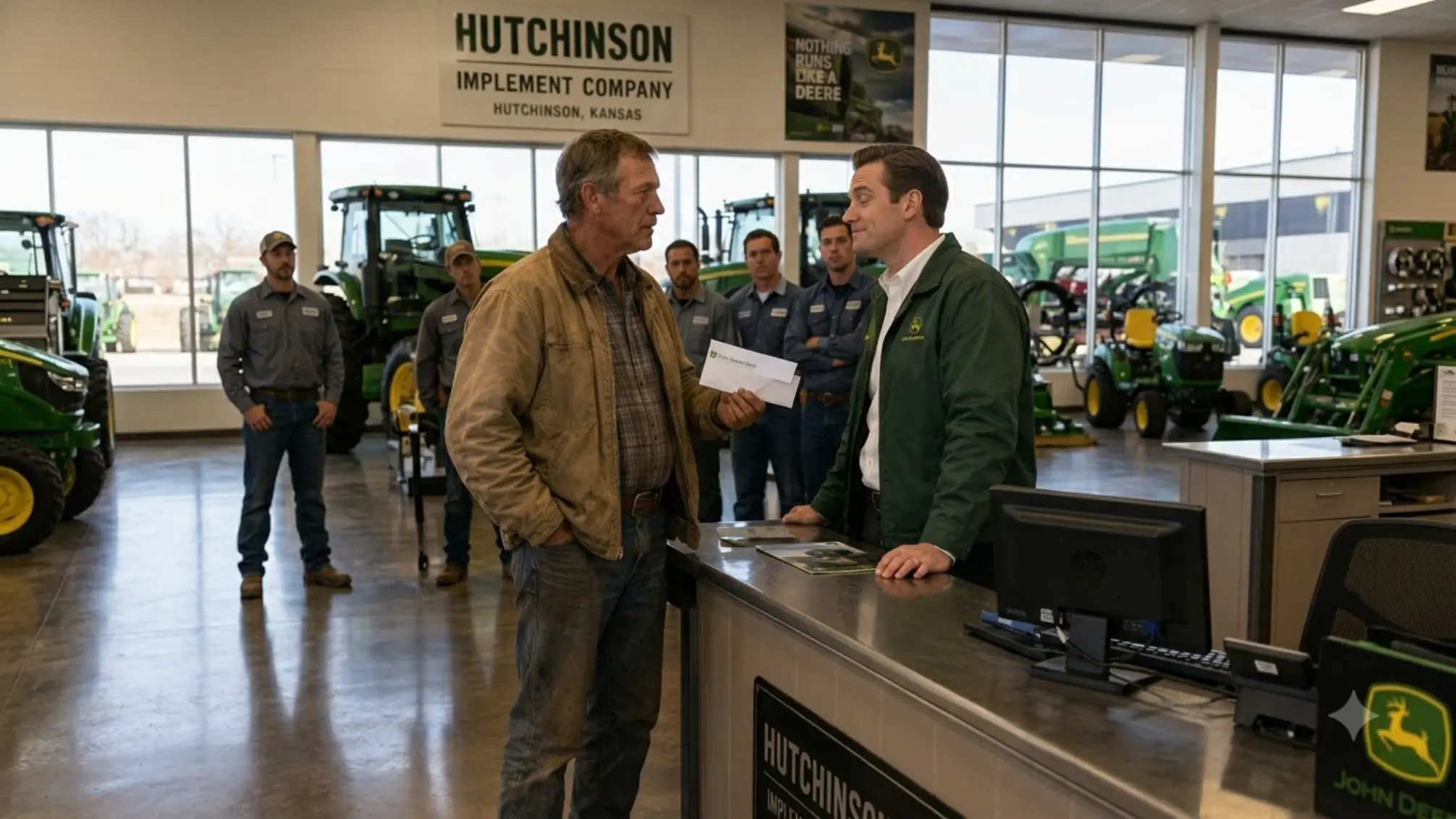
“I want buy six tractors, I pay cash.”
Bradley leaned one elbow against the counter and looked Walter slowly from his dusty boots to his weathered face. Behind him, three salesmen in blue work shirts paused near the coffee machine, already sensing entertainment. Bradley smiled as though Walter had just told a joke he was too polite to laugh at immediately. “Six? You don’t look like you could afford one used tractor.”
Walter’s face did not change. He had spent forty years negotiating land leases, fertilizer contracts, grain prices, and machinery purchases with men who occasionally mistook worn clothing for weakness. Most of those men learned quickly that farmers did not wear expensive suits into fields because wheat did not care about tailoring. Walter lifted the folded bank letter slightly.
“You refusing my money because of my clothes?”
Bradley laughed.
“I’m refusing to waste my afternoon pretending you’re a real buyer.”
One salesman looked toward the floor. Another grinned. The third, a younger employee named Luke Harris, stopped smiling altogether because he had recognized Walter’s last name from somewhere but could not immediately remember where.
Walter placed the letter on the counter.
“I need six new tractors. Four high-horsepower machines for tillage and grain carts, two smaller units for hay and utility work. I need delivery before planting.”
Bradley did not touch the paper.
“Do you understand what six new tractors cost?”
“Yes.”
“We’re talking well over a million dollars depending on specifications.”
Walter nodded.
“That’s why I brought the bank letter.”
Bradley pushed it back with one finger without reading it.
“Sir, we get dreamers in here every week. Guys want to sit in the cab, ask about options, take pictures, then discover financing requires an income.”
One of the salesmen laughed.
Walter glanced toward him.
The laughter stopped.
“I didn’t ask for financing.”
Bradley crossed his arms.
“Everybody says cash until we reach numbers.”
Walter looked through the showroom windows toward rows of green tractors parked outside. Six machines stood nearest the building, freshly detailed, their yellow wheels spotless beneath the cloudy Kansas sky. Walter had already studied their models online, compared specifications, spoken with his sons, and calculated exactly what his operation needed for the coming season.
He had not driven forty miles to browse.
“Let’s reach numbers.”
Bradley sighed dramatically.
“Fine. What acreage are you farming?”
“About nine thousand two hundred this year.”
Now even Luke looked up.
Bradley stared at Walter for half a second before smiling again.
“Nine thousand?”
“Nine thousand two hundred.”
“Owned?”
“Some.”
“How much?”
Walter’s eyes hardened.
“That relevant to the sale?”
“It’s relevant if I’m supposed to believe this conversation.”
Walter picked up the bank letter.
“Then I suppose we’re done.”
Bradley gave a tiny shrug.
“Probably best.”
Walter turned toward the door.
Luke suddenly remembered the name.
Bennett Farms.
He had seen it across service invoices dating back decades. Not recent ones from Hutchinson Implement, but older records transferred when the dealership bought a smaller regional equipment business six years earlier. Bennett Farms had once purchased nearly everything through that old dealership before changing brands after ownership changed.
Luke stepped forward.
“Mr. Bennett?”
Walter stopped.
“Yes?”
“Bennett Farms outside Sterling?”
Walter studied him.
“That’s right.”
Luke’s stomach dropped.
His grandfather had worked at the local grain cooperative. Bennett Farms was not merely a large family operation. It was one of the biggest privately run grain and cattle operations in that part of central Kansas, with land spread across multiple counties, contract acreage, storage facilities, and a family trucking division.
Luke looked toward Bradley.
Bradley noticed the expression.
“What?”
Luke lowered his voice.
“I think we should look at the letter.”
Bradley’s jaw tightened.
“I know how to qualify customers.”
Walter opened the showroom door.
Luke followed.
“Mr. Bennett, wait.”
Walter turned on the sidewalk.
The younger salesman looked genuinely embarrassed.
“If you’ll give me five minutes, I’ll work up whatever specifications you want.”
Walter looked through the glass at Bradley, who remained behind the counter.
“You the manager?”
“No, sir.”
“Can you sell six tractors?”
Luke hesitated.
“I can prepare the order, but he has to approve it.”
Walter nodded once.
“Then you can’t sell them.”
He walked toward his old Ford pickup.
Bradley came outside.
“Sir.”
Walter stopped again.
Bradley’s tone had changed slightly, not enough to become respectful, but enough to show Luke’s reaction had unsettled him.
“What exactly is Bennett Farms?”
Walter opened his truck door.
“A customer somewhere else.”
Then he climbed inside.
Bradley watched the Ford disappear from the lot.
For several seconds nobody spoke.
Then he turned toward Luke.
“What was that?”
Luke stared at him.
“You really don’t know?”
Bradley’s expression became irritated.
“Know what?”
Luke walked inside, opened the dealership’s customer database, and typed Bennett.
Old archived accounts appeared.
Bradley leaned closer.
Service history.
Combines.
Planters.
Sprayers.
Multiple tractors.
Parts purchases.
Fleet agreements.
The numbers became larger as they scrolled backward.
Luke pointed toward one account.
“That’s them.”
Bradley stared.
“How old is this?”
“Before Hutchinson bought Prairie Equipment.”
“So?”
Luke turned toward him.
“So Bennett Farms spent almost four million dollars through Prairie over twelve years.”
Bradley’s face changed.
“That was years ago.”
“Yes.”
“Maybe they downsized.”
Luke shook his head.
“My grandfather knows them. They’ve gotten bigger.”
Bradley looked toward the empty parking space where Walter’s truck had been.
A quiet salesman near the counter finally spoke.
“You told him he couldn’t afford a used tractor.”
Bradley snapped around.
“Thank you, Eric.”
Eric looked away.
Bradley walked into his office and closed the door.
Walter Bennett did not drive home.
He drove fourteen miles north to Prairie Plains Agricultural Equipment, a competing dealership carrying several major brands. Its building was older, smaller, and considerably less polished than Hutchinson’s showroom.
The moment Walter entered, an elderly parts clerk looked up.
“Walter Bennett?”
Walter stopped.
“Frank?”
Frank Delaney, seventy years old and supposedly retired three times, came around the counter smiling.
“Haven’t seen you in ten years.”
“Closer to eight.”
“Still too long.”
They shook hands.
Frank looked at the folded paper.
“Buying or complaining?”
“Buying.”
“How much trouble are we talking?”
“Six tractors.”
Frank whistled.
“Cash?”
Walter smiled.
“You always did know me.”
Frank called the general manager.
Within three minutes Walter sat at a plain desk drinking terrible coffee while Melissa Grant, Prairie Plains’ forty-six-year-old owner, opened a specification sheet.
“What are you replacing?”
“Three older tractors immediately. Two more before wheat. Sixth one is expansion.”
“Horsepower?”
Walter listed everything.
Melissa took notes.
No one asked what he could afford.
No one asked whether his jacket represented his income.
No one laughed.
After twenty minutes Melissa gave him preliminary figures.
The total came to $1.87 million before several fleet discounts and trade values.
Walter looked at the number.
“Can you deliver?”
“Four within three weeks. Other two probably five.”
“I need the first four sooner.”
Melissa thought.
“If I move two units from our Salina inventory and swap another dealer for one allocation, I can get four to you in twelve days.”
Walter nodded.
“Do it.”
Melissa looked toward him.
“You want financing options before we finalize?”
Walter opened the bank letter.
“No.”
He slid it across the desk.
The document confirmed immediately available funds sufficient to cover the purchase.
Melissa read it once.
Then she smiled.
“Cash it is.”
Walter signed the preliminary purchase agreement.
By noon, Prairie Plains had a deposit large enough to secure six tractors.
At 12:43, Bradley Collins received a phone call from Martin Hayes, Hutchinson Implement’s regional owner.
Bradley answered casually.
“Morning, Martin.”
“What happened with Walter Bennett?”
Bradley stopped moving.
“Who?”
Silence.
Then Martin said, “Do not make me repeat the name.”
Bradley looked through his office window.
Luke was standing near the parts counter.
“How did you hear about that?”
“Melissa Grant called me.”
Bradley’s stomach tightened.
“Why would she call you?”
“Because she wanted to confirm something about historic service records on a trade unit Bennett owns.”
Bradley swallowed.
Martin continued.
“She also mentioned she just sold him six tractors.”
Bradley said nothing.
“All cash.”
Bradley finally replied.
“He came in looking like he was wasting time.”
Martin’s voice became dangerously quiet.
“What exactly does a man with $1.8 million available for equipment purchases look like, Bradley?”
“That’s not what I meant.”
“Tell me what you meant.”
Bradley leaned back.
“He had dirty clothes. Old pickup. No appointment.”
Martin almost laughed, but there was no humor in it.
“You work at a farm equipment dealership in Kansas.”
Bradley closed his eyes.
“Half our customers arrive dirty.”
“I understand.”
“No, apparently you don’t.”
Martin explained something Bradley should already have known. Agricultural customers routinely looked nothing like conventional luxury buyers because the value they controlled existed in land, equipment, crops, livestock, storage, contracts, and businesses rather than clothing.
A farmer could step out of a twenty-year-old pickup while owning millions in acreage.
Appearance was almost useless as a qualification tool.
Bank documentation was not.
Walter had brought bank documentation.
Bradley never read it.
“I can call him.”
“You’re going to.”
Bradley sat straighter.
“I’ll fix it.”
Martin paused.
“No.”
Bradley frowned.
“What?”
“You’re going to apologize. Whether he ever buys from us again is his decision.”
Bradley found Walter’s number through the archived account.
The first call went unanswered.
So did the second.
On the third attempt, Walter answered.
“Bennett.”
“Mr. Bennett, this is Bradley Collins from Hutchinson Implement.”
“I know.”
Bradley forced warmth into his voice.
“I wanted to apologize for earlier. There was clearly a misunderstanding.”
“No misunderstanding.”
Bradley stared at his desk.
“I may have been too quick.”
“You were.”
“I’d like to personally put together a competitive quote for those tractors.”
“I bought them.”
Bradley knew, but hearing it directly still hurt.
“Perhaps we can beat their pricing.”
“Contract’s signed.”
“We could cover cancellation penalties.”
“No.”
Bradley struggled for the right angle.
“We’ve got premium service support, parts inventory, mobile technicians. Long term, we may be the better partner.”
Walter became quiet.
Then he said, “You had the chance to be my partner at ten seventeen this morning.”
Bradley did not answer.
Walter continued.
“I handed you proof of funds. You wouldn’t read it.”
“You have to understand, we see people—”
“No.”
Walter’s voice remained calm.
“You have to understand something.”
Bradley waited.
“I didn’t leave because you doubted whether I could afford six tractors.”
Walter paused.
“I left because you enjoyed making sure everyone else heard you doubt it.”
That sentence landed harder than Bradley expected.
Behind the arrogance of the morning had been exactly that.
The audience.
The smirking employees.
The opportunity to demonstrate that Bradley controlled who deserved serious attention.
Walter continued.
“I can forgive somebody asking whether I’m qualified to spend nearly two million dollars.”
He looked across Prairie Plains’ equipment yard as workers began identifying the units his family would receive.
“I won’t reward somebody who thinks humiliating a customer is part of checking.”
The call ended.
Bradley sat alone.
Two days later, the story spread through agricultural circles.
Not because Walter posted anything.
He did not use social media beyond occasionally checking cattle prices.
The story spread because three employees had witnessed it, one mentioned it to a brother, the brother mentioned it at the cooperative, and rural communities remained exceptionally efficient communication networks whenever somebody had behaved foolishly in public.
By Friday, people entering Hutchinson Implement were making jokes.
A farmer placed his muddy boots deliberately on the entry mat.
“Am I dressed wealthy enough to buy hydraulic fluid?”
The parts clerk nearly choked trying not to laugh.
Another walked toward Bradley and asked, “Need my bank balance before I’m allowed to look at a mower?”
Bradley stopped finding anything funny.
Then the cancellations began.
Not dozens.
Three.
But all three mattered.
One customer delayed a planter purchase.
Another moved a tractor service quote elsewhere.
A cattle producer buying two loaders told Martin directly that he did not want sales staff judging whether he looked expensive enough.
Martin drove to Hutchinson himself.
He called a staff meeting.
Bradley sat at the end of the conference table.
Martin placed no motivational presentation on the screen.
He simply asked one question.
“What are we selling?”
Eric answered first.
“Equipment.”
Martin shook his head.
“Anybody else?”
Luke said, “Service.”
“Closer.”
Then Martin looked around.
“We sell trust.”
Nobody spoke.
“A tractor is steel. Another dealer has steel.”
He pointed toward the service building.
“Parts are parts. Someone else stocks them.”
Then toward the customer entrance.
“The only thing keeping a customer here when five competitors can sell comparable equipment is whether that customer believes we respect his operation.”
His eyes settled on Bradley.
“We lost six tractors because we failed before pricing ever began.”
Bradley looked down.
Martin continued.
“Not because we couldn’t compete.”
“Because?”
Luke answered quietly.
“We didn’t treat him like a customer.”
“Exactly.”
Martin changed store policy that afternoon.
Large purchases still required financial verification.
Nobody objected.
But sales staff were prohibited from making qualification judgments based on clothing, vehicle age, occupation assumptions, or perceived social status.
Every serious buyer received the same initial needs assessment.
If financing was required, paperwork determined eligibility.
If cash proof was offered, employees read it.
The policy seemed embarrassingly obvious.
Sometimes the most necessary policies did.
Twelve days later, four tractors rolled onto Bennett Farms.
Walter’s two sons, Daniel and Evan, stood beside him while transport drivers unloaded the machines.
Daniel ran his hand along one front tire.
“You really bought six without calling us?”
“I called you.”
“You said you were going tractor shopping.”
“That was accurate.”
Evan laughed.
“How bad was the first dealer?”
Walter looked toward him.
“Bad enough.”
He told them the story.
Daniel became angry.
“You should post it.”
“No.”
“Why not?”
“Because I already solved the problem.”
Walter pointed toward the new machines.
“I bought somewhere else.”
Daniel shook his head.
“They should know why.”
“They know.”
That was enough for Walter.
He did not need Bradley fired.
He did not need Hutchinson Implement destroyed.
He needed equipment from people who respected his time.
Prairie Plains had provided that.
Still, the story refused to disappear.
Several weeks later, Martin Hayes arrived at Bennett Farms without Bradley.
Walter saw his truck and walked out of the machine shed.
Martin approached slowly.
“Mr. Bennett.”
“Mr. Hayes.”
“I wanted to apologize personally.”
Walter folded his arms.
“You already apologized by phone.”
“Bradley did.”
Martin shook his head.
“I own the dealership. His conduct happened under my name.”
Walter appreciated the distinction.
Martin looked toward four new tractors parked beside the shed.
“Good machines?”
“So far.”
“I’m not here to steal the sale back.”
“Good.”
“I’m here because your experience exposed something.”
Walter waited.
Martin explained the training changes.
New customer-service procedures.
Review of prior complaints.
Mystery-shopper checks across his locations.
Clearer authority for junior employees to step in when a manager treated someone improperly.
Walter listened.
“Luke tried.”
Martin nodded.
“He did.”
“Give that kid room.”
“I promoted him to assistant sales manager.”
Walter almost smiled.
“That fast?”
“He earned the opportunity.”
Martin hesitated.
“Bradley is still employed.”
Walter shrugged.
“That’s your business.”
“I thought you might want to know.”
“No.”
Martin looked surprised.
Walter explained.
“I’m not interested in revenge.”
He pointed toward the fields.
“I’ve got planting coming.”
“That’s what I’m interested in.”
Martin nodded.
Then he offered his hand.
Walter shook it.
Before leaving, Martin asked one final question.
“What could Bradley have done that morning after making the first mistake?”
Walter considered it.
“Picked up the letter.”
“That simple?”
“Yes.”
“He could’ve said, ‘Sorry, I judged too quickly. Let’s start again.’”
Walter looked toward him.
“People make mistakes. Arrogance is deciding the mistake deserves defending.”
Martin remembered that sentence.
Months passed.
The six tractors worked through planting and harvest.
The machines were not magical.
One developed a sensor problem.
Another required a hydraulic adjustment.
Prairie Plains sent technicians promptly.
Walter judged them not by whether equipment ever failed but by what happened when it did.
That was what relationships were built on.
Meanwhile, Luke Harris developed a reputation at Hutchinson Implement for treating every person who walked through the door seriously.
One afternoon, a nineteen-year-old kid arrived wearing stained overalls and asked about a $280,000 tractor.
Another salesman assumed he was wasting time.
Luke sat down.
“What are you using now?”
The kid explained that he worked for his grandfather, who wanted him learning purchasing responsibilities before retirement.
Twenty minutes later, the grandfather arrived.
Their family eventually bought two tractors.
Luke called Martin afterward.
“Almost happened again.”
Martin replied, “But it didn’t.”
A year after Walter’s visit, Bradley saw him at the Kansas Farm Equipment Expo.
For a moment Bradley considered avoiding him.
Instead he walked over.
Walter was examining a planter display.
“Mr. Bennett.”
Walter turned.
“Bradley.”
The former confidence was still there, but less theatrical now.
“I owe you an apology that doesn’t include trying to sell you something.”
Walter waited.
Bradley continued.
“I treated you badly.”
No explanation.
No mention of appearance.
No defense.
“I wanted everyone around me to see that I controlled the showroom.”
Walter’s expression softened slightly.
“That sounds about right.”
Bradley nodded.
“I’ve thought about what you said.”
“What did I say?”
“That I enjoyed making sure everyone heard me doubt you.”
Walter remembered.
Bradley looked toward the floor.
“You were right.”
Walter studied him.
“That admission probably cost you something.”
“It did.”
“Good.”
Bradley almost smiled.
Walter extended his hand.
Bradley looked surprised before shaking it.
“You forgive me?”
Walter answered carefully.
“I believe you learned.”
“That’s not exactly the same thing.”
“No.”
Walter released his hand.
“But it’s better than nothing.”
Three years later, Bennett Farms bought more equipment.
This time Walter returned to Hutchinson Implement.
Luke was running the sales floor.
When Walter walked inside wearing the same old tan jacket, Luke smiled.
“Mr. Bennett.”
Walter looked around.
“Bradley here?”
“He moved to another location last year.”
Walter nodded.
“I need two tractors.”
Luke pulled out a chair.
“Cash?”
Walter smiled.
“You remember.”
“Hard story to forget.”
Walter sat down.
Luke brought specifications.
No assumptions.
No theater.
No laughter.
Thirty-five minutes later, they had a preliminary order.
Walter removed a folded bank letter from his jacket.
Luke looked at it.
Then looked at Walter.
“You know we already have your account history.”
“I know.”
“You don’t need this.”
Walter placed it on the desk anyway.
Luke laughed.
“I’m reading it.”
“You better.”
Both men smiled.
The purchase closed the following afternoon.
When Martin heard about it, he called Walter.
“I appreciate you giving us another opportunity.”
Walter looked from his office toward acres of Kansas farmland stretching beyond the windows.
“You fixed the part that mattered.”
“The sales process?”
“The attitude.”
Martin understood.
Equipment dealerships liked talking about horsepower, torque, hydraulic capacity, electronics, fuel efficiency, warranties, and financing.
Those things mattered.
Walter cared about all of them.
But none mattered before the first human decision inside a showroom.
Does the person standing across the counter deserve respect?
That morning years earlier, Bradley Collins looked at an old jacket, dusty boots, an aging pickup, and decided the answer was no.
It cost the dealership six tractors.
Almost two million dollars.
Several customers.
Months of reputational repair.
And one relationship that took three years to rebuild.
Walter never changed how he dressed when buying equipment.
He saw no reason to.
The tan jacket grew more faded.
The boots accumulated more scratches.
The Ford pickup eventually passed three hundred thousand miles.
Sometimes new salespeople looked surprised when he entered.
Experienced ones usually recognized him.
Walter did not care either way.
He never expected special treatment because Bennett Farms was large.
He expected ordinary treatment.
That distinction became important whenever his sons discussed the story.
Daniel once joked that their father should deliberately dress badly when shopping to test salesmen.
Walter immediately disagreed.
“That’s childish.”
“Why?”
“Because I’m not trying to catch anybody.”
He looked toward his son.
“I’m trying to buy a tractor.”
Daniel laughed.
“Fair.”
Walter continued.
“If somebody treats a customer well only after learning he’s rich, he didn’t learn respect.”
“What did he learn?”
“Fear of losing money.”
Walter picked up his coffee.
“Different thing.”
Years later, that became the version of the story people around Sterling remembered.
Not simply that a dusty farmer walked into Hutchinson Implement and offered cash for six new tractors.
Not that an arrogant sales manager laughed at him.
Not even that the farmer immediately spent nearly two million dollars at another dealership.
The part that survived was simpler.
Walter Bennett had walked through the door looking exactly like what he was.
A farmer.
The manager saw old clothes and decided they represented a small life.
He never bothered looking at the document Walter brought.
Never asked the right questions.
Never considered that wealth on a farm often looked like acreage stretching beyond the horizon, grain elevators filled after harvest, cattle behind fences, machinery working before sunrise, and generations of work rather than watches or tailored suits.
Walter had given him every opportunity to discover that.
The bank letter was already in his hand.
All Bradley had needed to do was unfold it.
And that became the expensive lesson Hutchinson Implement never forgot:
Never decide what a customer can afford before you decide whether you’re willing to listen.