By the middle of July 1976, the soybeans on the Harper farm had stopped looking green.
They were still technically alive, which was the only reason Thomas Harper refused to call them dead, but the distinction was becoming increasingly difficult to defend. Leaves drooped from thin stems by midmorning, the soil between rows had hardened into plates, and every afternoon the hot Kansas wind pulled another little piece of moisture from a field that no longer seemed to have any to spare.
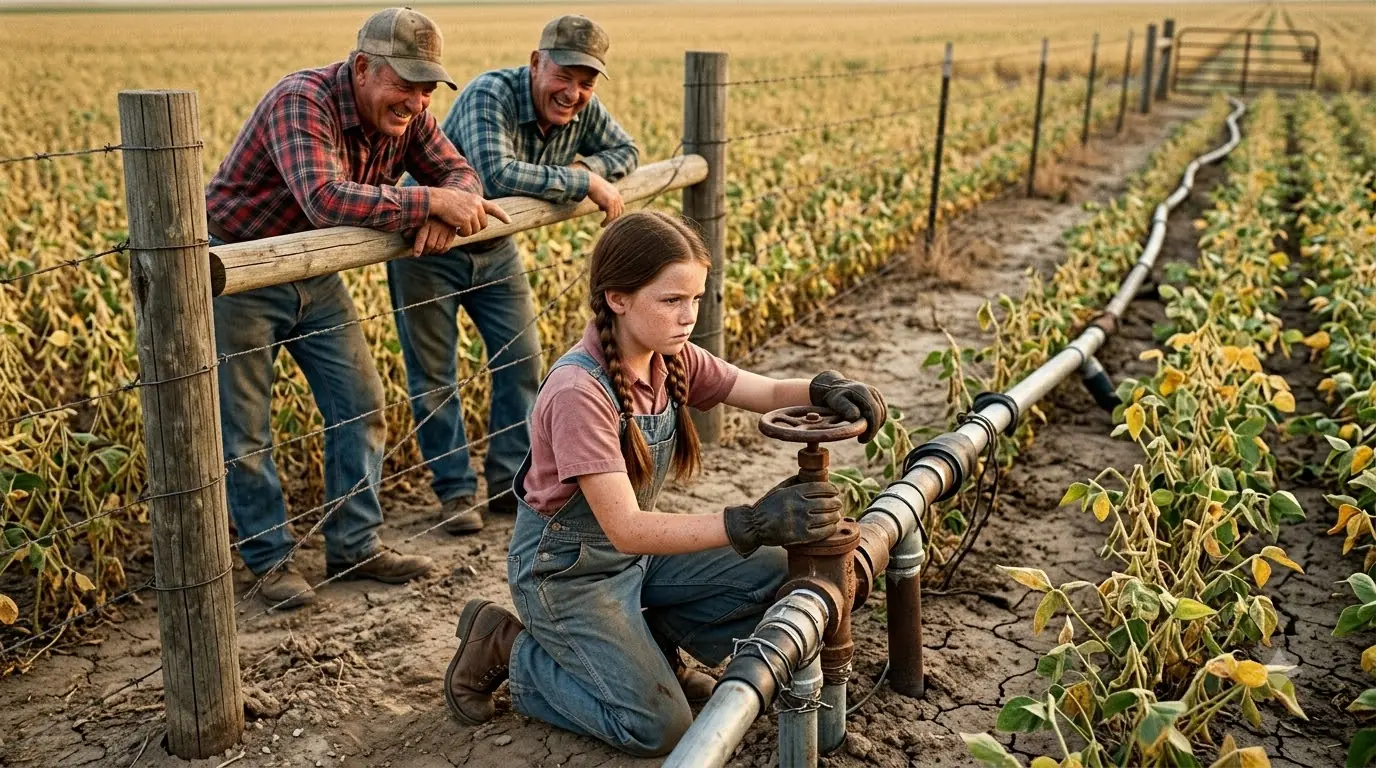
Thomas walked those rows every morning before breakfast.
Forty-three years old, broad through the shoulders, permanently tanned, and carrying a limp in his right knee from an accident involving a hay wagon when he was twenty-two, he had farmed long enough to know when optimism had become arithmetic.
The arithmetic was bad.
His soybeans covered thirty-eight acres south of the house.
Of those, roughly fourteen sat high enough that the soil dried quickly after every brief summer shower.
That upper ground was now the worst.
Thomas stopped beside one plant and rubbed a leaf between two fingers.
Papery.
Not gone yet.
But close.
His daughter, Ellie Harper, stood three rows away watching him.
She was ten years old, freckled, serious, and thin in the wiry way farm children often were because they seemed to grow upward before remembering to grow anywhere else. Long chestnut hair hung in two braids over a faded dusty-rose work shirt, and worn slate-blue denim overalls covered her knees where she had already collected streaks of dirt before seven in the morning.
Thomas noticed her.
“Thought you were feeding chickens.”
“Done.”
“Water trough?”
“Done.”
“Kitchen?”
“Mom says stay out.”
Thomas smiled faintly.
“That sounds like your mother.”
Ellie walked toward him.
“What are you doing?”
“Looking.”
“You looked yesterday.”
“They changed.”
She stared at the plants.
“Worse?”
Thomas waited too long.
Ellie understood.
“Worse.”
He nodded.
They stood together.
A cicada buzzed from the cottonwood near the windmill.
Farther west, a truck moved along the county road and threw dust into the air.
Ellie asked, “Can we irrigate?”
Thomas looked toward the north pasture.
The old irrigation riser stood there beside a rusted pipe that had not delivered meaningful water in almost four years.
“Not enough pipe.”
“We have some.”
“Not enough good pipe.”
“Same thing?”
“No.”
Ellie looked at him.
Thomas continued walking.
She followed.
The Harper farm had once possessed a functioning surface irrigation line.
It was never sophisticated.
A well pump near the north pasture pushed water into a steel header line that branched toward the soybean and alfalfa ground.
Ellie’s grandfather, Walter Harper, installed most of it in the early 1950s using whatever pipe he could afford.
By 1972, three sections had corroded through.
A coupling failed the next year.
Then the pump motor burned.
Thomas replaced the motor but never rebuilt the whole distribution line.
Temporary hoses worked around the lower ground.
Not the upper soybean block.
Replacement pipe cost money.
Everything cost money.
Thomas had told himself he would rebuild before the next serious drought.
The drought had arrived before the money.
Ellie knew the story.
She also knew something Thomas did not know she knew.
Behind the machine shed, she had been collecting metal.
Not stealing.
Collecting.
Old couplings.
Short pipe sections.
Elbows.
Clamps.
Anything Thomas or neighboring farmers discarded.
She liked mechanical things.
Not because machines were exciting in themselves.
Because they behaved logically.
A broken hinge did not pretend it was offended.
A valve did not change its mind.
Pressure did not care who believed in it.
Thomas’s father had taught Ellie simple plumbing before he died two years earlier.
Walter Harper believed children could learn anything that did not require them to be taller than the machine.
“Water is lazy,” he once told her.
Ellie had frowned.
“Water moves all the time.”
“Only because something makes it.”
“What?”
“Pressure.”
“Gravity.”
“Heat.”
“Wind.”
“Another river.”
He smiled.
“Water never gets up in the morning and decides to climb a hill.”
Ellie remembered that.
She remembered most things Walter said in the workshop.
Especially things her father later dismissed as “Grandpa stories.”
After breakfast, Ellie rode her bicycle toward the county road.
Her mother, Margaret Harper, called from the porch.
“Where are you going?”
“Dorsey’s.”
“Why?”
Ellie hesitated.
Margaret narrowed her eyes.
“Ellie.”
“Just looking.”
“That answer has never made me feel better.”
“I’ll be back before lunch.”
“Helmet?”
Ellie pointed at the metal frame strapped to the bicycle.
It was not technically a helmet.
Margaret stared.
“Fine.”
“Before lunch.”
Ellie pedaled away.
Three miles east stood Frank Dorsey’s farm.
Frank grew wheat, sorghum, soybeans, and enough opinions to irrigate all of them.
Fifty-six, thick-necked, red-faced, and perpetually amused by anything younger people attempted, Frank had recently replaced part of his irrigation line with newer aluminum pipe.
The old pieces sat behind his implement shed.
Ellie had seen them from the road.
Some were bent.
Some rusted.
Some looked fine.
That mattered.
She parked beside the shed.
Frank was standing near a combine with Calvin Reed, another local farmer, sixty-two, gray-haired, narrow-faced, and almost always wearing a plaid shirt regardless of temperature.
Frank looked at Ellie.
“Lose your farm?”
“No.”
“Then what are you doing here?”
“Looking at your pipe.”
Calvin laughed.
Frank looked toward the scrap pile.
“That junk?”
“Yes.”
“What for?”
Ellie shrugged.
Frank stared.
“You building a refinery?”
“No.”
“Oil pipeline?”
“No.”
“Then?”
“Water.”
Both men laughed.
Not cruelly at first.
More as though she had accidentally said something charming.
Frank wiped one hand on his jeans.
“That pipe doesn’t hold water.”
“Some does.”
“No.”
Ellie pointed.
“That straight section.”
Frank looked.
“Cracked coupling.”
“Coupling is cracked.”
“Pipe isn’t.”
Calvin smiled.
“You inspecting our trash now?”
Ellie nodded.
Frank walked toward the pile.
He kicked one piece.
Metal clanged.
“Take it.”
Ellie blinked.
“What?”
“All of it.”
Calvin laughed louder.
Frank grinned.
“You heard me.”
“Everything behind the shed.”
Ellie stared at the pile.
Thirty or forty feet of mixed pipe.
Maybe more.
Different diameters.
Two steel valves.
A branch tee.
Several clamps.
One rusted vertical riser.
One section crushed almost flat.
She asked, “Free?”
Frank laughed.
“Absolutely.”
Calvin leaned against the combine.
“Give her the valve too.”
Frank picked up one large gate valve with both hands.
It was heavy.
Paint mostly gone.
Wheel rusted.
He set it beside Ellie’s bicycle.
“There.”
“Premium equipment.”
Ellie crouched.
Turned the wheel.
It moved a quarter turn.
Stopped.
Frank laughed again.
“Best irrigation system in Finney County.”
Calvin pointed at her.
“Set it right in the middle of your beans.”
“Maybe scare the drought away.”
Ellie looked up.
“You said I can take it?”
Frank nodded.
“All of it.”
“No changing your mind?”
“Girl, if you can make that garbage move water, I’ll personally bring you another pile.”
Calvin added, “I’ll give you the whole south fence.”
Frank laughed.
Ellie stood.
“Okay.”
That answer amused them more.
She rode home slowly.
Not because the bicycle was carrying the pipe.
That would have been impossible.
Because she was thinking.
The pile was too heavy to move without help.
Thomas would not help if he knew why.
At least not immediately.
She needed a wagon.
Maybe Luke Mason.
Luke was thirteen and lived half a mile south.
He owned a small homemade utility trailer his father let him pull behind a garden tractor.
Ellie rode there.
Luke was repairing a bicycle chain.
“You busy?”
“Yes.”
“Doing what?”
He held up the chain.
Ellie stared.
“You’re done.”
Luke looked at the chain.
Then her.
“What do you want?”
“Pipe.”
He sighed.
An hour later, they drove the garden tractor toward Dorsey’s place.
Frank and Calvin were still there.
Frank saw the trailer.
His grin widened.
“You came back.”
“Yes.”
“Thought you’d reconsider.”