The first thing people noticed about Maggie Holloway was her age.
The second thing they noticed was that she was alone.
That was unusual at the Harlan County farm equipment auction in the summer of 1981.
The auction yard was the kind of place where generations of farmers gathered.
Men who had spent their entire lives around machines.
Men who could identify a tractor model from the sound of an engine.
Men who knew the value of equipment before the auctioneer finished describing it.
The yard was filled with old iron.
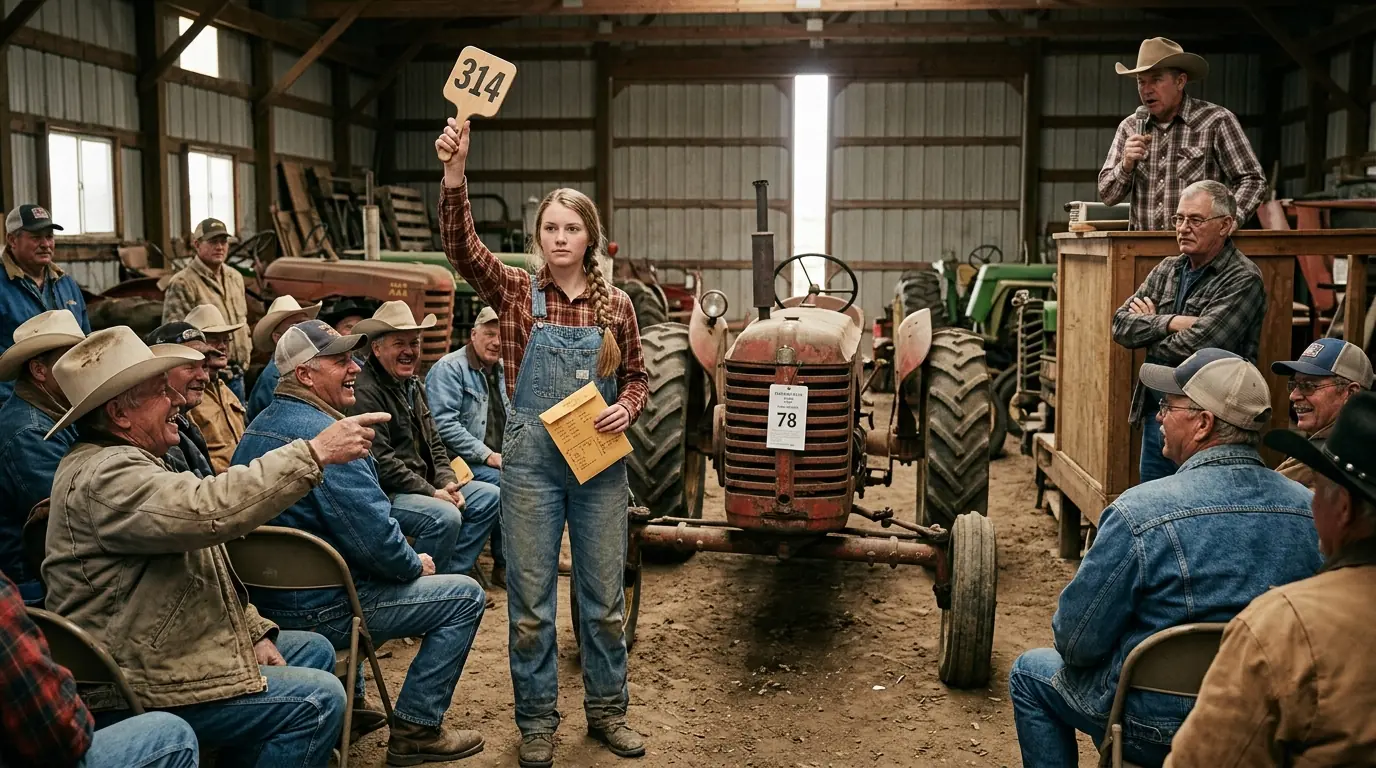
Tractors.
Plows.
Harvest equipment.
Machines that had worked thousands of acres before being replaced by newer models.
The air smelled like diesel fuel, dry dirt, and old machinery.
Coffee cups sat on truck beds.
Farmers leaned against trailers.
People greeted each other by name.
Everyone knew everyone.
And then a teenage girl walked through the gate.
Maggie Holloway was fifteen years old.
She was not there to watch.
She was not there because her father sent her.
She was there because she had a plan.
In her pocket was a small metal tobacco tin.
Inside was $380.
Two years of savings.
Money earned from mowing lawns.
Helping neighbors with farm work.
Detasseling corn during summer.
Every dollar had a purpose.
She also carried a small envelope.
Inside was not a dream.
Not a guess.
A list.
A repair plan.
Specifications.
Measurements.
Information.
That difference mattered.
Because Maggie was not looking for a tractor that looked good.
She was looking for a tractor other people had misunderstood.
The men at the auction noticed her immediately.
A teenage girl walking through rows of heavy equipment was not something they saw often.
Some smiled.
Some laughed quietly.
Some assumed she was just there because someone else sent her.
An older farmer named Earl Vickers watched her from near the registration table.
Earl had spent thirty-five years buying and selling farm equipment.
He knew machines.
He knew people.
And when he saw Maggie walking around with a notebook and flashlight, he shook his head.
“She’s just playing farmer.”
The man beside him laughed.
“Think her dad sent her?”
“Probably.”
Neither man meant to be cruel.
They simply believed they understood what they were seeing.
A child pretending.
Not a buyer.
Not someone who belonged.
But Maggie was not paying attention to them.
She walked through the rows carefully.
She ignored the tractors with fresh paint.
She ignored the machines that attracted crowds.
She looked at the forgotten ones.
The equipment people had already dismissed.
Because that was where opportunity existed.
Everyone noticed the obvious.
Very few people looked deeper.
Then she found Lot 22.
A 1951 Massey Harris 44.
At first glance, it looked terrible.
The paint had faded from bright red to a dull pink.
The tires were old.
The metal showed years of work.
But the biggest problem was obvious.
The front end.
It sat crooked.
The axle appeared damaged.
Most farmers looked at it and immediately decided.
Parts tractor.
Not worth repairing.
They walked past.
Maggie stopped.
She spent twenty-six minutes examining it.
People noticed.
Because nobody else cared.
She walked around the tractor.
Once.
Twice.
Three times.
She checked underneath.
She measured the front hub.
She looked at the steering components.
She opened her notebook.
She wrote.
The older farmers watching became amused.
“What’s she doing?”
“Taking notes for her museum piece?”
A few laughed.
Maggie ignored them.
She climbed into the seat.
Turned the steering wheel.
Listened.
Checked the engine.
Looked again.
The problem was not what everyone thought.
And she knew exactly why.
Two years earlier, Maggie had started learning from her grandmother.
Vera Holloway.
Vera was not the type of person who gave long speeches.
She taught through work.
“Hold this.”
“Bring me that wrench.”
“Watch closely.”
That was how Maggie learned.
She spent years in the workshop beside her grandmother.
She watched engines come apart.
She learned how machines failed.
She learned that experience was not just seeing something many times.
It was understanding why something happened.
Before Vera passed away, she left Maggie three things.
Her old wooden toolbox.
Her repair journals.
And the collection of service manuals and manufacturer documents she had saved for decades.
A note was attached.
Two words.
“Use them.”
Maggie did.
One of those documents changed everything.
A 1954 Massey Harris service circular.
It explained a known issue with certain 1950 and 1951 models.
The front end could appear damaged.
The tractor could look like it had suffered a major accident.
But the real problem was a worn steering spindle bushing.
A small part.
A cheap repair.
A problem that looked expensive but was not.
Maggie remembered the document.
And when she saw Lot 22, she recognized it.
Everyone else saw a broken tractor.
She saw a repair.
The auction started.
Machines sold one after another.
Farmers raised paddles.
Prices climbed.
Then the auctioneer reached Lot 22.
The Massey Harris was pushed forward.
The description was simple.
“1951 Massey Harris 44. Front end compromised. Sold as is.”
Nobody moved.
“Who’ll start me?”
Silence.
“$175?”
Nothing.
“$125?”
Nothing.
“$90?”
Still nothing.
Then a hand went up.
Not from one of the experienced buyers.
From Maggie.
The crowd noticed.
A fifteen-year-old girl bidding.
The auctioneer looked surprised.
“Bidder number 48.”
The price continued.
The salvage buyer raised.
Maggie raised.
The salvage buyer raised again.
Maggie raised again.
Slow.
Calm.
Certain.
Finally, the salvage buyer stopped.
The auctioneer looked around.
“Going once.”
Nobody moved.
“Going twice.”
The gavel dropped.
“Sold.”
Maggie owned the tractor.
$155.
Less than half the money she had saved.
The crowd reacted with disbelief.
Some thought she had made the biggest mistake of her life.
Earl Vickers walked toward her afterward.
He was not laughing anymore.
He looked concerned.
“Young lady.”
Maggie turned.
“I don’t mean to tell you what to do.”
“But that tractor has a bent axle.”
Maggie listened.
“That’s not the problem.”
Earl frowned.
“What?”
“The axle isn’t bent.”
He looked confused.
“It’s the steering spindle bushing.”
The older man stared.
“How do you know that?”
Maggie opened her envelope.
“Massey Harris service circular from March 1954.”
She explained the defect.
The measurement.
The specification.
The exact number she found.
Earl became silent.
Because she was not guessing.
She knew.
The entire conversation attracted attention.
Several farmers walked closer.
They wanted to hear.
They wanted to understand.
And slowly, something changed.
The girl they thought was pretending was teaching them something.
Not because she was older.
Because she was prepared.
Earl looked at the tractor.
Then at Maggie.
“Where did you learn this?”
“My grandmother.”
“What was her name?”
“Vera Holloway.”
Earl smiled.
“Vera?”
He laughed softly.
“She was one of the toughest farmers I ever met.”
For the first time that morning, people did not see Maggie as a child.
They saw her as Vera’s granddaughter.
And that meant something.
A week later, Maggie brought the tractor home.
She parked it in her grandmother’s old workshop.
The same place where she learned.
The same place where Vera kept her manuals.
She placed the Massey Harris on stands.
Then she began.
She removed the damaged parts.
Checked the components.
Replaced the worn bushings.
Adjusted everything according to the specifications.
The repair cost less than twenty dollars.
The time?
Three hours.
The tractor everyone thought was worthless was never broken.
It had simply been misunderstood.
When Maggie started the engine again, the sound filled the workshop.
She drove it down the gravel road.
The front end tracked perfectly.
No pulling.
No leaning.
No problem.
She had been right.
Two months later, Maggie sold the tractor.
Price:
$525.
Her total cost:
Around $170.
Profit:
More than $350.
But the money was not the important part.
The important part was proving something.
Age did not decide knowledge.
Appearance did not decide value.
And reputation did not replace research.
The story spread through the farming community.
People talked about the girl who bought the “broken” Massey Harris.
They talked about the auction.
The repair.
The mistake everyone made.
Soon, farmers began bringing equipment to Maggie.
Not because she was young.
Because she was good.
Old balers.
Broken combines.
Tractors nobody else could repair.
She studied them.
She listened.
She fixed them.
Years later, Maggie opened Holloway Agricultural Repair.
A small shop at the end of a gravel road.
No advertising.
No signs everywhere.
Just her reputation.
Farmers came because someone told someone else.
The same way rural communities always worked.
Trust moved faster than marketing.
Decades later, Earl Vickers visited her shop one final time.
He was retired.
Older.
Slower.
But he remembered the auction.
He remembered the girl with the paddle.
“I owe you an apology.”
Maggie smiled.
“For what?”
“That day.”
He looked around the shop.
“I thought you were lucky.”
Maggie waited.
“I thought you just repeated something you heard.”
She smiled.
“And now?”
Earl laughed.