“You planning to farm with those, or open a junkyard?”
The question came from the gravel shoulder just as Caleb’s father pulled the first rust-covered baler through the farm gate.
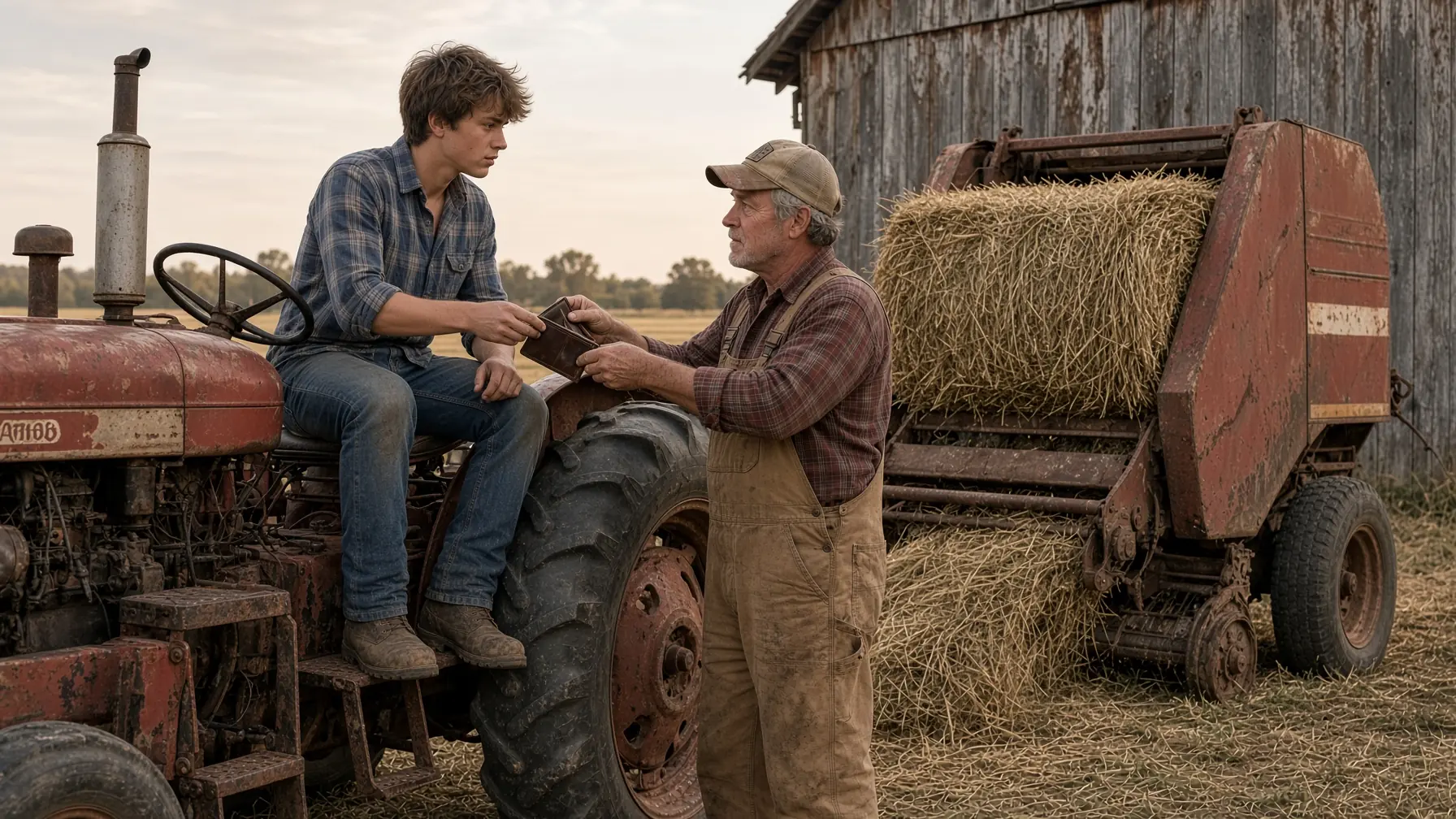
Caleb stood beside the mailbox, one hand raised to guide the trailer away from a broken fence post. At sixteen, he was old enough to hear what the question really meant, and young enough that everyone expected him to stand there and take it.
Two neighboring farmers had stopped their trucks to watch.
The man who had spoken leaned against his door, smiling at the baler as though Caleb had hauled home something he had already paid to get rid of.
“That one’s dead,” he said. “I remember when it quit.”
Caleb looked at the machine.
One side panel was missing. A chain hung loose beneath the frame. Weeds caught in the pickup assembly trembled as the trailer moved past.
“I know,” he said.
The farmer laughed.
Behind the first baler came the rest of Caleb’s purchase: three more abandoned machines, each waiting to be hauled from the equipment yard where they had stood long enough for the grass to grow around their tires.
By evening, all four would be sitting beside his family’s barn.
His father stopped the truck and leaned out the window.
“You can still change your mind.”
Caleb knew he meant it kindly.
He also knew what changing his mind would mean. They would spend more time and fuel taking the first machine back, lose the money already paid, and still have no reliable way to bale their hay.
“Let’s unload it,” Caleb said.
His father studied him for a moment.
Then he put the truck in gear.
The farmer on the shoulder shook his head.
“Four piles of scrap metal. That’s what you bought.”
Caleb lowered his guiding hand.
He did not argue, because explaining the plan beside the mailbox would not make it work. And until he had taken the machines apart, he could not be certain that the thing he had seen in them was real.
The family farm lay on a quiet Iowa road where everyone could tell how a season was going by what sat in a neighbor’s yard.
A new tractor meant things were going well.
A machine waiting beside the barn with its covers removed meant things were going less well.
The four balers were hard to misunderstand.
Caleb’s family had been trying to keep their older equipment working for several seasons. Each repair postponed a purchase they could not comfortably make, and each postponement made the next breakdown feel more serious.
Their own baler had finally reached the point where his father no longer trusted it.
It had failed late the previous season, then again during a test before the new hay crop was ready. This time, the damage was more than an afternoon’s repair.
His father had stood beside it holding a broken component and said nothing for a long time.
Caleb had watched from the barn doorway.
“How bad?”
His father set the piece on the workbench.
“Bad enough.”
They could hire someone to bale their hay, provided that person finished his own work first and the weather stayed favorable. They could look for another used machine, although the ones they could afford usually came with the kind of problems a seller described as minor.
They could repair theirs.
Every option cost money they were already using somewhere else.
At supper, his father spoke about calling around.
His mother asked whether any neighbors had room in their schedules.
“Maybe,” his father said.
It was an answer Caleb heard often enough to understand. It meant there was no good answer yet.
He had gone to the equipment yard the next afternoon looking for parts.
The owner led him toward a row of old machines behind the usable equipment. There were bent cultivators, an empty wagon frame, and the four balers standing beneath a layer of rust and sun-faded paint.
“Those are parts machines,” the owner said. “Or scrap. Depends how patient you are.”
Caleb walked around the nearest one.
Its frame looked straight. The pickup had damage, and part of the drive assembly was gone, but the bale chamber was more complete than he expected.
The second machine had a ruined section beneath a side cover. Its pickup assembly, however, looked better.
The third had good pieces in places where the first was missing them.
The fourth looked worst from a distance.
Up close, Caleb found a set of components he had just spent several minutes trying to locate on the others.
He crouched beside it.
The owner waited.
“You need a particular part?”
Caleb wiped dirt from a plate, then moved back to the first machine.
“Maybe more than one.”
He spent the next hour comparing them.
They were old balers from the same general line, close enough in design that many of the pieces appeared compatible. None was complete. None was worth trying to run as it stood.
But the reasons they had stopped working were different.
Caleb took photographs and wrote notes on the back of an old worksheet from school. He marked missing pieces, damaged assemblies, intact housings, and parts he needed to inspect more closely.