Harold Henderson saw the fish pouring from the pickup and thought Della Marsh had finally lost whatever sense grief had left her.
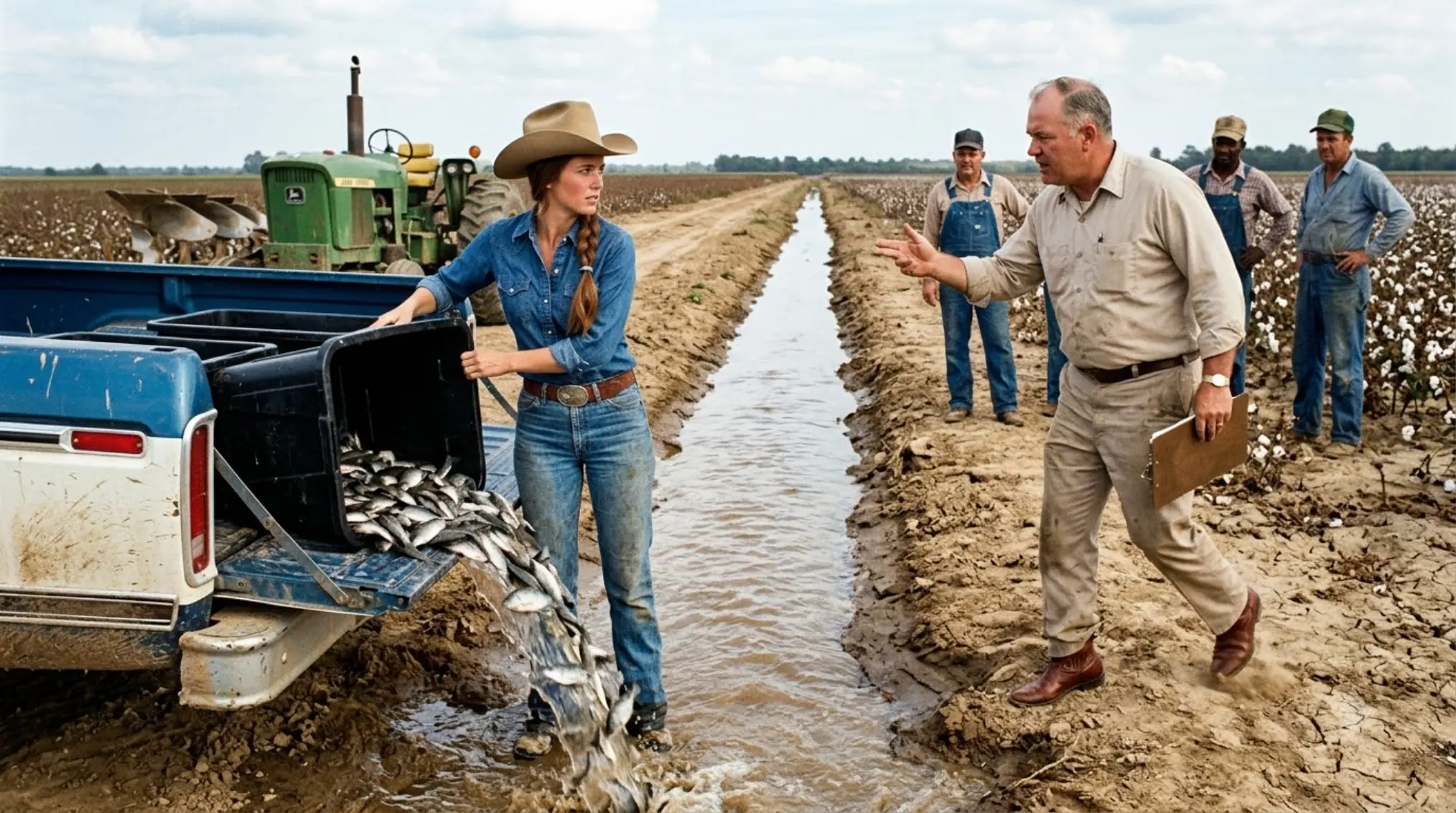
Hundreds of silver bodies slid across the lowered tailgate and disappeared into the muddy irrigation ditch beside her family’s cotton fields.
Water splashed against Della’s boots.
Her old Ford pickup rocked slightly as another tank emptied.
She stood beside the truck wearing a tan cowboy hat, fitted blue denim shirt with the sleeves rolled above her elbows, faded jeans, and a brown leather belt darkened by years of fieldwork.
Her chestnut hair hung in one loose braid over her shoulder.
Twenty-four years old.
Three hundred acres.
No husband.
No father.
Almost no money.
And now, apparently, a ditch full of fish.
Henderson came across the field clutching his clipboard.
“Shut that gate!”
Della did not turn.
Another rush of tilapia poured into the water.
“You hear me?”
She pushed the tailgate wider.
Henderson slapped the clipboard against the truck.
“You’re dumping your last dollar into a damn ditch!”
Della finally looked at him.
“Better than burying my farm under your fertilizer debt.”
His face reddened.
“You have no idea what you’re doing.”
“I know exactly what I’m doing.”
“You need nitrogen.”
“I know.”
“You need eighty pounds an acre if you expect that cotton to survive.”
“I know that too.”
Henderson stared at her.
“Then what the hell are the fish for?”
Della looked toward the water.
“For the nitrogen.”
He laughed.
Not politely.
He laughed loudly enough that two neighboring farmers standing near the fence line turned toward them.
“Fish?”
Della said nothing.
Henderson slammed his fist against the truck bed.
“When that cotton dies, nobody’s coming to save you!”
Della reached beneath the transport tank.
Her hand closed around the release lever.
“Good.”
She pulled.
The final surge of water exploded down the tailgate, carrying dozens more tilapia into the ditch.
“Come back at harvest and watch these fish make your numbers look stupid.”
Then she closed the valve.
Henderson stood speechless.
Della picked up an empty bucket and walked toward the pump house without giving him another look.
By sunset, half of Madison County knew what she had done.
By the end of the week, nearly everyone had an opinion.
Most agreed on one thing.
Della Marsh was going to lose the farm.
The Marsh land had not always looked exhausted.
When Della was a child, cotton grew thick across the fields.
Her father, Walter Marsh, could scoop up a fistful of soil and squeeze it into a dark clump that smelled rich and alive.
By the late 1960s, that had changed.
The soil became pale.
Hard.
Powdery.
Every year Walter needed more fertilizer to produce less cotton.
Rain disappeared into cracks and seemed to vanish.
The irrigation ditches turned stagnant during summer, their surfaces coated with algae and mosquito larvae.
Neighbors responded by buying more chemicals.
Anhydrous ammonia.
Synthetic nitrogen.
New herbicides.
Bigger pumps.
More debt.
Walter resisted longer than most.
He hated borrowing.
“The bank lends you an umbrella when the sky is clear,” he once told Della, “then wants it back the minute the rain starts.”
But his refusal had consequences.
Without expensive fertilizer, his yields fell faster than neighboring farms.
Some people called him stubborn.
Others called him old-fashioned.
Della simply watched him become tired.
During his final years, Walter spent less time driving the tractor and more time walking the farm.
Della often followed.
He would stop beside an irrigation ditch and stare into the water for several minutes.
Once, when Della was seventeen, she asked what he was looking for.
“I don't know yet.”
“That’s a strange answer.”
Walter smiled.
“Most useful answers start that way.”
He pointed toward the green algae.
“See that?”
“Yes.”
“Life.”
Della looked closer.
“Looks like pond slime.”
“That too.”
He laughed.
Then he crouched beside the cotton row and picked up a handful of pale soil.
“This dirt is hungry.”
“For fertilizer?”
“For food.”
“Aren’t they the same thing?”
Walter shook his head.
“That’s what I’m trying to figure out.”
He wrote constantly.
Rainfall.
Temperature.
Soil color.
Water level.
Algae growth.
Earthworms.
Root depth.
He recorded everything in leather-bound notebooks he kept beside his desk.
Sometimes he drew diagrams Della did not understand.
Water moving through ditches.
Fish inside ponds.
Arrows pointing toward fields.
One page contained a single question beneath a rough sketch:
Could the water itself become the fertilizer?
Walter never lived long enough to answer it.
He died in 1971.
Della inherited the farm.
And the notebooks.
The lawyer handling Walter’s estate expected Della to sell.
So did the bank manager.
So did most of the neighbors.
Three hundred acres could still bring respectable money even in poor condition.
A chemical company had already expressed interest in leasing part of the property.
Della refused.
“This is my home.”
The banker leaned back.
“Emotion doesn't make payments.”
“I don’t owe you anything.”
“Not yet.”
He slid a loan package across the desk.
“You will if you try another cotton season.”
The numbers were brutal.
Seed.
Fuel.
Repairs.
Fertilizer.
Labor.
Della could borrow enough to operate.
But if the harvest failed, the farm would become collateral for the debt.
She pushed the documents back.
“No.”
“What are you going to use for fertilizer?”
“I’m working on something.”
The banker almost smiled.
“What?”
Della stood.
“When I know, I’ll tell you.”
She went home and opened Walter’s journals.
For three weeks she read.
Not casually.
She cross-referenced dates.
Compared rainfall to yield.
Tracked the condition of fields nearest drainage areas.
Walter had repeatedly noted that cotton growing near certain wet sections appeared darker and stronger.
He had also noticed unusually healthy vegetation downstream from a neighbor’s livestock pond.
Della began reading agricultural books.
Then biology texts from the county library.
She learned how fish waste produced ammonia.
How bacteria converted ammonia into nitrites.
How other bacteria converted nitrites into nitrates.
Plants could use nitrates.
Water carrying dissolved nutrients could feed soil gradually.
The concept was not magic.
It was biology.
The question was whether she could make it work across irrigation ditches instead of controlled tanks or ponds.
Della had no university degree.
But she had something Walter valued more.
She paid attention.
The insurance money from her father was small.
She could buy fertilizer for one season.
Or try something nobody around her believed would work.
Della chose the second option.
She drove two hours to a coastal fish supplier.
“I want tilapia.”
“How many pounds?”
“Live.”
The owner looked at her.
“What?”
“I need breeders.”
“For a pond?”
“Ditches.”
He laughed.
Della didn’t.
By afternoon, a large tank in the Ford’s bed held hundreds of juvenile tilapia.
She drove home slowly because the weight of the water made every turn dangerous.
At the first irrigation headgate, she backed up.