Beau Landry’s laughter carried across the cracked Louisiana field while Marie Fontenot lowered the woven basket into the muddy basin. Live crawfish crawled over one another inside it, their claws scraping against the wet reeds as she tipped them into the shallow water. Four neighboring farmers stood beyond the broken levee, watching as if she were releasing money into a grave. Marie kept her eyes on the mud because she knew beginnings always looked foolish to people who had arrived only to witness the end.
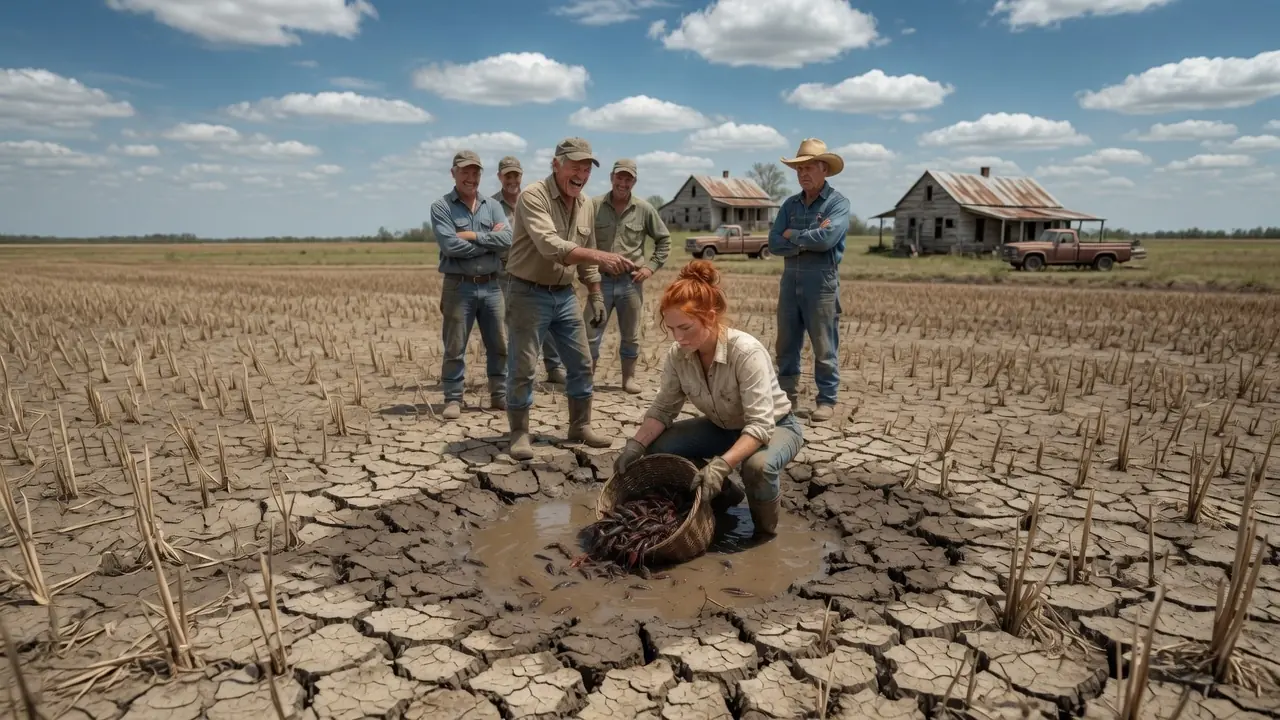
The farm stretched across sixty-two neglected acres outside the small community of Belle Rive in Saint Marais Parish. Years without proper drainage had left deep cracks across the rice fields, while the old crawfish ponds had collapsed into dry bowls filled with weeds and discarded fencing. The farmhouse leaned toward the east, the irrigation pump had not worked in twelve years, and the barn roof allowed more rain inside than it kept out. County records described the property as distressed agricultural land with limited commercial value.
Marie had purchased it for eighty-four thousand dollars.
That amount represented nearly every dollar her grandfather had left her, combined with the savings she earned working nights as a bookkeeper in Lafayette. Her friends believed she should have bought a small house or opened a safe business in town. The farmers at the local cooperative believed grief had made her reckless. Beau believed desperation would eventually force her to sell the land to him for half what she had paid.
Marie was twenty-seven, with freckled fair skin, sharp green eyes, and red hair she kept twisted into a work bun beneath a faded cap. Her cream farm shirt was stained with mud at the elbows, and her blue jeans had been repaired so many times that several patches covered other patches. She owned one unreliable pickup, a used water pump, six crawfish traps, and a collection of handwritten journals that had belonged to her grandfather, Étienne Fontenot. What she lacked in equipment, she carried in a plan no one else had bothered to understand.
Étienne had spent fifty years farming rice and crawfish before illness forced him to sell most of his acreage. He taught Marie that crawfish were never simply a second crop added after rice. Rice straw fed the crawfish, crawfish disturbed and fertilized the soil, flooded ponds suppressed weeds, and draining the fields prepared them for the next planting. Each season supported the one that followed.
“Nothing good on a farm should perform only one job,” Étienne often said.
His journals contained water depths, stocking dates, soil temperatures, rice varieties, feed rates, and notes about how crawfish behaved before storms. He recorded which levees held during floods and which ponds lost oxygen during sudden heat. Many pages included corrections written years apart, showing that experience was not a collection of perfect answers but a record of mistakes remembered honestly. Marie had read every journal twice before buying the abandoned property.
Beau Landry owned nearly eight hundred acres across the parish and served as vice president of the Belle Rive Agricultural Cooperative. His fields produced rice, soybeans, and sugarcane using machines worth more than Marie’s entire farm. He was not accustomed to being challenged by someone half his age, especially a woman returning from the city with old notebooks and ideas about rebuilding exhausted soil. When Marie applied for cooperative credit, Beau attended the review meeting.
She requested thirty-two thousand dollars for seed rice, juvenile crawfish, pump repairs, and levee construction. Her business plan projected a modest first harvest, followed by stronger production after the pond ecosystem stabilized. She planned to sell live crawfish directly to restaurants rather than accept the lower bulk price offered through the cooperative. She also intended to package specialty rice under her family name.
Beau read only the first few pages.
“You have no reliable water,” he said.
“The deed includes permanent access to the Belle Rive irrigation canal.”
“That canal hasn’t served your property in years.”
“The recorded easement never expired.”
“Paper rights don’t move water.”
“Pumps do.”
Several board members smiled.
The cooperative rejected her application, calling the project too experimental for land already considered unproductive. Beau offered to purchase the property immediately afterward. His price was fifty thousand dollars, less than sixty percent of what Marie had paid.
“You can walk away before this ruins you,” he said.
Marie placed his offer back on the table. “You don’t offer fifty thousand dollars for land you believe is worthless.”
Beau’s smile disappeared.
She understood something important at that moment. Beau did not truly believe the farm had no value. He believed Marie would be unable to unlock it before debt, drought, and ridicule forced her to sell.
Marie repaired the first levees by hand.
She rented a compact excavator for three days using money from the sale of her car, slept inside the farmhouse without reliable electricity, and carried fuel in red containers because no supplier extended her credit. She cleared the old irrigation channel, replaced rotten boards in the water gate, and rebuilt the pond banks with heavy clay dug from the basin itself. Every evening, she compared the day’s work with Étienne’s journals.
The original irrigation pipe remained buried beneath thirty years of grass.
It was rusted but usable.
Marie hired a retired pump mechanic named Clarence Webb to rebuild the intake motor. Clarence agreed to accept half his payment after the first harvest because Étienne had once repaired his family’s roof after a hurricane without charging him. He and Marie spent six days cleaning the housing, replacing seals, and rebuilding the corroded control box.
When they activated the pump, nothing happened.
Clarence checked the electrical supply, the intake, and every connection. The equipment was functional, but no water entered the pipe. Someone had closed the upstream canal gate and locked it with a new steel chain.
The irrigation district claimed Marie’s farm no longer appeared on its current service map. She presented the recorded easement, tax records, and historical water-allocation receipts from her grandfather’s journals. The district manager told her that old documents would need legal review and suggested waiting until the following season. Without water, the crawfish and seed rice she had purchased would be lost within weeks.
Marie visited the parish clerk’s office.
A records technician helped her locate the original canal agreement from 1968. It granted the Fontenot parcel a permanent agricultural draw of two hundred acre-feet annually in exchange for land Étienne had given the district for canal construction. The agreement could not be removed by an updated service map. More troubling, recent district records showed that Marie’s unused allocation had been reassigned temporarily to Beau Landry’s northern fields.
Beau knew the water right still existed.
He had benefited from it for eleven years.
Marie filed an emergency agricultural injunction. A parish judge ordered the irrigation district to unlock the gate while ownership rights were reviewed. Water entered the old pipe the following morning, traveled beneath the field, and poured into the first restored basin.
Marie stood barefoot in the mud while the pond slowly filled.
She did not celebrate publicly.
She simply opened Étienne’s journal and wrote the date.
The first crawfish she released were mature breeders purchased from a farm two parishes south. She placed them into the shallow pond during the cooler evening hours, distributing them near the banks where they could burrow. Behind her, Beau and several neighboring farmers watched from the fence.
That was when he called them bugs.
Marie lifted one crawfish toward him and told him to bring his buyers at harvest. The line sounded confident, but that night she sat alone in the farmhouse listening to every strange sound beyond the walls. She had spent nearly all her remaining money, and confidence did not protect living creatures from bad water, disease, predators, or heat.
For three weeks, very little happened.
The crawfish disappeared into burrows, leaving only small chimneys of mud above the ground. Beau drove past twice and slowed long enough to observe the empty pond. At the cooperative diner, men joked that Marie had purchased invisible livestock.
She planted rice in the flooded basins.
The young green shoots rose slowly from water that had once covered only cracked earth. Their roots held the mud together, while their growth shaded the ponds and provided cover for the crawfish. Marie installed simple oxygen meters at several depths and checked them before sunrise and after sunset.
A June heat wave created the first serious crisis.
Water temperatures rose rapidly, and the dissolved oxygen dropped overnight. Crawfish gathered near the edges, climbing reeds and exposing themselves to birds. Marie recognized the warning from one of Étienne’s entries and activated an old paddle-wheel aerator Clarence had repaired from salvaged parts.
The motor failed after twenty minutes.
Marie climbed into the water and turned the wheel manually while Clarence rushed from town with a replacement belt. For nearly two hours, she stood waist-deep in muddy water, forcing oxygen into the pond while her arms shook from exhaustion. By sunrise, the belt was installed and the crawfish began moving away from the banks.
She lost several hundred.
She saved thousands.
The first rice crop was smaller than neighboring farms, but Marie expected that. She harvested only enough to cover taxes, fuel, and part of Clarence’s payment. Rather than burning or removing the rice straw, she reflooded the fields and allowed it to decompose.
The straw became food.
Tiny organisms gathered around the decaying plant matter, and the crawfish emerged from their burrows to feed. Their movement loosened the compacted mud, while their waste returned nutrients to soil that had been considered dead. Marie began setting traps in October.
The first morning produced thirty-eight pounds.
The second produced forty-seven.
By the end of the week, she filled nearly every container she owned.
Marie drove the live crawfish to Lafayette herself and approached restaurants one by one. Most chefs already purchased through established distributors, but one woman named Celeste Broussard agreed to inspect them. Celeste owned a respected seafood restaurant and cared more about freshness than tradition.
She opened one sack, examined the size and color, and watched how actively the crawfish moved.
“How long since they left the pond?” Celeste asked.
“Fifty-seven minutes.”
“You timed it?”
“I time everything.”
Celeste purchased the entire load.
She offered nearly twice the cooperative price because the crawfish were large, clean, and delivered alive. Customers noticed the difference, and within three weeks Celeste requested every pound Marie could supply. Two other restaurants followed.
The first season did not make Marie wealthy.
It kept her alive.
She earned enough to repay Clarence, repair part of the barn roof, and purchase two hundred additional traps. More importantly, she completed an entire cycle: rice to straw, straw to crawfish, crawfish to income, and income back into the farm.
The soil tests changed.
Organic matter in the first basins had increased, while compaction decreased significantly. The pond mud held water longer and required less pumping than expected. Areas that once produced only weeds began supporting thick rice growth during the second year.
Beau stopped laughing publicly.
He continued working privately.
The cooperative refused Marie access to its refrigerated storage facility, claiming independent crawfish producers did not qualify for rice-member benefits. Because she sold directly to restaurants, he argued that she operated outside the cooperative’s marketing structure. Without cold storage, Marie risked losing product during sudden heat or transportation delays.
She converted the old barn’s north room into a temporary holding area using salvaged insulation and secondhand refrigeration units. Clarence designed a water-circulation system that kept the crawfish cool and oxygenated without submerging them completely. Celeste advanced part of the following month’s purchase to help finance the equipment.
Marie named the operation Fontenot Rice and Crawfish.
By the third year, she managed thirty-eight flooded acres and produced more than sixty thousand pounds of crawfish. Her rice yield remained below the parish’s highest conventional farms, but her combined income per acre exceeded nearly all of them. Because the same land produced two crops using one integrated system, her equipment and fertilizer costs remained unusually low.
Beau’s operation faced the opposite problem.
His farm produced enormous harvests but carried loans on tractors, harvesters, pumps, and chemical inputs. Falling rice prices reduced his margins, while fuel costs continued rising. His fields depended on large volumes of irrigation water, including the allocation he had quietly borrowed from Marie’s parcel.
The court issued its final decision during Marie’s third spring.
The Fontenot water easement remained permanent.
Beau was ordered to return every portion of the allocation that had been transferred from Marie’s farm. The irrigation district also compensated her for the delay that threatened the first stocking season.
Outside the courthouse, Beau approached her.
“You had enough water by the second year,” he said.
“It was mine in the first year.”
“You’re holding a grudge.”
“I’m holding a deed.”
He stepped closer. “You think a few restaurant contracts make you untouchable?”
“No.”
“What happens when the ponds get sick? When your buyers change menus? When one storm destroys those levees?”
“I rebuild.”
“You say that because you’ve never lost everything.”
Marie looked toward him. “I started with what everyone else had already abandoned.”
That summer, a tropical storm stalled over Saint Marais Parish and dropped nearly twenty inches of rain. Conventional drainage canals overflowed, sending water across roads and into low fields. Several farms lost young rice after deep currents tore plants from the soil.
Marie’s levees held.
She had planted willow, switchgrass, and water-loving shrubs along the weakest banks, allowing roots to reinforce the clay. Her overflow channels directed excess water into a lower wetland instead of forcing it against one wall. The ponds rose but did not break.
Beau’s northern levee failed during the night.
Water from hundreds of acres rushed into a drainage ditch carrying fertilizer, sediment, and young rice. The current headed toward a residential road and three nearby houses. Beau called the parish emergency office, but machinery could not reach the break through flooded ground.
Marie opened one of her emergency spill gates.
The action allowed part of the water to enter her lower retention basin, reducing pressure downstream. The basin flooded far beyond its normal depth, destroying part of her rice crop but preventing water from reaching the homes.
Beau arrived the following morning.
He stood beside Marie on the levee, looking across the submerged field she had sacrificed.
“Why did you open it?” he asked.
“Because those families live below us.”
“You lost twenty acres.”
“I lost rice.”
“You saved my land.”
“No. I kept your water from entering their houses.”
Beau looked away.
The storm created an unexpected opportunity. Sediment carried into Marie’s lower basin was rich in organic material, and the reinforced wetland captured it rather than allowing it to wash into the bayou. After the water receded, independent soil scientists found the basin healthier than it had been before the flood.
The following harvest broke every record Marie had kept.
Crawfish traps emerged heavy enough to require both hands. Average size increased, survival rates improved, and the restored mud supported dense natural food. Celeste coordinated a group of restaurants that agreed to purchase the entire harvest under a premium contract.
Refrigerated trucks lined the farm road before sunrise.
Beau arrived with two land brokers.
He had remembered Marie’s challenge from the first day.
“Bring your buyers at harvest—you’ll watch me reject every offer.”
One broker offered Marie seven hundred thousand dollars for the property. The other represented an agricultural investment company willing to pay nearly one million if she included the Fontenot brand, restaurant contracts, water rights, and production records.
Marie did not open either agreement.
The brokers increased their offers.
She refused again.
Beau watched workers load sacks into the trucks. “You could walk away rich.”
Marie looked across the ponds. “Walk away to where?”
“A farm with better land.”
“This is better land.”
“It was dead when you bought it.”
“It was neglected.”
The first day’s shipment alone contained more than fifteen thousand pounds of premium crawfish. Across the full season, Marie’s farm generated more net income per acre than Beau’s rice and soybean fields combined.
Local newspapers called it the richest land in Saint Marais Parish.
The description referred to revenue, but the soil tests told an even deeper story. Organic matter had multiplied, bird populations increased, water leaving the property carried less sediment, and the restored wetland reduced downstream flooding. Marie’s farm had become profitable because it grew healthier rather than because it was exhausted faster.
The cooperative changed its rules.
Independent crawfish and mixed-system producers were suddenly invited to use cold storage, join purchasing programs, and apply for seasonal credit. Beau supported the changes without publicly acknowledging that Marie had forced them.
Months later, he came to her farmhouse alone.
He carried no offer and no contract.
“My southern fields are failing,” he said.
Marie waited.
“Salt levels are rising, and the soil seals after every hard rain. The extension office says I need to reduce pumping and rebuild organic matter.”
“What do you want from me?”
He looked toward the crawfish ponds. “Teach me the rotation.”
Marie remembered the laughter, the denied cooperative application, and the locked canal gate. Forgiveness did not arrive automatically because a powerful man finally needed what he had mocked.
“You tried to starve this farm of water.”
“Yes.”
“You wanted me to fail so you could buy it.”
“Yes.”
“You called my grandfather’s system foolish.”
Beau lowered his head. “Yes.”
“Why should I help you?”
He took a slow breath. “Because you were right about one thing. Men like me kept fighting the land until it couldn’t give us anything without being forced.”
Marie studied him for a long time.
“I’ll teach your workers,” she said. “Not for free, and not through the cooperative.”
He nodded.
“You will also return the smaller farmers’ voting rights you blocked.”
His eyes lifted.
“And the cooperative will create an independent water-allocation review.”
“That could remove me from the board.”
“Yes.”
Beau looked toward the ponds again. “Send me the agreement.”
Marie trained twelve farms during the next three years. She did not teach everyone to copy her system exactly. Some properties could support crawfish, while others needed different crops, deeper drainage, or restored pasture.
She taught them to observe first.
Fontenot Rice and Crawfish expanded carefully, eventually adding a nursery that supplied healthy breeding stock to smaller producers. Marie built a cold-storage and packing facility beside the barn but refused offers from large corporations that wanted exclusive control of her harvest.
Celeste remained her first buyer.
Clarence continued repairing pumps until he retired, after which Marie hired his granddaughter as the farm’s mechanical manager. The first broken aerator belt hung inside the office beside Étienne’s journals.
Years later, visitors often asked Marie which moment proved the farm would succeed.
They expected her to name the record harvest, the restaurant contract, or the court decision restoring the water rights. Marie always gave the same answer.
“The morning the crawfish climbed out of low-oxygen water.”
That crisis showed her the system was alive enough to fail and valuable enough to save.
The cracked field never became rich because someone discovered hidden treasure beneath it. Its value grew from rice roots, decomposing straw, crawfish burrows, captured rain, patient records, and one woman unwilling to accept that abandoned land had reached the end of its usefulness.
Beau once promised to buy the farm for pennies after her crawfish died.
Years later, he stood beside his own restored pond holding the first successful trap from a field he had nearly destroyed through exhaustion. He looked toward Marie and offered a quiet smile.
“No graves,” he said.
Marie examined the living crawfish inside the trap.
“No,” she replied. “Just another harvest.”
Across Saint Marais Parish, ponds filled where cracked basins once sat empty. Small farmers earned income from rice and crawfish without borrowing for two separate operations. Wetlands returned along drainage channels, and stormwater moved more slowly through land that had learned how to hold it again.
Marie never became the richest person in the parish.
She became the caretaker of its richest soil.
Every spring, she returned to the basin where she released the first woven basket. The original mud bank had disappeared beneath thick grass, healthy rice, and crawfish chimneys rising like tiny towers along the water.
People had laughed because they saw insects entering a dead pond.
Marie saw workers entering a living system.
The farmers believed she had bet her future on bugs.
In truth, she had bet it on a lesson her grandfather understood long before anyone else listened: land becomes worthless only after people stop asking what it still knows how to grow.