The first livestock trailer arrived at Whitaker Ranch at 7:12 on a gray July morning, followed twelve minutes later by another truck that looked as though it had been dragged backward through twenty years of Kansas winters.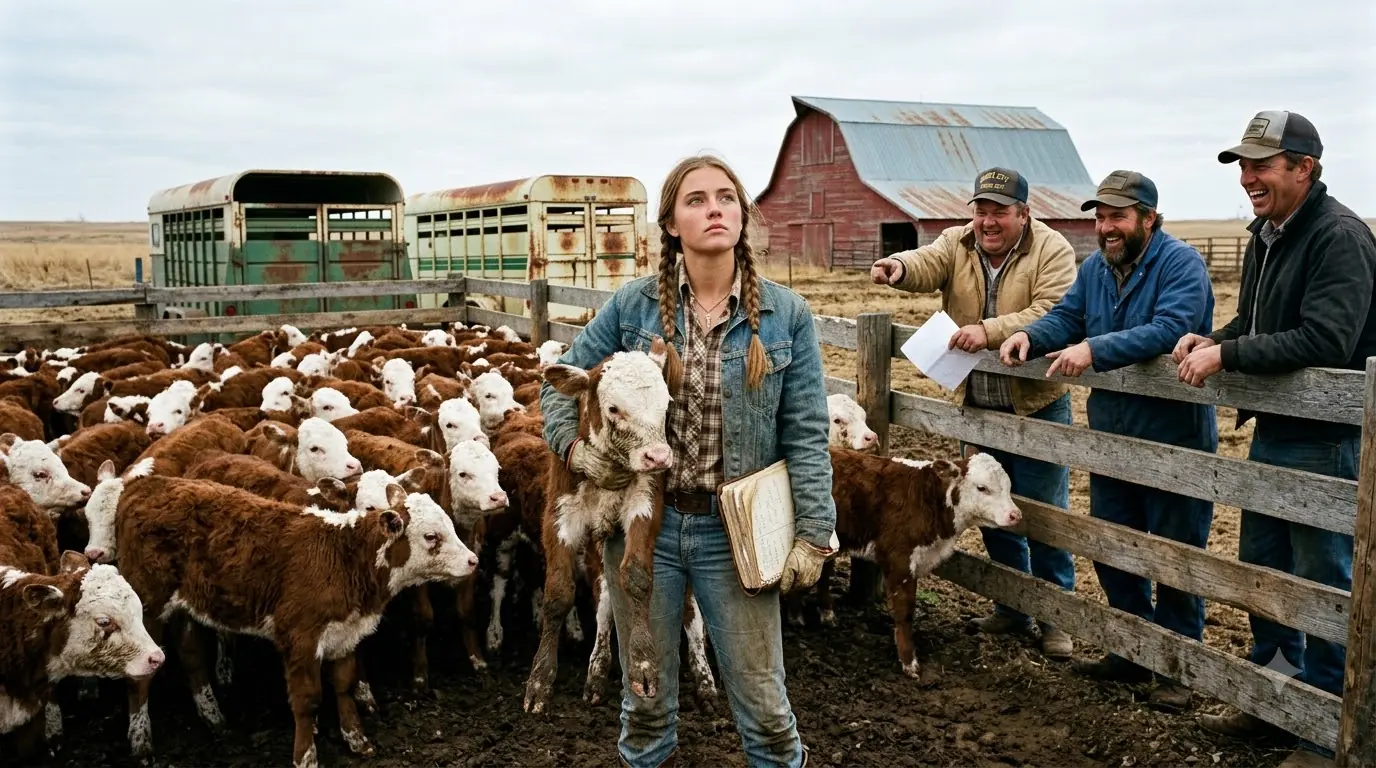
Emma Whitaker stood beside the old wooden receiving pen with both hands shoved into the pockets of her denim jacket and watched the trailers turn through the gate. At nineteen, she was younger than almost every cattle buyer who had ever stepped onto the property, and people regularly made the mistake of assuming that youth meant ignorance. Her long light-brown hair was divided into two braids, her boots were already muddy from opening water troughs before sunrise, and tucked beneath one arm was the thick, grease-stained notebook that had belonged to her grandfather.
The notebook was the closest thing Emma had left to Walter Whitaker.
He had died eight months earlier after suffering a heart attack while repairing a windmill in the western pasture. Walter had raised Emma after her mother died and her father disappeared into oil work in Oklahoma, and he had taught her cattle before he taught her algebra. By twelve, she could estimate the weight of a Hereford calf within twenty pounds. By fifteen, she could tell dehydration from pneumonia by watching an animal stand for thirty seconds.
But knowing cattle and owning a ranch were very different things.
Walter left Emma one hundred sixty acres, an aging barn, fourteen miles of questionable fencing, thirty-seven breeding cows, two tractors that required prayer before starting, and more debt than he had ever admitted while alive. The bank wanted its quarterly payment in six weeks. Hay prices were climbing. The summer pasture had browned earlier than expected. If Emma did not create income before autumn, Whitaker Ranch might become another piece of land absorbed by one of the large operations steadily swallowing the county.
That was why she had agreed to buy the calves.
The price was absurd.
Thirty-five dollars a head.
Less than half of what even poor feeder calves normally brought.
Emma knew there had to be something wrong.
The seller, Dorsey Plains Feeders, was one of the largest feedlots in western Kansas. Raymond Dorsey ran nearly twenty thousand head and had the kind of reputation that made small ranchers lower their voices when his name came up at livestock auctions. He had money, trucks, feed contracts, lawyers, and enough influence at the county bank to make unpleasant conversations happen without appearing in the room himself.
Three days earlier, Raymond had called Emma personally.
“We’ve got three hundred calves we’re clearing.”
Emma had been repairing a broken gate.
“Why?”
“Poor performers.”
“How poor?”
“Underweight.”
“Disease?”
“No confirmed disease.”
“Deaths?”
A pause.
“Some.”
Emma stopped hammering.
“How many?”
“Nothing unusual for stressed cattle.”
“That wasn’t a number.”
Raymond laughed.
“You always this difficult?”
“My grandfather said vague answers cost more than honest ones.”
“Walter always had opinions.”
“He usually earned them.”
Raymond offered the calves for ten thousand five hundred dollars total.
Emma nearly hung up.
Then he added:
“You can pay half now and half after sixty days.”
That was unusual.
Very unusual.
Emma asked, “Why give me credit?”
“Because Walter and I did business.”
That was technically true.
It was also incomplete.
Walter disliked Raymond.
Emma knew that too.
Her grandfather had once described Dorsey Plains Feeders as “a place where accounting grew faster than cattle.”
Still, ten thousand five hundred dollars for three hundred living calves was impossible to ignore.
If even two hundred fifty recovered and gained weight, Emma could turn them by autumn and potentially save the ranch.
If they died, she would lose everything faster.
Walter used to say that ranching was mostly deciding which disaster had better odds.
Emma had signed.
Now the trailers were here.
The first driver opened the rear gate.
A brown-and-white calf stumbled backward.
Then another.
Then six.
Emma’s stomach tightened.
They were worse than she expected.
Much worse.
Ribs showed beneath rough coats.
Several calves carried their heads low.
One had watery eyes.
Another stepped awkwardly as though every joint hurt.
A third simply stood inside the trailer refusing to move until the driver slapped the aluminum wall behind it.
Emma climbed onto the pen rail.
“Easy!”
The driver looked toward her.
“They’re stubborn.”
“They’re weak.”
“Same difference when unloading.”
“No, it isn’t.”
A pickup entered behind the second trailer.
Three men climbed out.
Raymond Dorsey first.
Fifty-two, broad around the waist, red baseball cap, tan canvas jacket despite the summer humidity, and a smile Emma had never liked.
Beside him came Clint Mason, his feed manager, and Harvey Sloan, livestock procurement manager.
Raymond leaned against the fence.
“Morning, Emma.”
She did not look away from the calves.
“You said poor performers.”
“They are.”
“You didn’t say they could barely stand.”
Clint laughed.
Raymond lifted one shoulder.
“They stood well enough to load.”
Emma jumped from the fence.
A calf staggered toward her.
She caught it beneath the chest before it fell.
The animal weighed perhaps two hundred fifty pounds but felt strangely light against her.
Emma ran one hand along its neck.
Dry skin.
Dull hair.
She lifted the eyelid.
Pale.
Then looked at the gums.
Too pale.
Raymond watched.
“You planning to diagnose all three hundred yourself?”
Emma ignored him.
She checked another calf.
Then another.
Same dull coat.
Pale mucous membranes.
Poor body condition.
Several had weakness in the rear legs.
One showed slight swelling above a hock.
Emma frowned.
Not random.
Patterns mattered.
Harvey unfolded the transfer papers.
“You signed as-is.”
Emma looked at him.
“I know what I signed.”
“No refunds.”
“I didn’t ask for one.”
Raymond laughed.
“That’s Walter’s granddaughter.”
Clint pointed toward the pen.
“Give her a week.”
Harvey grinned.
“What?”
“Half these things will be horizontal.”
Raymond shook his head, amused.
“Now, boys.”
Emma slowly stood.
Mud covered both gloves.
She looked toward them.
“You drove all the way here to laugh?”
Raymond smiled.
“Just wanted to make sure you understood what you bought.”
“I understand ownership.”
“That’s not what I mean.”
Emma held his gaze.
“Then say what you mean.”
His smile sharpened.
“You bought problems experienced cattlemen already decided weren’t worth solving.”
Clint chuckled.
Harvey leaned against the fence.
Raymond continued.
“You’re nineteen.”
“Yes.”
“You’ve got forty cows, maybe.”
“Thirty-seven.”
“Exactly.”
“And now you have three hundred calves requiring feed, medicine, labor, and luck.”
Emma looked back toward the herd.
Raymond pointed.
“Those animals ate money for ninety days and gave us nothing.”
“You think your grandfather’s little notebooks are going to make you smarter than a commercial yard running twenty thousand head?”
Emma’s hand tightened around Walter’s notebook.
“No.”
She looked back at Raymond.
“I think looking at the cattle might.”
Harvey laughed loudly.
Clint joined.
Raymond simply smiled.
Emma opened the notebook.
The pages smelled faintly of machine grease, dust, and Walter’s tobacco.
She had read much of it, but not everything.
Forty years of handwritten information filled the pages.
Calving dates.
Bull performance.
Weather.
Pasture observations.
Mineral formulas.
Disease outbreaks.
Weight gains.
Failures.
Lots of failures.
Walter believed failures deserved more ink than successes because success made people arrogant.
Emma turned pages while Raymond watched.
Then an entry from 1967 caught her eye.
Haskins calves. Rough coat. Pale membranes. Weak hind legs. Hocks enlarged. Poor gain despite grain. Not infection. High molybdenum pasture interfering with copper. Mineral corrected gradually under veterinary direction. Recovery visible 18–25 days.
Emma stopped breathing for a second.
She looked toward the calf in her arms.
Rough coat.
Pale gums.
Weak hind legs.
Swollen hocks.
Poor gain.
Her heart began beating faster.
Raymond noticed.
“Find the magic spell?”
Emma looked at him.
“What are they eating?”
He frowned.
“What?”
“At Dorsey.”
“Feed.”
“What ration?”
Clint answered this time.
“Milo base.”
“Hay?”
“Prairie plus some alfalfa.”
“Mineral?”
“Standard feedlot premix.”
Emma looked toward him.
“Which one?”
Clint rolled his eyes.
“Jesus, girl.”
“Which mineral?”
“Whatever the mill supplies.”
Emma’s eyes sharpened.
“You don’t know?”
Clint stopped smiling.
Raymond stepped forward.
“You implying something?”
Emma closed the notebook.
“No.”
Not yet.
She did not know enough.
Raymond took the transfer papers from Harvey.
He extended them.
“Sign receipt.”
Emma did.
Raymond tore away his copy.
Then looked toward the calves.
“Seven days.”
Emma frowned.
“What?”
“That’s how long before you call asking us to haul them away.”
Harvey laughed again.
Emma held his gaze.
Raymond continued.
“I’ll even make you a deal.”
“What deal?”
“When they start dying, we’ll collect carcasses cheap.”
Emma stepped closer to the fence.
The men went quiet.
She lifted Walter’s notebook.
“Come back in sixty days.”
Raymond smiled.
“Why?”
“Just come.”
“What will I see?”
Emma looked across the herd.
Then back at him.
“Either you were right…”
She paused.
“…or you’re going to need a checkbook.”
Raymond laughed so hard he slapped the fence.
“Buy them back?”
Emma did not smile.
“If you can afford them.”
The three men left still laughing.
Emma waited until the pickup disappeared through the gate.
Then fear finally arrived.
She looked at three hundred weak calves crowded around the water trough.
Walter’s handwriting suddenly seemed very small.
“Grandpa,” she whispered.
“I hope you knew what you were talking about.”
The first call Emma made was to Dr. Samuel Reed.
Sam was sixty-three, semi-retired, and had treated cattle across Ford County for nearly thirty years. He had known Walter longer than Emma had been alive and possessed the useful personality of a man who considered optimism suspicious until laboratory results supported it.
He arrived an hour later.
Emma met him beside the chute.
Sam looked into the pen.
Then at Emma.