The livestock trailers arrived beneath a hard Texas sky, throwing dust across the neglected forty-acre ranch outside Perryton. Nineteen-year-old Dana Warren stood inside the crowded pen, ankle-deep in straw and mud, holding a weak brown-and-white calf against her chest while nearly three hundred rejected animals stumbled down the loading ramps around her. Their ribs showed beneath dull coats, several coughed continuously, and one calf collapsed before reaching the water trough. Four cattlemen leaned against the fence laughing as though they had delivered garbage instead of living creatures.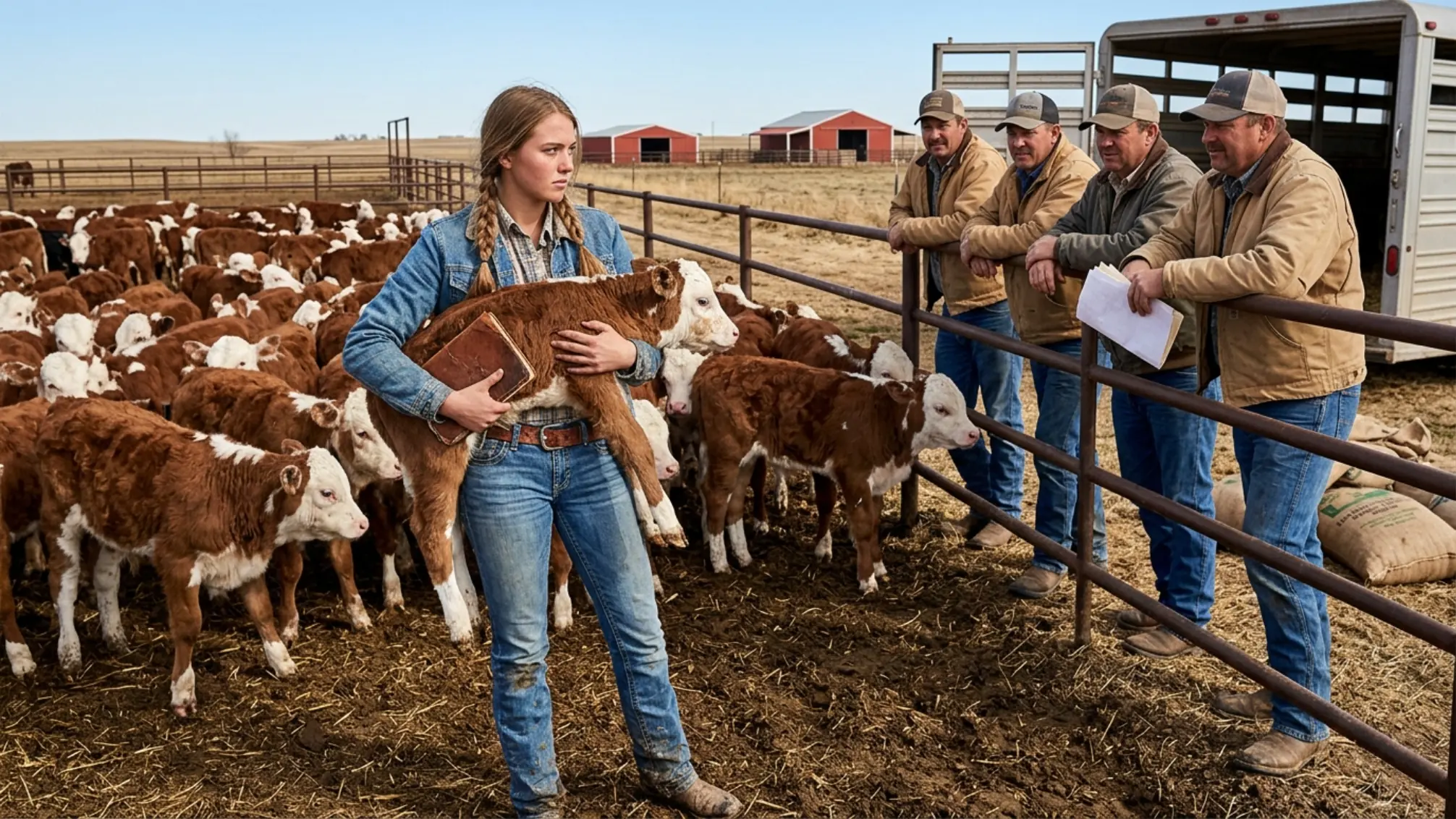
The neighbor released her arm, more surprised by her defiance than frightened by it. His name was Hollis Dean, an aging rancher who owned the better section of land two miles east and had known Dana since she was small enough to ride his fence rails. He did not consider himself cruel. In his mind, grabbing her had been the gesture of an older man trying to stop a stubborn girl from destroying herself.
Gary Boyce, the manager from Caprock Regional Feedlot, glanced at the transfer papers lying in the mud. The feedlot had accepted the calves from an Oklahoma shipment, only to discover that most were undersized, sick with scours, or too weak to justify further expense. Caprock’s accountants had decided writing off the entire group would cost less than treating them.
Dana’s inherited ranch was listed as active grazing land.
To Gary, that made it a convenient hole into which the feedlot could pour a loss.
“You don’t understand what you’ve been handed,” he said, wiping dust from his canvas coat. “Half of them won’t survive the month. They’ll eat every dollar you have before they die.”
“Then why did you bring them here?”
“Because the paperwork says this property can receive livestock.”
“You could have called.”
“And given you time to refuse?”
Dana stared at him.
Gary looked away first.
The trailers pulled out before noon, leaving behind three hundred bawling, coughing calves and a cloud of dust that settled slowly across the pens. One animal lay on its side near the ramp. Dana placed the calf she was holding beneath the shade and hurried toward the fallen one.
Its breathing was shallow.
She poured water into her palm and touched it to the animal’s mouth. The calf did not respond.
Hollis remained beside the fence.
“There’s a buyer near Spearman,” he said. “He’ll take the whole lot Thursday. Eleven cents on the dollar, cash. You’ll lose money, but at least you won’t lose the ranch.”
Dana kept one hand against the calf’s neck. “They arrived ten minutes ago.”
“And already one is dying.”
“That means it needs help.”
“It means Gary was telling the truth.”
Dana lifted her head. “My grandfather never sold an animal because saving it looked difficult.”
“Your grandfather had forty years of experience.”
“And I have his land.”
“Land doesn’t teach judgment.”
“No. Men standing at fences telling women they’ll fail seem eager to do that.”
Hollis removed his hat and pressed it against his leg. “Dana, this is not about you being a woman.”
“It became about that the moment you called me girl and grabbed my arm.”
“I’m trying to keep you from making a mistake.”
“Then let me make my own.”
Hollis studied her for several seconds. Pity and frustration moved across his weathered face.
“Your grandfather would understand a hard decision made quickly.”
Dana looked at the calf trying to lift its head.
“No,” she said. “He’d understand refusing to quit before the work even starts.”
Hollis left without another argument.
Only after his truck disappeared did Dana feel the true weight of what she had refused to surrender. Three hundred calves stood on land that had buried her grandfather two months earlier. She had no feed contract, no veterinarian on retainer, and barely enough money in the estate account to keep the ranch operating through summer.
Her grandfather, Warren Cole, had died beside a water tank on a cold February morning. His heart simply stopped while he was checking a frozen line. A lawyer’s letter arrived three weeks later informing Dana that she had inherited the ranch, its equipment, and every debt attached to it.
The banker in Perryton had already decided how the story would end.
Russ Callaway kept Warren’s mortgage file open on his desk during Dana’s first meeting. He asked whether she had a plan in the careful tone adults used when testing whether a child understood a dangerous object. Dana said she did, though she had no plan she could explain without sounding foolish.
Russ nodded and told her to return if she needed help.
She understood what he meant.
Return when you are ready to sell.
That afternoon, surrounded by dying calves, Dana finally admitted that stubbornness was not a plan. Refusing Hollis’s buyer had purchased only a few days. It had not created grass, medicine, fencing, or money.
She spent the rest of the day carrying water and separating the weakest calves into the barn. Three could not stand. Several had severe diarrhea, and others showed signs of respiratory illness.
By midnight, Dana’s arms trembled from exhaustion.
She sat on an overturned feed bucket beneath a single hanging bulb and listened to the animals breathe. The barn still smelled like her grandfather—hay dust, leather, pipe tobacco, and the mineral oil he rubbed into old harnesses.
His boots remained beside the mudroom door.
Dana had not moved them.
She told herself she had been too busy, but the truth felt closer to superstition. As long as the boots remained there, some part of Warren might still walk through the kitchen asking why the coffee had gone cold.
Near the back of the barn stood the tack room Dana had never been allowed to enter as a child. A rusted padlock secured the door. Warren always told her it contained sharp tools and things that might fall on small hands.
Now there were no small hands left on the ranch.
The following morning, Dana searched the farmhouse for the key. She checked desk drawers, coat pockets, kitchen jars, and the wooden box where Warren kept receipts. She found it accidentally inside an old coffee can filled with screws, cotter pins, and a pencil worn nearly to its metal band.
The brass key was tied to a brittle scrap of paper.
On it, Warren had written one word:
Later.
The padlock had rusted so badly that it broke apart instead of opening. Dana stood in the doorway holding the two pieces, wondering whether later had finally arrived.
Inside, bridles hung from orange nails. Dust covered a pair of hand clippers, feed scoops, and boxes marked with years long past. Behind a folded horse blanket, Dana found a cracked leather notebook the color of a saddle left through too many storms.
She opened it while sitting on the feed bucket.
The first entry was dated March 1962.
Warren had been younger than Dana when he wrote it.
His handwriting was small and slanted, pressed deeply into the paper. He described a drought that loosened fence posts from soil hardened like concrete. He recorded the death of eleven cattle in May and wrote the number as though confessing a failure.
He wrote about losing his father and fearing he would lose the land next.
Dana turned the pages slowly.
There were no inspiring speeches or polished wisdom. The notebook contained grazing dates, rainfall measurements, feed costs, animal weights, and calculations written at two in the morning. Fear appeared not as poetry but as numbers crossed out and written again.
Then she found the map.
Warren had divided the forty acres into six grazing sections: North Draw, Well Field, Rocky Quarter, Low Pasture, the Strip, and Home Section. Arrows formed a rotation between them. Beside each field, he recorded the number of days cattle could graze before the grass required rest.
Seven days in North Draw.
Five in Low Pasture.
Ten in Well Field because the grass recovered slowly over shallow caliche.
One corner of Rocky Quarter had been circled twice.
Do not use, even when dry. Roots will not hold.
Below the map was a feed formula.
Cottonseed meal.
Stock salt.
Finely ground bone meal.
Measured quantities mixed and placed near the windmill every third day, more often during extreme heat. Warren had underlined bone meal twice and added a note in darker ink:
Cheaper than losing them. It works. Do not let anyone call it waste.
A second handwriting appeared in the margins. It belonged to Dana’s grandmother, a woman Dana knew only from a faded photograph.
She had recorded feed expenses and potential losses, then added a sentence unrelated to money:
He has not slept in eleven days. I told him the land is not punishing him. He does not believe me yet.
Dana remained in the tack room until the light through the small window turned gold.
For the first time since the funeral, she did not feel alone.
The notebook did not promise success. It proved only that Warren had once been terrified, inexperienced, and close to failure.
And he had continued.
Dana carried the ledger into the kitchen and copied the grazing plan onto clean paper. The ranch had only two usable large pastures. Warren’s system required six.
That meant rebuilding fences immediately.
The next morning, Dana borrowed a tractor-mounted post auger from Hollis’s nephew. She worked from sunrise until the machinery had to be returned two days later, then continued with a hand digger.
The ground changed from loose soil to caliche within a foot.
Each strike sent pain through her shoulders. Blisters formed, opened, hardened into calluses, and blistered again beneath them. She stretched wire alone, drove staples into old posts, and learned to brace corners strong enough to resist hundreds of animals pressing against them.
At night, she mixed Warren’s mineral formula.
The smell of cottonseed meal filled the old feed room. Dana measured each ingredient according to the notebook rather than the instructions printed on modern bags.
It felt like arithmetic and faith in equal measure.
The weakest calves received water, electrolytes, and careful feeding. A local veterinarian agreed to visit once after Dana promised payment following the eventual sale. He gave her treatment instructions but warned that the losses could still be severe.
“Most ranchers wouldn’t attempt this,” he said.
“Most ranchers weren’t handed three hundred animals without permission.”
“You can still sell.”
“So everyone keeps telling me.”
“That doesn’t make them wrong.”
“No. But it doesn’t make them right either.”
By late May, Dana had completed four paddocks. The calves moved according to Warren’s rotation, allowing grazed sections to recover before the herd returned. She watched the animals constantly, adjusting the schedule when grass thinned faster than the old notebook predicted.
Warren’s plan was not magic.
It required observation.
Some evenings, Dana returned to the house too tired to eat. She sat at the kitchen table with the leather ledger open beside her own cheap spiral notebook, comparing pasture conditions, weights, feed costs, and rainfall across sixty years.
Russ Callaway called from the bank twice in June.
He said he was concerned.
Dana recognized the tone. It meant he expected failure but wanted to sound kind when it arrived.
“The operating account is falling quickly,” he said.
“I know.”
“Selling part of the herd could protect the property.”
“They’re gaining.”
“Not fast enough to cover your exposure.”
“You haven’t seen them.”
“I’ve seen the numbers.”
“So have I.”
“Dana, sentiment is not a business strategy.”
“Neither is panic.”
He became quiet.
“The bank cannot extend the line indefinitely.”
“I didn’t ask you to.”
After ending the call, Dana sat in the dark kitchen and wondered whether confidence was simply fear spoken in a steadier voice.
July came with temperatures above one hundred degrees.
Grass browned at the edges. Water tanks dropped several inches each day, and calves gathered beneath every strip of shade. Dana began moving the herd before sunrise, counting each animal as it passed through the gate.
Then the deaths began.
Four calves died in one week.
Three more the next.
Dana buried all seven with the tractor because paying for removal would consume money needed for feed. Each grave felt like an accusation.
By July twenty-second, she barely slept.
One night, the electricity failed, and Dana read Warren’s notebook by lantern light. She searched every page for a mistake she might have made—a measurement misunderstood, a rotation followed too long, a warning she overlooked.
In a margin dated July 1962, she found a line written so small that she had passed it twice:
Lost four this week. Wanted to sell the rest cheap and be finished. Did not. Cattle do not know your calendar. They know grass, water, and whether you quit on them.
No entry followed for six days.
Dana closed the notebook.
Outside, the herd shifted in darkness, creating a low and continuous sound of animals that were resting but not entirely comfortable.
She wanted to cry.
Instead, she carried the lantern outside and checked the water.
The next morning, Hollis appeared at the fence.
He had stopped offering to contact the Spearman buyer. Now he watched the calves quietly, his elbows resting on the top rail.
“You look terrible,” he said.
“Thank you.”
“How many have you lost?”
“Eleven total.”
“Out of three hundred?”
“Yes.”
Hollis looked across the pen.
The calves were no longer hollow through the flank. Their coats had improved, coughing had nearly disappeared, and several steers had begun thickening through the shoulders.
“What are you feeding?”
“My grandfather’s mineral mix.”
“That old bone-meal recipe?”
“You knew about it?”
“Everyone knew Warren mixed something strange during drought years. Nobody knew the numbers.”
“He wrote them down.”
Hollis nodded slowly. “I shouldn’t have grabbed you.”
“No.”
“And I shouldn’t have called you stupid.”
“No.”
“I thought you were going to kill every animal trying to prove something.”
Dana looked toward the herd. “Some nights I thought so too.”
Hollis removed his hat. “Grass looks better than it should.”
Coming from him, the words sounded almost like an apology.
By September, the death count had remained at eleven for three weeks.
The surviving calves had arrived weighing barely two hundred pounds. Many now approached four hundred fifty. Dana borrowed a livestock scale from Hollis and recorded every weight in her spiral notebook.
She placed it beside Warren’s ledger each night.
Two generations of handwriting rested on the kitchen table: his grazing dates from 1962 and her weight records from the present.
What had begun as grief slowly became proof.
In October, a cattle buyer named Cole Hartsell arrived from Amarillo. He represented a packing company investigating Caprock’s livestock write-offs. Gary Boyce had declared the shipment nearly worthless, but insurance auditors wanted confirmation.
Cole leaned against the fence differently from the men who came before him. He watched the animals instead of Dana.
He examined several steers, feeling along their shoulders, loins, and briskets. Then he asked for the scale records.
Dana handed him the notebook without exaggerating the results.
Cole drove to Caprock that afternoon to compare littermates from the same original shipment. He returned two days later carrying a clipboard and an expression of disbelief.
“Your animals are sixty to eighty pounds heavier on average.”
Dana nodded.
“You did this on forty acres?”
“My grandfather did it first.”
Cole offered a premium cash contract for the entire surviving herd. Trucks could arrive before the end of the month.
The amount would cover the mortgage, repay feed expenses, and leave enough money to stabilize the ranch.
For one long minute, Dana imagined signing away every calf.
She imagined the pens empty, the account safe, and sleep returning without numbers running through her mind.
“I’ll sell two hundred seventy,” she said.
Cole lowered his pen. “Why keep thirty?”
“Breeding stock.”
“You could take the full profit now.”
“I could.”
“Then why wait years for calves?”
Dana glanced toward the leather notebook tucked beneath her arm.
“Because fast money leaves faster.”
Cole studied her, then revised the contract.
The trucks arrived near the end of October.
Gary Boyce came with them.
He stepped from a white pickup wearing the same Caprock jacket and stopped when he saw the herd. The animals he had called dead weight now filled the pens with healthy bodies and bright eyes.
“That cannot be the same shipment,” he said.
Dana opened the gate for the loading crew. “You signed them over yourself.”
Gary examined the scale sheet. “What did you use?”
“The land you called a dumping ground.”
“I’m asking about the feed program.”
“And I’m not selling it.”
Gary looked toward the thirty calves being separated from the shipment.
“Caprock might pay well for the breeding group.”
Dana laughed once.
“You threw them away.”
“That was a business decision.”
“So is this.”
“We could make you a serious offer.”
“You already offered your opinion.”
Gary’s face tightened. “You got lucky.”
Dana held up Warren’s notebook.
“Luck doesn’t leave sixty years of records.”
The cattle sold for enough money to change the ranch’s future.
Dana paid the immediate expenses, repaired the well, and placed the remaining funds against the mortgage. The thirty retained animals produced calves the following spring.
Within two years, she entered First State Bank carrying the final payment.
Russ Callaway reviewed the figures twice.
“You are paying the note early.”
“Yes.”
He slid the release papers across his desk. His handshake felt different from the one he had offered the frightened nineteen-year-old he expected to sell by summer.
“I underestimated you,” he said.
Dana folded the document carefully. “A lot of people did.”
Years later, Warren’s notebook remained on the same kitchen table.
Its leather spine had cracked further, and the pages had softened at the folds. Dana kept her own records beside it—pasture rotations, breeding results, feed costs, rainfall, and losses written without hiding fear or failure.
She understood now why Warren saved the ledger behind a locked door.
It was not merely a cattle formula.
It was proof that survival could be studied, recorded, and passed forward.
The feedlot had delivered three hundred animals expecting Dana to become the final entry in a list of losses.
Instead, she saved two hundred eighty-nine.
She retained thirty to build a herd.
She paid the bank.
And every time Gary Boyce’s trucks passed the ranch, he had to look across a fence at descendants of the calves he once declared worthless.
Dana never asked him to admit he was wrong.
The living cattle did it for her.