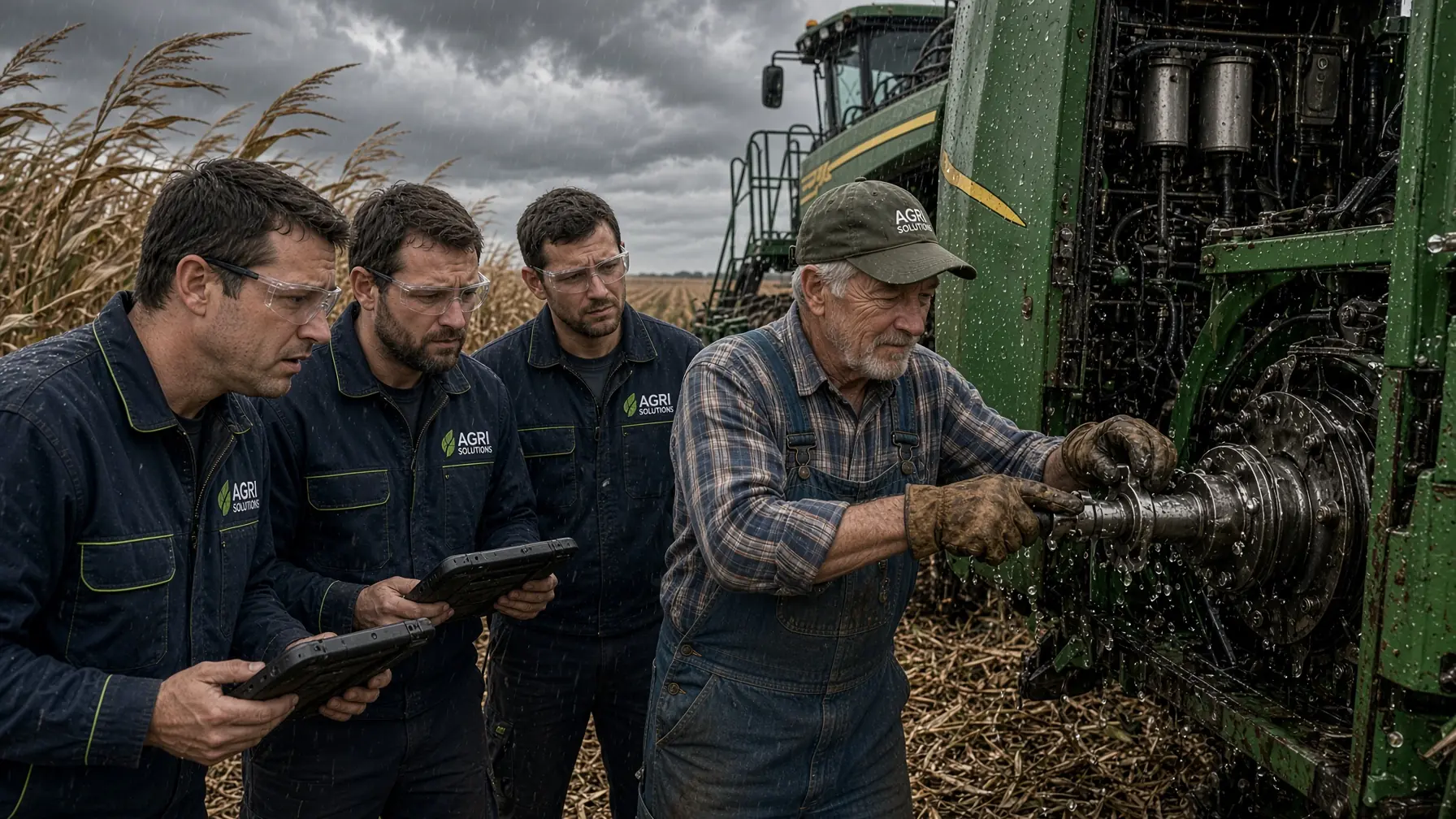
The first engineer laughed when Walter Hayes asked him to shut the combine down and open the drive panel again.
Not a polite laugh.
A real one.
Short.
Sharp.
Dismissive.
Walter stood beside the massive red combine with both hands resting on the bib of his faded denim overalls.
Behind him stretched nearly four hundred acres of corn ready to come out of the field.
Ahead of him, over the western tree line, the sky had turned the color of wet charcoal.
Rain was coming.
Everyone knew it.
That was why five agricultural engineers were standing in Walter’s cornfield at four-thirty on a Thursday afternoon with more electronic equipment than Walter had owned during his first twenty years of farming.
Two diagnostic tablets.
One ruggedized laptop.
A handheld electronic scanner.
Pressure-testing equipment.
Data cables.
Specialty sensors.
A service truck with drawers full of tools and nearly a quarter-million dollars’ worth of dealer diagnostic software.
And a combine that still would not harvest corn.
Engineer Lucas Bennett looked down at Walter’s greasy hands.
“You want us to open the mechanical drive again?”
Walter nodded.
“Yes.”
Lucas smiled toward the other engineers.
“We already checked it.”
Walter looked at the combine.
“You looked at it.”
“That’s generally how checking works.”
One of the younger engineers, Trevor Mills, held up his diagnostic tablet.
“We've got five specialists out here and half a truck full of equipment.”
He smirked.
“Maybe we should let Grandpa fix the computer too.”
Two of the others laughed.
Walter did not.
He looked toward the clouds.
Wind moved through the corn hard enough to turn hundreds of leaves pale-side-out at once.
The smell of rain had already reached the field.
Walter said:
“Keep laughing.”
He pulled on one glove.
“That rain won’t.”
The laughter faded slightly.
Lucas sighed.
“Mr. Hayes, we understand the urgency.”
“No.”
Walter looked at him.
“You understand a weather forecast.”
He pointed toward the corn.
“I understand what happens if that forecast gets here before that machine moves.”
That stopped them.
Because Walter was right.
The crop was ready now.
Too ready.
Moisture had fallen below eighteen percent.
Several stalks had begun leaning after three days of hard wind.
The approaching storm was not supposed to be a summer shower.
The National Weather Service had predicted almost four inches of rain over the next forty-eight hours, followed by strong winds.
If the field became saturated, the combine might not get back in for a week.
If the wind came hard enough first, ears would hit the ground.
Once corn went down, harvest slowed.
Loss climbed.
And Walter Hayes did not have a week.
He had maybe six hours.
The machine had stopped at 11:17 that morning.
A brand-new-looking combine that had cost more than Walter’s first three farms combined.
It had run perfectly through the first thirty-seven acres.
Then, under full load, the rotor speed dropped suddenly.
The monitor flashed yellow.
Then red.
ROTOR SPEED MISMATCH
DRIVE LOAD FAULT
HYDRAULIC PRESSURE DEVIATION
POWER MANAGEMENT LIMIT ACTIVE
Walter had stopped immediately.
Shut down.
Restarted.
Everything appeared normal.
No codes at idle.
No codes during stationary engagement.
The rotor accelerated.
Feederhouse ran.
Hydraulic pressures looked good.
Then Walter drove twenty yards into standing corn.
Load increased.
A vibration came through the floor.
Barely noticeable.
The rotor speed fell.
Warning lights returned.
The computer disengaged the threshing system automatically.
Walter tried twice.
Same result.
That was when he called the dealer.
By noon, one field technician arrived.
By one-thirty, two more.
At three, the regional product specialist arrived.
Then two engineers from the manufacturer who happened to be conducting training seventy miles away were diverted to the farm.
Five experts.
They updated software.
Recalibrated sensors.
Tested hydraulic pressure.
Swapped a rotor-speed sensor.
Checked the drive actuator.
Inspected wiring.
Reviewed live data logs.
Reset the machine.
Nothing worked.
Every component behaved correctly with no crop entering the machine.
Under load, the faults returned.