By three o’clock in the afternoon, the yellow semi had become the most expensive object ever buried in Walter Briggs’s soybean field.
The truck sat at a miserable angle thirty yards from County Road 18 outside Des Moines, Iowa, its front wheels turned slightly toward the road while the rear axles had disappeared deep into black spring mud. The trailer was loaded close to its legal limit, bringing the entire combination to nearly 90,000 pounds.
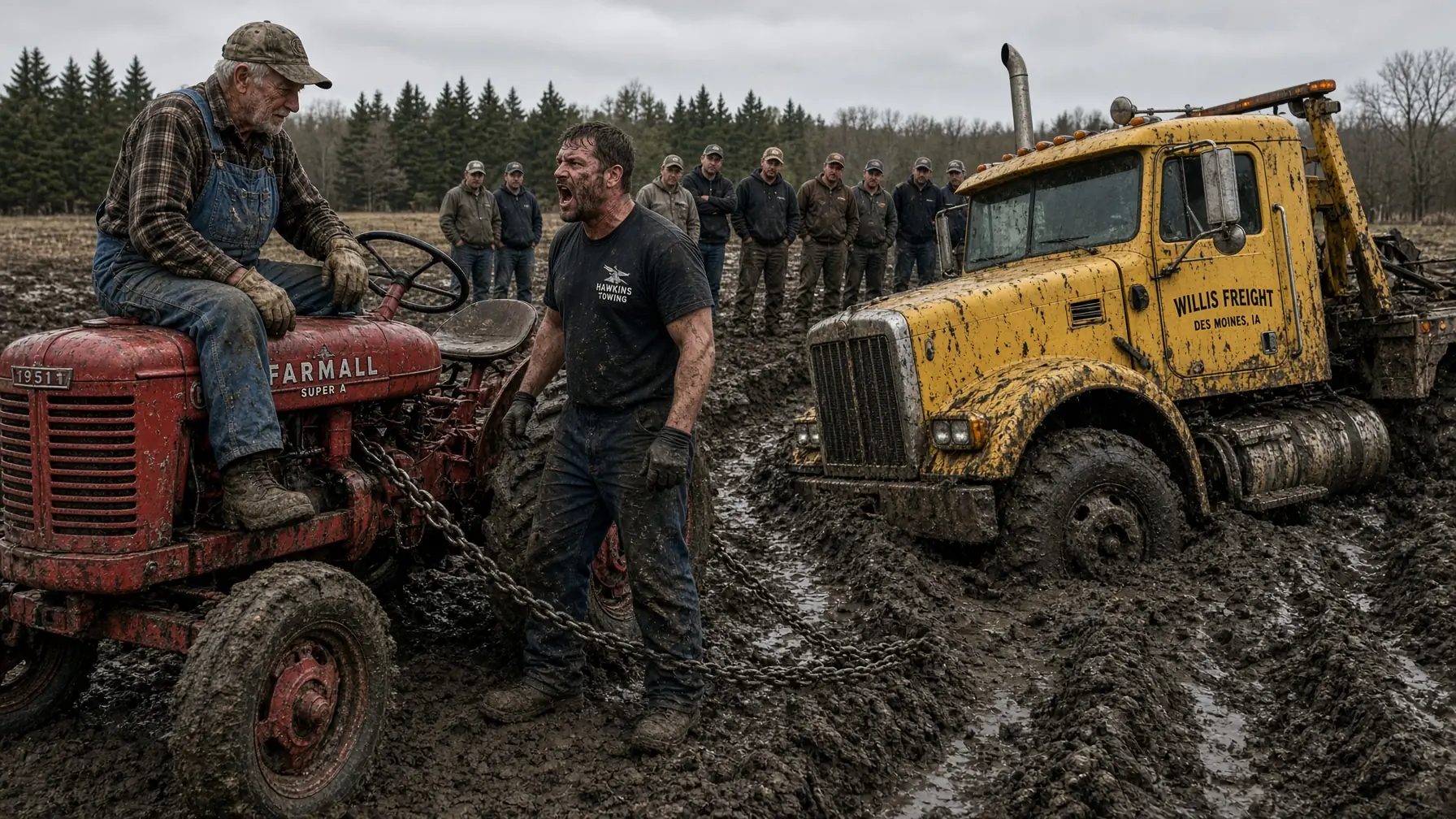
Five towing companies had arrived since sunrise.
All five had tried.
All five had failed.
The field now looked worse than when they started.
Deep ruts crossed one another like trenches. Heavy recovery trucks had churned the ground into a thick mixture of clay and standing water. Steel cables stretched across the field. Workers in muddy boots moved between wreckers, shouting measurements and checking equipment while a growing crowd of farmers watched from the roadside.
At the center of the chaos stood Derek Collins.
Forty-two years old.
Muscular.
Short dark hair.
Black work shirt stained with mud.
He owned Collins Heavy Recovery, the fifth and largest company called to the scene.
Derek had arrived two hours earlier convinced the problem would take thirty minutes.
Now his jaw hurt from clenching it.
“Give me tension again.”
One operator looked at him.
“Boss, we already tried this angle.”
“I know what we tried.”
“The truck dropped another two inches last time.”
Derek turned sharply.
“And doing nothing gets us what?”
Nobody answered.
The semi driver, Calvin Price, stood several yards away with both hands buried inside his jacket pockets. He had spent twenty-seven years driving trucks without putting one into a field.
Until that morning.
He had been approaching a narrow turn when another vehicle crossed too far over the center line. Calvin avoided it, his right tires caught the soft shoulder, and the loaded tractor-trailer slowly slid off the roadway.
Nobody was injured.
At first Calvin thought he had gotten lucky.
Then gravity and saturated Iowa soil began working together.
By the time the first tow truck arrived, the semi had sunk nearly a foot.
By noon, repeated recovery attempts had buried the rear axles deeper.
Now daylight was beginning to fade.
Derek stared at the wreck.
“Again.”
His operator reluctantly climbed back into the recovery truck.
That was when somebody in the roadside crowd laughed.
Not loudly.
Just enough.
Derek turned.
The crowd became quiet.
Then he noticed the tractor.
A faded red machine had appeared at the edge of the field.
Small.
Old.
Almost absurd beside the towering recovery trucks.
At the wheel sat a seventy-three-year-old man wearing a battered camouflage cap, faded denim overalls, an old plaid shirt, and boots covered in dried mud.
The tractor was a 1951 Farmall.
Its paint had faded toward brown in places.
Rust marked the hood.
The seat had been repaired with black tape.
One headlight was newer than the other.
Derek stared.
Then looked toward the farmer driving it.
“Sir!”
The old man shut down the tractor.
The engine settled into silence.
Derek walked toward him.
“You need to stay clear of the recovery zone.”
The farmer looked at him.
“I own the recovery zone.”
Derek stopped.
“What?”
“The field.”
The farmer climbed down slowly.
“My name’s Walter Briggs.”
Derek looked toward the surrounding acreage.
“This is yours?”
“Since 1974.”
Walter glanced toward the semi.
“My father owned it before that.”
Derek nodded impatiently.
“Fine. But we have heavy equipment operating.”
“So I noticed.”
Walter studied the truck.
“How long you been pulling straight toward the road?”
Derek stared.
“Excuse me?”
Walter pointed.
“You’ve got all your equipment north of the truck.”
“That’s where the road is.”
“I can see the road.”
“Then what’s the question?”
Walter stepped farther into the mud.
“The question is why you keep trying to drag ninety thousand pounds uphill through the deepest part of my field.”
Several workers looked toward him.
Derek folded his arms.
“We’re trying to recover the vehicle.”
Walter nodded.
“Been going well?”
A few farmers smiled.
Derek’s expression hardened.
“With respect, Mr. Briggs, this is professional recovery work.”
Walter looked toward five giant tow rigs.
“Expensive too, I imagine.”
“Very.”
Walter nodded toward the semi.
“Still stuck.”
Derek stepped closer.
“You think you can do better?”
Walter looked toward his little Farmall.
“No.”
That answer surprised everyone.
Derek laughed once.
“Good.”
Walter continued.
“But I think I know why you can’t.”
The laughter stopped.
Derek stared.
“Go ahead.”
Walter pointed toward the muddy tire tracks.
“You're pulling against the ground instead of using it.”
Derek shook his head.
“That sentence means nothing.”
“It will.”
Walter walked toward the semi.
Mason Reed, one of Derek’s operators, followed him.
Derek reluctantly did the same.
Walter stopped beside the buried rear wheels.
“See this color?”
He pointed toward the mud.
Mason crouched.
“Dark clay.”
“No.”
Walter picked up a handful.
“Topsoil mixed with clay.”
He moved several feet east and kicked through another rut.
“Here.”
The soil beneath was lighter.
“Sandier.”
Mason looked at him.
Walter nodded.
“This used to be a livestock lane.”
Derek frowned.
“When?”
“Before you were born.”
Walter pointed toward a line of old fence posts barely visible near the far edge of the field.
“My father hauled feed through here every winter. We laid crushed limestone underneath it because wagons kept sinking.”
Derek looked toward the lane.
“I don't see limestone.”
“Because forty years of dirt grew over it.”
Walter looked toward the semi.
“But it's still under there.”
Mason immediately understood.
“A firm base.”
Walter nodded.
“About fifteen feet wide.”
Derek stared toward the invisible path.
“How do you know it hasn't washed out?”
Walter shrugged.
“I drove the Farmall over it this morning.”
Derek looked toward the tiny tractor.
“You drove that through this?”
“Yep.”
“And?”
Walter spread his hands.
“I'm standing here.”
Mason smiled.
Derek did not.
“What exactly are you suggesting?”
Walter pointed toward the semi’s rear.
“Don't pull it toward the road.”
“That’s where it needs to go.”
“Eventually.”
Walter drew a rough line in the mud with his boot.
“First turn the rear toward the old lane.”
Derek stared at the line.
“That moves the trailer farther away.”
“For maybe ten feet.”
“That makes no sense.”
Walter looked at him.
“You've spent six hours trying what makes sense.”
Silence.
One of the farmers laughed.
Derek ignored him.
Walter continued.
“Your trucks have more power than you need. Problem isn't power.”
“What is it?”
“Every time you pull, those rear tires are making their own wall.”
Walter pointed toward the mud packed in front of the wheels.
“You're trying to drag the truck through what it's already pushed up.”
Mason nodded slowly.
“If we rotate the trailer…”
“The wheels could enter the old lane.”
Walter looked toward him.
“Then your equipment can pull from ground that won't swallow everything.”
Derek crossed his arms.