Clara Whitlock was crouched beside the largest mud basin in the lower meadow when Harlan Briggs stopped his truck at her fence for the fourth time that week. She had one yellow-gloved hand wrapped around a clear hose filled with water and the other pressing a wooden measuring stake into the wet clay. Mud streaked the knees of her dark work trousers, covered the toes of her worn leather boots, and marked both forearms beneath the rolled sleeves of her faded denim shirt.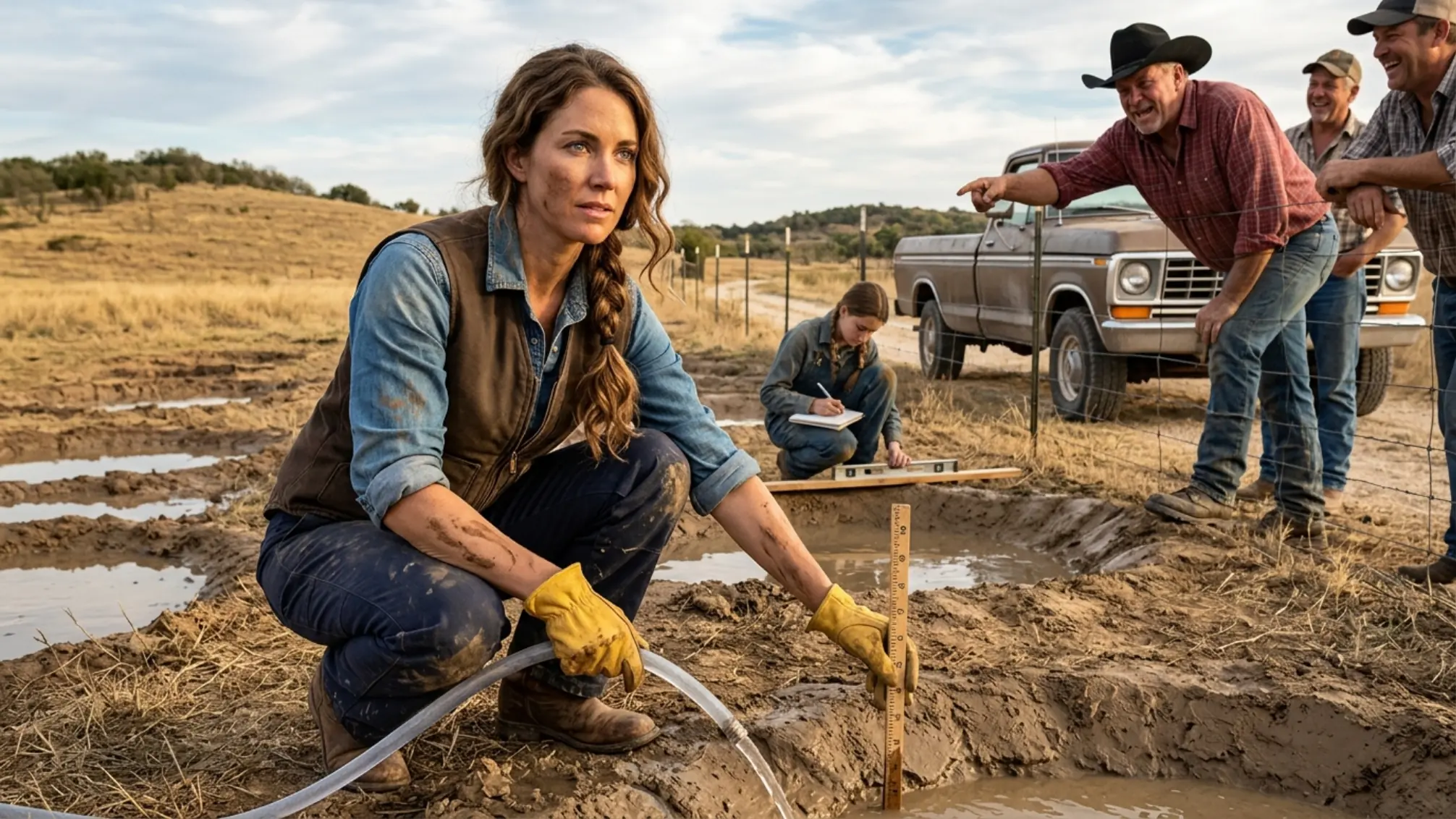
Behind Clara, her fifteen-year-old daughter Lucy knelt beside another basin with a notebook open across one thigh. Four farmers leaned over the wire fence near Harlan’s dusty pickup, laughing as they surveyed the rows of shallow holes scattered across thirty-two acres of dry land. At the center of them stood Harlan in his black cowboy hat, pointing across Clara’s property as though he had been appointed to condemn it.
“You destroyed thirty-two acres with a hundred and twenty mud holes,” he called. “When the bank takes this farm, don’t come begging us.”
Clara slowly lifted her head.
She was thirty-four, with lightly sun-browned skin, clear blue-green eyes, and long chestnut hair woven into a loose braid over one shoulder. Exhaustion had sharpened her face during the summer, but it had not reduced the quiet beauty that made people underestimate how hard she could become when cornered. She released the measuring stake, rose from the basin, and walked toward the fence while muddy water dripped from her gloves.
“Cross this wire and touch one,” she said.
The laughter softened.
Harlan leaned farther over the fence. “One hard storm will wash your little experiment onto the county road.”
Thunder rolled beyond the western ridge.
Every face turned toward the clouds.
Clara looked back at the first basin, where the surface had begun to ripple beneath the earliest drops of rain. Then she raised the clear water level so Harlan could see the marks Lucy had drawn along the hose.
“Don’t leave yet,” Clara said. “The storm’s here, and when that water reaches basin twelve, one of us is losing a farm.”
Six months earlier, there had been no basins.
There had only been Whitlock Farm, sixty-three acres outside Bell Crossing, Texas, a white farmhouse with a sagging porch, a red barn that needed another coat of paint, and a mortgage that did not care how little rain had fallen. Clara had inherited the property after her grandfather Amos died, along with twenty-seven cattle, an aging tractor, and debts large enough to keep her awake after Lucy had gone to bed.
The lower meadow had once been the farm’s strongest ground. Amos used to say hay grew so high there that a man could drop his hat and spend an hour trying to find it. The meadow had fed the cattle, replenished the shallow well, and kept a narrow creek moving along the southern property line even during the hottest months.
Three dry years changed everything.
The grass faded to the color of rope. The ground hardened until the surface cracked under Clara’s boots, and when rain finally came, it rushed across the meadow rather than sinking into it. Two gullies formed along the slope, each one deeper after every storm, carrying soil toward the county road and water away from the farm.
By early June, Clara was hauling feed that the meadow used to provide for free. The well required longer recovery periods after she filled the livestock tank, and the creek remained silent except for a few hours following heavy rain. Every lost inch of soil and every purchased bale moved her closer to the conversation she feared most.
Wendell Cross requested that conversation inside Bell Crossing Community Bank.
He sat across from Clara behind a polished desk, reading the farm’s numbers through narrow glasses while she waited with her hat folded between both hands. Wendell had known Amos for thirty years, but familiarity did not change the figures printed on the page.
“The operating loan remains manageable,” he said carefully. “As long as the herd stays intact and your pasture holds through the season.”
Clara understood the sentence beneath the sentence.
“And if the pasture doesn’t hold?”
Wendell removed his glasses. “You may have to reduce the herd before winter.”
Selling cattle during a drought meant selling alongside every other struggling farmer in the county. Prices would fall precisely when Clara most needed them to remain strong. She drove home gripping the steering wheel so tightly that her fingers ached, calculating how many cattle she could sell before the farm itself became the next thing the bank requested.
A storm struck two nights later.
It arrived fast, throwing hard rain against the roof for forty minutes before moving east. Clara walked the lower meadow at sunrise, expecting the ground to be darker and softer. Instead, most of the water had already vanished into the gullies.
She followed one muddy stream uphill.
For the first time, she noticed that the water had not moved randomly. It followed twelve shallow paths down the slope, tracing nearly identical routes during every storm. The channels were subtle when dry, but once Clara saw them, she could not stop seeing them.
She stood beneath the rising sun, looking across the damaged meadow.
“If that’s where you want to go,” she whispered to the absent water, “maybe I need to give you somewhere to stop.”
That evening, Clara opened Amos’s old deed box at the kitchen table. Beneath property records and yellowed receipts, she found a survey map drawn almost eighty years earlier. The lower meadow was labeled in faded brown ink.
Seep Meadow.
Clara ran one finger beneath the words.
The name suggested that the ground had once held small pockets of moisture near the surface. She walked the forgotten fence line the next morning and found dark soil around several rotting posts, brittle rush roots beneath the crust, and thin layers of clay below the hardened topsoil.
The meadow had not always rejected water.
Something had changed, and Clara could not reverse three years of drought, but she could slow what little rain still arrived. Her first idea was crude enough to sound foolish even to her. If water kept running along the same twelve paths, she would dig shallow basins directly in front of it.
Lucy listened while eating cereal at the kitchen table.
“How many?” she asked.
“As many as it takes.”
“That isn’t a number.”
Clara smiled for the first time in days. “Then you’d better bring a notebook.”
They began with stakes, string, a shovel wrapped in old tape, Amos’s pickaxe, and a clear garden hose turned into a homemade water level. Clara filled the hose and held both ends upright, using the matching water height to compare one section of ground with another. Lucy recorded every measurement in a spiral notebook.
The first basin took nearly three hours.
Clara broke the hardened crust with the pickaxe, widened the opening with the shovel, and shaped the sides into a shallow oval. It was eight feet across and less than two feet deep, with slopes gentle enough for a calf to cross without becoming trapped.
When she finished, it looked like nothing more than an ugly dent in dead ground.
Lucy wrote Basin 1 at the top of the first page.
They dug the next seventeen mostly by hand. Clara worked before sunrise, rested during the harshest afternoon heat, and returned to the field in the evening. Blisters formed beneath the gloves, hardened into calluses, then opened again along new edges of her palms.
After Basin 18, she began using the old tractor.
The machine required three attempts to start on a good morning and six on a bad one. Clara dragged a worn grading blade across each marked location to break the surface, then shaped the basins manually. The process remained slow, but the numbers in Lucy’s notebook climbed.
Twenty became thirty-eight.
Thirty-eight became sixty-one.
By Basin 72, drivers began slowing on the county road.
Harlan Briggs was the first to stop.
He farmed the neighboring property and had an opinion about every piece of land visible from his truck. He leaned through the open window and shouted that Clara was building drinking cups for mosquitoes. Rick Cole, riding beside him, laughed hard enough to strike the dashboard.
Within a week, people at the feed store were calling the Whitlock property Pond Farm.
Someone asked whether Clara planned to raise frogs. Another offered to sell her minnows. At church, an older woman squeezed Clara’s hand and asked whether she was coping properly after her grandfather’s death, as though digging basins were evidence of grief damaging her judgment.
Lucy heard worse at school.
Children who had never seen the meadow claimed it smelled like a swamp. One boy asked whether she arrived each morning by boat. Lucy did not tell Clara until the jokes had continued for nearly two weeks.
Clara set down the fence staple she had been holding.
“Do you want me to speak to the school?”
“No.”
“Are you certain?”
Lucy looked toward the meadow. “I want the basins to work.”
That answer made Clara both proud and afraid.
Because the truth was that Clara did not know whether they would work.
By the time Basin 100 was complete, every drainage path held a chain of shallow holes. Some lines contained eight basins, others eleven or twelve. Clara positioned them where the ground appeared naturally low, but she had no formal training and no equipment beyond the hose level.
The final basin was completed on a Tuesday evening.
Lucy drove a small wooden marker into the bank and wrote 120 in black paint. Clara stood beside her, looking across a meadow covered with scars and no rain to justify any of them.
Harlan stopped again the following day.
“You planning to grow hay between those bathtubs?” he shouted.
Clara kept working.
“Maybe her cash crop is mud,” Rick added.
The men laughed and drove away.
Three weeks later, the first real rain arrived.
Clara stepped onto the porch before sunrise and saw water shining across the meadow. Nearly every basin had caught something. From the house, the pools reflected the pale sky like mirrors placed along the twelve drainage paths.
For three days, Clara believed she had saved the farm.
Then Basin 14 cracked through the bottom and emptied.
Basin 22 lost its lower bank, sending mud across the grass below it. Basins 41 and 42 merged after one wall collapsed, creating a shapeless puddle deep enough to swallow Clara’s boot to the ankle.
Nine basins developed green film.
Several of the shallowest pools held mosquito larvae.
Harlan heard about them before Clara had finished inspecting the damage.
“Mosquito farm is open!” he announced at the feed store.
The second rain caused worse trouble. Three upper basins overflowed in the wrong direction, burying lower ones in loose soil. A low bank near the county road split, releasing enough muddy water to reach the shoulder.
The road department left a warning on Clara’s mailbox.
If sediment entered the road again, the county could require the basins nearest the boundary to be removed. Depending on the next inspection, officials might order changes throughout the entire field.
Clara sat on the porch that evening with Lucy’s notebook open across her lap.
Every page documented failure.
Empty too quickly.
Bank collapsed.
Overflowed east instead of south.
Standing water.
Mosquito activity.
Heavy silt.
Clara pressed both hands against her forehead.
“I dug a hundred and twenty mistakes.”
Lucy sat beside her.
“No.”
Clara looked at the notebook.
“What else would you call them?”
“Measurements.”
Lucy turned several pages.
“We know which ones failed.”
“That doesn’t tell us how to fix them.”
“No,” Lucy admitted. “But it tells us where to begin.”
Ruth Calder arrived the following morning in a faded green truck older than Clara’s tractor.
She was seventy-three, lean and weathered, with short silver hair and pale gray-blue eyes that missed very little. Ruth had spent four decades working in soil and water conservation before retiring to a small property twelve miles away. A mutual neighbor called her after hearing that mud from Clara’s basins had reached the road.
Ruth did not inspect the holes first.
She stood at the fence and studied the slope.
“A hundred holes can lose water as easily as one field,” she said. “What matters is where the next gallon goes.”
Clara walked her through all twelve drainage paths.
Ruth pushed a metal probe into the soil, tested the depth of the clay, measured the height of the basin edges, and drew curves across several pages of her own worn notebook. Lucy followed closely, carrying the hose level and recording every number Ruth called out.
By noon, Ruth had identified the central failure.
“You found where the water travels,” she told Clara. “That part was smart.”
Clara waited.
“But you treated every basin as a separate pond.”
“Aren’t they?”
“They cannot be.”
Ruth crouched beside the collapsed wall of Basin 14.
“This hole never knew where to send extra water. When it filled, the water chose the weakest edge and escaped. That is why your banks failed.”
She walked twenty feet downhill to the merged basins.
“You did not build one hundred and twenty ponds. You built one hundred and twenty separate accidents waiting for the same storm.”
Clara looked across months of work.
The words hurt because they were true.
Ruth straightened.
“That does not mean the idea failed.”
“It looks failed.”
“It looks unfinished.”
She drew twelve curved lines in the dirt with the end of her measuring rod.
“Every basin needs one controlled overflow point. Each point must lead safely into the next basin downhill. The system should work like steps built for water.”
Clara knelt beside the drawing.
“What happens when one fills?”
“It spills through a lowered stone sill into a shallow channel.”
“And then?”
“The next fills.”
“And the next?”
Ruth nodded. “Until the water reaches the bottom without tearing the field apart.”
The rebuilding began the following day.
They lowered one section of every basin bank, keeping the remaining sides several inches higher. Clara packed the lowered section with wet clay and pressed flat stones into the surface to prevent erosion. Ruth called each reinforced opening a spillway sill.
Lucy used the hose level to ensure each sill sat slightly below the one above it.
Short channels connected the basins along the twelve drainage lines. Clara lined the channels with stone so moving water could not carve new gullies through the soft ground. When the top basin filled, the overflow would have only one safe route.
Ruth also explained that not every basin should hold water equally.
Those above loose soil became infiltration basins designed to fill quickly and drain within a day or two. Basins resting over heavier clay were compacted to hold water longer. Clara drove the tractor slowly across their bottoms, pressing wet clay into a tighter seal.
They filled the smallest stagnant pools entirely.
The remaining banks were planted with native rushes, low clover, and deep-rooted grasses. Those roots would hold soil together during future storms. Frogs and dragonflies began appearing naturally as the water movement improved.
Harlan continued stopping at the fence.
This time he brought three other farmers.
They leaned across the wire while Clara and Lucy tested the fourth drainage line using buckets of water carried from the livestock tank. Ruth stood beside them, watching the first basin rise toward its stone sill.
The water spilled gently.
It traveled through the shallow channel and entered Basin 2.
Then Basin 3.
Then Basin 4.
Six basins filled in order before the test ended.
Harlan pointed toward them.
“You wasted all summer building a water toy.”
Clara set down her bucket.
“At least my field still has soil.”
His smile disappeared.
“My soil is fine.”
“Then stop watching mine.”
Harlan stepped against the wire. “You think this old woman and that garden hose make you an engineer?”
Clara walked toward him.
“No.”
She stopped face-to-face across the fence.
“They make me someone measuring the ground before opening her mouth.”
The other men became quiet.
Harlan’s fingers tightened around the wire.
“One storm will expose this whole circus.”
Clara held his stare.
“Then pray it reaches my field before yours.”
The county gave Clara thirty days to prove the redesigned system would keep mud from the road.
The deadline added pressure to every measurement. Clara still had cattle to feed, fences to repair, and bills to pay, but nearly every daylight hour went into reinforcing the basins. Lucy worked before school and after returning home.
Ruth insisted they create comparison sections.
The largest area contained the connected system with spillways, stone channels, and planted banks. A smaller section preserved several old disconnected basins exactly as Clara had first built them. Another strip remained untouched, allowing water to travel freely across hardened ground.
“You need evidence,” Ruth explained. “Not a feeling.”
Clara looked at the three sections.
“You expect part of the field to fail.”
“I expect the storm to tell us the truth.”
The bank sent another letter.
Wendell Cross requested updated numbers before approving winter flexibility on the loan. Clara placed the unopened envelope beside Amos’s deed box and returned to the field. She could not change the bank’s decision until the meadow changed first.
Late August brought heat strong enough to empty several shallow basins.
Harlan used the dry pools as proof that the system had failed.
“Look at them,” he shouted one afternoon. “Not enough water to drown a grasshopper.”
Lucy answered before Clara could.
“They are infiltration basins.”
Harlan laughed. “That a fancy word for empty?”
“It means the water is under the ground instead of on top of it.”
The smile left his face when Ruth nodded.
Lucy had changed during the summer.
Her notebook no longer contained only basin numbers. It held rainfall totals, fill times, soil-moisture readings, mosquito observations, plant growth, and diagrams of every overflow point. She could identify which banks required reinforcement by studying the direction of tiny sediment deposits.
Ruth watched the girl with growing respect.
“Most people look where the water is going,” she told Clara. “Lucy asks where it should slow down.”
Storm clouds appeared over the ridge eleven days before the county deadline.
The weather report predicted heavy rain across Bell Crossing, possibly the largest storm of the season. Clara and Lucy spent the morning clearing leaves from channels, checking the stone sills, and measuring each overflow point one final time.
Ruth arrived with her folding chair.
She set it beside the fence and looked toward the blackening sky.
“This one will tell us whether we built a system or decorated a field.”
Harlan’s truck stopped shortly after noon.
Rick Cole and two other farmers climbed out behind him. They had come to watch the failure they believed Clara deserved. Harlan leaned over the fence while she crouched beside the first basin with the clear hose.
“You destroyed thirty-two acres with a hundred and twenty mud holes,” he said. “When the bank takes this farm, don’t come begging us.”
Clara rose.
Thunder moved across the valley.
She walked toward the fence and warned him not to cross it.
“One hard storm will wash your little experiment onto the county road,” Harlan answered.
The first drops struck the dry grass.
Clara turned toward Basin 1.
Its surface began to darken.
“Don’t leave yet,” she said. “The storm’s here, and when that water reaches basin twelve, one of us is losing a farm.”
Rain fell harder.
Within minutes, the upper meadow disappeared behind a gray curtain. Clara and Lucy moved along the first drainage line wearing canvas coats, checking the basins while Ruth watched from beneath the raised tailgate of her truck.
Basin 1 began filling.
Water entered from the shallow natural groove Clara had first noticed months earlier. The surface rose steadily until it reached the lowered stone sill.
Harlan gripped the fence.
The water slipped over the stones in a broad, gentle sheet.
It traveled through the connecting channel and entered Basin 2.
Lucy started the stopwatch.
“Thirty-eight seconds.”
Basin 2 filled more slowly because it was deeper and built over heavy clay. When the water reached its sill, the overflow moved toward Basin 3 without breaking either bank.
The men stopped laughing.
By Basin 5, rain hammered the truck roofs and flooded the county road’s drainage ditch. Clara stood in the field, soaked through her canvas coat, watching the system perform the job it had failed to do months earlier.
Each basin slowed the water.
Each spillway directed it.
Each channel protected the ground beneath it.
At Basin 8, Lucy noticed water rising too close to the northern edge.
“Mom!”
Clara ran toward her.
A branch had washed into the channel and blocked half the opening. Water backed up, pressing against the bank. Clara plunged both gloved hands into the moving flow and pulled the branch free.
The pressure released.
Water surged safely toward Basin 9.
Harlan shouted from the fence. “You almost lost it!”
Clara looked at him through the rain.
“But I didn’t.”
Basin 10 filled.
Then Basin 11.
Every farmer at the fence leaned forward as the water approached Basin 12, the final holding basin before the lower meadow and the county road. If its wall failed, months of work would collapse in public.
Clara stood beside the sill.
Lucy checked the measurement again.
“It’s right.”
“How much lower?”
“Three and a half inches.”
Ruth called from the truck.
“Trust your level!”
The water climbed.
For one dangerous moment, it appeared to press against every side equally. Clara saw Harlan smile, believing the bank was about to break. Then the surface touched the stone sill.
The overflow spread across it.
Not a violent rush.
Not a collapsing wall.
A smooth sheet of brown water entered the armored channel and moved toward the reinforced lower outlet. By the time it reached the creek, the flow had lost most of its speed and carried far less soil than any previous storm.
No mud reached the county road.
Lucy raised both arms.
Clara closed her eyes.
Rain ran across her face, indistinguishable from the tears she had refused to shed all summer.
Ruth allowed herself one small nod.
Across the fence, Harlan said nothing.
Then someone pointed toward his farm.
A new stream had formed across Harlan’s upper field. Water rushed over the hardened surface, gathering speed as it moved downhill. It cut through bare soil and entered an old depression near his southern fence.
“Harlan,” Rick said.
Harlan turned.
The stream widened.
A section of topsoil tore loose and moved toward the road in a thick brown wave. One fence post leaned, then collapsed, dragging wire into the flood. Water spread across Harlan’s lower field, submerging several rows of late-season grass.
He ran toward his truck.
Clara watched him scramble through the rain.
Her prediction had not been a threat. It had been an observation. One of the farms was prepared to hold the storm, and the other was not.
The rain lasted three hours.
When it ended, Clara walked every drainage line with Lucy and Ruth. A few stones had shifted. Two channels required clearing, and one planted bank had lost a patch of clover.
But the system remained intact.
The disconnected comparison section told a different story. One bank had collapsed, two basins merged, and muddy water spread downhill. The untouched control strip showed fresh erosion scars.
Side by side, the sections proved what Clara could never have proven through argument.
The county road inspector arrived the following morning.
He examined the lower outlet, photographed the intact banks, reviewed Lucy’s records, and walked the comparison sections. When he reached the road, he found mud from Harlan’s property but none from Clara’s.
The warning against Whitlock Farm was formally withdrawn.
The county called the basins a successful site-specific demonstration, not a universal solution. Clara appreciated the careful wording. She had learned enough to understand that copying her layout onto different ground could create the same mistakes she had made the first time.
Harlan appeared at the fence two weeks later.
He came alone.
His black hat rested between both hands rather than on his head. The new gully across his property remained visible behind him, cutting through land that had seemed invulnerable when he stood laughing at Clara.
She approached the fence.
“Here to count mosquitoes?”
“No.”
He looked toward Basin 1.
“How did you know which one was supposed to fill first?”
Clara studied him for a long moment.
Then she opened the gate.
She walked Harlan from the top of the first drainage line to Basin 12, explaining how each sill sat slightly lower than the one above it. Lucy followed with her notebook, showing him the measurements rather than offering a single copied plan.
“So I need a hundred and twenty?” Harlan asked.
“No.”
Clara pointed toward his field.
“You need to understand your own slope.”
He looked disappointed.
“I thought you could tell me where to dig.”
“I could guess.”
“And?”
“You spent a summer laughing at guesses.”
Harlan lowered his eyes.
Clara continued.
“Start with eight. Watch the next rain. Mark where the water travels. Measure before you cut one bank.”
Lucy loaned him the original hose level.
Harlan tried to place his first spillway where his tractor could reach it easily. Lucy held one end of the hose and showed him that the proposed location sat three inches too high.
He argued until the water line settled.
Then he silently moved the stake.
His first eight basins were completed before autumn.
During the next rain, seven worked perfectly. The fourth basin held too long because Harlan had raised the spillway by two inches after Lucy left. Pressure created a thin leak through the opposite wall.
He repaired it the following morning without being asked.
Word traveled quickly.
Farmers who had laughed at Clara began arriving with real questions. A vegetable grower wanted to slow spring erosion. A small ranch owner hoped to improve the recovery time of his well. Another family had a back pasture that remained flooded for weeks after every storm.
Clara never handed anyone the Whitlock layout.
She walked their land.
Lucy measured their slopes.
Ruth reviewed the early plans from her folding chair.
By autumn, the lower meadow held green bands of grass along the twelve drainage paths. The earth remained moist longer after rain, and no new gullies formed in the connected section. Fine sediment began collecting inside the older erosion cuts, slowly reducing their depth.
The creek ran several weeks longer than it had the previous year.
Clara’s well recovered faster after she filled the livestock tank. The deeper basins held enough clean water for cattle during the hottest afternoons, while the shallow basins dried normally after feeding moisture into the soil.
The meadow produced a modest second cutting of hay.
It was not enough to make Clara wealthy.
It was enough to keep every animal.
She returned to the bank carrying updated feed costs, hay records, county inspection letters, and pages copied from Lucy’s notebook. Wendell Cross studied the numbers behind the same polished desk where he had warned her about reducing the herd.
“Your purchased feed is down.”
“Yes.”
“The road complaint was withdrawn.”
“Yes.”
“And you kept all twenty-seven cattle.”
Clara nodded.
Wendell replaced his glasses.
“The operating note remains manageable.”
This time, the sentence meant what it appeared to mean.
Clara drove home without calculating which piece of her life the bank might request next.
Ruth visited less often as winter approached.
Her knees hurt during cold mornings, and her niece began insisting she remain closer to home. Before leaving after one final inspection, Ruth stood at the fence and watched Lucy correct a settled stone sill without assistance.
The girl added wet clay, reset the stones, and checked the height twice with the level.
Ruth smiled.
“You won’t need me much longer.”
Clara looked at her.
“That isn’t true.”
“It had better become true. Otherwise I did not teach you anything.”
Years later, the lower meadow no longer resembled either the dead field Clara inherited or the swamp her neighbors predicted. Green grass followed the contour bands in long visible curves. Some basins held water while others waited dry for the next storm.
The channels remained open through regular maintenance.
Rushes and clover held the banks together.
Dragonflies traveled low above the deeper pools.
Harlan expanded his eight basins into a modest system shaped specifically for his field. He never became an easy man, but he stopped laughing at measurements. Whenever another farmer suggested copying Clara’s work without studying the ground, Harlan was usually the first to warn against it.
Lucy studied environmental engineering after high school.
During school breaks, she returned with better surveying equipment but kept the original clear hose hanging inside the barn. She said it reminded her that water did not care how expensive a tool was if the person holding it refused to listen.
One summer morning, Clara found her daughter beside Basin 1.
The first basin remained crooked and uneven, preserved exactly as Clara had dug it. Its edges were rougher than the later ones, and the spillway had required several repairs over the years.
Lucy looked across the meadow.
“Did you know what this would become?”
Clara thought about the question.
She remembered the mortgage letter, the laughter at the fence, the county warning, and the storm moving toward Basin 12. She remembered believing she had built a hundred and twenty mistakes.
“No,” Clara said.
“What did you know?”
Clara knelt and placed one hand against the damp bank.
“I knew the water kept taking the same path every time it rained.”
Lucy waited.
“And I knew a dying field deserved one honest try before anybody decided it was finished.”
They stood together beside the first crooked basin.
Beyond it, the meadow held twelve connected lines, each one built from failures that had been measured rather than hidden. Water had not been conquered. It had been slowed, directed, and given time to remain where the land needed it.
The neighbors believed Clara Whitlock had dug one hundred and twenty ponds.
What she had truly built was one hundred and twenty places where rain was finally allowed to stay.