Clara Whitlock spent an entire Texas summer digging shallow basins into a meadow her neighbors had already given up on. Four farmers came to her fence to laugh at the work, certain the next storm would wash away both her plan and what remained of her farm. But Clara was not watching the same parts of the field they were. She was watching Basin Twelve—and when its outer wall began to move, every man at the fence suddenly needed an answer only she could give.
“Well, Clara,” Hank said, resting his forearms on the fence. “Guess we’re finally going to find out whether you built a water system or a hundred and twenty pig wallows.”
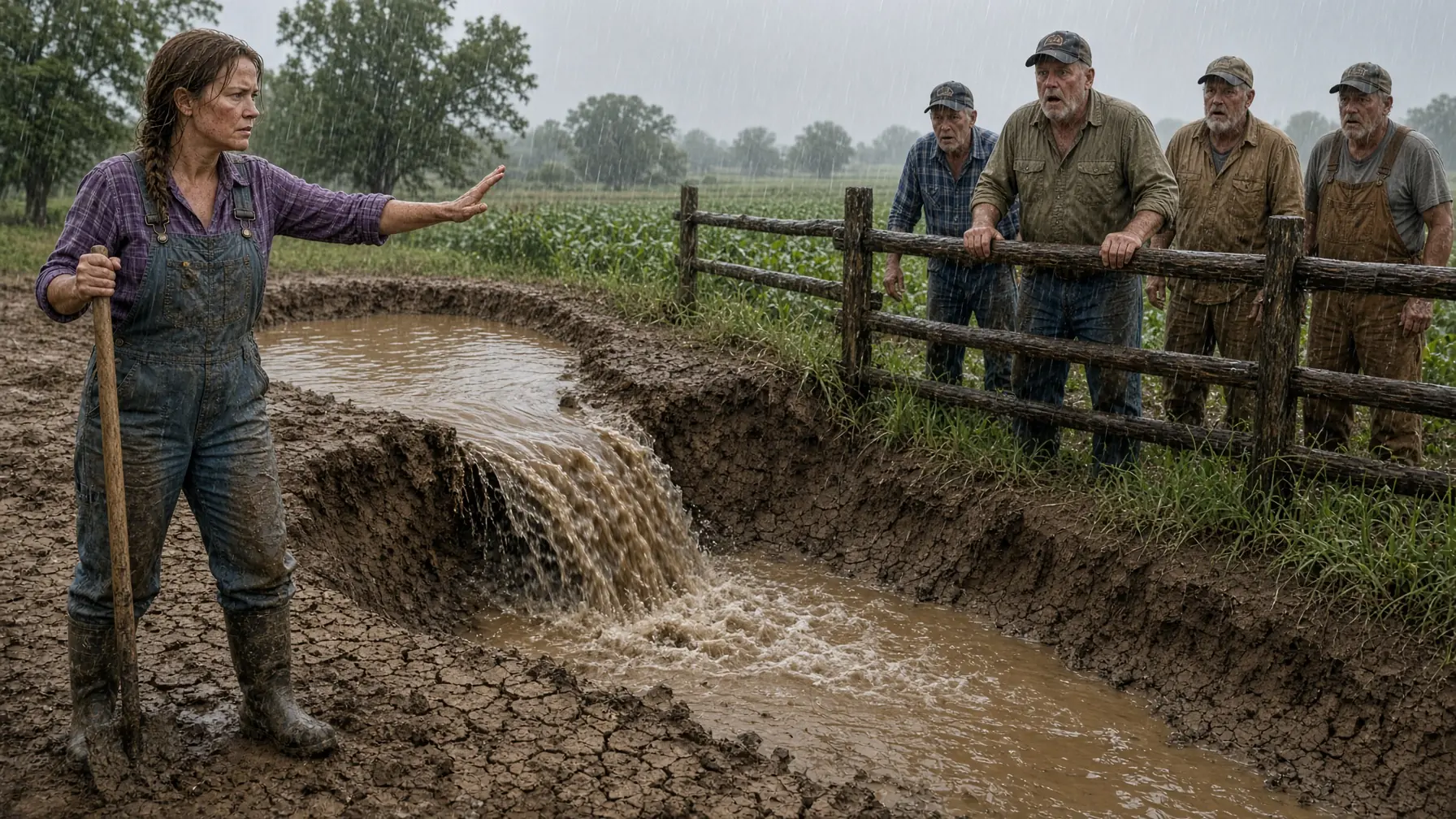
Roy laughed first.
Ellis followed, looking across the meadow as though the effort alone offended his sense of how a farm should work. Ben, the youngest of the four, smiled without quite joining them.
Clara stood on the other side of the fence with a shovel in her hand.
Her shirt clung to her shoulders. Dirt had worked into the seams of her gloves, and the heel of one boot had rubbed a raw place she could feel whenever she stopped moving.
Behind her, 120 shallow depressions lay across the slope.
Some were twenty feet wide. Others were barely half that size. They followed the land in a pattern the men could not understand from the road.
Or did not want to.
Clara looked past them toward the western ridge.
Clouds had swallowed the pale strip of sky above it.
“You ought to go home,” she said.
Hank turned to follow her gaze.
“Afraid we’ll see what happens?”
“No. I think you’ve got things of your own to check.”
“Checked them this morning.”
“Then check them again.”
Roy shifted his weight against the fence.
“You always this friendly with people showing an interest?”
Clara looked at him.
“You’re showing an interest now?”
The smile left his face.
Ellis glanced at the shovel.
“You can’t dig your way out of every problem.”
She looked toward the lower field, where a thin trail of pale dust marked the old erosion scar.
“No,” she said. “Just this one, if I’ve done it right.”
A gust crossed the meadow.
The cattle near the trough lifted their heads. One turned toward the shed, and the others began to follow.
Clara watched them move before looking back at the men.
“Stay off the banks.”
Hank laughed.
“We’re not going anywhere near those holes.”
She nodded once.
That was good.
At least one part of the afternoon was going according to plan.
The first heavy drop struck beside her boot.
Then another hit the fence rail.
Within seconds, rain darkened the dust in scattered spots. The spots joined. The wind changed direction, carrying a smell Clara had waited for all summer.
Wet ground.
She closed her eyes for one brief moment.
Then she opened them and looked uphill.
The water was coming.
In spring, before she dug the first basin, Clara had watched a storm waste itself.
It lasted less than an hour.
Thunder moved over the farm, rain struck the meadow, and for a few minutes she thought the season might finally turn.
Then she went outside.
Water raced over the hard surface instead of settling into it.
The upper meadow shed rain the way a tilted roof did. Small streams gathered into larger ones, carrying loose soil toward the fence.
By the time the storm passed, the ditches held muddy water.
The field did not.
Two days later, the ground was hard again.
Clara stood near the old erosion scar and pressed a shovel into the surface. It entered only after she put her weight on it.
She looked toward the ditch.
The water there had already begun to disappear.
It had crossed her land without doing the work she needed it to do.
For years, she had heard the same sentence from people around her.
We need rain.
She needed rain too.
But standing there with the shovel, she began to wonder whether that was only half the problem.
If the next storm behaved like the last one, more rain might mean more soil leaving the meadow.
The field needed time with the water.
It needed the rush broken into something slower.
That evening, Clara took an old notebook to the kitchen table.
She drew the slope.
Not neatly.
She marked the fence, the service track, the upper ground, the low corner, and the scar that had widened during the last storm.
Then she drew one shallow bowl.
Her first thought was simple enough to seem foolish.
What if the water had to stop before it could leave?
She slept badly that night.
By morning, the bowl had become several.
She went outside with the notebook and walked the meadow, looking for the small changes in height she had crossed for years without studying.
A ridge barely higher than her ankle.
A natural hollow beside a patch of dead grass.
A line where runoff already preferred to travel.
The land was not flat.
It only looked flat when she was thinking about cattle instead of water.
At breakfast, she opened the notebook beside the unpaid bills.
The largest envelope came from the bank.
She had read it twice the day before.
The farm had survived poor seasons by delaying repairs, reducing expenses, and selling cattle she would rather have kept. Those decisions bought time, but they also made the next season harder.
Fewer animals meant less future income.