For seventy-two hours, the John Deere 9RX 640 had not moved far enough to change the shape of its own shadow.
It sat buried in a river-bottom field outside Paducah, Kentucky, angled nose-down into wet clay like something that had fallen through a trapdoor. From the road, it still looked magnificent. The green hood carried the unmistakable scale of a machine built for farms measured in thousands of acres. The four-track undercarriage, the high cab, the massive stance, the clean lines of modern engineering—all of it still announced power. Up close, the illusion fell apart. The entire front section had punched through a deceptive shelf beneath the surface. Mud pressed around the forward undercarriage. The tractor leaned at roughly seventeen degrees, its nose deeper than anyone liked and its front linkage driven so hard into the soil that every attempt to pull it backward seemed to make the field tighten around it.
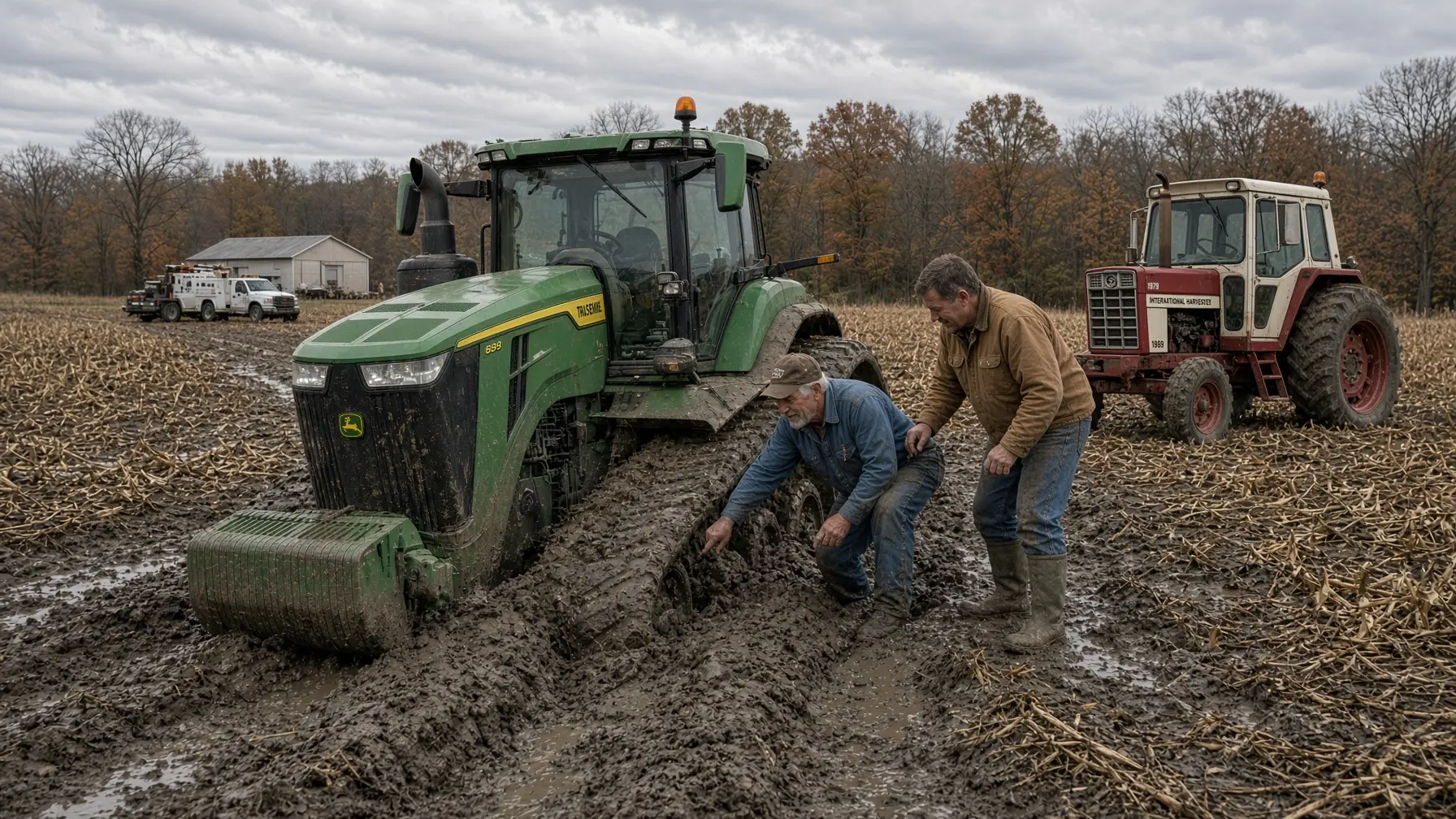
A machine worth around three-quarters of a million dollars had become a stationary object in the middle of harvest.
By the third afternoon, nobody on the farm wanted to hear another confident sentence.
They had already heard too many.
The first recovery crew had arrived while the tractor’s engine was still warm. The second had brought more equipment. The third had brought more power. The fourth had brought a different machine entirely. Every crew had used methods that made sense in other recoveries. Every crew had left the field with less confidence than they had brought in. The headland around the 9RX was now torn with deep ruts. Sections that had once been merely wet had been compacted, chewed, and destabilized by the repeated movement of heavy recovery equipment. What began as one stuck tractor had become a field-wide geometry problem made worse by urgency.
The farm manager stood near the edge of the damaged headland that afternoon with both hands locked on his hips and stared at the green tractor as if the right kind of anger might lift it.
Around him, men spoke in lower voices than they had on day one.
No one wanted to be the next person to say, “This should work.”
The harvest window was narrowing. Corn stood waiting in fields beyond the river bottom, dry enough to come out but not dry enough to wait indefinitely. The forecast showed another system building later in the week. If the rain came before the 9RX was recovered, the tractor might settle farther. Worse, the already damaged access route could become unusable for anything heavy enough to help.
The farm’s owner had begun doing what owners do when a mechanical crisis lasts longer than expected: calculating every possible loss at once. The cost of the stranded tractor. The delay to harvest. The cost of missed delivery windows. The damage to the field. The repair risk. The expense of each failed recovery attempt. The question of whether insurance would treat the next mistake as an accident or negligence.
Nobody needed to say the number out loud anymore.
They all knew it was getting larger.