The summer of 1879 had burned the eastern slope of Montana Territory until the mountain trail looked ready to split apart. Dry grass bent beneath the wind, creek beds lay empty between the rocks, and even the scattered pines seemed exhausted by the August heat. Ethan Cole rode alone beneath the Beartooth Range on a dark bay horse named Cutter, expecting nothing more demanding than checking a distant fence line before returning to his ranch. He had stopped expecting the world to offer him anything worth keeping three years earlier.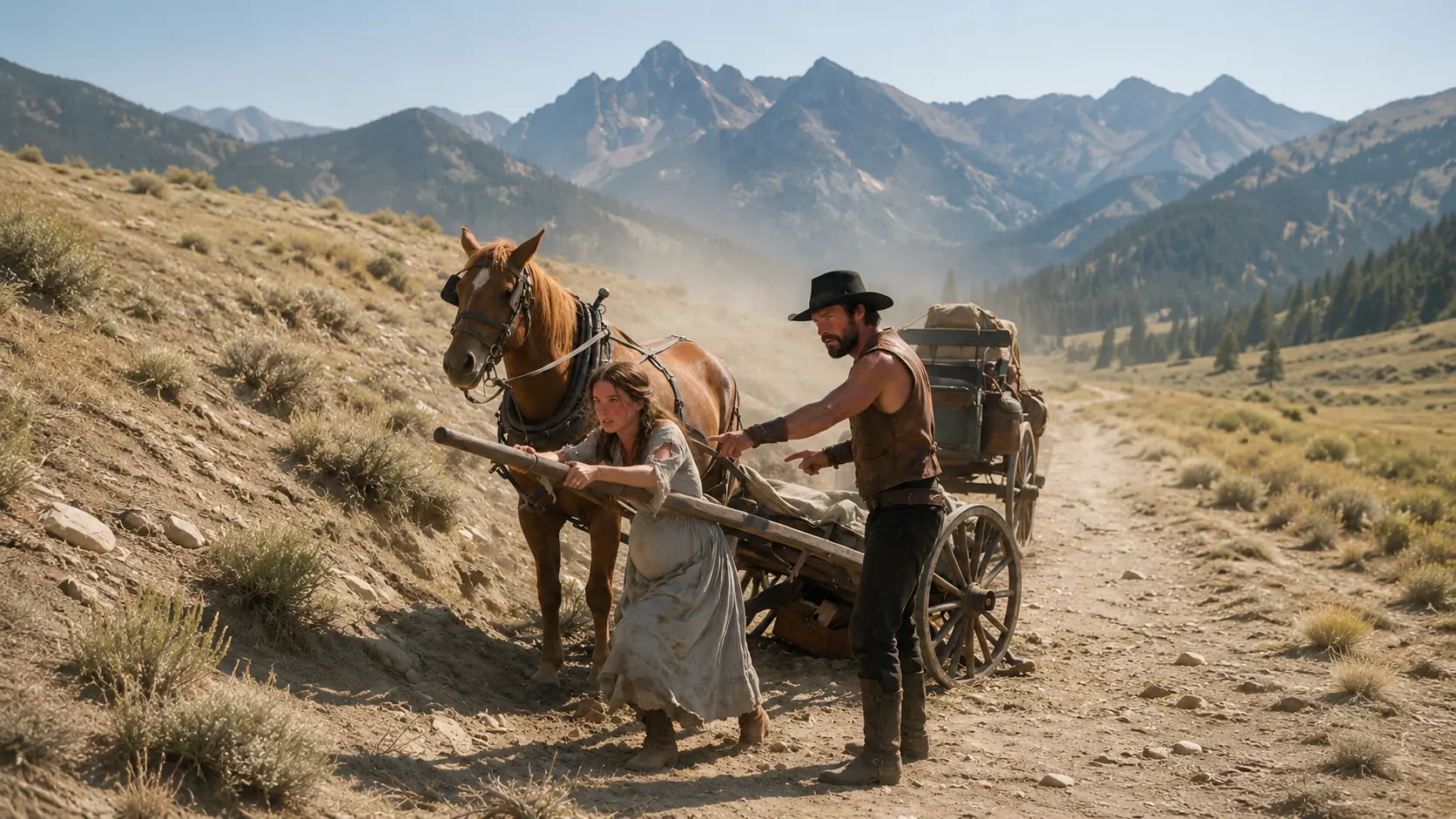
Ethan was thirty-nine, tall and lean through the shoulders, with a weathered face, dark hair, a heavy beard, and hands hardened by rope, timber, and winter. He had once shared a valley ranch with his wife, Margaret, and their four-year-old son, Thomas. A fire had taken them while Ethan worked the north pasture, leaving him with a silence he carried higher into the mountains. Since then, he had treated distance like protection and solitude like discipline.
Cutter stopped halfway down a long switchback.
The horse’s head rose, ears turning toward the cottonwoods near the bottom of the trail. Ethan listened and heard wind moving through the dry leaves, then wood creaking somewhere beyond the bend. Beneath both sounds came the faint voice of a woman calling for help. He remained in the saddle for several seconds, fighting the rule that had protected him since the fire: other people’s trouble did not become his.
The voice came again.
“Please. Somebody.”
Ethan guided Cutter around the cottonwoods and found a covered wagon leaning dangerously toward a dry gully. One rear wheel had shattered, its spokes split and its rim twisted beneath the weight of the wagon. A thin chestnut mare stood trapped in the tangled traces, her sides heaving and her head hanging low. In front of the wagon, a very pregnant woman strained beneath one wooden shaft as if she meant to pull the entire load back onto the trail herself.
She wore a dust-covered pale-gray widow’s dress with torn sleeves and worn brown boots. Her long brown hair had fallen loose from its braid, sticking to her flushed face as she fought for breath. One hand gripped the harness while the other repeatedly moved toward the side of her stomach. She appeared to be in her late twenties, but pain and exhaustion had placed years around her dark-brown eyes.
Ethan dismounted and approached slowly.
“Ma’am.”
The woman spun toward him, nearly losing her footing. Fear appeared first, followed by relief she quickly tried to hide. She straightened her back and tightened both hands around the shaft as though his presence changed nothing. Ethan saw the effort it took for her to remain standing.
“What happened?” he asked.
“The wheel broke.”
“I can see that.”
“The wagon slid toward the gully. I thought if I could move it just enough, the mare might pull it back.”
Ethan looked at the animal.
“Your horse is done.”
“She only needs water.”
“She needs shade, water, and several hours without a harness. She cannot move this wagon.”
The woman’s chin lifted.
“I didn’t ask you to judge what she can do.”
“I’m judging what the heat already did.”
Another wave of pain crossed her face. She bent slightly, breathing through clenched teeth, then forced herself upright before Ethan could reach for her. Her determination impressed him, but it also made the situation more dangerous. A person willing to collapse before admitting weakness could not be persuaded gently.
“How far along?” he asked.
“Seven months.”
He waited.
“Almost eight.”
“What’s your name?”
“Rose Callaway.”
“Ethan Cole.”
She looked toward his horse and then toward the empty trail behind him.
“Are you traveling alone?”
“I live two hours up the mountain.”
“I’m going to Billings. My sister is waiting for me.”
“You won’t reach Billings in this wagon.”
“I know that now.”
Ethan inspected the damaged wheel. The break itself was severe, but something else caught his attention near the hub. The retaining pin had not snapped under pressure. It had been loosened, then pushed back into place just far enough to survive several miles before sliding free.
He touched the scraped metal and looked at Rose.
“When was this wheel last checked?”
“This morning.”
“By you?”
“Yes.”
“Did you remove the pin?”
“No.”
“Did anyone approach the wagon?”
Rose’s expression changed.
“A man helped me water the horse near the last settlement.”
“Did he touch the wheel?”
“I was inside the store.”
Ethan rose.
“Someone wanted this wagon to fail after you left town.”
Rose looked toward the tilted canvas cover. The fear she had hidden from him finally reached her eyes, but she did not ask how he knew. She merely shifted her body so she stood between Ethan and the rear of the wagon.
“What are you carrying?” he asked.
“Clothes. Household things.”
“What are you protecting?”
“That does not concern you.”
“It concerns me if the men who broke your wheel are riding this trail.”
Rose said nothing.
Ethan looked at the sun. They had perhaps four hours before the temperature dropped and darkness settled across the mountain. The mare could not pull, Rose could barely stand, and the pains appearing across her face were coming too often to ignore.
He extended his hand.
“Get in my wagon.”
Rose tightened her grip on the harness.
“I’m not leaving my husband’s wagon behind.”
“Your horse is done, and you’ve got four hours before dark.”
“I have papers in there.”
“We take what matters.”
“There’s a cedar box beneath the quilt.”
Ethan held her gaze.
“Take the cedar box first,” she said. “Then I’ll ride.”
He climbed carefully into the tilted wagon. Inside he found a leather-bound trunk, a faded quilt, a brass lantern, and the cedar box Rose had mentioned. It was small enough to carry but heavy enough to contain more than letters. A brass clasp held the lid shut, and several scratches around the lock suggested someone had previously tried to open it.
Ethan handed the box to Rose.
She pulled it against her chest.
“My husband left it to me.”
“What’s inside?”
“His unfinished work.”
“That work got your wheel loosened.”
Her dark eyes hardened.
“That is still all I’m telling you.”
Ethan released the mare from the traces and led her into the shade. He tied the trunk and essential supplies to the back of his own narrow utility wagon, then helped Rose onto the padded bench. She protested when he placed the cedar box beside her instead of loading it with the other belongings. He told her anything important enough to sabotage a wagon should remain where she could see it.
They left the broken wagon where it stood.
Ethan walked beside Cutter rather than adding his weight to the load. Rose kept one arm around the cedar box and the other hand against the bench whenever another pain came. She made no sound, but Ethan noticed every change in her breathing. He adjusted their pace without explaining why.
An hour passed before Rose spoke.
“My husband’s name was William.”
Ethan waited.
“He was a surveyor. We were supposed to make this journey together.”
“What happened?”
“Fever. Four months ago.”
“I’m sorry.”
“He spent two years planning a life in Montana. He said the mountains did not care who you had been somewhere else.”
“He was right about that.”
Rose looked down at the ring on her finger.
“The chestnut mare was his.”
Ethan understood why she had refused to abandon the wagon and why the exhaustion of the animal had looked like another death. The ruined vehicle was not merely transportation. It was the last structure of a future William had built before Rose was forced to carry it alone.
The trail climbed through darker pine stands. When another pain struck, Rose closed her eyes and pressed one hand beneath her stomach. Ethan stopped immediately.
“How far apart?”
“Ten minutes. Sometimes longer.”
“That started before I found you?”
“About twenty minutes before.”
“You should have said so.”
“And what would you have done differently?”
“Moved faster.”
“I’m still pregnant, Ethan. Moving faster is not always the answer.”
He studied her.
“You argue even when you’re in pain.”
“I’ve had practice doing both.”
He resumed walking.
As evening approached, his ranch appeared in a protected meadow below the second ridge. The house was built from thick pine logs, with a low roof, a stone chimney, and a deep porch facing the pasture. A barn stood farther back beside neatly stacked firewood and fenced grazing land. It was not luxurious, but everything had been built to survive.
Rose looked at it with visible relief.
“You live here alone?”
“Yes.”
“Why is everything so orderly?”
“Because disorder spreads.”
“That sounds like something a lonely man tells himself.”
“It has worked so far.”
She almost smiled.
Ethan gave Rose the spare room that had once belonged to his mother. He heated water, found clean blankets, and prepared salt pork, beans, and cornbread. Rose washed the dust from her face, repaired her braid, and joined him at the kitchen table wearing a clean pale-yellow dress from her trunk. She ate quietly until strength began returning to her hands.
The cedar box sat between them.
Ethan did not ask about it again.
Rose eventually placed both palms around her coffee cup.
“You’re waiting.”
“I can wait longer.”
“The men who broke the wagon will search it.”
“Yes.”
“They’ll know the box is gone.”
“Yes.”
“And this is the only ranch near that part of the trail.”
Ethan set down his fork.
“So tell me before they arrive.”
Rose opened the box.
Inside lay survey maps, signed affidavits, copies of land grants, private correspondence, and a list of property transfers. William had discovered that several legal homesteads were being quietly moved on official maps. Boundaries were changed after settlers improved the land, allowing a territorial businessman named Harlon Cross to claim valuable farms, timber routes, and water access through companies controlled by his associates.
Some documents carried the signature of a survey official who had been dead for two years.
William gathered proof for months. He planned to deliver it to the federal land office in Helena, but the fever killed him before he could leave Missouri. Two days before his death, he made Rose promise that the evidence would reach the authorities.
“Harlon Cross knows about the box?” Ethan asked.
“I believe so.”
“Why not send it by post?”
“William’s office was searched after he died. Someone followed me for weeks. Two men offered money if I surrendered his work.”
“And you refused.”
“I packed that night.”
Ethan examined the loosened clasp.
“They tried opening it.”
“At an inn near Bozeman. Nothing was taken, but the lock was damaged.”
Ethan leaned back.
“If these documents reach Helena, what happens to Cross?”
“He loses his land, his contracts, and his influence over the territorial office. He may also face federal charges.”
“And he has already tried to strand an eight-month-pregnant widow on a mountain trail.”
Rose’s voice remained steady.
“Yes.”
“You’re afraid.”
“I’m terrified.”
“You don’t look terrified.”
“I did not say I intended to obey it.”
That answer settled something inside Ethan. He had met brave men who spoke loudly because they needed witnesses to their courage. Rose’s courage was quieter and therefore more convincing. She had crossed hundreds of miles carrying her husband’s truth while grief, pregnancy, and powerful enemies worked against her.
“You’ll stay here,” he said.
“I brought danger to your house.”
“Danger was already coming. I’m simply aware of it now.”
“Why help me?”
“Because it’s right.”
Rose watched him for a long moment.
“Men usually need a better reason.”
“Then they’re usually looking for permission to do the wrong thing.”
Ethan hid the cedar box beneath a loose floorboard in the spare room. He checked every door, shutter, and window before placing a chair near the front of the house. Rose tried to thank him, but he told her gratitude could wait until morning.
He did not sleep.
At dawn, Ethan rode four miles south to the Branigan homestead. He asked their oldest son to carry an urgent message to Deputy Marshal Aldis Graves in Miles City. Ethan had helped Graves during a winter pursuit two years earlier, and the marshal had promised to repay the favor.
When Ethan returned, Rose stood behind the locked door.
“You took three hours,” she said.
“I said midday.”
“It is eight minutes past midday.”
“You counted?”
“I had nothing else to measure.”
Ethan produced a folded note he had found pushed into the broken wheel hub.
Rose opened it.
Give us what the surveyor left and return to Missouri. No one needs to know you were here.
Her face became unnaturally still.
“They know where I came from.”
“They also know someone took you from the trail.”
“I’m sorry.”
“Stop apologizing for being threatened.”
“They will come here because of me.”
“They will come here because they chose theft over land law.”
Rose looked at him.
“You truly believe the distinction matters?”
“It matters to me.”
That afternoon, Ethan noticed two riders hidden near the northern tree line. They remained far enough away to deny trespassing but close enough to study the ranch. Once Ethan made it clear he had seen them, they disappeared into the forest.
Rose watched from the window.
“Scouts,” she said.
“Yes.”
“How long?”
“Tonight, perhaps tomorrow.”
“And the marshal?”
“Two days if he rides hard.”
Rose placed one hand against her stomach and straightened.
“Tell me what to do.”
Ethan moved the cedar box again, this time beneath the bedroom floor. He filled water barrels, secured the barn, and prepared a second horse in case Rose needed to leave by the northern trail. She objected to every plan that required her to remain behind, but Ethan refused to risk her life or the child’s life in an open confrontation.
Past midnight, four riders stopped outside the gate.
Harlon Cross announced himself in the smooth voice of a man accustomed to authority. He claimed Rose had stolen private documents and demanded that Ethan send her outside with the cedar box. In return, Cross promised that neither Ethan nor Rose would be troubled again.
Ethan remained behind the wall.
“The woman is my guest.”
“She is a widow carrying property that belongs to me.”
“She is a pregnant widow whose wagon you sabotaged.”
“You cannot prove that.”
“I don’t need to prove it tonight. Deputy Marshal Graves will decide what can be proved.”
Silence followed.
Cross had not expected official involvement.
“You are bluffing,” he finally said.
“Ask me again when the marshal arrives.”
One of Cross’s riders moved toward the gate, but Cross ordered him back. The four men withdrew without entering the property. Ethan listened until the hoofbeats completely disappeared.
Rose came from the hallway.
“They’ll return.”
“Yes.”
“What happens then?”
“We choose the place before they do.”
By morning, Ethan had a plan. He would carry one forged survey to the lower meadow and allow Cross to believe he was willing to negotiate. The rest of the evidence would remain hidden with Rose. If Cross believed the documents had already been copied and sent toward Helena, fear might force him into a mistake.
Rose disliked the plan immediately.
“I’m coming.”
“No.”
“I know his voice. William dealt with him before discovering the fraud.”
“You are nearly eight months pregnant.”
“I am not helpless.”
“I know. That is why I need you where I know you can protect the box.”
She stared at him.
“You expect me to sit here while you gamble your life?”
“I expect you to guard the reason the gamble matters.”
That silenced her.
Before Ethan left, Rose placed one hand over his on the kitchen table.
“You’re coming back.”
“You cannot know that.”
“No, but I intend to believe it.”
Ethan reached the cottonwood meadow before two in the afternoon. Cross arrived with one heavyset guard, exactly as expected. The businessman wore a clean black coat despite the heat and carried himself like a man visiting property he already owned.
Ethan held up the forged survey.
“This signature belongs to a dead man.”
Cross’s eyes fixed on the paper.
“Where is the box?”
“Gone.”
“You’re lying.”
“Copies are moving toward Helena.”
Cross’s confidence cracked for only a moment, but Ethan saw it.
“The widow has been on your mountain for two days,” Cross said. “She had no opportunity to copy anything.”
“Are you certain enough to bet your empire?”
Cross studied him.
“What do you want?”
“You leave Rose Callaway alone. You withdraw your men, and you stop touching land that does not belong to you.”
“And in return?”
“You get time to wonder when the federal office will open William Callaway’s evidence.”
Cross’s guard stepped forward.
Ethan did not move.
The guard reached for the survey, but Ethan caught his wrist and turned him hard enough to force him to his knees. Cross backed toward his horse. Ethan released the guard only after removing a length of rope from his saddle.
“You cannot hold me,” Cross said.
“I only need to hold you until the marshal arrives.”
“You have no authority.”
“I have witnesses, evidence, and a man coming with authority.”
A second set of hoofbeats entered the meadow.
Deputy Marshal Aldis Graves appeared beneath the cottonwoods, his horse white with sweat after the hard ride from Miles City. He took in Cross, the kneeling guard, the forged survey, and Ethan’s rope within seconds. His tired face showed no surprise.
“What did I ride twenty hours for?” Graves asked.
“Land fraud,” Ethan answered. “Forged surveys, stolen homesteads, intimidation, and the attempted killing of a pregnant witness.”
Cross’s composure vanished.
Graves dismounted and examined the survey.
“Harlon Cross,” he said. “I’ve heard your name.”
“You have no warrant.”
“Not yet. But I have probable cause, a federal complaint, and two men trying to negotiate over a dead surveyor’s evidence.”
Cross looked at Ethan.
“You planned this.”
“No,” Ethan said. “William Callaway planned it. His widow finished it.”
Graves secured both men and rode with Ethan toward the ranch. Rose stood on the porch before they reached the final bend, listening for approaching horses. She counted Ethan, Graves, Cross, and the guard, then lowered herself onto the step as the strength holding her upright finally released.
Ethan crossed the yard.
“It’s done.”
“Cross?”
“Behind me.”
“The box?”
“Still yours until you place it in federal custody.”
Rose closed her eyes.
“William was right.”
“About what?”
“That the truth only needs one honest person to carry it far enough.”
Inside the house, Rose opened the cedar box for Graves. The marshal reviewed the forged grants, shifted boundaries, dead man’s signatures, and statements from displaced homesteaders. He confirmed that William had built a powerful case and that Cross’s holdings could be frozen as soon as the investigation opened in Helena.
Rose placed one hand on the cedar lid.
“He needed to know this mattered.”
“It matters,” Graves said.
He took Cross and the evidence into custody the following morning.
Before sunrise, Rose’s labor began.
Ethan found her sitting on the edge of the spare bed, gripping the bedpost while pain moved through her. The contractions were less than five minutes apart. There was no time to reach the nearest settlement.
“I helped deliver horses and cattle,” Ethan said.
Rose stared at him.
“That may be the least comforting sentence ever spoken.”
“I’m not trying to comfort you. I’m telling you I can remain useful.”
Despite the pain, she laughed.
For the next two hours, Ethan boiled water, gathered clean linens, and followed Rose’s instructions whenever her experience exceeded his own. She spoke once of the daughter she and William had lost after four days of life. Each new contraction carried the memory of that child and the terror that history might repeat itself.
Ethan did not promise that nothing could go wrong.
He promised only that she would not face it alone.
Just before dawn, a baby girl entered the world with a strong cry that filled the house. Ethan wrapped her carefully and placed her in Rose’s shaking arms. Rose looked down at her daughter as grief and joy moved across her face together.
“She’s perfect,” Ethan said.
Rose wept without hiding it.
“What will you name her?” he asked.
“Margaret.”
Ethan went still.
“My grandmother was Margaret,” Rose explained. “But I know it was your wife’s name too.”
“It is a good name.”
“You’re certain?”
“My Margaret would have been honored.”
The baby settled against her mother.
Sixteen days later, Ethan drove Rose and Margaret into Miles City to give their formal statements. Cross had hired lawyers from Denver, but William’s evidence connected him to false surveys, illegal transfers, intimidation, and the theft of multiple homesteads. Federal officials froze his land claims and suspended every territorial contract linked to his companies.
Rose completed the promise she had made beside William’s deathbed.
Afterward, she stood on the boardwalk holding Margaret while townspeople passed around them. Her original plan had been to continue to Billings and live with her sister. Ethan waited beside the wagon without asking her to change it.
“What happens now?” Rose asked.
“That belongs to you.”
“My sister has room.”
“She does.”
“Your house has a spare room.”
“It does.”
“And good soil near the eastern fence.”
Ethan looked at her.
“You noticed?”
“I notice many things.”
“What would you plant?”
“Vegetables first. Flowers when the ground trusts me.”
“The ground does not care who you were somewhere else.”
Rose smiled.
“William said that.”
“He was right.”
She climbed into the wagon with Margaret bundled against her chest. Ethan took the reins and turned the horses toward the mountain road rather than the route to Billings.
When they reached the ranch, Rose stood in the yard and looked at the weathered front door.
“I want to paint it.”
“What color?”
“Dark green. Something that looks alive even in winter.”
Ethan considered the house he had built to disappear into the mountain. For three years, it had been orderly, strong, and empty of anything that might be lost. Now there was a woman inside carrying her husband’s courage, a child named for the wife Ethan still loved, and the beginning of a garden beside the eastern fence.
“Dark green,” he agreed.
Rose carried Margaret into the house.
Ethan remained outside for a moment, looking at the trail where two lives had arrived after a broken wheel forced them together. He had believed grief demanded distance and that survival meant needing nothing the world could take. Rose had taught him that protection was not the same as possession, and love was not a refusal to remember those who came before.
William’s truth had saved stolen families from losing their land.
Rose’s courage had carried that truth farther than the men hunting her believed possible.
Ethan’s decision to stop had saved Rose and Margaret, but it had also saved something in him that had been buried beneath three years of silence.
He walked toward the house.
Before he reached the porch, Rose opened the door.
“You’ve been standing out there a long time.”
“I was thinking.”
“About what?”
“The paint.”
She studied him, seeing more than he had said.
“Dark green was right,” Ethan continued.
Rose nodded.
“It will look like it always belonged here.”
Ethan stepped inside and closed the weathered door behind him.
For the first time since losing Margaret and Thomas, the quiet surrounding him no longer felt empty. It held Rose’s footsteps, the soft cry of a newborn, and plans for something that would grow when spring returned.
The world had not restored what grief had taken.
It had simply placed a broken wagon on Ethan’s trail and asked whether he would keep riding.
This time, he stopped.