“Walk away. This ain’t your business.”
“Six on one. You call that fair?”
Brett spat on the pavement two feet from the old man’s boot. The old biker on the pavement turned his head, his voice cracking.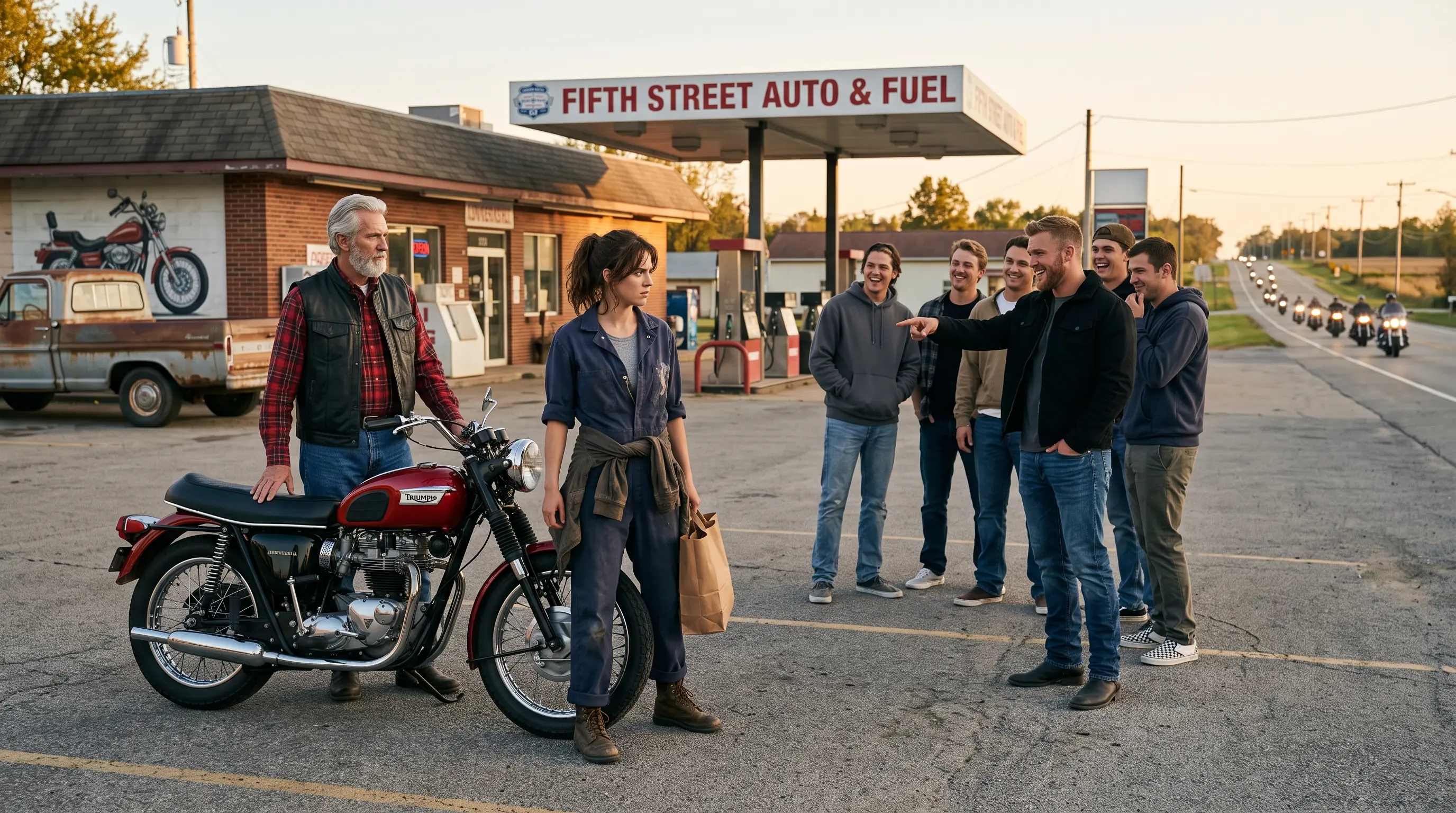
“Help me, please.”
That broke something in Casey’s chest.
Brody stepped between them, a rusted pipe wrench heavy in his fist, tapping it against his palm.
“Get back in your car, girl, or you’re next to him on the ground.”
Six bullies.
One mechanic with grease still under her nails.
One Hell’s Angel bleeding on the concrete.
The man begging for help would be on every news channel by Monday.
The chain was cold in her hand, heavier than it looked.
Brody had not seen her yet. Five seconds, maybe six.
He was still talking, still circling the old man on the ground, enjoying the sound of his own voice too much to check his blind side.
“Eight grand, this bike,” Brody said. “Maybe ten. Grandpa won’t even remember where he parked it tomorrow.”
Cody kicked the back tire of the Panhead parked behind him. Metal rang out across the empty lot.
The old man’s shoulders tensed for half a second, then went still again.
That stillness should have told them something.
It did not.
Jesse spat on the concrete two feet from the old man’s boot.
“Old-timer’s deaf, or just too stupid to know when to beg?”
Casey’s grip tightened on the chain.
She had one shot at this. Maybe two.
Six against one had already become six against two the moment she stopped walking.
She just had not told them yet.
Brett swung the cracked plastic chair off the ground, testing its weight in one hand, grinning at the others like he had found a new toy.
“Somebody’s gonna feel this one.”
Casey moved.
She did not shout. She did not give them a warning.
She threw her water bottle hard, end over end, and it caught Brody across the back of the head.
He staggered forward into his own wrench arm, swearing, spinning to find what had hit him.
For one full second, nobody moved.
Then Brett came at her first, the chair raised high, and Casey was already inside his reach before he finished the swing.
Her shoulder caught him under the ribs and drove the air out of him in one short bark.
The chair clattered to the pavement, cracked clean down the middle.
Cody grabbed for her arm. She twisted out of it and snapped the bicycle chain low and hard across his shins.
He went down sideways into the gravel, screaming through his teeth.
Two down.
Four standing.
Brody was turning back around now, wrench raised, a cut already open above his eyebrow.
Behind her, something changed.
The old man on the ground was no longer on the ground.
He came up off the concrete like a spring that had been wound for two minutes and finally released, sweeping the legs out from under the nearest boy in one motion so practiced it looked rehearsed.
The kid hit the pavement flat on his back, all the air leaving him in a single wet exhale.
Jesse froze mid-step, staring at the old man’s face. Whatever he saw there made him take a step backward instead of forward.
Brody charged at Casey with the wrench swinging wide.
She ducked under it, felt the wind of it pass an inch from her ear, and looped the bicycle chain around his wrist in the same motion.
One hard pull.
The wrench hit the ground.
He stared at his own empty hand like it had betrayed him.
The old man stepped up beside her now, one heavy palm settling on her shoulder, putting his body between Casey and the three boys still standing.
His voice came out low and flat. No anger in it at all.
“Walk away while you still can.”
Something crossed his face when he said it.
None of the boys could have named what it was, but they felt it in their chests, in the way the night air went still around him.
Brody looked at the old man for one full second.
Then he turned and ran.
The other three scattered behind him, boots slapping against concrete, and the Chevy peeled out of the lot with its tires screaming against asphalt.
The whole thing was over in eight seconds.
Casey would only learn the exact number later from a man who counted everything.
She stood there for one breath.
Two.
Then her knees gave out under her, and she sat down hard on the curb, the chain still tangled around her shaking fingers.
Her left forearm was already turning a deep, ugly purple where the chair had caught it.
The old man crouched down slowly in front of her. His knees cracked on the way down.
He did not look at her face first.
He looked at her hands. Grease still under the nails from a transmission job three hours earlier. A small adjustable wrench sticking halfway out of her back pocket. A library card poking out of a worn leather wallet that had fallen onto the gravel beside her.
He reached inside his vest and pulled out a folded blue bandana, clean, worn, soft from years of use, and wrapped it carefully around her swelling forearm.
His hands moved like a man who had done this a hundred times before.
“What’s your name?” he asked.
“Casey,” she managed.
Her breath still had not caught up with her.
“Why’d you do that, Casey?”
She thought about it for a moment.
Then she just shrugged.
“Nobody else was going to.”
He looked at her for a long time without saying anything else.
Behind them, on the gas station wall, a faded mural caught the last orange light of evening. A winged motorcycle wheel. A name half-eaten away by twenty years of weather.
Doyle Custom Cycles.
She did not know yet what that name meant, but something at the back of her mind had already started to whisper.
She did not know who he was.
And to understand why that mattered, the story had to start over from the beginning.
Three days before any of that happened, the kitchen light at the Marlo house was already on at five in the morning.
Eleanor Marlo sat at the counter, testing her blood sugar with the same kit she had been using for three years. The strip turned a deep shade of red.
She did not say anything.
She just wrote the number down in her notebook and closed the cover.
Casey kissed the top of her grandmother’s head on the way to the stove.
Casey counted what was in her pocket on the way out the door.
Forty-one dollars and some change.
She paused by the rent jar on the counter, glanced over her shoulder, and slid a folded twenty between the bills already inside.
She was almost out the door when Eleanor said her name.
“Casey.”
She froze.
Her grandmother was leaning in the kitchen doorway now, arms crossed. She was not angry.
She was something worse than angry.
She was sad.
“Bring that back.”
“Grandma…”
“Bring it back, baby.”
Casey walked over slowly, took the twenty back out of the jar, and held it flat in her palm.
Eleanor lowered her voice. She had never needed to raise it.
“Listen to me one time. Our family, your great-grandmother on down, we don’t take what we didn’t earn. And we don’t take from our own children to pay for ourselves. You hear me?”
“Yes, ma’am.”
“That medical bill is mine, not yours.”
“It’s a lot.”
“It’s still mine.”
Eleanor put her hand on Casey’s cheek.
“I don’t need you to save me, Casey. I need you to become a woman I’m proud of when I’m gone. That’s how you pay me back. You understand?”
Casey nodded.
She folded the twenty into her own wallet instead, kissed her grandmother again, and walked out into the gray light of morning.
She walked the eighteen blocks to Garrison Auto on foot, the bicycle chain having snapped two weeks earlier.
Marcus Garrison was already at the shop when she arrived, hood up on a Honda Civic, cursing quietly at the alternator.
“You’re early.”
“Bus didn’t come.”
That was the closest thing to a compliment Marcus Garrison gave anybody.
Casey pulled on her coveralls and went straight to a 1986 BMW sitting in the back corner of the shop.
Old. Stubborn.
The kind of bike nobody else wanted to touch.
On her lunch break, she pulled a library book out of her backpack, the sticker on the spine worn soft from being checked out so many times.
Custom Builders of the American Road: A Visual History.
She flipped to the dog-eared page, a photograph of a cherry-red 1959 Panhead.
The caption underneath read: Walter Doyle, Founder, Doyle Custom Cycles.
Casey traced the lines of the photograph with one finger.
Marcus walked past with a coffee in hand.
“You ever gonna build one of those?”
“One day.”
“Yeah,” he said. “You will.”
Stay with her there for one more second, because the woman walking home that night with grease on her hands had no idea she was two days away from becoming a name people in that town would repeat for years.
She walked home that evening with her arms aching and the wrench still riding in her back pocket.
She stopped at the corner of Birch and Sixth Street, where Norma Castellon was struggling on her front stoop with two grocery bags and a cane.
Casey crossed the street without thinking twice about it.
“Let me get those, ma’am.”
“Oh, Casey, you don’t have to.”
“It’s nothing.”
She carried the bags up the steps, did not wait around for thanks, waved once, and kept walking.
In three days, none of that would matter the way she thought it did.
Casey was nine years old the first time she saw her grandfather stop.
A man stood on the shoulder of the road, hood up on a station wagon, three kids in the back seat. It was raining.
Frank Marlo did not ask Casey if she minded waiting. He just put the truck in park.
“Stay here, baby girl. Doors locked.”
She watched through the rain-streaked windshield as her grandfather walked over, said something she could not hear, and disappeared under the hood of the station wagon for twenty minutes.
He came back soaked through, wiped his hands on his jeans, and did not say a word about it.
Casey finally asked him on the drive home, “Why’d you stop, Grandpa? You don’t even know him.”
Frank kept his eyes on the road for a long moment before he answered her.
“You know what’s worse than being stuck on the side of the road, Casey?”
She shook her head.
“Being stuck on the side of the road and watching forty cars pass you like you’re invisible. Every single one of those drivers had a reason not to stop. None of those reasons mattered to the man standing in the rain.”
“So you stop even when you’ve got a reason not to?”
“I stop because I always told myself, if it was you stuck out there, I’d want forty people to have a reason not to stop and one person to stop anyway.”
That was three weeks before the heart attack took him in his sleep.
She never told anyone about her grandfather’s rule. It was just a sentence sitting quietly in the back of her mind for seventeen years, waiting for a reason to matter.
She did not know that day was three days away.
That Tuesday started the way most Tuesdays did, except for a phone call at eleven in the morning.
Hospital billing.
The voice on the other end was polite, rehearsed, and entirely unmoved by anything Casey said.
Eleanor’s account was sixty days past due.
Four thousand, two hundred seventeen dollars.
If a payment plan was not arranged by the end of the month, the account would be sent to collections.
“I can do two hundred today,” Casey said. “I just need…”
“We understand, ma’am, but the policy requires…”
There was not any room.
There never was with policies like that.
She finished her shift at six and started the walk back toward Birch Street.
She did not know yet that two miles away, on the same evening, an old man on a 1959 Panhead had just pulled off Route 9 to get gas before the long ride home.
His name was Walter Doyle, though almost nobody in town called him that anymore.
Most people who knew him at all called him Iron Walt.
Even fewer people knew why.
He had buried his sister forty years earlier. She had worked the night counter at a motel outside Tulsa, and she had told their mother more than once that her manager made her uneasy.
Nobody had believed it was anything more than a young woman being overly sensitive.
She died in a car accident on a stretch of dark highway two years later.
The investigation never connected it to anything.
Walter never stopped wondering anyway.
Tonight, the moment found him at a gas pump.
He noticed the six young men loitering near the air pump the second he pulled in. He filled his tank slowly, watching.
When Brody Kane and the others moved toward an elderly man fumbling with his wallet by the convenience store door, Walter set the pump handle down without finishing.
“Six on one?” he said. “That’s how you boys count these days?”
“Mind your business, old man.”
“This is my business now.”
Casey was four blocks away at that exact moment, walking past the Doyle Fuel Station on her way home, replaying the hospital call in her head for the fortieth time.
She almost kept walking.
Forty cars pass a man on the side of the road, her grandfather’s voice said somewhere behind her ribs.
Every single one of them has a reason not to stop.
She stopped anyway.
She heard the second car door slam before she saw anything.
Brett and the others were closing in around the old man, who was already on the ground now, a cut at his eyebrow, the wrench raised above him.
“Help me, please.”
The voice cracked through the parking lot, thin and certain in a way that made something in Casey’s chest go very still.
She set her grocery bag down on the pavement, slow and careful, like she had all the time in the world.
Her right hand found the bicycle chain coiled in the dirt by the dumpster.
Six against one became six against two in the time it took her to stand back up.
What happened at the very beginning of the story was eight seconds stripped of everything except the violence.
What mattered now was what had been happening inside the one man who was not truly helpless in that parking lot, and why he did not move until exactly the right moment.
Walter Doyle was on his knees for one hundred twelve seconds before anyone touched him, and he spent every one of them doing math.
Six of them.
One bad knee from a fall off a ladder eleven years back.
No weapon but a tire iron bunched to the side of his saddlebag eight feet away, useless to him now.
He had buried better odds than this and walked away standing.
What he was waiting for was not an opening.
He already had three.
What he was waiting for was the moment their attention would scatter just enough that all six could not watch him at once.
Brody gave him that moment without meaning to, turning to brag to his friends about the bike’s resale value.
Walter felt the girl behind him before he heard her, some old instinct from a lifetime of knowing when a room had changed.
He did not turn to look.
He trusted it and used the half second she bought him.
He came up off the concrete already moving, the bad knee screaming, and swept the nearest boy’s legs out clean.
Around him, chaos.
A bicycle chain singing through the air.
A wrench hitting concrete.
A girl he had never met fighting like she had been born for exactly this.
He stepped between her and what was left of them.
And for the first time in longer than he could remember, the calculation in his head was not about how many he could take.
It was about how fast he could get this girl somewhere safe.
“Walk away while you still can,” he told them.
He meant it as a mercy he did not owe them.
They ran.
He let them.
Then his knees gave out, and he sat down hard on the curb beside the girl who had just saved his life.
“What’s your name?” he asked.
“Casey,” she managed.
“Why’d you do that, Casey?”
She shrugged.
“Nobody else was going to.”
He reached into his vest, pulled out a folded blue bandana, and wrapped it carefully around her swelling forearm without being asked.
Behind them, the convenience store door chimed.
A woman in a Doyle Fuel polo shirt stepped halfway outside, phone already pressed to her ear, eyes wide.
“Yes, Sheriff’s Department. There’s been an assault at the station on Fifth. Six guys jumped an old man.”
She paused, looking at Walter, and her voice changed.
“Sir, are you Walter Doyle?”
“That depends on who’s asking.”
“My uncle rides with the Cedar Ridge chapter. He talks about you like you’re not real.”
“I’m real. Tell your uncle Walt says hello.”
Two patrol cars arrived eleven minutes later.
The first officer recognized Walter immediately.
“Walt. Heard there was trouble out here.”
“Trouble found these boys before I did, Officer Reyes.”
“You want to press charges, sir?”
“Aggravated assault. Attempted robbery. Probably. You’ll find Brody Kane’s prints on that wrench. Same kid who put a man in the hospital outside Larkin’s Diner eight months back, if memory serves.”
“We never could pin that one on anybody.”
“You might have better luck this time.”
Walter watched the exchange without comment.
When the ambulance arrived to check Casey’s arm, he stood beside the stretcher the entire time, saying nothing.
“She’s lucky,” the medic said. “Could have been broken.”
Walter’s eyes did not leave Casey’s face.
“Luck didn’t have much to do with tonight.”
“You didn’t have to stop,” she said quietly.
“Most people don’t.”
“Most people have a reason not to.”
“I ran out of those a long time ago.”
He reached into his vest and pulled out a small leather card holder. He handed her a plain card with nothing on it but a name and a phone number.
Doyle Custom Cycles.
“You ever need anything,” he said, “anything at all, you call that number.”
“I don’t need charity, Mr. Doyle.”
“Good. I wasn’t offering any. I’m offering work, if you want it. A girl who fights like that and still carries a wrench in her back pocket on a day off? That’s not somebody who needs saving, Casey. That’s somebody worth investing in.”
Behind them, in the distance, a sound was beginning to rise.
Low at first.
Almost nothing.
“What is that?”
“That’s about thirty of my brothers who heard there was trouble at a gas station on Fifth Street and didn’t wait to be asked twice.”
The motorcycles arrived in three waves.
First the sound rolling through the dark like weather.
Then the headlights.
Then finally the silence.
A heavyset man with a gray beard swung off his bike first and crossed the lot straight to Walter.
“You good, Walt?”
“I’m good, Hollis. This young lady did most of the work before I even stood up.”
“Heard you handled six of them with a bicycle chain.”
“Five and a half,” Casey said. “The old man got one for free.”
By the time Brody Kane was located four hours later, sheriff’s deputies had already pulled the security footage along with two prior reports that had gone nowhere.
With three corroborating incidents now on record, the district attorney filed charges that included aggravated assault, attempted robbery, and witness intimidation.
Walter never mentioned the case again after that first night.
Three days later, an envelope arrived at the Marlo house with no return address.
Inside was a cashier’s check made out to Riverside General Hospital in the exact amount of four thousand, two hundred seventeen dollars, along with a single typed line.
This isn’t charity. Consider it back pay for thirty years of you not being born yet to fix my bike sooner.
She called the number on the card the following Monday.
Doyle Custom Cycles operated out of a converted barn on the edge of town, and Walter put her to work the same afternoon she walked through the door.
Brody Kane’s case went to trial five months later.
Casey was called as a witness along with Walter. She testified for eleven minutes and watched Brody the entire time.
He did not look at her once.
It was during sentencing that something shifted.
The judge asked Brody if he had anything to say before the court issued its ruling.
Brody stood, hands cuffed in front of him, and for a long moment said nothing at all.
Then he spoke quieter than Casey had ever heard him.
“I used to think being scared of me meant people respected me. I had eight months in county to think about that diner kid, about the old man, about her. I’m not asking for less time. I just wanted somebody to know I finally understand what I did. That’s all.”
The judge sentenced him to four years with mandatory anger management and restitution to be paid to both Walter Doyle and the diner busboy he had injured the previous year.
Casey left the courthouse that afternoon without saying anything to anyone.
Walter caught up to her in the parking lot.
“You all right?”
“I thought I’d feel something bigger than this.”
“Justice doesn’t usually feel the way people expect it to,” Walter said. “It just feels like the scale finally sitting level again.”
He shook her hand.
Then he told her to keep an eye on the timing chain in the Shovelhead and rode off without ceremony.
Six months after the night at the gas station, Casey Marlo opened a small storefront two doors down from Garrison Auto.
A hand-painted sign above the door read:
Marlo and Doyle Custom Restoration.
Eleanor sat behind the front counter most afternoons now, her medical bills paid in full.
A folded blue bandana hung in a simple wooden frame on the shop’s back wall. The words, We don’t forget, were stitched along its edge in careful, uneven thread.
Casey took on her first apprentice that spring, a young man named Tyler who had been caught twice trying to siphon gas from cars in the Garrison Auto lot.
She did not lecture him.
She just handed him a wrench and told him there was a right way and a wrong way to need help, and only one of them got you somewhere worth being.
People talk about courage like it is loud, like it announces itself, like it comes with music behind it.
It rarely does.
Most of the time, it looks exactly like what Casey Marlo did on an ordinary Tuesday evening.
Setting down a bag of groceries.
Picking up whatever was within reach.
Refusing to keep walking.
It looks like a man who buried a sister forty years ago still pulling over for strangers because he never wants someone else’s family to wait the way his did.
It looks like an old woman pushing a twenty-dollar bill back across a kitchen counter, teaching a granddaughter that dignity is not something you borrow.
Nobody in that gas station parking lot was a hero by trade.
They were ordinary people choosing, in the space of about eight seconds, not to look away.
That choice is still available to all of us every single day.
Most of us just never get asked to make it in front of a camera.