Marcus Avery had arrived early, dressed carefully, and chosen a place beside the handrail where he would not obstruct anyone entering the building. The officer who approached him decided that none of those things mattered. But when a lieutenant came through the doors and saw Marcus’s face, her reaction changed the morning before anyone explained who he was.
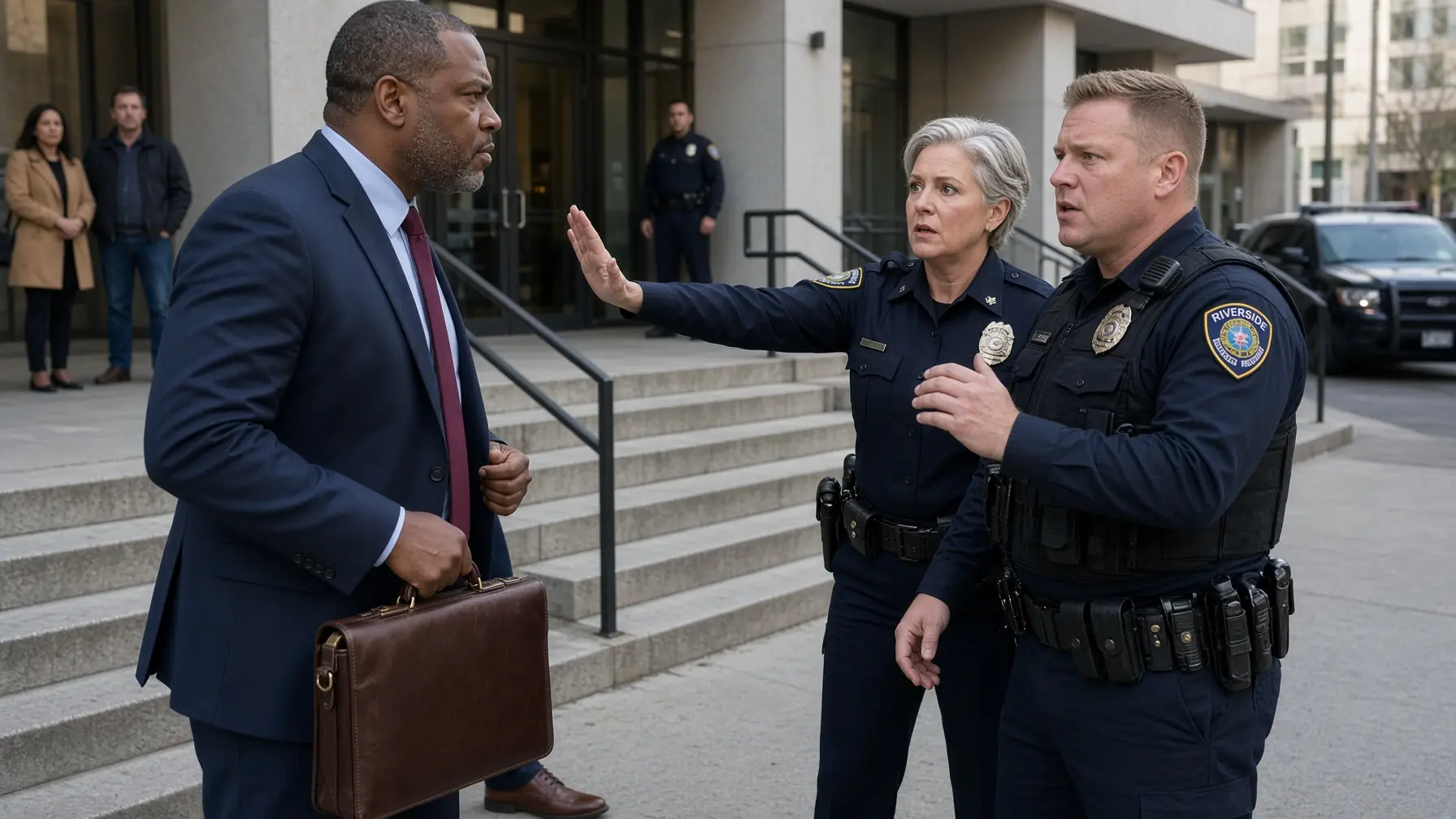
Officer Kyle Mercer’s finger struck the center of Marcus’s chest.
Not hard enough to push him back.
Hard enough to make the contact unmistakable.
“Get off the steps.”
Mercer gestured toward the sidewalk with his other hand.
“That suit doesn’t mean you belong here.”
Marcus looked down at the finger pressing against his burgundy tie.
Then he raised his eyes.
The officer stood directly in front of him, broad shoulders squared beneath navy body armor, his sandy blond hair cut short and his expression already arranged into irritation. Marcus had not seen him approach until he crossed the space between the entrance and the handrail.
There were several feet of open steps beside them.
People continued entering Riverside Metropolitan Police Headquarters without difficulty.
Marcus had made sure of that before choosing where to stand.
He held the brown leather briefcase at his side, away from the entrance and the passing pedestrians. His polished shoes remained planted where they had been when he checked the time a minute earlier.
He did not move.
“Take your hand off me.”
His voice was firm.
Mercer’s eyes narrowed.
Marcus continued.
“Give me your name and badge number.”
For a moment, the officer looked almost amused.
Then he laughed.
A short, contemptuous sound.
Marcus heard it clearly over the traffic at the curb.
He would remember that sound more precisely than the words preceding it.
At six forty that morning, Marcus had been standing in front of his bedroom mirror deciding whether the tie was too dark.
The suit was navy.
The shirt pale blue.
The burgundy tie had seemed right when he laid it out the evening before, but morning light changed the balance slightly.
He adjusted the knot.
Then he stopped.
He was forty-six years old.
He had worn enough suits to know when one looked right.
The uncertainty had nothing to do with the color.
He placed both hands on the dresser and looked at his reflection.
Closely cropped hair.
Gray at the temples.
A face that looked calm even when he did not feel it.
People had mistaken that calm for ease before.
Sometimes he let them.
Explaining every private effort was not a useful way to begin a day.
His wife passed the open bedroom door, glanced inside, and paused.
“You’re doing it again.”
Marcus looked at her through the mirror.
“Doing what?”
“Arguing with the tie.”
He looked down.
“It started it.”
She smiled.
Then she came closer and straightened the knot with two small movements that accomplished nothing he could not have done himself.
He let her.
For a few seconds, neither spoke.
Her eyes moved over his face.
“Sleep?”
“Some.”
“That isn’t a number.”
“It’s the number I have.”
She shook her head.
“You don’t have to make everything sound settled.”
“I know.”
“Do you?”
Marcus turned.
He was tall, athletic, and accustomed to carrying himself as though he had somewhere definite to go. That morning, his posture had taken more work than usual.
“I’m all right,” he said.
His wife studied him.
Then she nodded, accepting the answer only as far as it deserved.
“Eat before you leave.”
“I will.”
“Something more than coffee.”
“Yes.”
“And don’t let arriving early turn into skipping breakfast because you’ve decided the world is going to begin without you.”
He smiled.
“That’s a very specific accusation.”
“It has a history.”
She left him to the mirror.
Marcus adjusted nothing else.
In the kitchen, he ate slowly enough to taste the food.
His phone lay beside the plate.
A short message confirmed the time he had already written down.
He read it again.
The appointment was not new.
The arrangements had been made.
Still, the reality of walking through those doors that morning felt different from the ease with which he had agreed to do it over the phone.
He had been postponing part of the day in his mind.
Not the appointment itself.
The act of entering.
There were buildings that became more than buildings through repetition.
People carried memories into them.