The letter trembled in Nathaniel Cole’s hands before he finished reading the first sentence.
I accept your offer.
He sat motionless at his kitchen table, reading those four words repeatedly while the final embers faded inside the stone fireplace. Miss Adeline Foster would arrive in Casper on Tuesday’s afternoon stage, bringing one carpetbag, two references, and a willingness to become the wife of a man she had never met.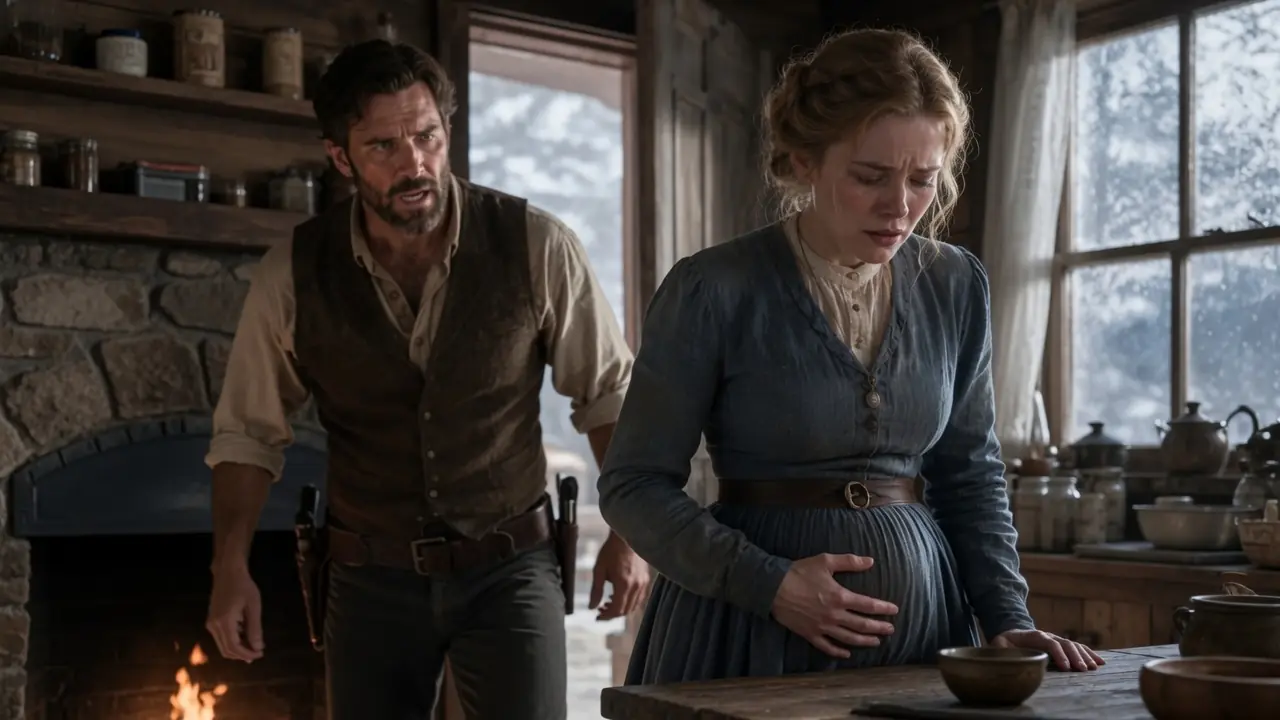
At thirty-eight, Nathaniel possessed nearly everything Wyoming Territory respected in a man. He owned nine hundred acres of grazing land, a sturdy timber house, and a thriving cattle herd that had survived drought, disease, and two brutal winters. Neighboring ranchers trusted his judgment, merchants extended him credit without hesitation, and his hired hands remained because he paid fairly and worked beside them.
Yet every evening, silence greeted him when he entered his house.
There was no laughter from the kitchen, no second pair of boots beside the door, and no soft voice asking whether the northern fence had held through the wind. Nathaniel had spent years convincing himself that solitude was the price of independence. By his thirty-eighth birthday, the lie had grown too heavy to carry.
Six weeks earlier, he placed an advertisement in a Cheyenne newspaper.
He refused to hide behind charming language or promises he could not guarantee. The notice stated that he was a rancher seeking a wife willing to endure frontier life, hard winters, and the uncertainty of cattle work. It also contained the truth that had ended every courtship before it could begin.
A doctor had told Nathaniel he would probably never father children.
The diagnosis followed a severe fever he suffered at seventeen. Nathaniel nearly died during that illness, and when he recovered, Dr. Silas Wren told him the damage had likely made fatherhood impossible. Nathaniel buried that grief so deeply that he eventually learned to speak of it without allowing his voice to break.
He expected no woman to answer his advertisement.
Then Adeline did.
Her letter was careful, intelligent, and strangely gentle. She wrote that she understood loneliness, that she was not afraid of work, and that family could be built through loyalty rather than blood alone. She asked only for patience and the promise that he would never raise a hand against her.
Nathaniel replied the next morning.
He promised her a private room, complete control of her personal money, and the freedom to leave if life with him became unbearable. He promised honesty, protection, and respect. He did not promise love because he feared making an oath to a feeling he had nearly forgotten how to recognize.
On Tuesday, Nathaniel arrived at the Casper depot wearing his cleanest shirt.
Smoke rolled above the stagecoach yard while horses stamped their hooves in frozen mud. Passengers shouted for trunks, drivers cursed at stubborn harnesses, and merchants moved through the crowd seeking expected deliveries. Nathaniel stood near the platform holding his hat so tightly that the brim bent beneath his fingers.
He expected a frightened woman with nowhere else to go.
Instead, he saw Adeline Foster.
She stood beside the stagecoach with one gloved hand resting on a worn carpetbag. Her wheat-colored hair had escaped several pins during the journey, and the winter wind moved loose strands across her pale face. She appeared tired, but her spine remained straight and her blue-gray eyes met his without surrender.
“Mr. Cole?” she asked.
“Miss Foster.”
He removed his hat. “I am glad the roads were kind to you.”
“They were less cruel than I expected.”
Her answer surprised a smile from him.
Nathaniel lifted her carpetbag and found it lighter than he anticipated. It seemed impossible that a woman could cross half the country carrying so little. Adeline noticed his expression but offered no explanation.
The wagon ride to the ranch passed beneath an endless gray sky.
Nathaniel spoke about the land, the cattle, and the weather because those were subjects he understood. Adeline listened while keeping both hands folded tightly across her lap. Once, when the wagon struck a frozen rut, she gasped and pressed one hand against her stomach before quickly lowering it.
Nathaniel assumed the journey had made her ill.
“You will have your own room,” he said. “I will ask nothing from you until you are ready to give it.”
Adeline turned toward him, and surprise softened the guarded lines around her eyes. “That means more than you know.”
Hearing his first name on her lips stirred something inside him that he had spent years trying to silence. He looked toward the road before she could see how deeply the sound affected him. For the remainder of the journey, neither spoke much.
They reached the ranch shortly before dusk.
Adeline stepped into the house and studied the plain wooden walls, the wide stone fireplace, and the table polished smooth by Nathaniel’s solitary meals. The house was clean but lacked every unnecessary object that made a place feel inhabited rather than merely maintained. A single framed photograph rested on the mantel.
It showed Nathaniel beside a younger man with dark hair and a reckless smile.
Adeline looked at it for several seconds.
“Your brother?” she asked.
Nathaniel’s expression hardened. “Samuel.”
“Is he nearby?”
“I have not seen him in seven years.”
She lowered her eyes. “I’m sorry.”
Nathaniel carried her bag down the hallway without explaining further.
They prepared supper together that first evening. Adeline peeled potatoes while Nathaniel attempted biscuits, and when he joked that his cooking could shoe a horse, she laughed. The sound moved through the quiet house so naturally that Nathaniel stopped working just to hear it.
For the first time, the ranch felt like a home.
Their wedding took place three days later inside the small chapel outside Casper. Reverend Thomas Hale performed the ceremony with his wife and Nathaniel’s foreman, Eli Mercer, serving as witnesses. Adeline wore a simple blue dress, and Nathaniel placed his mother’s narrow gold band upon her finger.
When the reverend pronounced them husband and wife, Nathaniel kissed her forehead.
Adeline’s eyes filled with tears.
He thought they were tears of relief.
For several weeks, they learned how to live beside one another. Adeline woke early, kept the house warm, and reorganized the pantry so completely that Nathaniel could no longer find anything. She understood horses better than she had admitted and quickly gained the trust of a nervous gray mare no ranch hand could approach.
Nathaniel began returning home earlier.
He found reasons to repair objects near the kitchen simply because Adeline would be there. She read aloud during winter evenings while he mended harnesses, and sometimes he forgot the book because he was listening to the rhythm of her voice. The loneliness that had once filled every room gradually retreated.
Adeline’s secret grew harder to hide.
She woke nauseated before sunrise and sometimes disappeared behind the barn until the sickness passed. She blamed her exhaustion on the journey and the altitude. Nathaniel believed her because trust came naturally to him once given.
He brought her peppermint tea and warmed her gloves near the fire.
Every act of kindness deepened her guilt.
Adeline had intended to tell him immediately. She repeated the truth each night while lying alone in the room across the hall, but daylight always made courage more difficult. Nathaniel treated her with a patience she had never known, and she feared that one confession would transform his kindness into disgust.
The child beneath her heart had already begun to move.
She pressed her palm against the faint flutter and whispered apologies to both the baby and the man sleeping across the hallway. Nathaniel believed his house had finally received a wife. Adeline knew she had entered carrying the final secret of the brother he refused to name.
The truth arrived on a frozen morning in January.
Nathaniel entered the kitchen and found Adeline gripping the edge of the table. Her face was pale, tears shone in her eyes, and both hands suddenly moved protectively over her stomach. A cup lay broken near her feet.
“Adeline, what’s wrong?”
He rushed toward her.
She stepped backward before he could touch her.
“I should have told you before I became your wife.”
Nathaniel stopped.
The silence between them seemed to fill the entire house. Outside, winter wind pressed snow against the windows, while the fire snapped softly behind them. Adeline drew a trembling breath.
“I am carrying a child.”
Nathaniel stared at her.
For one terrible moment, he did not understand the words. Then his gaze dropped to her stomach, noticing the shape her loose clothing had concealed. The warmth vanished from his face.
“How long?”
“Nearly five months.”
He staggered back as though she had struck him. “You were already with child when you answered my advertisement.”
“Yes.”
“And you knew I could never father one.”
Adeline’s tears fell freely. “Nathaniel, please let me explain.”
His grief became anger before she could continue.
“You chose a barren rancher because you believed I would be too grateful to question you.”
“No.”
“You read my weakness in the newspaper and used it.”
“I came because the father died begging me to find the only man he still trusted.”
Nathaniel’s jaw tightened. “Who was he?”
Adeline crossed the room and opened her worn carpetbag. Beneath two dresses and a folded shawl, she removed a sealed envelope darkened by age and marked by an old brown stain. Her hands shook as she placed it on the table.
“His name was Samuel Cole.”
Nathaniel went completely still.
The wind outside seemed to disappear.
“Do not say that name to me.”
“He was the child’s father.”
“You are lying.”
“I wish I were.”
Nathaniel swept the envelope from the table, but it struck the floor without opening. “My brother left Wyoming seven years ago after stealing cattle and nearly destroying this ranch.”
“He did not steal from you.”
“I saw the altered ownership papers.”
“Those papers were prepared by your uncle.”
Nathaniel’s eyes narrowed. “Caleb?”
Adeline nodded.
Nathaniel turned away as though the room had become too small. Caleb Cole had raised the brothers after their parents died and later helped Nathaniel establish the ranch. He had also been the person who brought evidence accusing Samuel of selling family cattle and hiding the payment.
Samuel denied everything.
Nathaniel refused to believe him.
Their final argument ended with Nathaniel striking his brother and ordering him off the property before sunrise. Samuel left with a split lip, one horse, and a promise never to return. Nathaniel received no letter from him afterward.
Until now.
Adeline bent to retrieve the envelope.
“Samuel worked freight routes after leaving Wyoming,” she explained. “I met him in Missouri while I was teaching at a boardinghouse school. He was injured protecting a driver during a robbery and remained there while he recovered.”
Nathaniel continued staring toward the window.
“He told me very little about his family at first,” she said. “Only that he had an older brother who hated him for something he had not done.”
“He always had explanations.”
“He also had proof.”
Nathaniel faced her sharply.
Adeline placed the letter back on the table. “Caleb sold your cattle through an agent in Denver and changed the ledger entries to Samuel’s name. Samuel discovered it and confronted him.”
“Why did he not show me?”
“He tried.”
Nathaniel remembered Samuel entering the barn one night with mud on his coat and desperation in his voice. He had carried papers, but Caleb arrived moments later holding another set. Nathaniel had believed the uncle who helped raise them rather than the brother known for reckless choices.
“What happened to his proof?”
“Caleb burned most of it.”
“Most?”
“Samuel kept one receipt.”
Adeline removed a smaller folded document from the envelope. It bore the name of a Denver livestock broker and listed Caleb Cole as the receiving party. The sale date matched the missing cattle transaction.
Nathaniel read it twice.
His hands began trembling.
“That proves Caleb received money,” he said. “It does not prove Samuel was innocent.”
“The letter contains more.”
Nathaniel looked at the sealed envelope but did not touch it.
Adeline continued. “Samuel returned to Wyoming last autumn. He wanted to confront Caleb and tell you everything.”
“He never came here.”
“He never reached you.”
Her voice broke.
Samuel had found Caleb living near Laramie under another name. He confronted him at an abandoned trading post and demanded a confession. Caleb admitted not only the cattle theft but another deception that began twenty-one years earlier.
Nathaniel looked toward Adeline.
“What deception?”
She pushed the letter closer.
“Dr. Silas Wren was paid to lie about you.”
Nathaniel’s face emptied.
“No.”
“Caleb believed the ranch would eventually pass to Samuel if you never had children. Samuel was younger, easier to manipulate, and reckless enough that Caleb expected to control the land through him.”
“That makes no sense.”
“It did after your parents’ will was read.”
Nathaniel remembered the will vaguely. The land passed jointly to the brothers, but management authority belonged to the older son until either brother produced a lawful heir. Nathaniel had considered the clause meaningless.
Caleb had not.
According to Samuel’s letter, Caleb bribed Dr. Wren after Nathaniel’s fever. The illness had been severe, but the doctor possessed no evidence that Nathaniel could not father children. Caleb invented the diagnosis to prevent Nathaniel from marrying and producing an heir who would place the ranch permanently beyond his influence.
Nathaniel dropped into a chair.
For twenty-one years, he had refused courtships, buried hope, and accepted a future built on a paid lie. He remembered women he had avoided, invitations he declined, and the shame that kept him from speaking honestly until he wrote the advertisement. A lifetime of loneliness suddenly belonged to someone else’s design.
“Where is Samuel?” he asked.
Adeline covered her mouth.
Nathaniel already knew.
“He was shot after leaving the trading post,” she whispered. “Caleb followed him.”
The wound did not kill Samuel immediately. He reached a settlement near Fort Collins, where Adeline had been staying with a widowed cousin. She cared for him during his final days, and he told her everything he had learned.
Samuel wrote the letter while fever consumed him.
He made Adeline promise to bring it to Nathaniel.
“Why did you marry me?” Nathaniel asked.
Adeline’s face crumpled. “Because I was afraid.”
“That is not an answer.”
“Samuel’s child had no legal protection. Caleb knew about the baby, and he believed the child might become evidence of Samuel’s claim to the land. After Samuel died, a man followed me from Colorado to Cheyenne.”
Nathaniel’s anger shifted.
“Caleb followed you?”
“I do not know whether it was Caleb or someone hired by him.”
“So you found my advertisement.”
“Yes.”
“And you believed becoming my wife would protect you.”
Adeline did not deny it.
Nathaniel stood slowly.
“You should have told me.”
“I know.”
“Before you entered my home.”
“I know.”
“Before you stood beside me in that chapel.”
“I know.”
Each answer made him angrier because she offered no defense against the truth.
“I gave you trust,” he said. “You built our marriage on a secret.”
Adeline lowered her head. “I did.”
Nathaniel walked toward the door.
She reached for him but stopped before touching his sleeve. “Where are you going?”
“Anywhere I can breathe.”
He entered the storm without his heavy coat.
For hours, Nathaniel remained inside the barn. He worked without purpose, moving tools and checking animals that needed nothing. Anger fought grief until he could no longer identify which pain belonged to Samuel, Caleb, Adeline, or himself.
Eli Mercer found him near midnight.
The older foreman listened without interruption while Nathaniel explained everything. Eli had worked for the Cole family before the brothers reached adulthood and remembered the night Samuel was driven away.
“I never believed that boy stole those cattle,” Eli said.
Nathaniel turned on him. “Why didn’t you tell me?”
“I did.”
Nathaniel remembered.
Eli had urged him to wait before judging Samuel, but Nathaniel accused him of protecting a thief. The foreman never mentioned it again.
“I failed him,” Nathaniel whispered.
“You believed the wrong man.”
“I chose to believe him.”
Eli looked toward the house. “And now you have another choice.”
Nathaniel’s face hardened. “Adeline lied.”
“She did.”
“She used my advertisement to reach this ranch.”
“She did that too.”
“You expect me to forgive her?”
“No. I expect you to decide whether the worst thing she did is the only true thing about her.”
Nathaniel remained in the barn until dawn.
When he returned to the house, Adeline’s carpetbag stood near the door.
She wore her traveling coat and held Samuel’s letter against her chest. Her eyes were swollen from crying, but her voice remained steady.
“I will leave before breakfast.”
“In this weather?”
“The stage passes the lower road this afternoon.”
“You will not survive five miles through this snow.”
“I cannot remain after what I did.”
Nathaniel looked at the carpetbag. “Where will you go?”
“I don’t know.”
“And the child?”
Her hand moved over her stomach. “I will find work.”
He almost laughed at the impossible plan.
A pregnant woman traveling alone through Wyoming winter had few safe choices. Adeline understood that, yet she preferred the danger to demanding more kindness from the man she had deceived. Nathaniel saw shame rather than manipulation in her face.
“You are not leaving today,” he said.
Her eyes lifted.
“That does not mean I forgive you.”
“I understand.”
“It means I will not send Samuel’s child into a blizzard.”
Adeline nodded and carried the bag back to her room.
For several days, they spoke only when necessary.
Nathaniel read Samuel’s letter repeatedly. His brother described Caleb’s theft, the doctor’s confession, and his hope that Nathaniel might someday understand why he had stayed away. The final paragraphs contained no anger.
Adeline is kinder than she believes herself to be, Samuel had written. She carries my child, but she should not be forced to carry my sins or yours. If she reaches you, protect them both—not because they belong to me, but because you are still the man I remembered before we learned how to hate each other.
Nathaniel wept over that sentence.
He had not cried when his parents died, when drought killed half the herd, or when the doctor stole his hope. He cried now because Samuel’s final words contained forgiveness Nathaniel had never earned.
The following morning, he entered the kitchen while Adeline prepared bread.
She stopped working.
“Tell me about him,” Nathaniel said.
Her eyes filled.
“Samuel?”
Nathaniel nodded.
Adeline spoke for nearly two hours.
She told him Samuel laughed whenever he was frightened, loved terrible poetry, and claimed he could recognize every horse by its footsteps. He had wanted to return to Wyoming but believed Nathaniel would refuse to hear him. He spoke of the ranch constantly, not with resentment but with homesickness.
“He loved you,” Adeline said.
Nathaniel stared into the fire. “I made that difficult.”
“He believed you would understand eventually.”
“He had more faith in me than I deserved.”
Adeline reached across the table but stopped halfway.
Nathaniel placed his hand over hers.
Trust did not return in a single moment. It returned through small acts, repeated choices, and truths offered before they were demanded. Adeline told Nathaniel everything about her past, Samuel, and the fear that drove her west.
Nathaniel told her about the fever, the diagnosis, and the shame he had carried since boyhood.
They wrote to authorities in Laramie and Denver. With Samuel’s receipt, letter, and information regarding Caleb’s false name, a territorial marshal began investigating. Dr. Wren was found living in Nebraska, where he admitted receiving payment to falsify Nathaniel’s diagnosis.
Caleb attempted to flee west.
He was arrested near Evanston after selling a horse under Samuel’s name. Records recovered from his belongings connected him to the old cattle theft and the attack that caused Samuel’s death. Nathaniel felt no triumph when the telegram arrived.
Justice could punish Caleb.
It could not return twenty-one stolen years or the brother Nathaniel had driven away.
Spring reached the ranch slowly.
Adeline’s child was due in May, and Nathaniel became increasingly anxious as the date approached. He repaired the cradle that once belonged to Samuel, sanded every sharp edge, and placed it near the bedroom window. Adeline found him one evening testing the wooden joints for the fourth time.
“You know the child will weigh less than a calf,” she said.
“I have seen calves destroy stronger fences.”
She smiled.
Their affection returned carefully, no longer supported by illusion.
One evening, Nathaniel stood beside her on the porch while sunset spread across the Wyoming plains. He admitted he still did not know whether he could father children. The doctor’s confession proved only that the diagnosis had been false, not what the future might hold.
Adeline took his hand.
“You offered me a life when you believed children were impossible,” she said. “I will not measure our future by whether they become possible.”
Nathaniel looked at her.
“What do you measure it by?”
“Whether we keep choosing the truth after learning how much lies cost us.”
He kissed her then.
It was not the careful kiss he placed on her forehead after their wedding. It was a promise made by two imperfect people who finally understood what honesty required. When they separated, Adeline rested her head against his chest.
The child came during a late spring storm.
Reverend Hale’s wife helped with the birth while Nathaniel waited outside the bedroom, walking the hallway until the floorboards seemed likely to wear through. Hours passed before a baby’s cry finally broke through the house.
Nathaniel stopped breathing.
The door opened.
Adeline lay exhausted beneath the quilt, holding a small dark-haired boy against her chest. She looked toward Nathaniel with tears on her face.
“Come meet your nephew.”
Nathaniel approached slowly.
The child’s tiny hand closed around his finger.
“What will you name him?” Nathaniel asked.
Adeline watched his face. “I hoped you would decide with me.”
Nathaniel looked toward Samuel’s photograph on the bedside table.
“Samuel Nathan Cole.”
Adeline smiled. “Samuel Nathan.”
Nathaniel held the boy for the first time and felt grief and love occupy the same place inside him. The child belonged to his brother, but no law, bloodline, or secret could measure what Nathaniel already felt. He understood then that fatherhood had never depended only on what his body could create.
It depended on who he chose to protect.
Years later, the Cole ranch would echo with children’s laughter.
Little Samuel grew strong, curious, and reckless enough to remind Nathaniel painfully of his brother. Adeline gave birth to a daughter three years later, proving that Caleb’s lie had stolen possibility but not destroyed it. They named her Hope.
Nathaniel never distinguished between the children.
When neighbors referred to Samuel as his nephew, Nathaniel corrected them gently.
“He is my son.”
Adeline sometimes watched Nathaniel teaching the boy to ride and remembered the frozen morning when she believed her secret would destroy everything. The truth did shatter their marriage as it had first existed. What they rebuilt afterward was stronger because neither could pretend it had been founded without pain.
Nathaniel had once believed blood made a family.
Then he believed blood had been denied to him forever.
In the end, Samuel’s final gift taught him something larger. Family was not merely inherited through birth, land, or a shared name. It was created every time a person remained when fear, betrayal, and grief made leaving easier.
Nathaniel lost a brother because he trusted a lie.
He nearly lost Adeline because she feared the truth.
But when she finally whispered the secret that turned his blood cold, it did not end his chance at a family.
It revealed that his family had been trying to find its way home all along.