The tractor jerked so hard that Ethan Vance nearly came out of the seat.
One second he was leaning into the cold October wind, watching the three-bottom steel disc plow bite its way through the lower pasture at barely three miles an hour. The next, the engine groaned, the rear tires spun in the wet red clay, and a metallic shudder traveled through the frame with enough force to rattle his teeth.
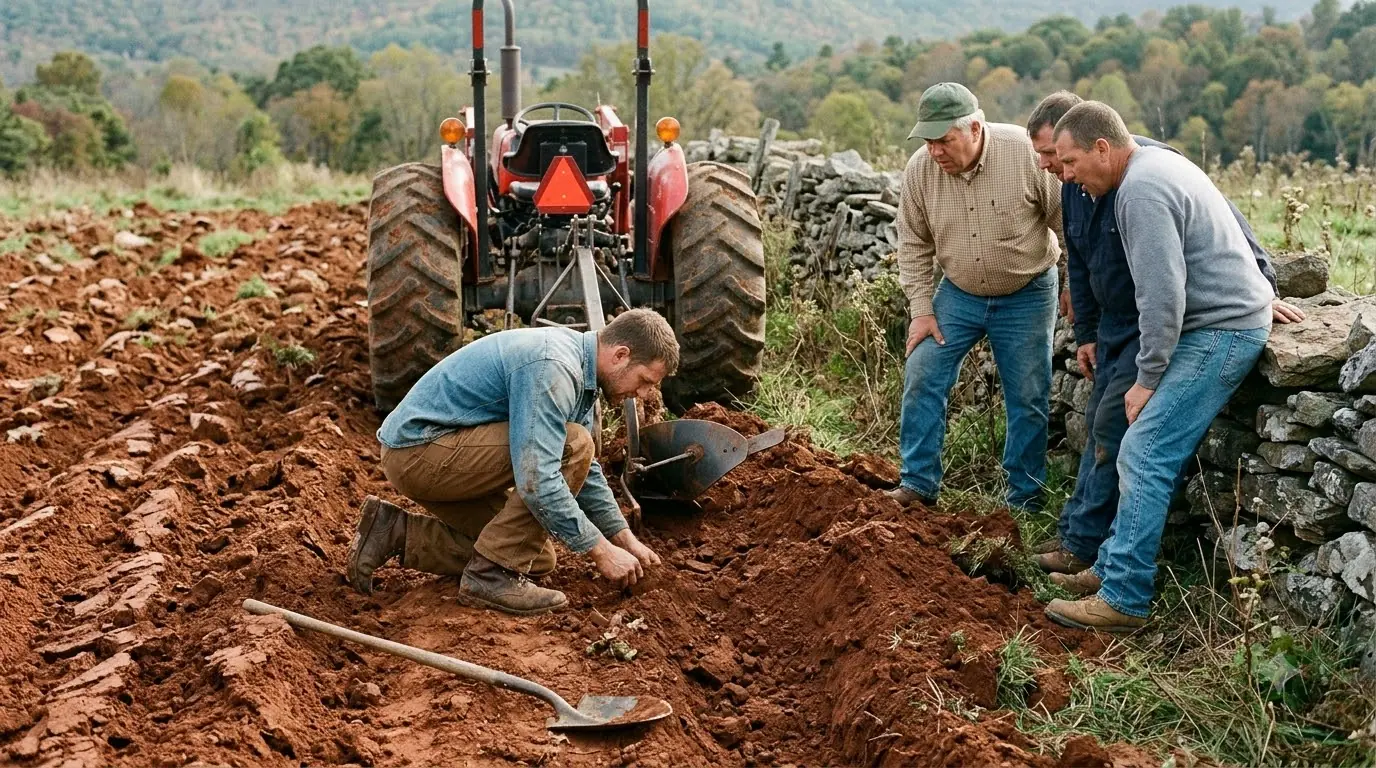
Ethan cut the ignition before the engine could fight whatever had stopped it. Silence fell across the eighteen acres so quickly that he could hear loose mud sliding from the tread of the rear tires.
He sat there for a moment with both hands resting on the wheel.
There went another plow point, he thought.
That was what the neighbors would say. That was what they had been saying since April, when he spent every dollar he had saved to buy eighteen acres of Grayson County pasture nobody else wanted. The listing had sat untouched for more than three years. Twelve thousand dollars for rocky ground covered in scrub, red clay, vines, and limestone that had a reputation for snapping steel like dry kindling.
The locals had a name for it.
The stony waste.
Ethan had heard the name before he signed the papers. He had heard every version of the same warning too. You could not hay it profitably. You could not plow it without breaking iron. The drainage was strange. The upper ground dried too quickly, the lower ground held water too long, and the brush returned almost as fast as anyone cut it.
At thirty-two, Ethan was old enough to know that repeated advice deserved respect and young enough to believe it could still be wrong.
He had spent most of his working life as a diesel mechanic. Machines had taught him something people often did not: a problem that looked permanent from the outside was sometimes nothing more than several smaller problems stacked together. Rust, neglect, bad adjustment, missing maintenance, a part installed wrong ten years earlier. Fix the pieces in the right order and what everyone called junk could move again.
He had bought the land because he believed ground might work the same way.
Now, seven months later, the land seemed determined to prove otherwise.
Ethan climbed down from the red tractor and sank ankle-deep into wet clay. The morning rain had softened the surface, but beneath it lay the hard, dense ground that had fought him since spring. He walked around the rear wheel expecting to see the plow wedged against another pale chunk of limestone.
Instead, one disc sat crooked over a shallow trench where the soil had been torn open.
He crouched and pressed his gloved fingers into the mud.
Something dark showed beneath the clay.
Steel, he thought first.
Maybe an old culvert. Maybe scrap from a long-gone fence. Maybe the axle of some abandoned implement that had disappeared beneath the pasture before he was born.
He retrieved a hand trowel from the tractor box and began clearing dirt from the obstruction. The first scrape exposed smooth metal. The second showed a curved surface. By the time he had removed enough clay to see a handspan of it, Ethan stopped moving.