Sometimes the best intentions lead to the worst discoveries.
What started as a heartfelt surprise trip to Boston with my children quickly turned into a nightmare I never saw coming.
One hotel door.
One moment of truth.
And twelve years of marriage suddenly hung in the balance.
They say what happens in hotel rooms stays there, but some secrets refuse to remain hidden. Some secrets grow too heavy for closed doors. Some secrets wait for one wrong knock, one unexpected arrival, one husband who still believes his family is worth surprising.
My name is Michael Anderson.
Mike to my friends.
I was thirty-five years old when my marriage fell apart in a hotel hallway in Boston.
For almost twelve years, I had been married to my wife, Rebecca. To most people, we looked ordinary in the way happy families often look ordinary from the outside. We had a house in Ohio with a maple tree in the front yard, a mortgage that never seemed to shrink fast enough, two children who left shoes in every room, and a calendar full of school events, grocery lists, dentist appointments, and soccer practices.
Our son, Curtis, was eleven.
He was quiet, observant, and growing into that difficult age where childhood still clung to him, but pride had already begun teaching him to hide his feelings. He loved baseball cards, science documentaries, and pretending he did not care when his little sister hugged him in public.
Our daughter, Sophie, was eight.
She was bright, dramatic, tender, and always asking questions that made adults uncomfortable because children have a way of seeing straight through the curtains we hang over the truth. She still slept with a stuffed rabbit named Buttons and believed every hotel had a pool because, in her mind, that was the whole purpose of travel.
Rebecca was thirty-four.
Beautiful, sharp, organized, and ambitious in a way I once admired without reservation. She worked as a project consultant for a national marketing firm, which meant she traveled more than I liked, especially during the last few years. At first, the trips were short. One night in Chicago. Two days in Pittsburgh. A conference in Indianapolis.
Then the trips became longer.
Boston.
Denver.
Atlanta.
San Diego.
She always had explanations.
Client meetings.
Strategy sessions.
New accounts.
Quarterly reviews.
I believed her because marriage, at least the marriage I thought we had, was supposed to be built on trust. And trust meant not turning every late phone call into suspicion, not turning every tired answer into an interrogation, not becoming the kind of husband who searched through pockets and phones because insecurity had replaced love.
So I trusted her.
Even when she became distant.
Even when she began sleeping with her phone face down.
Even when she laughed at messages and then locked the screen too quickly when I walked into the room.
Even when I asked if everything was okay between us and she smiled without quite looking at me and said, “Of course, Mike. I’m just exhausted.”
Exhausted.
That word covered everything for nearly a year.
She was too exhausted to talk.
Too exhausted to eat dinner with us.
Too exhausted to come to Curtis’s school science night.
Too exhausted to help Sophie practice her reading.
Too exhausted to notice that I had begun carrying the weight of the house almost entirely alone.
And still, I made excuses for her.
That is what love sometimes does before it becomes wisdom.
It explains away what it is not ready to face.
The Boston trip was supposed to fix something.
Not everything.
I was not foolish enough to think one surprise visit could repair every quiet distance in a marriage. But I thought it could help. I thought if Rebecca saw how much we missed her, if she opened her hotel room door and found me standing there with Curtis and Sophie grinning beside me, maybe something warm would return to her face.
Maybe she would laugh.
Maybe she would cry.
Maybe she would hug the kids and say this was exactly what she needed.
The idea came from Sophie.
It was Wednesday night, and Rebecca had already been in Boston for three days. Sophie sat at the kitchen table pushing peas around her plate while Curtis pretended to read a book but was actually listening to everything.
“Dad,” Sophie said, “does Mom miss us when she’s gone?”
The question hit me in a place I was not prepared to show.
“Of course she does.”
“She didn’t call last night.”
“She was busy.”
“She’s always busy.”
Curtis did not look up, but his fingers tightened around the edge of his book.
I glanced at him, then back at Sophie.
“She loves you both very much.”
Sophie frowned.
“Then why does she sound happy when she says she has to go?”
I had no answer ready for that.
Children notice tone before adults admit meaning.
“She likes her work,” I said.
Sophie looked down.
“I wish she liked being home too.”
The kitchen went quiet.
That night, after the kids went to bed, I sat in the living room staring at Rebecca’s last text.
Long day. Going straight to bed. Kiss the kids for me.
It was only 8:37 p.m.
Boston was in the same time zone.
Something about the message felt thin.
Not false exactly.
Just empty.
I called her.
It rang six times and went to voicemail.
I did not leave a message.
A reasonable man would have gone to bed.
Instead, I opened my laptop and checked flights to Boston.
By midnight, the plan had formed.
I had vacation days. The kids had a teacher workday Friday. Rebecca was supposed to fly home Sunday morning. We could fly out Friday, surprise her at the hotel, spend Saturday together in Boston, maybe take the kids to the aquarium, walk through the park, eat clam chowder somewhere touristy, and remind ourselves that we were still a family.
I booked the tickets.
Then I reserved a room at the same Marriott where Rebecca said her company had put her up.
I told the kids Thursday after school.
Sophie screamed so loudly I had to remind her we had neighbors.
Curtis tried to act unimpressed.
“Boston is pretty far for a surprise,” he said.
“You don’t want to go?”
He shrugged.
“I didn’t say that.”
Sophie ran upstairs to pack six stuffed animals, three dresses, two pairs of shoes, and a plastic tiara she claimed was “for hotel breakfast.” Curtis packed one backpack and asked whether there would be Wi-Fi.
For the first time in weeks, the house felt alive.
I almost called Rebecca to tell her.
That was the kind of husband I still was.
The kind who wanted to share good news with the woman I was planning to surprise.
I stopped myself only because surprises require silence.
Friday morning, we flew out of Columbus under a gray sky.
Sophie got the window seat and pressed her face to the glass during takeoff. Curtis sat between us, pretending not to enjoy the tiny pack of pretzels the flight attendant handed him. I watched them both and felt something close to hope.
At Logan Airport, Sophie asked if Boston had castles.
Curtis told her America did not really have castles.
Sophie said hotels counted.
We took a taxi into the city. The driver drove too fast, the traffic was thick, and Sophie kept asking if every tall building was famous. I answered when I could. Curtis looked out the window silently, but every few minutes I saw his reflection smile.
The Marriott lobby was bright, busy, and polished. Business travelers moved through with rolling bags and coffee cups. A family near the elevators argued over luggage. Somewhere, someone laughed too loudly into a phone.
I walked to the front desk with Sophie holding my hand and Curtis standing beside me.
“Checking in?” the receptionist asked.
“Yes. Michael Anderson.”
She typed for a moment, smiled, and handed me the key cards.
“Room 732. Two queens, city view.”
“Perfect.”
I almost asked then whether Rebecca Anderson had checked in.
But I wanted the surprise to be clean.
Instead, I took the kids upstairs, dropped our bags, and ordered them to rest for twenty minutes before we went to find Mom.
Sophie jumped onto one of the beds.
Curtis went straight to the window.
“Can we call her now?” Sophie asked.
“Not yet.”
“Why?”
“Because if she knows we’re here, it’s not a surprise.”
She thought about that.
“Can I knock first?”
I smiled.
“Absolutely.”
At 4:15 p.m., I texted Rebecca.
How’s Boston? Kids miss you.
No response.
At 4:42, I called.
Voicemail.
At 5:10, I called again.
Voicemail.
I told myself she might be in a meeting.
At 5:36, Sophie began to worry.
“What if she’s not at the hotel?”
“She is,” I said, though I no longer felt certain.
Curtis looked at me.
“Do you know her room?”
“No.”
“Can the front desk tell you?”
“Maybe.”
His tone changed slightly.
“Dad, is everything okay?”
I looked at my son and saw something in his face that made me uncomfortable. He was not a little boy in that moment. He was watching me the way I had watched adults when I was young, trying to determine how much fear was being hidden behind calm.
“Everything is fine,” I said.
That was the first lie I told my children in Boston.
It would not be the last.
I went back down to the lobby alone.
The receptionist was different this time, a young man with dark hair and a polite smile.
“Hi,” I said. “I’m trying to reach my wife. She’s staying here for a business trip. Rebecca Anderson.”
He typed her name.
Then paused.
It was brief.
But I noticed.
“Is she here?” I asked.
“Yes, sir. She is registered.”
“Can you connect me to her room?”
“Of course.”
He picked up the phone and dialed internally. I watched his face while he waited.
No answer.
He tried again.
Still nothing.
“I’m sorry,” he said. “She isn’t answering.”
“Can you tell me the room number?”
His smile tightened.
“I’m not supposed to give out guest room numbers.”
“I understand. I’m her husband. Our children are upstairs. We flew in to surprise her.”
He hesitated.
I could see the rules fighting with his sympathy.
Then he looked at the screen again.
His brow moved slightly.
“What is it?” I asked.
“Nothing, sir.”
But it was not nothing.
I had worked in insurance for more than a decade. I had spent years reading small changes in people’s faces across desks, over claims, during negotiations. The receptionist had seen something that made him careful.
“Please,” I said quietly. “Is she alone?”
He looked up quickly.
Too quickly.
There are answers people give before they speak.
“I cannot discuss guest details,” he said.
My mouth went dry.
“But she is checked in?”
“Yes.”
“And someone else is with her?”
He did not answer.
He looked down.
That was answer enough.
I felt the lobby tilt around me.
Business travelers continued moving past with bags and phones. The elevators chimed. A woman near the bar laughed. The world went on with insulting ease.
I leaned one hand on the counter.
“Please,” I said again, and my voice sounded unlike mine. “My children are upstairs. I need to know what room.”
The receptionist looked genuinely uncomfortable.
“I could get in trouble.”
“I understand.”
He glanced behind him, then lowered his voice.
“Room 718.”
The number landed hard.
Fourteen rooms down from ours.
Same floor.
She had been fourteen rooms away while I told our children we were about to surprise their mother.
I swallowed.
“Thank you.”
He looked at me with pity.
I hated him for that for about three seconds.
Then I hated myself for needing it.
I rode the elevator back to the seventh floor alone.
The hallway was quiet, carpeted, softly lit. Every door looked identical. Room numbers in brass. Small peepholes. Tiny gaps beneath doors showing strips of light.
I passed our room first.
Inside, my children were waiting.
Sophie probably bouncing with excitement.
Curtis pretending to be calm.
I should have gone in.
I should have sent them to the lobby.
I should have called Rebecca again.
Instead, I walked down the hallway toward 718 because some terrible part of me needed the truth before I could decide how much of it would touch my children.
I stood in front of the door.
For a long moment, I heard nothing.
Then laughter.
Rebecca’s laughter.
Not the tired laugh she used at home lately.
Not the quick, distracted laugh she gave the kids over video calls.
This was soft.
Relaxed.
Warm.
The laugh I had been trying to bring back.
I knocked.
The laughter stopped.
Silence.
Then a man’s voice, low enough that I could not make out the words.
My heart began pounding so hard it felt like something trying to escape my chest.
I knocked again.
“Rebecca,” I said.
Movement inside.
A whisper.
Then more silence.
“Rebecca,” I said again, louder.
The door opened several inches.
Not fully.
Just enough.
A man stood there.
He was maybe forty, with short dark hair, a half-buttoned white dress shirt, and the startled face of someone who had expected room service and found judgment instead.
I recognized him.
Trevor Blake.
Chicago office.
I had seen him once on a company holiday Zoom call. Rebecca had mentioned him several times over the last year. Trevor handled client strategy. Trevor understood the pressure. Trevor was brilliant but difficult. Trevor was funny once you got past his ego.
Trevor was standing in my wife’s hotel room with his shirt half buttoned.
For a moment, neither of us spoke.
Then I saw Rebecca behind him.
She was wearing a hotel robe.
Her hair was loose.
Her face had gone white.
“Mike,” she whispered.
There are moments in life when the mind refuses to understand what the eyes already know.
I looked at Trevor.
Then at Rebecca.
Then at the room behind them.
Two wine glasses on the desk.
A room service tray.
A suitcase open near the chair.
Rebecca’s heels beside the bed.
The truth stood there in ordinary objects.
That was the part that made it impossible to deny.
No one had to say anything.
The room said enough.
Trevor stepped back slightly.
“I should…” he started.
I looked at him.
“Are you Trevor?”
He nodded slowly.
“Yes.”
“Did you know she was married?”
His eyes flicked to Rebecca.
That look told me more than his answer.
“I knew she was separated,” he said.
Rebecca closed her eyes.
A sound left my mouth.
Not a laugh.
Not exactly.
“Separated.”
Trevor looked confused now.
Not innocent.
Confused.
Rebecca stepped forward, clutching the robe closed.
“Mike, please. Let me explain.”
I looked at her left hand.
Her wedding ring was on.
That almost broke me.
Not because she was wearing it.
Because she had worn it into this room.
“Your children are fourteen doors away,” I said.
Her face collapsed.
“What?”
“They came to surprise you.”
Trevor turned fully toward her.
“Children?”
I watched his expression change.
He had known she was married but thought she was separated.
He had not known about the kids.
At least not the way a man should.
Or maybe he had known and preferred not to look directly at it.
Rebecca’s hand went to her mouth.
“Mike…”
“Sophie is wearing a plastic tiara because she thought hotel breakfast would be fancy.”
Rebecca began crying.
I did not.
Not then.
Something inside me had frozen too quickly.
“If you come anywhere near our room right now,” I said, “I will not be responsible for what the kids see on my face.”
She reached toward me.
I stepped back.
“Don’t.”
Trevor said quietly, “I think I should leave.”
I looked at him.
“Yes. You should.”
Then I turned and walked away.
Rebecca called my name once.
I did not look back.
The hallway seemed longer on the way back.
Every step felt unreal.
The carpet swallowed sound, making the whole place feel like a bad dream staged in soft lighting.
When I reached room 732, I stood outside for nearly a minute.
Inside were my children.
Our children.
The reason I could not collapse in the hallway.
I wiped my face with both hands though there were no tears yet. I took a breath. Then another. Then I opened the door.
Sophie looked up from the bed immediately.
“Did you find Mom?”
Curtis turned from the window.
I closed the door behind me.
My son saw something before my daughter did.
His face changed.
“Dad?”
I looked at Sophie and forced my voice to remain steady.
“Mom is busy right now.”
Sophie frowned.
“But we came to surprise her.”
“I know.”
“Can we see her later?”
I sat on the edge of the bed.
“Maybe.”
Curtis’s eyes stayed fixed on me.
He knew.
Not the details.
But he knew enough to understand that something had gone wrong.
“Did she know we were coming?” he asked.
“No.”
“Then why can’t she see us?”
Sophie looked from him to me.
“Curtis, stop.”
He did not stop.
“Dad.”
I rubbed my hands together.
They were cold, though the room was warm.
“I need a few minutes, okay?”
Sophie’s lip trembled.
“Is Mom mad?”
“No, sweetheart.”
“Then why do you look like that?”
That was when the first crack opened.
I turned toward the window because I could not let my eight-year-old watch her father break.
Curtis came to me quietly.
He stood beside the bed, close enough that I could see he was trying to be older than he was.
“What happened?” he whispered.
I looked at my son and understood one of the cruelest truths of parenthood.
Sometimes honesty is too heavy for a child, but lies are too poisonous to feed them.
“Your mother was not alone,” I said softly.
Curtis stared at me.
“What does that mean?”
I looked toward Sophie, who had begun hugging Buttons tightly.
“It means there is something your mom and I need to talk about.”
Curtis’s face hardened.
“Was she with a man?”
The question landed like a punch.
Sophie turned sharply.
“What?”
I closed my eyes.
Curtis was eleven.
Not a baby.
Not grown.
Old enough to understand betrayal.
Too young to carry it.
“Curtis,” I said carefully, “I am going to handle this. You do not need to ask more right now.”
His eyes filled.
“So yes.”
I could not answer.
That was answer enough.
Sophie began crying without understanding fully why.
“I want to go home,” she said.
I did too.
God, I did too.
But flights were not that simple, and I was in no condition to drag them through an airport that night. So I did the only thing I could do.
I ordered pizza.
That sounds absurd now.
Maybe it was.
But children still need food when worlds collapse.
They still need pajamas.
They still need someone to tell them to brush their teeth.
They still need ordinary routines to stand around them like temporary walls.
So I ordered pizza.
Sophie ate one slice and cried into her napkin.
Curtis ate nothing.
At 8:17, Rebecca knocked on our door.
I knew it was her before she spoke.
“Mike,” she said through the door. “Please. Let me see them.”
Sophie looked up.
“Mom?”
Curtis stood suddenly.
“Don’t open it.”
The force in his voice startled all of us.
Rebecca heard it.
“Curtis?” she called softly.
His face twisted.
“No.”
Sophie began crying harder.
I walked to the door but did not open it.
“Rebecca, go back to your room.”
“I need to explain.”
“Not here.”
“They’re my children too.”
I leaned my forehead against the door.
“Then you should have remembered that before they became witnesses to your choices.”
She sobbed once.
I hated hearing it.
I hated that some part of me still wanted to open the door and comfort her.
I hated myself for that most of all.
“We’ll talk tomorrow,” I said.
“Mike, please.”
“Tomorrow.”
I stood there until I heard her footsteps fade.
That night, Sophie slept beside me in one bed, her stuffed rabbit pressed between us. Curtis stayed awake in the other bed with the television on mute. I pretended not to notice him crying silently into his pillow.
At 3:12 a.m., I went into the bathroom, turned on the fan, sat on the closed toilet lid, and finally broke.
Quietly.
Because my children were asleep.
Or pretending to be.
The next morning, Boston looked offensively beautiful.
Sunlight hit the buildings across from our window. Snow from the night before had melted into wet shine on the streets. People moved below with coffee cups, shopping bags, dogs, scarves, and ordinary Saturday plans.
Our family was not ordinary anymore.
Rebecca texted at 7:04.
Please let me see you. Please. I will come alone. Trevor left.
Trevor left.
As if that solved something.
As if the problem had been his physical presence and not the thousand decisions that allowed him into that room.
I told her to meet me in the hotel café at 8:30.
Alone.
I left Curtis and Sophie in the room with breakfast, cartoons, and instructions not to open the door for anyone. Curtis nodded solemnly. Sophie asked if Mom was coming back with me.
I said, “Not right now.”
The café was nearly empty when I arrived.
Rebecca sat in a corner booth wearing jeans, a sweater, and no makeup. Her eyes were swollen. Her wedding ring remained on her finger.
I sat across from her.
For a moment, we looked like any married couple having a hard conversation over hotel coffee.
Then she said, “I am so sorry.”
The words were not enough.
No words would have been.
“How long?” I asked.
She looked down.
“Mike…”
“How long?”
She swallowed.
“Four months.”
I stared at her.
“Try again.”
Her face crumpled.
“Six.”
There it was again.
The first lie trying to soften the larger truth.
“Six months.”
She nodded.
“Physical for six months?”
She closed her eyes.
“No. Emotional before that.”
“How long before that?”
“I don’t know.”
“You do.”
Her hands trembled.
“Almost a year.”
I sat back.
A year.
A year of late meetings.
A year of phone secrecy.
A year of me packing lunches, helping with homework, explaining her absence, telling Sophie Mom was just tired, telling Curtis not to take it personally.
A year.
“Did you tell him we were separated?”
She whispered, “Yes.”
“Why?”
“Because…”
She stopped.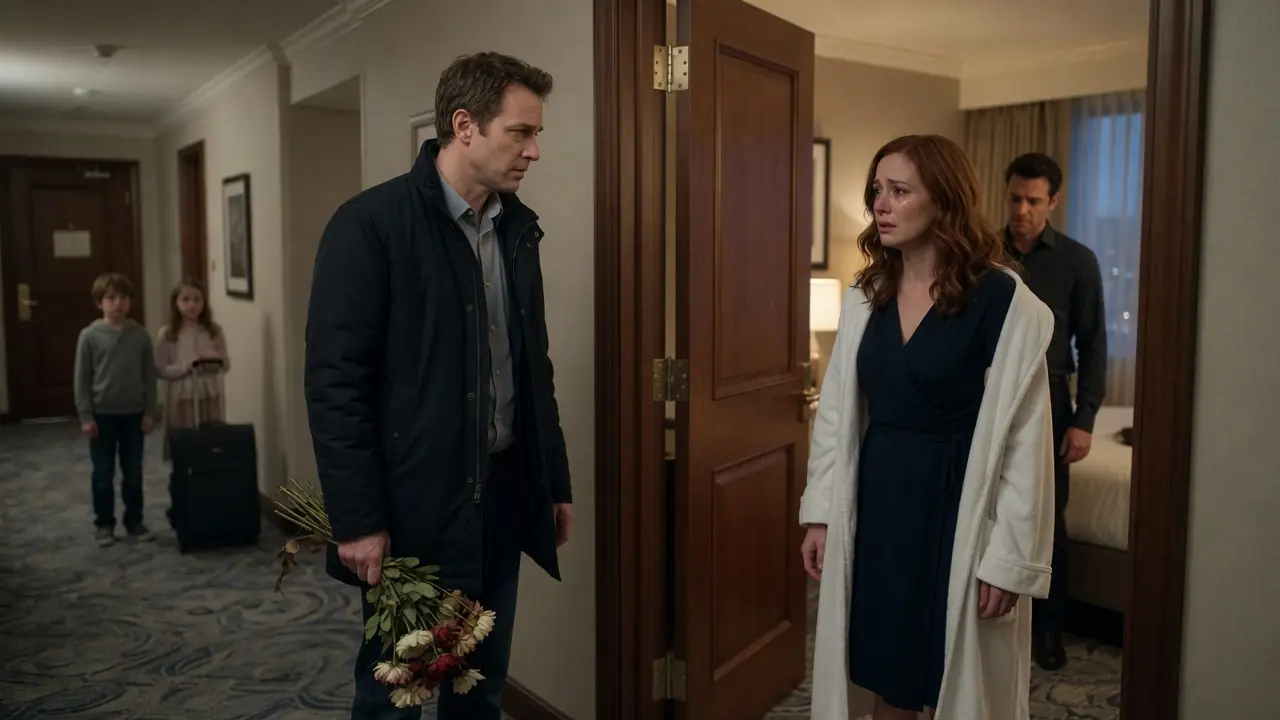
“Because what?”
“Because it made it easier.”
I laughed once.
It was a terrible sound.
“Easier.”
She began crying again.
“I didn’t mean for it to become this.”
“No one ever means for consequences. They only mean for the part they enjoy.”
She flinched.
Good.
I needed one thing I said to land.
“Did you talk about leaving me?”
Her silence answered.
“Rebecca.”
“Yes.”
My hands curled into fists under the table.
“Were you planning to?”
“I don’t know.”
“Don’t say that.”
“I was confused.”
“No,” I said. “You were comfortable. Confusion does not book hotel rooms.”
She looked like I had slapped her.
I had not.
I would not.
But truth can strike harder than hands when it arrives after months of lies.
“What did you tell him about the kids?” I asked.
“That I loved them.”
“That’s not an answer.”
She covered her face.
“I told him co-parenting would be complicated.”
Co-parenting.
Such a clean word for tearing a home apart.
“Did he ask to meet them?”
“No.”
“Did you want him to?”
“No.”
At least that answer came quickly.
Maybe true.
Maybe only less false.
“Are you in love with him?”
She looked at me through tears.
“I thought I was.”
“And now?”
“I don’t know what I am.”
I nodded.
That might have been the most honest thing she had said.
“What do you want?” she asked.
I looked at the woman I had loved for twelve years.
The woman who gave birth to our children.
The woman who once danced with me barefoot in our kitchen during a thunderstorm because the power went out and she said music was not always necessary.
The woman who had lied to me for a year.
“I want to take the children home,” I said.
Her face twisted.
“I need to see them.”
“You can see them in the lobby before we leave, if they want to.”
“If they want to?”
“Yes.”
“I’m their mother.”
“And last night Curtis told me not to open the door.”
She began sobbing.
I looked away.
Not because I felt nothing.
Because I felt too much.
We flew home that afternoon.
Rebecca took a separate flight later that evening.
Sophie hugged her in the hotel lobby before we left. She cried into Rebecca’s sweater and asked, “Did we do something wrong?”
Rebecca collapsed at that.
“No, baby. No. Never.”
Curtis stood beside me, stiff and pale.
Rebecca tried to hug him.
He stepped back.
Her face broke in a way I had never seen before.
“Curtis,” she whispered.
He looked at her with an expression no mother should have to receive from her child, and no child should have to form.
“Was he worth it?” he asked.
Rebecca had no answer.
So we left.
The plane ride home was silent.
Sophie slept with her head on my arm. Curtis stared out the window the entire time. I watched clouds pass beneath us and felt as if I had aged ten years since landing in Boston.
When we reached our house, it looked exactly the same.
That offended me.
The porch light came on automatically. The maple tree stood bare in the yard. A package waited by the door. Inside, the living room still held Sophie’s blanket on the couch, Curtis’s sneakers near the stairs, Rebecca’s coffee mug in the sink from before her trip.
A home should look different after betrayal.
It does not.
That is one of its cruelties.
I put Sophie to bed.
She asked if Mom was coming home.
I said, “Not tonight.”
“Tomorrow?”
“I don’t know.”
She cried again.
I sat beside her until she slept.
Curtis was waiting in the hallway when I came out.
“You’re going to divorce her, aren’t you?”
I looked at my son.
“I don’t know yet.”
“You should.”
“Curtis…”
“She lied to us.”
His voice cracked.
“Not just you. Us.”
I nodded slowly.
“You’re right.”
He looked surprised that I admitted it.
“She did.”
His eyes filled.
“I hate her.”
“No, you don’t.”
“Yes, I do.”
“You’re hurt.”
“I can be both.”
I almost smiled because even in heartbreak, Curtis sounded like himself.
“You can feel anything you need to feel,” I said. “But hate is heavy. Don’t pick it up too fast.”
He looked away.
“Do you hate her?”
I leaned against the wall.
“No.”
“Why not?”
Because I remembered her holding newborn Sophie.
Because I remembered the first apartment.
Because I remembered being twenty-three and broke and laughing over burned spaghetti.
Because love does not die on command even when trust is already gone.
“I’m too hurt to know what I feel,” I said.
Curtis nodded.
Then he stepped forward and hugged me.
He had not done that in months.
I held him and felt his shoulders shake.
“I’m sorry, Dad,” he whispered.
That nearly destroyed me.
“You have nothing to be sorry for.”
“You wanted to surprise her because of us.”
“No,” I said firmly. “I wanted to surprise her because I believed in our family. That is not your fault.”
He held on longer.
For the next three weeks, life became a series of controlled emergencies.
Rebecca stayed at a hotel for two nights, then with her friend Lauren. I did not let her return to the house immediately because the children needed space, and because I could not sleep beside her without feeling the hotel hallway open inside my head.
She called daily.
Sophie took most calls.
Curtis refused at first.
Then he answered once and said almost nothing.
I met Rebecca twice in public places to discuss practical matters. School pickups. Clothing. Bills. What to tell the children’s teachers. Whether she could come to Sophie’s winter recital.
At the second meeting, Rebecca said, “I want counseling.”
I looked at her across the table at a coffee shop where college students typed papers and an elderly couple shared a muffin.
“Marriage counseling?”
“Yes.”
“Why now?”
She lowered her eyes.
“Because I don’t want to lose you.”
I stared at her.
“You risked losing me when you thought I wouldn’t find out.”
She nodded, crying.
“I know.”
“No,” I said. “You are learning. That is different.”
Still, I agreed to attend one session.
Not because I believed it would fix us.
Because I wanted to be able to tell my children someday that I did not make the final decision in anger alone.
The therapist’s name was Dr. Helen Marsh.
Her office had soft gray chairs, a box of tissues, and a window overlooking a parking lot. Rebecca cried before we began. I did not.
Dr. Marsh asked what brought us there.
Rebecca said, “I had an affair.”
I appreciated that she did not soften it.
Then she said, “But we were disconnected.”
There it was.
The but.
Dr. Marsh noticed too.
“Rebecca,” she said gently, “explanation and justification are not the same. Be careful which one you are offering.”
Rebecca went quiet.
I told Dr. Marsh about Boston.
Not graphically.
Not cruelly.
But clearly.
The surprise trip.
The front desk.
Room 718.
Trevor at the door.
Rebecca in the robe.
Sophie’s tiara.
Curtis asking if she was with a man.
By the time I finished, Rebecca was sobbing into her hands.
Dr. Marsh looked at me.
“What do you need right now?”
I thought for a long time.
“Truth,” I said.
Rebecca lifted her head.
“All of it.”
So she told me.
The affair had begun emotionally nearly a year earlier during a Chicago project. Trevor had made her feel admired, understood, important. She had complained about feeling invisible at home. He had listened. She liked being listened to by someone who did not see laundry baskets, school permission slips, bills, or the tired version of her who fell asleep on the couch.
Their first kiss happened at a work dinner.
Their first hotel room happened two months later.
She told him our marriage was “basically over.”
It was not.
She told him we were “functioning as co-parents.”
We were not.
She told him I was distant.
Maybe I was sometimes.
But I had also been holding the house together while she drifted away and called the distance mutual.
Every detail hurt.
Not because each one surprised me.
Because each one replaced a memory I had trusted.
A night she said she was delayed by flight trouble.
A weekend she said she was too tired to talk.
A text she sent me from Chicago saying, Wish you were here, while Trevor was apparently already there.
Truth does not arrive as one blow.
It arrives as a thousand small revisions.
After the session, Rebecca asked if I could ever forgive her.
I looked at her in the parking lot.
“I don’t know.”
“Do you still love me?”
I looked down.
“Yes.”
Hope flickered in her face.
I hated that I had to extinguish it.
“But love is not the same as safety.”
She closed her eyes.
Two months later, I filed for divorce.
Not dramatically.
Not impulsively.
After therapy.
After sleepless nights.
After long conversations with my brother Adam, who mostly listened and occasionally reminded me to eat.
After watching Curtis become quiet and angry.
After hearing Sophie ask if Mom would like living in another house better.
After realizing that even if Rebecca ended all contact with Trevor, even if she cried sincerely, even if she regretted everything, I no longer knew how to share a bed with someone whose lies had rewritten an entire year of my life.
Rebecca did not fight the divorce at first.
Then she did.
Not because she wanted money.
Because she wanted delay.
Delay can look like hope when someone is desperate.
She asked for more counseling.
More time.
More conversations.
More chances to show change.
I gave her access to the children.
I gave her respect in front of them.
I gave her the truth without cruelty.
I did not give her the marriage back.
That was the boundary she struggled with most.
The children struggled too.
Sophie cried every Sunday evening after visiting Rebecca’s apartment. She loved her mother. She wanted everyone back in the same house. She drew pictures of four stick figures holding hands under a giant sun and left them on my pillow.
Curtis became protective of me in a way that made me proud and sad. He asked questions about bills. He watched Rebecca with suspicion. Once, during pickup, he heard her say to me, “I just want our family back,” and he snapped, “Then why did you break it?”
Rebecca went pale.
I pulled Curtis aside afterward.
“You can be angry,” I told him. “But you are still her son. Do not make yourself her judge forever.”
He glared at me.
“Why are you defending her?”
“I am defending you from becoming someone made entirely of this.”
He did not understand then.
Maybe he could not.
But I had to say it anyway.
The divorce finalized nine months after Boston.
We sold the house.
That decision hurt more than signing the papers.
The house was where Curtis learned to ride a bike. Where Sophie took her first steps. Where Rebecca and I painted the nursery before we knew Sophie was a girl and argued over shades of yellow. Where we hosted birthdays, Christmas mornings, sick days, movie nights, and all the ordinary moments that make a life before you realize they are irreplaceable.
But the house had become too full of ghosts.
Rebecca could not afford it alone.
I did not want it.
So we sold.
I bought a smaller house fifteen minutes away, close enough to the school that the kids’ routines could remain steady. Rebecca rented a townhouse near her office. Trevor left the company before the divorce was final. I heard he transferred to another branch, then later left the firm entirely.
I never contacted him.
I had imagined, in darker moments, what I might say if I saw him.
But by then I understood something.
Trevor had helped destroy my marriage, yes.
But he had not made vows to me.
Rebecca had.
That did not absolve him.
It simply kept my focus where it belonged.
A year after the divorce, Curtis and I took a short trip to Boston.
People thought I was strange for doing that.
Maybe I was.
But the city had become a wound in our family story, and I did not want it to remain only that. Curtis was twelve then. Sophie stayed with Rebecca that weekend because she was not ready.
Curtis and I went to the aquarium.
We ate clam chowder.
We walked through Boston Common.
We did not go to the Marriott.
Not inside.
But on the last evening, Curtis asked if we could walk past it.
We stood across the street from the entrance as people came and went with luggage, phones, coffee, and ordinary plans.
Curtis looked at the building.
“Do you think about it a lot?”
“Less than I used to.”
“Do you miss her?”
I answered honestly.
“Sometimes I miss who I thought we were.”
He nodded.
“I miss being little and not knowing.”
I put a hand on his shoulder.
“I know.”
He looked up at me.
“Are we going to be okay?”
I thought about lying.
Then I thought about every lie that had brought us there.
“Yes,” I said. “But not because it doesn’t hurt. Because we keep going anyway.”
He leaned into me slightly.
Not much.
Enough.
Time did not erase what happened.
I dislike when people say time heals everything.
Time does not heal by itself.
Time only gives you space to choose what you will do with pain.
I chose therapy.
I chose showing up for my children.
I chose not asking Curtis to be my friend instead of my son.
I chose not making Sophie carry messages between homes.
I chose not poisoning them against their mother, even when anger tempted me.
Rebecca changed too.
Not immediately.
Not perfectly.
But visibly.
She left the travel-heavy job and took a local position with less status and more stability. She went to therapy. She wrote apology letters to the children, which Dr. Marsh helped her shape so they did not become excuses. She never introduced them to Trevor. To my knowledge, she never saw him again after everything collapsed.
There were days I respected her effort.
There were days I still could not stand to look at her.
Both were true.
Three years after Boston, Sophie had a school art show.
She was eleven, taller, still dramatic, still tender, but no longer carrying Buttons everywhere. She had painted a picture of two houses under one sky. A path ran between them. On one side stood a father and son. On the other, a mother and daughter. In the middle of the path, all four figures met under a tree.
The title was Still Family.
Rebecca saw it and cried.
I did too, though I tried not to.
Sophie rolled her eyes.
“You guys are embarrassing.”
Curtis, now fourteen, said, “It’s actually pretty good.”
That was high praise from him.
After the show, we all went for ice cream.
All four of us.
Not as a reunited family.
As a changed one.
Rebecca and I sat across from each other while the kids argued over toppings. There was no romance between us anymore. No hidden hope. No attempt to return to what had been.
But there was something like peace.
Not forgiveness fully.
Not forgetting.
Peace.
Rebecca looked at me while the kids were distracted.
“Thank you for coming tonight.”
“I wouldn’t miss it.”
“I know.”
She paused.
“You became a better parent than I deserved to co-parent with.”
I looked at her carefully.
“That may be the first thing you’ve said about this that costs you nothing and still sounds true.”
She nodded slowly.
“I’m trying to tell the truth without making it useful to me.”
That sentence stayed with me.
It told me therapy had done something.
Years later, when I look back on Boston, the image that returns most often is not Trevor at the door.
Not Rebecca in the robe.
Not even Curtis asking if she was with a man.
It is Sophie in the hotel room wearing her plastic tiara, waiting to surprise her mother, still believing that love meant people were happy when you showed up.
That is the image that still hurts.
Because betrayal does not only break trust between spouses.
It rearranges childhood.
It teaches children questions they should not have to ask yet.
It makes them study adult faces for danger.
It makes hotel rooms, phone calls, business trips, and closed doors mean things they never meant before.
Rebecca knows that now.
I know she does.
Knowing does not undo it.
But knowing has made her gentler with the children’s anger and more careful with their trust.
As for me, I eventually built a life that was not only an aftermath.
I kept working.
I made dinner badly until I got better.
I learned how to braid Sophie’s hair from online videos because Rebecca had always done it before school picture day.
I learned to talk to Curtis without forcing him to talk back.
I dated eventually, slowly, awkwardly, after two false starts and one woman who told me kindly that I was still speaking about my marriage like a man standing in smoke.
She was right.
Later, I met someone named Hannah through a friend.
She was patient but not passive, kind but not careless, and honest in a way that felt almost startling after so many years of half-truths. I did not introduce her to the children for a long time. When I finally did, I made clear she was not replacing anyone.
Sophie liked her because Hannah knew how to draw horses.
Curtis approved because she did not try too hard.
That was his official review.
Life moved.
Not on.
I hate that phrase.
It moved forward.
There is a difference.
Moving on sounds like leaving the past behind untouched.
Moving forward means carrying what happened without letting it be the only thing your arms remember.
If I could go back to the day I booked those tickets, would I still go to Boston?
I have asked myself that more times than I can count.
Part of me wishes I had never gone.
Part of me wishes my children had never been on that hallway floor of the story.
Part of me wishes I had found out alone, through a phone, an email, a credit card statement, anything less cruel than bringing them to a city with hope in their backpacks.
But another part of me knows the truth was already there.
Behind room 718.
Behind Rebecca’s tired smiles.
Behind the phone turned face down.
Behind the trips that made her happier than coming home.
I did not create the betrayal by discovering it.
I only stopped living inside the version of our marriage that required me not to know.
Sometimes the best intentions lead to the worst discoveries.
I took my children to Boston because I wanted to remind my wife she was loved.
Instead, I learned she had been giving another man the parts of herself she had withdrawn from our home.
One hotel door.
One half-dressed stranger.
One wife in a robe with her wedding ring still on.
And twelve years of marriage came apart in a hallway so quiet I could hear my own breathing.
They say what happens in hotel rooms stays there.
That is a lie.
What happens in hotel rooms follows people home.
It sits at kitchen tables.
It cries into children’s pillows.
It signs divorce papers.
It shows up years later in school art titled Still Family.
But it does not have to destroy everything that comes after.
That is what I know now.
A marriage ended in Boston.
A family changed shape.
A father learned that protecting his children did not mean hiding every painful truth, but holding them steady while truth moved through the house.
A son learned anger could be real without becoming his whole heart.
A daughter learned families can break and still find ways to love carefully.
And I learned that trust is not proven by never looking behind the door.
Sometimes trust in yourself begins the moment you finally open it and refuse to pretend you did not see what was inside.