Sergeant Garrett Caldwell thought the unfamiliar man standing in his lobby needed a lesson in respect. He never read the paperwork, never asked a name, and never imagined anyone would question what happened next. But when the telephone rang behind the counter, the laughter stopped before the dispatcher finished listening. By then, the documents were on the floor, the handcuffs were locked, and every person in the room had already made a choice.
“New transfer?”
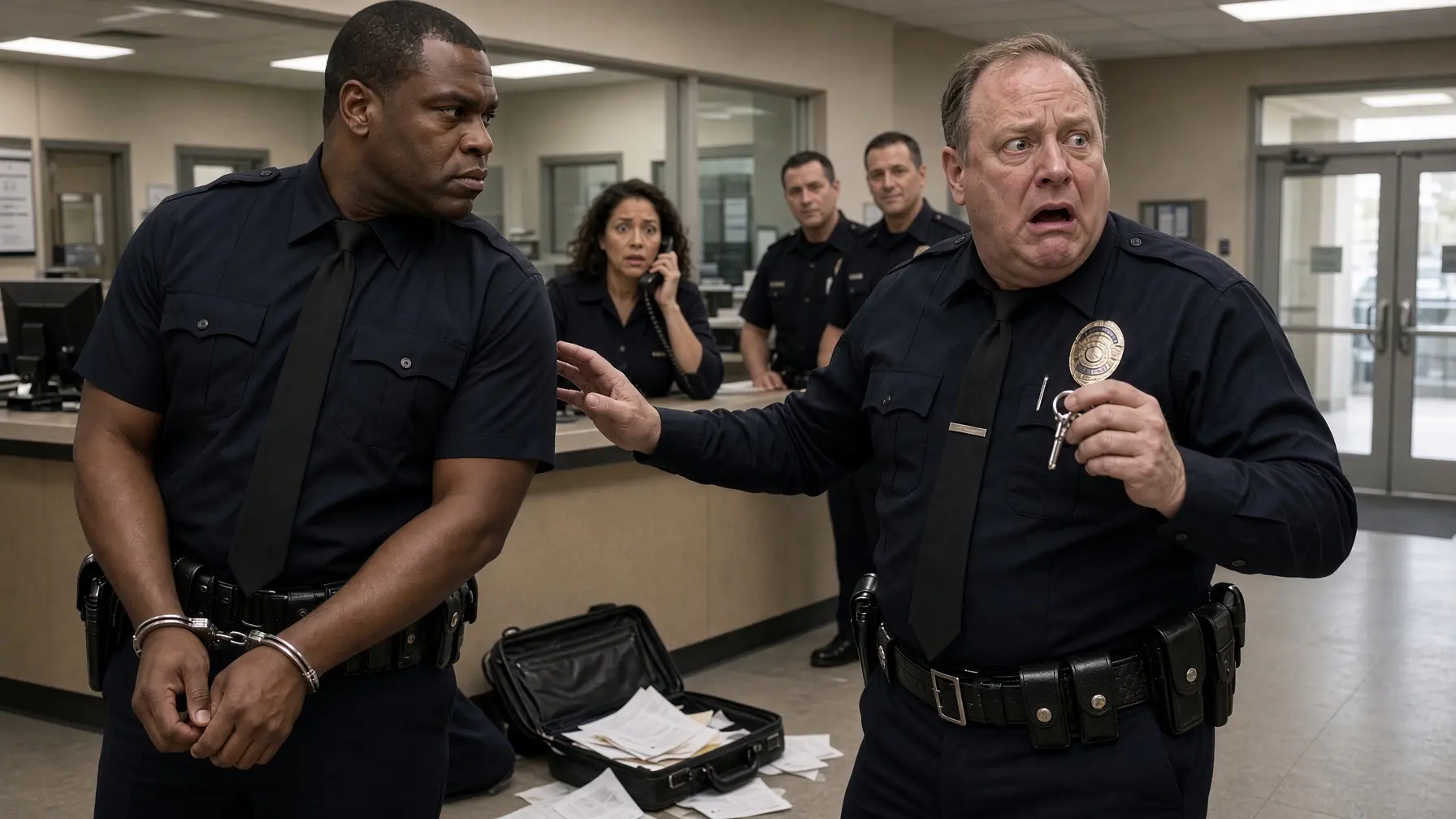
Garrett Caldwell caught Marcus Reed by the upper arm before Marcus could set his briefcase on the counter. His fingers closed through the immaculate uniform sleeve, and he turned the taller man toward the desk with the practiced confidence of someone who expected other people to move when he touched them.
Marcus’s leather briefcase struck the counter’s edge. The clasp, already released beneath his thumb, gave way, and a stack of papers slid across the polished surface before spilling onto the floor.
One sheet landed beside Caldwell’s shoe. Another drifted beneath the visitor chair.
The sound was small: leather hitting laminate, paper brushing tile. Yet Marcus would remember it more clearly than the laughter that followed.
“Around here,” Caldwell continued, “rookies wait until somebody gives them permission to speak.”
Behind the counter, one officer smiled immediately. The second looked up from his computer, saw the first officer smiling, and allowed himself a quieter version.
Marcus stood still.
He was forty-five, tall and broad through the shoulders, with closely cropped hair and a face that had learned to keep its first reaction private. His straight tie remained centered despite the turn Caldwell had given him, and his black shoes reflected the fluorescent lights above the front desk.
He looked down at the fingers gripping his sleeve.
Then he looked at Caldwell.
“Take your hand off my arm.”
The first officer’s smile sharpened, as if Marcus had just supplied the morning’s entertainment.
Caldwell did not release him.
Outside the lobby windows, weekday traffic passed in ordinary intervals. A delivery truck slowed at the intersection. A woman carrying a coffee cup walked along the opposite sidewalk without glancing toward the station.
Inside Riverside Police Department, the wall clock advanced with a faint electrical click.
Marcus raised his free hand slowly, palm open.
“Then check my paperwork before you make another mistake.”
Caldwell glanced at the scattered documents.
He did not bend to read them.
That morning had begun with Marcus standing in his kitchen, straightening his tie against the reflection in a window. Dawn had brightened the glass enough to show his face over the quiet street beyond it, and for a moment he had remained there after the knot was finished.
His wife had watched from the doorway.
“You’ve checked that tie three times.”
“Twice.”
“Three.”
He had smiled, but she had noticed that he still had not touched his coffee.
The briefcase stood beside his chair. He had packed it the previous evening, reviewed its contents before bed, then opened it again that morning to make sure the papers were arranged in the order he wanted.
His wife approached and adjusted a corner of his collar that did not need adjusting.
“First mornings are allowed to feel like first mornings.”
“I know.”
“You keep saying that when you don’t.”
He had taken her hand away from the collar gently and held it for a second. There was reassurance in the gesture, but there was also a request he did not quite know how to make.
He wanted the day to begin without anyone else’s expectations arriving before he did.
His wife understood enough to leave the rest alone.
“Call me when you get a chance.”
“I will.”
“And eat something.”
He had taken half a piece of toast because she was watching. At the door, he turned back to retrieve the coffee he had forgotten, and she laughed softly at him.
That laugh was the last easy sound he carried into the morning.
He had driven to Riverside without calling ahead again. The arrangements had already been made, and there was nothing useful to accomplish by announcing that he was ten minutes away, then five, then outside.
In the parking lot, he sat long enough to finish his coffee.
The station was an older municipal building, maintained carefully at the entrance and less carefully around the edges. Someone had repainted the front doors recently. A crack in the concrete near the side passage had collected cigarette ends and the brown remains of last season’s leaves.
Marcus noticed both.
He also noticed an officer holding the door for an older man using a cane.
The older man had a folded envelope in one hand and looked uncertain about whether he should thank the officer or hurry. The officer waited without urging him, then followed him inside.
Marcus let several seconds pass before approaching.
He did not want to mistake a single good gesture for the character of a whole place. Still, it pleased him to have seen it.
Inside, the lobby smelled of floor cleaner, printer toner, and coffee that had been standing too long. Fluorescent ceiling panels washed the counter and visitor chairs in even light, leaving nowhere for a face to disappear.
The older man was already seated near the wall.
The officer who had held the door stood behind the counter now, speaking to him through an opening beside a computer monitor.
“You can leave the copy with us.”
“I’d rather know who gets it.”
“It goes where it needs to go.”
The older man looked at the envelope.
Marcus paused inside the entrance, not close enough to intrude but close enough to hear.
A female dispatcher in uniform sat at a separate workstation behind the desk. She was around forty, with her hair secured at the back of her head and a headset resting beside her keyboard.
She turned toward the older man.
“If you want a receipt, I can make you one.”
The officer’s jaw moved slightly.
“He didn’t ask for a receipt.”