The stagecoach arrived in Copper Ridge long after most sensible people had gone home. Dust rolled beneath its wheels as the black coach slowed beside the weathered station, horses snorting after the final brutal miles from Missouri. Beneath the wooden awning stood Silas Mercer, thirty-eight years old, broad-shouldered beneath a long black duster, one hand holding a faded photograph that had spent three months folded inside his coat. The woman in the picture was supposed to become his wife before sunset.
Silas had looked at that photograph often enough to memorize the expression without understanding the woman behind it. Clara Whitfield appeared composed, almost severe, with chestnut hair pinned neatly behind her head and eyes that seemed to look past the photographer rather than toward him. Their letters had been practical because Silas had insisted on practicality. He owned a mountain ranch, needed another pair of capable hands, and had no interest in pretending he could offer the sort of romance younger men promised.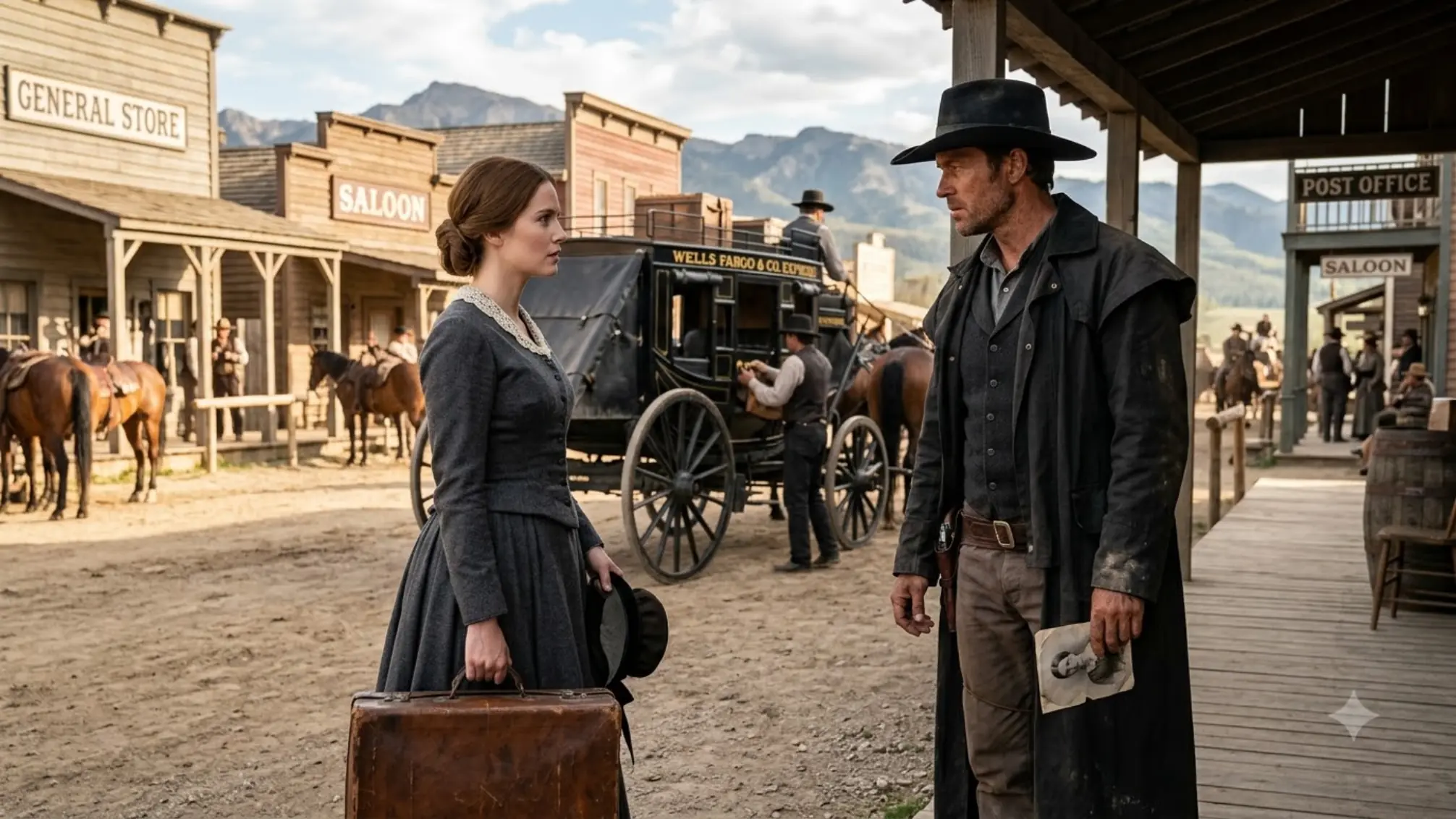
Then the coach door opened.
A woman stepped down carrying one weathered brown suitcase. She wore a charcoal-gray traveling dress dusty from the road, and when she raised her face toward Silas, he realized immediately that the photograph had failed her. Clara was far more beautiful than the paper had suggested, but it was the steadiness in her hazel eyes that unsettled him.
Silas glanced at the photograph and then back at her.
“You’re Clara Whitfield.”
“And you’re Silas Mercer.”
Neither smiled.
For several seconds, the two strangers simply studied one another while the driver unloaded the final parcels. Clara noticed the scar near Silas’s jaw, the revolver at his hip, and the way he carried himself slightly stiff through the right shoulder. Silas noticed that Clara did not look frightened, despite arriving alone in a frontier town to marry a man she had never met. That impressed him more than he expected.
He folded the photograph and placed it inside his coat.
“I can promise you a roof, food, and a place that’s yours as long as you want it.”
Clara’s expression barely changed.
“And what can’t you promise?”
Silas looked toward the waiting horses.
“Feelings I may not have.”
Clara regarded him for a moment, then reached for her suitcase.
“Then don’t promise anything yet.”
Silas took the suitcase before she could lift it.
She let him.
“Give us time to become something honest,” she said.
The sentence followed him all the way into the mountains.
They rode mostly in silence. Clara sat behind him on the saddle but kept her hands against the leather rather than around his waist, preserving a careful distance even when the trail narrowed. Silas appreciated it, though he could not have explained why. The entire arrangement had been designed around boundaries, and somehow Clara understood that without being told.
Darkness was settling when the cabin appeared between the trees. It stood alone against the Montana wilderness, constructed from thick logs with one chimney and a narrow porch. Nothing grew near it except mountain grass and pine. No flowers, no curtains, no sign that anyone had ever bothered making the place beautiful.
Silas dismounted.
“This is it.”
Clara looked at the cabin for a long time.
“It’s solid.”
That was not the reaction he expected.
Most women might have called it lonely.
Clara called it solid.
Silas carried her suitcase inside and set it beside the bedroom door. The cabin was clean, painfully organized, and almost aggressively plain. Every tool hung in its assigned place, every dish faced the same direction, and the furniture looked as though it had been positioned years earlier and never moved.
“The bedroom is yours,” Silas said.
Clara turned.
“And you?”
“Loft.”
“You don’t have to.”
“I do.”
Before she could respond, he walked outside to tend the horses.
Clara stood alone in the cabin and slowly opened her suitcase. Beneath several dresses lay a folded white tablecloth embroidered with tiny blue flowers. It had belonged to her mother, and Clara had carried it through two states because it was one of the few objects left from a life that no longer existed.
She spread it across Silas’s rough kitchen table.
When he returned, he stopped.
His eyes rested on the cloth.
For a moment, something painful crossed his face.
Then he looked away.
“Beans are in the pot.”
That first supper lasted less than twenty minutes. Silas spoke only when necessary, while Clara learned quickly that he ate slowly and waited until she sat before beginning. The gesture felt strangely old-fashioned for a man who otherwise seemed uninterested in social convention. She wondered who had taught him that courtesy.
Neither asked.
After supper, Clara removed paper and ink from her suitcase and began writing to her younger sister in Missouri. Silas climbed to the loft, but sleep did not come. Through the gap between floorboards he could see Clara’s hand moving across the page beneath the lantern.
Her handwriting was precise.
Educated.
Not the writing of someone who had spent her life only cooking and sewing.
Silas remembered the few things Clara had told him in her letters. Widow. Twenty-nine. No children. Capable of household work.
Nothing about education.
He wondered what else she had chosen not to say.
Morning began before sunrise. Silas climbed down and discovered coffee already waiting beside his chair. Clara was kneading dough near the stove, sleeves rolled carefully to her elbows. She did not ask how he took his coffee.
Black.
She had remembered from his letters.
Silas drank it.
“Good?”
“Yes.”
That was all.
Days became a quiet routine.
Clara cooked and cleaned, but she also repaired a broken cabinet hinge, organized preserved food by date, and somehow made the cabin feel larger without moving much of anything. Silas spent daylight outside repairing fencing, clearing snow, cutting timber, and managing the horses. At night they shared supper and sparse conversation.
The silence between them slowly changed.
At first it had been defensive.
Then it became comfortable.
Clara noticed Silas checked the door twice every night before climbing to the loft. She noticed he paused outside her bedroom as though confirming she was safe. She noticed he never entered without knocking even when the door stood open.
Silas noticed Clara hummed softly when kneading bread. He noticed she read every scrap of printed paper that entered the cabin, including feed labels and old newspapers. He noticed she sometimes woke before dawn from dreams she never discussed.
Neither confronted the other.
Winter confronted them instead.
The first major storm struck three weeks after Clara’s arrival. Snow swallowed the trail within hours, and by evening the mountains disappeared behind white wind. Silas had ridden out that morning to repair fencing and had not returned.
Clara reheated supper once.
Then twice.
By the third time, she stopped pretending she was hungry.
The door finally burst inward near midnight. Silas stumbled inside covered in snow, ice caught in his beard, and his right arm hanging strangely. Clara immediately crossed the room.
“What happened?”
“Horse slipped.”
“Sit.”
“I’m fine.”
“Sit.”
Something in her voice stopped him.
Silas lowered himself into the chair.
Clara removed his frozen coat and discovered bruising around the shoulder. No obvious break. Probably a strain aggravated by an older injury.
“You’ve hurt this before.”
Silas looked at her.
“Coffee first.”
She almost smiled.
Clara poured him a cup and placed it in his hands. Their fingers touched.
Neither moved away immediately.
The cabin seemed unusually quiet.
Silas looked at the woman standing beside him and felt something shift inside the locked room he had spent twelve years maintaining around himself.
“I think this is the warmest coffee I’ve ever had.”
Clara’s eyes softened.
“It’s the same coffee as yesterday.”
“Doesn’t taste the same.”
She said nothing.
Outside, the storm continued.
For three weeks, snow isolated them from Copper Ridge. Clara found a bottle of liniment among her belongings and quietly placed it beside Silas’s cup one morning. Her mother had used the mixture for strained joints and bruised muscles.
Silas looked at the bottle.
“You’ve been watching me.”
“You’ve been hurting.”
He said nothing.
The following morning, the bottle returned half empty.
His shoulder moved more easily.
That became their language.
Silas repaired Clara’s rocking chair without mentioning it.
Clara reorganized the woodshed so heavy logs sat within reach of his good arm.
Silas cleared a path to the spring before dawn.
Clara kept hot coffee waiting when he returned.
Neither called these gestures affection.
Naming them felt dangerous.
One night, Clara heard Silas speaking in his sleep.
“Emma.”
Just one name.
She lowered her sewing.
The loft became quiet again.
The following morning Silas looked exhausted. Clara poured him another cup of coffee and said nothing until he spoke.
“My wife’s name was Emma.”
Clara stopped.
Silas stared toward the frozen window.
“She died twelve winters ago.”
His hand tightened around the cup.
“I left for medicine. Storm came before I got back.”
He stopped there.
Clara understood the unfinished sentence.
She did not reach for his hand.
She did not tell him Emma would want him happy.
She did not say time healed everything, because clearly it had not.
Instead, Clara picked up her sewing.
“That must have been a terrible winter.”
Silas looked toward her.
“It was.”
Nothing more was needed.
Several nights later, Silas asked about Clara’s handwriting.
“Your father teach you?”
“He insisted.”
“Teacher?”
“Lawyer.”
Silas looked surprised.
Clara continued sewing.
“I copied documents for him when I was young.”
“You never mentioned that.”
“You never asked.”
Silas looked down.
She was right.
Their arrangement had been built partly on not asking.
He was beginning to wonder whether that needed to change.
Christmas came quietly. Clara found an old wooden box beneath the loft ladder while cleaning. Inside rested a wedding ring, a faded photograph of a smiling young woman, and a folded letter.
Clara closed the box immediately.
She did not read the letter.
That evening Silas watched her more carefully than usual. He seemed to know she had found something.
Neither mentioned it.
Eventually Silas spoke.
“I’ve spent twelve years trying not to remember.”
Clara remained seated beside the fire.
“I thought marrying again would give this cabin another pair of hands.”
He looked around the room.
“Instead, it gave it another heartbeat.”
Clara stared into the fire.
Then she told him her truth.
“My husband never hit me.”
Silas waited.
“He simply lived as though I wasn’t there.”
She swallowed.
“Every decision was his. Every conversation ended where he wanted it to end. When he died, everyone expected me to grieve forever.”
“Did you?”
“I grieved.”
Clara looked at him.
“But I also realized I had forgotten what it felt like to matter.”
Silas understood more than she expected.
“So we were both hiding.”
“For different reasons.”
The silence that followed felt shared rather than empty.
That winter changed them.
Not suddenly.
Not in one dramatic moment.
Something older and harder simply began thawing between two people who had stopped demanding explanations from each other.
When spring finally broke the mountain ice, Clara walked onto the porch carrying two cups of coffee. Silas stood beside the fence watching sunlight spill over the valley.
“You healed,” she said.
“I had a good nurse.”
“You had liniment.”
Silas smiled.
A real smile.
Clara felt unexpectedly victorious.
Their days became easier as the mountain turned green. They planted vegetables beside the cabin, repaired fencing, cleared brush, and traveled into Copper Ridge together. Neighbors gradually stopped treating Clara as Silas Mercer’s mysterious mail-order wife and began addressing her directly.
Then three strangers rode onto the property.
The leader introduced himself as Edwin Barrett of Northern Western Railway.
Silas’s expression hardened immediately.
“We’re not selling.”
Barrett removed a stack of papers.
“I’m afraid this isn’t about selling.”
He claimed the railroad possessed an older legal right to a strip of land crossing Silas’s property. According to the documents, part of the ranch had never lawfully belonged to the Mercer family.
Silas read them twice.
His face went pale.
The disputed land included the spring, lower pasture, and access trail.
Without it, the ranch would become nearly worthless.
Barrett smiled politely.
“The company is prepared to compensate you for improvements.”
Silas’s jaw tightened.
“I said this land is mine.”
“Your confidence doesn’t alter the filing.”
Barrett rode away.
Silas carried the papers inside and dropped them onto the table.
“For twelve years I kept this place alive.”
Clara sat opposite him.
“Let me see them.”
“There’s nothing you can do.”
She looked sharply at him.
Silas stopped.
That was exactly the kind of assumption she had spent years escaping.
“I’m sorry.”
Clara unfolded the first document.
Then the second.
She read every line.
The longer she studied them, the calmer she became.
Finally, she looked up.
“These are false.”
Silas stared.
“What?”
“This seal belongs to another county.”
She pointed.
“This survey number doesn’t follow Montana territorial filing format.”
Another line.
“And this witness signature is dated six months after the man died.”
Silas leaned closer.
“You’re certain?”
“I copied property filings for seven years.”
Clara met his eyes.
“Silas, these papers are fraudulent.”
For the first time since Barrett arrived, hope returned to his face.
“Can you prove it?”
“Yes.”
Three days later, Copper Ridge’s courthouse filled with ranchers, merchants, railway representatives, and people who simply wanted to witness the dispute. Barrett stood confidently beside two lawyers while Silas entered with Clara carrying a leather folder.
Barrett’s smile disappeared.
Judge Nathan Collins heard the railway claim first.
The lawyers presented maps, filings, and property notices.
Then Clara stood.
The courtroom murmured.
Women rarely addressed land cases directly, and mail-order brides even less often.
Clara ignored everyone except the judge.
She placed the original Mercer deed on the table.
Then county survey records.
Then certified filings.
Finally, Barrett’s papers.
“These documents contain multiple inconsistencies.”
Barrett laughed.
“Mrs. Mercer is not an attorney.”
Clara turned toward him.
“No.”
She pointed toward the false seal.
“But neither was the man who forged this.”
The room went silent.
Judge Collins leaned forward.
Clara explained every problem.
Wrong county seal.
Impossible witness date.
Incorrect survey number.
Land description copied from another valley.
Then an older railway surveyor stood from the rear bench.
“I drew the original map fifteen years ago.”
Barrett turned sharply.
The surveyor approached the table.
“These documents are altered.”
Judge Collins stared at Barrett.
“Do you dispute that?”
Barrett’s face lost color.
The railroad claim collapsed within minutes.
Judge Collins dismissed it and ordered the forged documents turned over for criminal investigation. Barrett left the courthouse surrounded by angry whispers.
Silas remained seated.
He could barely move.
Clara touched the folder.
“It’s over.”
Silas looked toward her.
“I would have lost everything.”
“No.”
“You saved this place.”
Clara shook her head.
“We saved it.”
That single word struck him harder than anything spoken in court.
We.
Months earlier, Silas had promised Clara only a roof.
Now she had become part of what the roof protected.
Weeks passed.
Spring turned the mountain green.
Wildflowers appeared along the meadow.
Fresh curtains hung at the windows.
Clara’s garden grew beside the porch.
The cabin Silas had once kept frozen around Emma’s memory finally looked alive again.
One evening, Silas walked outside carrying something wrapped in cloth.
Clara sat on the porch.
“What’s that?”
He handed it over.
Inside was a small wooden bluebird carved by hand.
Every feather had been carefully shaped.
Clara ran her thumb along the smooth wing.
“You made this?”
“During winter.”
“Why?”
Silas looked toward the valley.
“I didn’t know how to give it to you.”
Her voice softened.
“It’s beautiful.”
Silas turned toward her.
“So are the mornings since you came here.”
Clara became very still.
Silas removed his hat.
“I wrote for a wife because I thought I needed help keeping the ranch.”
He glanced toward the cabin.
“I expected somebody who would cook and keep the fire alive.”
His eyes returned to hers.
“I thought that was enough.”
Clara waited.
Silas continued.
“The truth is I had stopped living twelve years ago.”
His voice roughened.
“I was only maintaining things.”
Clara reached slowly for his hand.
“You were grieving.”
“I was hiding.”
She tightened her fingers around his.
“So was I.”
Silas looked toward their joined hands.
“I don’t want to hide anymore.”
Clara’s eyes filled, but she smiled.
Neither needed another ceremony.
They were already married legally.
What happened on that porch was something more difficult.
They chose the marriage.
For the first time.
The next winter came early.
Snow covered the trail again, but the cabin no longer felt isolated.
There were curtains at the windows now.
Books beside the fire.
Two cups on the table.
Clara’s letters stacked beside Silas’s ranch ledgers.
The wooden bluebird sat above the hearth.
One snowy evening, Silas woke from a dream and descended quietly from the loft.
Clara sat beside the fire reading.
He stopped.
“You all right?” she asked.
Silas nodded.
“Dreamed about Emma.”
Clara closed her book.
“Bad?”
“No.”
That surprised them both.
Silas sat opposite her.
“She was standing near the old spring.”
He looked toward the fire.
“She smiled.”
Clara waited.
“I think that’s the first dream where she wasn’t dying.”
Clara reached across the table.
Silas took her hand.
Neither treated Emma as a rival.
Grief had become part of the house without owning it.
Years later, people in Copper Ridge would tell the story differently depending on who told it.
Some said Clara Whitfield arrived from Missouri and saved Silas Mercer’s ranch.
Others said Silas rescued a lonely widow by giving her a home.
Neither version was entirely true.
Silas had given Clara a place where nobody treated her as invisible.
Clara had given Silas a reason to stop treating tomorrow like a burden.
They had not rescued one another.
They had simply stopped standing alone.
One spring morning, Silas found Clara on the porch writing another letter.
“To your sister?”
“Yes.”
“What are you telling her?”
Clara smiled.
“That Montana is warmer than people say.”
Silas looked toward snow still covering the highest mountains.
“That’s a lie.”
“I didn’t say the weather.”
He understood.
Silas sat beside her.
Clara rested her head lightly against his shoulder, the one that had healed during their first winter together.
For a long while, they watched the valley.
Horses moved near the fence.
Smoke rose from the chimney.
The garden waited beneath freshly turned soil.
Nothing about their life looked extraordinary from a distance.
That was what made it extraordinary to them.
Silas had spent years believing love announced itself with promises he no longer trusted.
Clara had spent years believing marriage meant becoming invisible inside someone else’s life.
Instead, what they found was quieter.
Coffee waiting before sunrise.
A repaired chair.
A reorganized woodshed.
A trail cleared before snow.
A forged document noticed because someone finally respected what the other person knew.
A hand held without obligation.
A question asked without demanding a particular answer.
The arrangement that began at a dusty Montana stagecoach station had become something neither stranger could have written into their first letters.
A home.
Not the cabin.
Not the ranch.
Not even the land they fought to keep.
Home was the moment Silas began looking for Clara when he entered a room.
It was Clara realizing she no longer needed to prove she mattered because somebody beside her had never asked her to.
And when another winter eventually covered Copper Ridge in deep white snow, the Mercer cabin glowed beneath the mountains.
Inside, two people sat beside the fire.
The woman from Missouri.
The rancher who had forgotten how to hope.
Between them rested two cups of coffee and the little wooden bluebird Silas had carved during the winter when neither of them yet understood what was happening.
Clara looked toward him.
“Silas?”
“Yes?”
“Do you remember what you told me at the station?”
He frowned.
“I said several things.”
“You said you couldn’t promise feelings you might not have.”
Silas smiled.
“I remember.”
Clara rested her hand over his.
“Good thing I told you not to promise anything yet.”
Silas closed his fingers around hers.
“Best advice anybody ever gave me.”
Outside, snow covered the mountains.
Inside, Clara laughed.
And for the first time in twelve years, Silas Mercer’s cabin did not sound like a place where someone had died.
It sounded like a place where two people had finally learned how to live.